
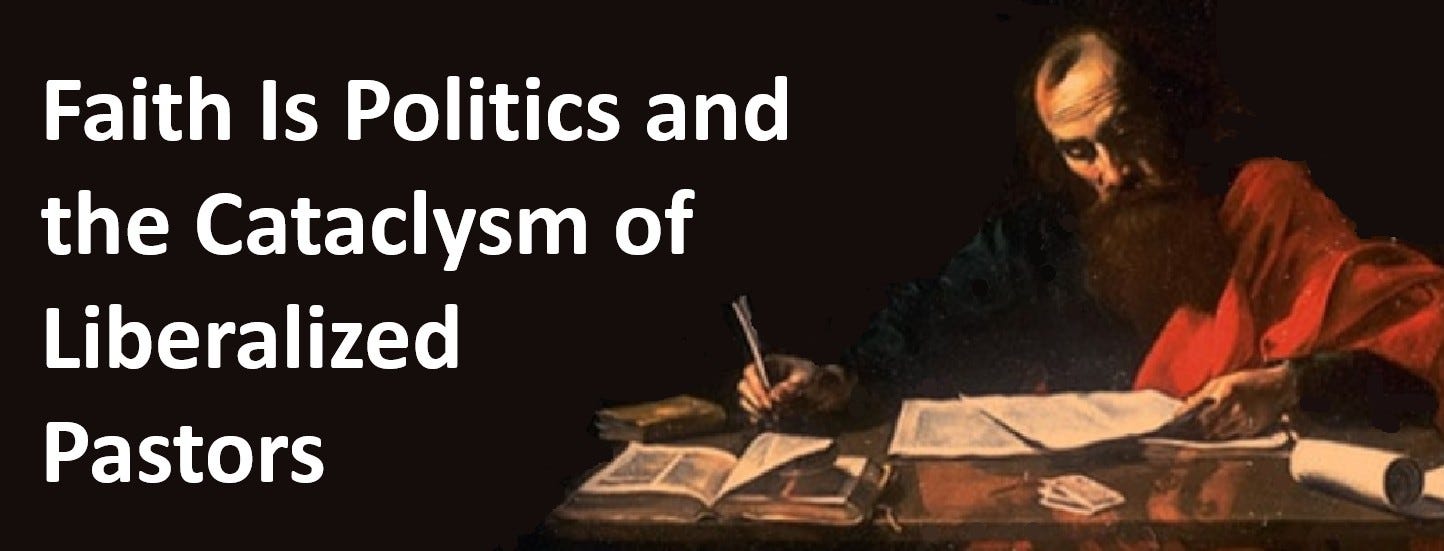
These past few weeks, I have watched several dozen Evangelical pastors eulogize the death of Charlie Kirk while they simultaneously excused themselves from addressing political issues. They often proclaimed to their congregations, “I don’t get into politics, but I boldly proclaim the Gospel.” This is odd since the people they address have already been persuaded of the truth of the Gospel and are willing audiences. To be clear, it is good that they shepherd their congregations. Collectively, they benefit the faithful millions, but they are not bold. At best, their ministries provide second line maintenance and deal with the logistics of believers. The liberalization of American seminaries has taught ministers to avoid the historical and Biblical reality that both faith and politics have always been the norm of the Gospel. Today’s liberalized pastors have chosen to do only half the job they are called to perform. Worse yet, they have often opposed or restricted those in their congregations who seek to fill the Biblical gap as a ministry of the church. What these liberalized Evangelical pastors fail to understand is that the Christian faith is politics because they are both founded on a choice of moral judgment. The connection between faith and politics is clear from St. Augustine’s writing,
“How you view God, determines how you view your fellow man; how you view your fellow man determines the government you shall have, and it is that government that will determine whether you live in freedom or bondage.”
The consequence of the liberalization of American seminaries on our country has been profound. Over the last 60 years, the “bold ones” have lost every moral-political fight since Lyndon Johnson’s presidency, including the diminution of black Americans as victims, flooding boys with Ritalin for being boys, the federal government’s forced introduction of Islam in our public schools, COVID crackdowns on churches, the entrapment of Christian private businesses by LGBTQ lawyers, BLM racist attacks on white communities, and even legislation that gives the LGBT community the right to destroy children without parental consent. As in Dietrich Bonhoeffer’s time, they appear to be too interested in myopic passivity, expecting the lost to wondrously come in from a narcissist culture that increasingly views Christians as hateful hypocrites. Hence, the death culture of the insane prevails today because there is no voice of moral opposition. They should know better.
We can clearly see the dual nature of effective outreach expressed by nearly every prophet of the Old Testament as well as by every apostle in the New Testament, without exception. A myriad of examples include the Genesis story of the Tower of Babel, Moses’ political and spiritual conflict with Pharoah, Nehemiah’s use of his political contacts to secure the remnant of Jerusalem, the establishment of just law of a sovereign nation in Leviticus, the blessings and curses of that national law spelled out in Deuteronomy. Who could miss, “Woe to those who decree unrighteousness, who write misfortune, which they prescribe to rob the needy of justice, and to take what is right from the poor of My people. . . .” from the prophet, Isaiah. Then there are the stories of Daniel’s bold faith under the iron fist of Nebuchadnezzar’s rule, the rise and fall of King David, and Esther, who became Queen of Persia and, politically out-maneuvered Haman to ensure the salvation of the Jewish citizenry.
When it comes to the New Testament, no one ever labelled Peter’s behavior, in Acts, as an appeasement to the governmental body. The apostle Paul’s ministry constantly engaged with political and social opposition in the course of spreading the teachings of Jesus to the first century world. The tactics in both Old and New Testaments are the same. Listening to and engaging people where they were and bypassing the elites and their ideological protectionist decrees is at the heart of Biblical Christian victory, then and now.
If Biblical examples are not enough, there are many examples of theologians from Western history. John Calvin sought to protect Huguenot Christians from the persecutions of a globalist Roman Catholic French monarchy. Martin Luther reviled the overstepping of Pope Leo X and his protectionist proxy monarchs. John Knox became an influential pastor who sparked the Scottish Reformation against the English crown. How can seminaries claim to equip ministers without even mentioning the theological and political impact of John Wycliffe, William Whittingham, John Rutherford, William Tyndale, and many others? What is even more condemning for our liberalized pastors is that bold, direct public outreach is at the heart of their own American national identity.
The American Great Awakening crossed social divides as large numbers of people shared their experiences thanks to a growing number of citizens and non-traditionalist ministers that brought the Scottish Calvinist foundations of faith and freedom to the colonies. Among the most effective was George Whitefield. Whitefield was among many who relentlessly derided the established clerics for their dispassionate mediocrity and he often highlighted their hypocrisy. The Great Awakening was, in fact, the first time that criticism of clerics was out in the open and heard by hundreds of thousands. Dismayed by the zeal of Whitefield’s supporters, traditional ministers, called Old Lights, complained bitterly against the revival’s usurpation of ministerial privilege. Pastors of the established churches, particularly Anglicans and Congregationalists, resented Whitefield and the growing number of traveling preachers and evangelical laymen coming to their towns at the invitation of the masses.
As a result, the status quo Old Lights were worried that non-traditional preachers were undermining their spiritual authority and, as a result, sought government protection. They attacked the New Light ministers as delusional. They later expanded their derision to include all those who broke with the placating, traditional social norms of the pulpit. For example, New Light Reverend James Davenport was labelled as “not sound of mind” and was banished from Connecticut and Massachusetts, after inciting a public repentance that brought about the burning of irreligious books, clothing, and other “worldly” materials. Future Princeton College president, Samuel Finley, was banished, arrested, and escorted out of Connecticut as a vagrant after he preached extemporaneously to a church in Milford. In 1742, the Connecticut General Assembly (controlled by the Old Lights) passed “An Act for Regulating Abuses and Correcting Disorder in Ecclesiastical Affairs” designed to curb “literate” men from extolling their faith in public. As the momentum of the American revolution approached, traditional pastors, now clearly on the defensive, complained,
“The whole country is in perfect enthusiasm for liberty. Would to God that men would become as zealous and unanimous in asserting their spiritual liberty, as they are in vindicating their political freedom”
What these pastors failed to realize was that, at the core of the revival, God and the fight for civil liberty were one and the same. They did not understand that the young men who fought the evolution were born and raised during the 30-year ministry of George Whitefield and the Great Awakening. They had already fought the Revolution by their Calvinist faith in their minds. The ecclesiastical conflict over their upbringing was nothing less than a dress rehearsal for the American Revolution. As John Adams noted in his letter to Hezekiah Niles, “The Revolution was affected before the war commenced. The Revolution was in the minds and hearts of the people; a change in their religious sentiments of their duties and obligations.”
The same principle that “faith is politics” applied in the past is equally powerful today. Sean Feucht is a Christian singer who presents his concerts out in the open on church and private land. As he has traveled Canada this year, bureaucrats in jurisdiction after jurisdiction have systematically denied him permits, police have threatened to haul him off stage should he preach the Gospel, and his travel bus was even purposefully rammed on the highway outside of Montreal. When confronted by the most hostile liberal reporters, he answers them with the Gospel message, offering them the love of Christ in a most disarming way that sets a new standard of engagement with the media for us today. The more the wolves circle, the more secular people are drawn to Sean’s events to hear the “forbidden” message that the country’s governance finds so dangerous. What people find is a message that has no hidden agenda, no spin, and no guile. The stark contrast between Feucht’s message and that of those who set themselves against him transforms thousands to their core. In America, the assassination of Christian political apologist, Charlie Kirk, woke up a nation because such hardcore contempt for peaceful Christian political thought had been considered unthinkable in the land of the free. Charlie Kirk’s message struck a chord with millions of Gen Z’ers - those who Victor David Hansom declared to be the most lied to generation in U.S. history. Charlie Kirk’s questioning rhetoric showed a path back to reason and civility largely absent from the liberal indoctrination of many of his listeners. Much more can and has been said about the influence of Charlie Kirk on the spiritual and intellectual trajectory of our nation and the world. All of it can be summed up in the fact that over 1 billion people viewed the return of the Charlie Kirk Show, now continued by his widowed wife. More importantly, this moral inflection point is the moment Christian patriots have been waiting for.
In closing, it appears that there will be a revolution, yet there is something that makes this moment of spiritual and moral declaration different. The revolution at hand is ultimately being won in the hearts of the people. This time, we have bold examples to follow if we want to win. When you see people of faith engage, spreading the Gospel while bypassing their placid pastors, you will know, without a doubt, that Charlie Kirk lit an enduring flame. Charlie Kirk, Sean Feucht, and many other bold men and women today, as the prophets before them, take the Gospel into the lion’s den where it is heard with no hidden agenda, no spin, and no guile. Christian faith is politics. This is how the Gospel, and freedom, wins.
Until next time, may God and liberty bless,
Dr. Robert James
A Heritage Lost is an Identity Stolen, For Someone Decided Not To Tell You Who You Are.
No posts
Comments
Nothing yet. Say the first thing.
Sign in to join the conversation.