
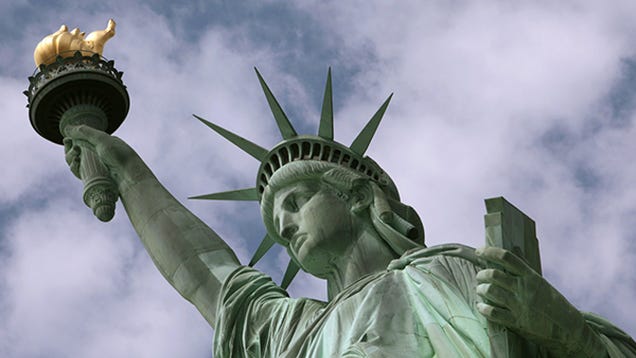
Many Americans believe that, at the base of the Statue of Liberty, resides the following poem.
The New Colossus
“Not like the one giant of Greek fame with conquering limbs astride from land to land;
Here at our sea-washed, sunset gates shall stand
A mighty woman with torch, whose flame is imprisoned lightning, and her name, Mother of Exiles.
From her beacon-hand glows world-wide welcome; her mild eyes command
The air-bridged harbor that twin cities frame.
“Keep , ancient lands, your storied pomp!” cries she.
With silent lips. Give me your tired, your poor, your huddled masses yearning to breathe free,
The wretched refuse of your teeming shore.
Send these, the homeless, tempest-tossed to me,
I lift my lamp bedside the golden door!”
Emma Lazarus wrote this poem in 1883. Recently, Raphaël Glucksmann, a member of the European Parliament, asserted in a speech, “Give us back the Statue of Liberty. It was our gift to you. But apparently you despise her,” as he referenced Emma Lazarus’ words, the “mighty woman with a torch” who promises a home for the “huddled masses yearning to breathe free” along with the “shared values” common to America and Europe.
While it is true that the “America First” policy changes in foreign policy and trade have upset European relations, the European Union’s increasingly oppressive, election cancelling (twice) criminalization of dissenters, open-border high crime rates, and poverty-causing de-industrialization policies raise some questions about which common values of liberty Gluckmann is referencing? While “shared values” may be nebulous, his reference to Emma Lazarus’ words “mighty woman with a torch” who promised a home for the “huddled masses yearning to breathe free” provides some clarity about what he actually means. The real question we need to address, however, is what are the American values represented in the Statue of liberty?
The Statue of Liberty is actually entitled “Liberty Enlightening the World.” It is a monument to America’s independence (hence the inscription of “July 4th, 1776” in the book she holds) and the long sought achievement of the rights of man prevailing over slavery.
In 1865, Édouard René de Laboulaye, a persuasive French political thinker and staunch abolitionist of the time, said, "If a monument should rise in the United States, as a memorial to their independence, I should think it only natural if it were built by united effort—a common work of both our nations.” In Laboulaye’s mind, the United States had finally achieved its originally intended scope of liberty for all men with the abolition of slavery and the Union's victory in the Civil War. Laboulaye's wishes of freedom and democracy were turning into a reality, not in France, but in the United States. In order to honor these achievements, Laboulaye proposed that a gift be built by France for the United States. Laboulaye hoped that by calling attention to the recent achievements of the United States, the French people would be inspired to call for their own democracy in the face of the repressive monarchy of Napoleon III.
The theme of the statue was clearly understood by Americans as revealed in history books of the period.
“In 1776, the thirteen United States of America declared themselves independent; and since that period, we have maintained our stand among the sovereign nations of Christendom. We have since been making a great experiment in political philosophy, which is to determine the question of whether the people of any country are competent to govern themselves. But as the reformers in Europe were protestants against the spiritual dominion of papacy, so were the founders of our political institutions, repudiators of kings and princes. They denied the divine right of certain individuals to reign over mankind; they asserted that the end of government was the greatest good of the governed, and that the people were at one the only safe depository and legitimate source of political power”.
With that background in mind, let’s take a look at the statue to see what the its design truly reflects.
The first design feature to notice is the statue’s location and orientation. The statue does not face Ellis Island - the port of entry for immigrants. Rather, it faces outward from the entrance of the harbor. It was positioned this way not to welcome immigrants but to send out liberty from America’s shores to the world. The orientation of the statue made perfect sense at the time. New York harbor was America’s export capital. Therefore, it was only fitting to orient the statue as exiting from the harbor representing America’s foremost export to the world, that of self-governed liberty.
The second design feature is the statue’s pose. Notice how Lady Liberty is not shown in a stationary pose. She is stepping forward with her right foot raised as if in mid-step. The question to ask is: If Lady Liberty is meant to represent a welcoming host for immigrants, why is she facing outward and striding away from sanctuary?
The third feature to notice is that Liberty is not designed with a welcoming gesture. Her arms are not outstretched like the Christ the Redeemer statue overlooking Rio de Janeiro in Brazil. Her hands are not gesturing toward the sanctuary of the inner harbor or to the immigration port of Ellis Island. Instead, she holds a book that references the start of the American experiment in one arm and, in the other, she holds, high and outstretched, the torch of liberty to illuminate the world.
Fourth, it is an important distinction that Liberty is not holding a guiding light that illuminates in a single direction as a navigational beacon does. Out of the darkness of tyranny and monarchies, America had proven that all peoples have the potential to govern themselves. Liberty is holding a torch that illuminates in all directions because the cause of liberty can be found among all men. She is showing the world the way to freedom.
But what about the poem, “The New Colossus”? The truth is that it was never a part of the statue. In reality, it was presented nearly 50 years after the statue’s conception and twenty years after its dedication. Furthermore, the plaque was presented by fans of the poet to show appreciation for her work and not by government representatives. As idealistic and emotional as the poem is, it was never mounted on the statue itself but, instead, is located at the immigration museum on Ellis Island.
In summary, the Statue of Liberty embodies the cause of self-determined liberty striding forth to the ends of the Earth to spread the light of freedom to all of mankind. Her piercing eyes scan the horizon toward distant shores as she holds a light radiating in all directions and the knowledge book of how to achieve liberty for all. In contrast, France and the European Union’s embracement of open border Islamic immigration, suspension of UK voter approved Brexit, the annulment of open elections in Romania, the retaliation upon Hungary and Georgia for seeking peace between Russia and Ukraine, law fare against France’s popular nationalist candidate - Marine Le Pen, Macron’s public endorsement of the Paris Olympic’s Satanic theme, and Brussels’ centralization of multi-national power seem to be the antithesis of both self-government and of America’s current effort to return to her Founder’s principles. The Statue of Liberty seems to be more aligned with its current home in the United States than its country of origin.
In the end, Raphaël Glucksmann’s commentary only highlights how far the prospects of French and European liberty have fallen. As the moral, demographic, cultural and political rift widens between us, the Statue of Liberty beckons a different question. How much longer can we call the government of France and the European continent our ally?
Thanks for reading A Just Republic! This post is public so feel free to share it.
A Heritage Lost is an Identity Stolen. For Someone Decided Not to Tell You Who You Are.
May God and Liberty Bless
No posts
Comments
Nothing yet. Say the first thing.
Sign in to join the conversation.