
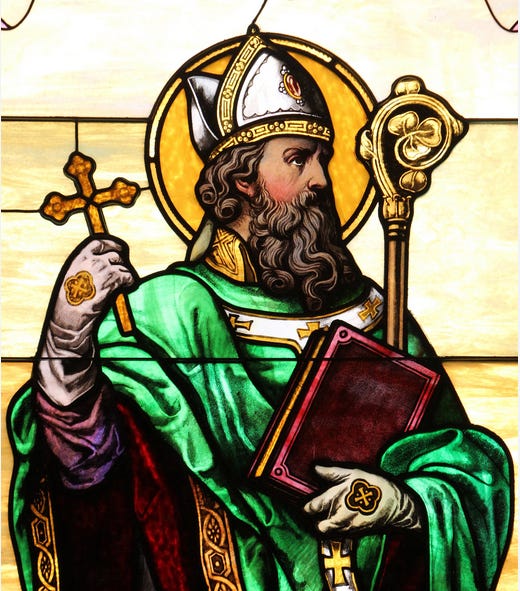
Among the western Christian faith that founded this country, the celebration of St. Patrick’s’ day was among the most revered dates of the year. Yet today, most of us have little idea why it’s even on the calendar.
The reason why we celebrate St. Patrick’s Day begins during the time of St. Augustine when an English boy, age sixteen, was kidnapped by a raiding party and became enslaved to a man named Milchu – a Druid high priest. After years of fervent prayer, he was told in a dream to meet his rescue ship at a certain time and place, he escaped at age 21. Convincing a doubtful Captain that he was the foretold part of the boy’s divine deliverance, Patrick returned to his native England where he trained under St. Jerome. Over years of training and faith, he rose up in the Church hierarchy only to return to Ireland – to the very people that enslaved him, to single-handedly oppose the evil of the Druid priesthood, and win the land for Christ. Upon his arrival, he performed miracle after miracle on his way across Ireland. His deeds are so miraculous that the line between truth and legend has long since blurred.
St. Patrick’s first stop is to repay his personal debt to Milchu, his former master, for his stolen property (namely, his escaped self). But, upon hearing the news of St. Patrick’s works, Milchu is consumed with fear as news of each deed, greater than the last, reaches him. Just as St. Patrick comes in sight of Milchu’s home, the Druid High priest, driven to panic, sets his estate and himself on fire.
Patrick’s second stop is even more dramatic. Going directly to the King and the Council of Druid High Priests. The ensuing confrontation between the powers of faith and evil reads like an account of Moses before Pharaoh’s conjurers. The Queen is convinced of power and benefit of the Gospel message and is eventually converted by St Patrick, much to the anger of the king. It is the Queen’s protection that keeps the king’s wrath at bay.
Over St. Patrick’s thirty years in Ireland, he established over three-hundred churches (that is an average church plant each month), winning over 1 million direct converts. In fact, After Armenia, Ireland becomes the second nation to be converted to Christianity without an army. St. Patrick was also the first historical figure to oppose slavery. He also instituted monks to preserve the Greek and Roman classics of Europe during the tumultuous Dark Ages. In fact, we have many of the Greek and Roman classics today as well as our concepts of western civilization, because of St. Patrick’s vision.
From an American standpoint, there is much to appreciate about St. Patrick’s’ legacy. St. Patrick was first to apply the Ten Commandments to civil law. The idea was taken up by Alfred the Great in the 9th century and later became the foundation of the Magna Carta in 1215 as well as the driving principles of the Sonet de Harte Declaration of the Scottish Covenanteers during the Scottish Reformation in 1560s, who brought the concept to the American colonies during the wave of Sottish/Irish immigration two hundred years later. The reformist principles of faith and government opposing English proprietary government was passed on to our Founding Fathers as young men through the teaching influence of Scottish/Irish immigrant dean of Princeton University – Reverend John Witherspoon. As the teaching dean of Princeton, Witherspoon influenced four-hundred-and-eighty-seven graduates consisted of thirty-nine Congressmen, twenty-one Senators, on-fifth the Signers of the Declaration of Independence, one-fifth the Continental Congress, one Supreme Court justice, twelve governors, one Vice President, 1 attorney General and one president (the government architect himself) – James Madison. In fact, it should be no surprise that one-half the Founding Fathers that signed the Declaration of Independence were of direct Scottish/Irish heritage.
It is alarming to think that we have reduced St. Patrick’s legacy to “ If you don’t wear green on a particular day of parades and sophomoric beer drinking, your going to get pinched!” We have a greater obligation to honor such a man, a patriot of human rights, a preserver of western civilization in its darkest era, and a great prophet of God that set nations free of the shackles of sin an oppression. In fact, we owe our nation’s very liberty to this one man. That is why we, as Americans, celebrate St. Patrick’s Day.
This is the Dr. Robert James reminding you that a heritage lost is an identity stolen for someone decided not to tell you who you are.
Till Next Time, May God and Liberty Bless.
Comments
Nothing yet. Say the first thing.
Sign in to join the conversation.