
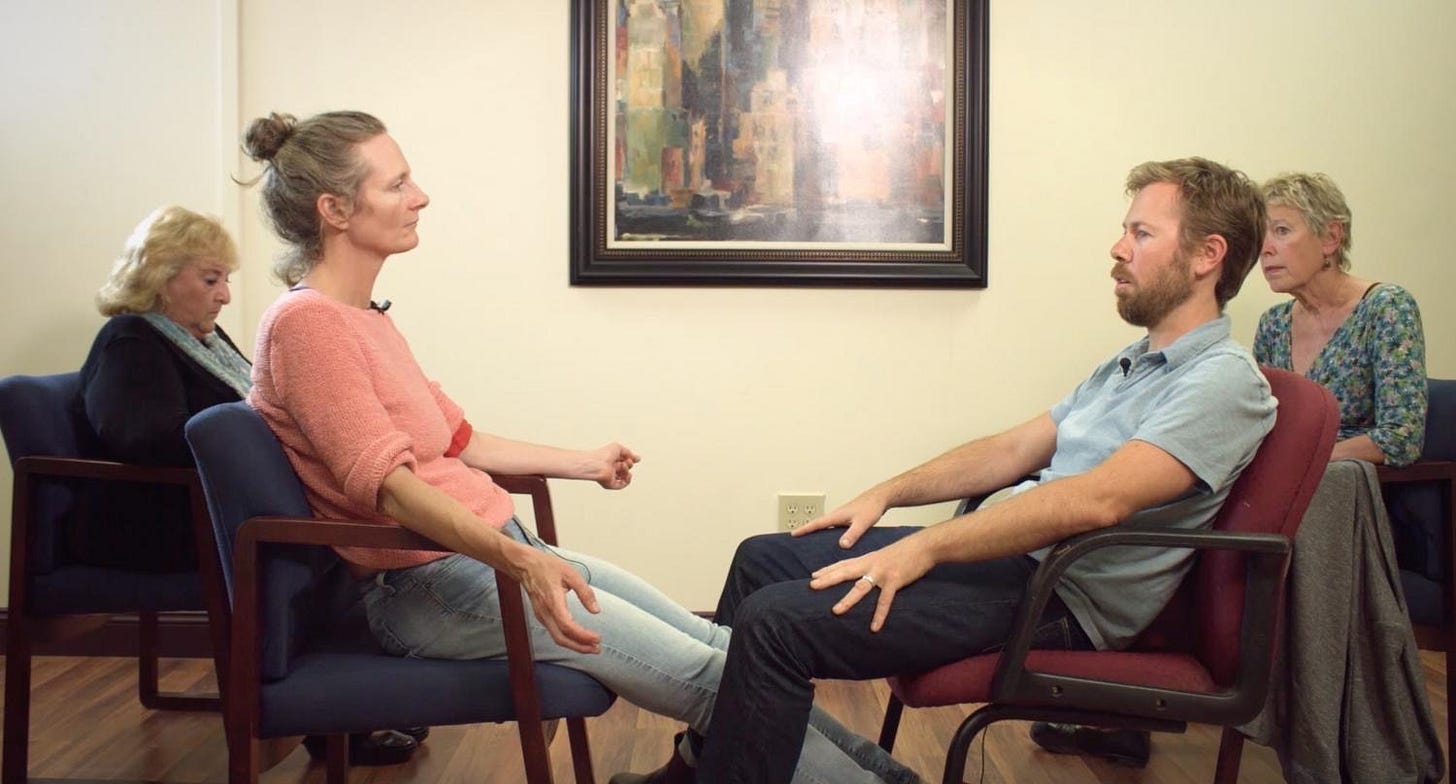
Dr. Jean Pieniadz and Dr. Polly Young-Eisendrath Doing Dialogue Therapy Demo
Many psychotherapists, counselors, and coaches – even those who are familiar with working with couples – frequently feel overwhelmed and under-prepared for the emotional dynamics presented by couples, married or not, cohabiting or not. When couples come into my consulting room for their first session in Dialogue Therapy, as I have mentioned elsewhere, I ask them to sit across from each other and talk with each other about what they hope for and why they have come.
Most partners begin with the belief that they “need help with communication.” Often they say, individually and collectively, that they don’t “trust each other” because they can’t talk anymore, even about the simplest topics. They run up against repetitive conflicts every time they try to take up problem-solving or talk about anything difficult. Sometimes they state specifics about what they can’t solve: parenting issues, intimacy issues, financial concerns, and the like.
But the main complaint is that this kind of repetitive conflict just keeps happening. Sometimes, one or both mentions that it seems like a “zero-sum game” or that only one person can win. They believe it’s a “communication” problem, but actually it’s an emotional/dehumanization problem. The repetitive conflicts are the by-product of an emotional entanglement in which each person is trying to control the other one emotionally and ultimately perceives the other person as the “enemy.” Sometimes it seems they are trapped with a parent who wounded them in childhood, in terms of the dynamics seeming to be familiar.
The theory of “projective identification” – that we become entangled with another’s unconscious wishes and desires in trying to get our needs met – originated with the psychoanalyst Melanie Klein and was further developed by Carl Jung and other psychoanalysts such as Wilfred Bion, Thomas Ogden, and Robert Caper.
What does the term mean? Boiling it down to its basic ingredients: it means that each partner is trying to control the other person, often unknowingly. BUT neither person has an accurate view or understanding of the other person within this dynamic. Each one is “projecting” or attributing intentions or desires or meanings to the other person who does not have them in the way the partner believes. However, the other person seems to play them out, in fact, and so the observe believes the other is doing the exact thing that is most problematic, hurtful, or undermining. To use a metaphor, each person is trapped in their own movie, in which they are the star and the director, directing the other person to play a part — often an ideal part during the romance and then a destructive part after the romance has ended, when disillusionment has set in, as it must.
The whole business of these repetitive dynamics is maddening. It seems to be endless. It doesn’t go away. That’s because projective identification is unconscious and neither party can see/hear/feel with any clarity what their own part is. It simply seems totally unreasonable that they are caught in the same conflicts repetitively with no way to resolve them!
Most couple therapists also get caught up in the movies. Sometimes the therapist believes one of the movies is “more true” or “more harmful” than the other one. One partner seems to “have a point” or one seems to “make sense.” And there also can be a script or implied blame (of one partner) that the therapist falls for: one partner has an addiction, one partner has ADHD, or depression, etc. In that version, the therapist and the other partner will try to change or “cure” the identified patient who feels blamed or maligned or hopeless in the therapy. Triangulation, with the therapist allying with one partner, is a disaster. After all, the therapist is not in the relationship and cannot go home with the couple and play a quasi-protective role with one partner.
Knowledge of projective identification, and the state of mind it induces, makes it clear that both people are always involved in this kind of repetitive conflict even if it seems that only one is at fault. Without breaking through this repetitive cycle of destructive conflicts, the partners can do nothing to restore trust, sometimes even intimacy.
Some couple therapists will try to “teach new behaviors” or increase “secure attachment” by giving the partners homework tasks to increase intimacy or reduce hostility. Or the therapist will interpret what one person “needs” from the other person. While these interventions may bring some relief and a bit of clarity, they will ultimately fall apart in the face of projective identification and the therapist, as well as the couple, will begin to feel despair and irritation.
The solution to all this will not emerge until each partner can experience the other person (1) as a vulnerable human being who is wanting the best; (2) as not intending to wound or gaslight the perceiver; (3) as not a part of their movie; and (4) as understandably imperfect and limited in an entirely human way (just as oneself is). It’s best if the above can be clarified in a strong and convincing way, and become a part of a playful space or “mindful gap” between the two people, disentangled because the two people are differentiated and their movies no longer overlap.
Dialogue Therapy for Couples, which I originated with my late husband Ed Epstein, was designed specifically to clarify and then break through projective identification.
As I have done Dialogue Therapy with hundreds of couples, over thousands of hours, I have been fascinated by how and why projective identification is the major obstacle to intimacy, love, and trust in every couple I see. Everyone lives inside a movie that is fashioned from their survival in their early family life and circumstances. Everyone will draft their partner into a wounding role once disillusionment sets in, after the romance fades.
If you know anything about the work of the cognitive scientist Donald Hoffman, you know that he formulates that survival “fitness” always “beats truth.” Whatever we learned to do to survive will unconsciously capture our perceptions (what we see, hear and remember) when we feel emotionally or physically threatened. As he says “Fitness beats truth.” By evolution we were designed to save ourselves from what already happened. Ironically, we can make it happen again when we are convinced that it is happening.
Sometimes projective identification deadens the relationship and one or both partners have affairs or believe they should experiment with non-monogamy. Sometimes it provokes dangerous or hostile fighting and the partners tire of even trying to talk. Sometimes they take separate houses on different coasts.
But only the differentiation of their movies and breaking through their defenses (survival fitness) will give the two people the freedom that is required for true love to be restored. They have to see and feel exactly how casting the partner into their movie has made them (and the partner) miserable. Then, broken trusts can be healed and betrayals can be talked about. Eventually, each person comes to know and see and accept the other person as separate and human.
The skill of Real Dialogue – speaking for yourself, listening mindfully and remaining curious – is what is taught to partners in Dialogue Therapy as the means of remaining differentiated after the projective identification is broken through.
After they can clearly operate inside their own movies, partners can use this skill when conflict becomes emotionally activating. While the skill may seem like “active listening” or “conscious communication,” it is something different. Real Dialogue requires cultivating a true and deep humility in speaking and listening, recognizing the limits of your own awareness, perception, and memory. Real Dialogue requires, when it is being used, that the two people take responsibility for their own subjectivity and stop trying to run the other’s.
In the end, it’s really the Zen idea of “Don’t Know Mind” that is the best way to regard your partner during conflict, if it’s sincerely felt. “This is how I understood you. Did I get it? Maybe I don’t remember it correctly or just didn’t hear you.” That’s the beginning of getting free of the emotional trap that creates that causes the most harm between people who love each other.

Break Through Projective Identification. Restore Emotional Contact. Transform Couples Therapy.
At a certain point in working with couples, most therapists encounter the same problem:
Insight is not enough.
Empathy is not enough.
When conflict becomes emotionally threatening, partners lose the capacity to remain present.
They defend, withdraw, or escalate.
And what takes over—often invisibly—is projective identification.
Dialogue Therapy was developed to work directly at this level.
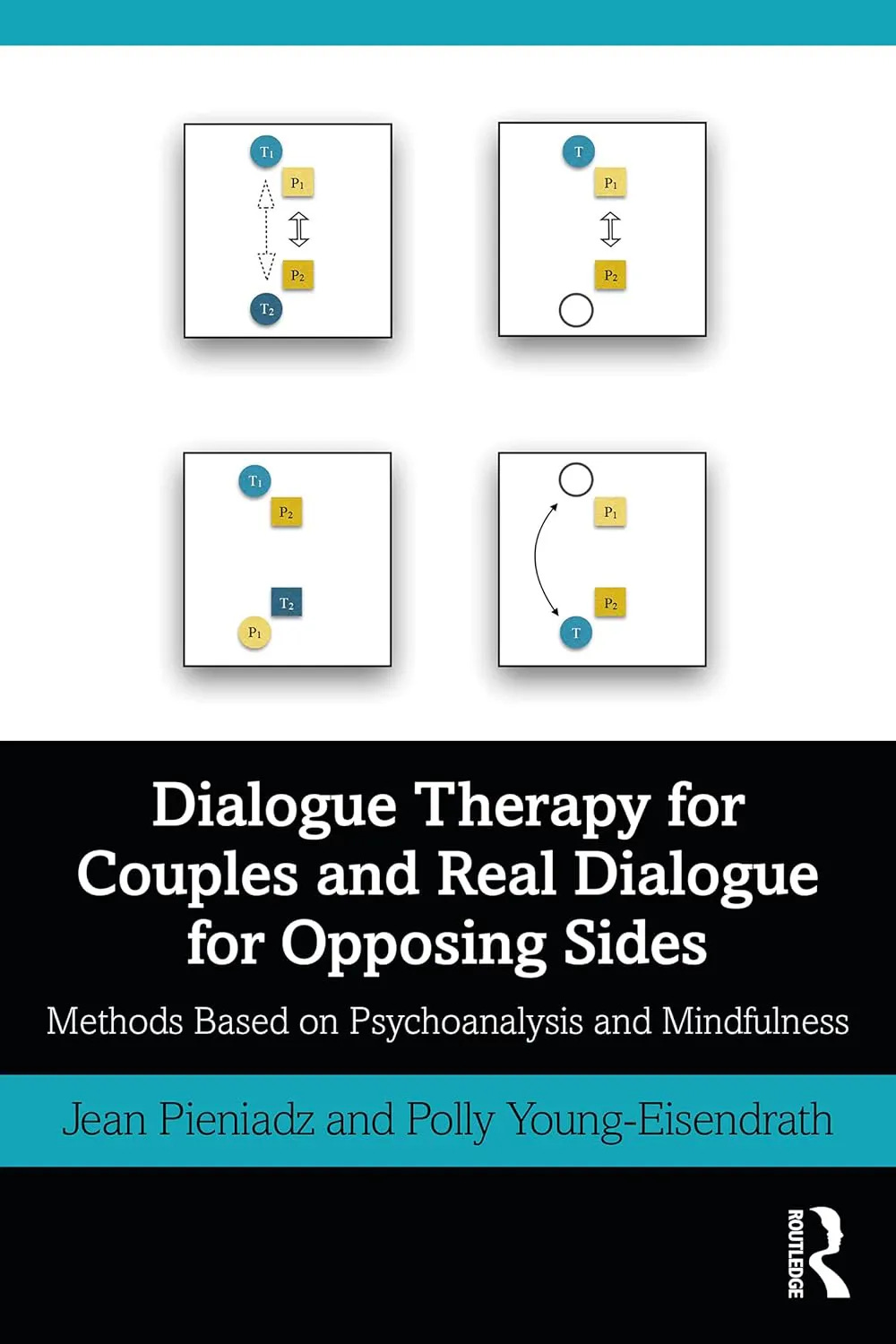

Describe the basic principles underlying Dialogue Therapy and recognize how it differs from other methods
Define the concept of “projective identification” and understand its role in couples’ repetitive conflicts.
Identify the time-limited structure and techniques used in Dialogue Therapy.
This educational activity is intended for behavioral health professionals, including Psychologists, Social Workers, Counselors, and MFT’s.
No posts
Comments
Nothing yet. Say the first thing.
Sign in to join the conversation.