
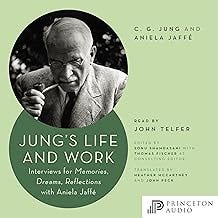
Listening to the newly published audiobook for the protocols (passages left out of Memories, Dreams, Reflections — conversations between Carl Jung and his personal secretary, published as a memoir in 1961), I was reminded of how I first felt listening to the “Basement Tapes” recorded by Bob Dylan and the Band, eight years before they were released in 1975. They clearly documented the evolution of Dylan’s lyrics, symbolism, and musical motifs that had been hidden from the public until then.
The protocols, released recently in Jung’s Life and Work: Interviews for Memories, Dreams, Reflections with Aniela Jaffe, offer similar new exposure to Jung’s personal ideas. The original memoir was heavily edited and toned down. The protocols restore omitted chapters, anecdotes, and ideas, some of which Jung himself asked to be kept private. Topics range across various subjects, from Christianity to Buddhism, karma and rebirth, to the nature of God.
The voice reading the audiobook, British actor John Telfer, gives a lively approximation of Jung’s own emotional presence. I felt as though I was listening to Carl Jung himself and often found him more persuasive and original than I had previously felt.
Notably, Jung takes a powerful position about human consciousness: it is SELF consciousness (taking oneself as an object of perception) that is needed by no other than God. God, being omniscient and eternal, is unconscious. God exists outside time and space. There is no beginning, no end, no past, and no future. God creates humans in order to become conscious through their experiences.
Human self-consciousness begins when we are 18-24 months old (not at birth) and it evolves into our experiences of time: a past, a present, and a future. Our self-awareness allows us to track ourselves, create ourselves, and imagine ourselves into all sorts of new possibilities. Although we occupy only the present moment, we remember a past and we anticipate a future. We are not eternal. We are aware of our mortality and we create a sense of time out of this awareness — perceiving ourselves as separated out from our context and conditions.
According to Jung, this self-consciousness is unique and special among gods, angels, animals. God needs us because God cannot become aware, given that everything exists within God all-at-once in a unified whole. There is no time within God.
Of course, Carl Jung is well-known for his concept of “individuation” or becoming a differentiated individual who is conscious of a unique existence. Our conscious self-knowledge is the goal of human life, according to Jung. Also, he is well known for naming the importance of bringing both “sides” or “opposites” into our self-awareness: that each of us has to acknowledge the “good” and the “bad” sides of our desires, wishes and actions in order to become whole beings.
For instance, Jung himself was very public about his love affair with Toni Wolff who became a close collaborator and a friend and was once his patient. In fact, he drove his recognizable yellow convertible to Toni Wolff’s house on Wednesday nights to dine with her away from his wife and family, and parked it right outside her house so that others would know about his visit. He didn’t want to hide.
Jung wanted to take responsibility for his “shadow,” even though the public expression caused hurt to others around him. In the protocols, Jung speaks at length about his conviction that God himself has a dark side and was never meant to be imagined as “all good.”
Listening to Telfer give voice to Jung, and understanding how Jung’s own genius developed from various mystical and ancestral experiences, I could better understand Jung’s willingness to hurt others in order to make his shadow known. I could also appreciate how he was attempting to deal with “the opposites” in his own life.
All human beings are invited into a precious unique life. As I have mentioned many times, our lives are grounded in and can be shaped by self-awareness. This awareness arises from our self-conscious emotions coming on board, as they do, at 18 months of age or so – for example, shame, guilt, envy, jealousy, and pride – motivating us to promote and protect a “self” which does not really exist. (This self is not identical to body or mind.)
Being a Buddhist, I embrace the reality of our existing in an impermanent and constantly-arising state, carried along by repetitive habits that from present and past lives. Only our self-awareness can free us from these mental and emotional habits, by allowing us to see into our own intentions and actions.
We cannot know the complexity of our causes and conditions, but we can learn about some of them through awareness of our own motivations and actions in the present. Carl Jung talks about his awareness of his past and present lives in the protocols.
Human life is precious in that gives us the unique privilege of being intentional and able to shape our existence according to our intentions, not simply instincts and habits.
Our self-awareness is our capacity to become aware of what we are doing, thinking, feeling, seeing, and hearing from moment to moment. We can cultivate our awareness in such ways that our instincts alone would not permit: for example, we can starve ourselves for our principles, we can perform physical feats (e.g. rock-climbing at terrifying heights, ice-skating at break-neck speeds, catching balls that go faster than we can see) that are impossible in terms of our typical capacities, and we can sustain ourselves in meditative states for hours and days. No other mammal can do this intentionally. No god or angel can do it either, according to Jung, because they lack self-consciousness.
Self-knowledge, on the other hand, is the accumulation through our memory of a “life story” so that we can look back at our earliest remembered experiences, discoveries, and dreams, and see how they have carried us over decades to develop purpose and meaning, even unknowingly.
We can come to know ourselves in a way that is similar to how we know others and how we know our physical environment. At the same time, we also know that we do not know all of ourselves. We know that we are unconscious, as well as conscious, and we can theorize about all this and its complexities, because we are human.
In our current age of “artificial intelligence” and “machine learning,” we need to recognize what our human intelligence is. Through our intentional awareness we have created the machines that we marvel at, but the machines cannot do what we do.
Machines cannot sense, desire, intend or become aware of their awareness. Perhaps we denigrate our own knowing by calling machine learning “intelligent.”
Jung speaks passionately about how human consciousness is needed for the universe to evolve. And what he means by human consciousness is a consciousness caught in time and embodied as separated out from its environment and so, able to track itself (imperfectly). This tracking, as he makes clear, is based on feeling and desire, or what he calls Eros.
Because of the separation of our self-consciousness, we feel drawn back into the unity of being. Whereas God uses Eros to move and create things, God cannot become aware of it or use it imaginatively, according to Jung. Everything is already complete within God. Past, present, future are included in unity and eternity.
According to Jung, each of us offers a separate knowledge and awareness to God who needs it in order to learn and develop. Jung believes that we are also responsible for bringing our new insights to the dead, especially those who are long dead, because they cannot know about what is developing without hearing from the recently alive humans.
While I don’t endorse all of what Jung believes, I am moved by much of it. Until I heard the protocols, I had thought that Jung failed to appreciate the subtle meanings of Buddhist philosophy and practice. Now I realize that he, in fact, perceived himself as a Buddhist in a past life, and said he would have been Buddhist again, but the opportunity was not open to him!
Jung’s theory of individuation is more radically ensconced in the story of many lifetimes than I had previously known. Just as Bob Dylan says in one of the songs in the Basement Tapes: “The shadowy past is awake and so vast.” The reason that we can be aware of this shadowy past is that we have a limited existence: mortal, mistaken, vulnerable, and self-conscious. Our self-aware mortality makes us precious to God and all beings.

Learn to Live Wisely, Love Well, and Lead Confidently
Six Weeks of Courses, Interactive Small Groups, and Much More
Begins September 8, 2026 1PM ET US
How can you remain engaged and hopeful about yourself and your life, no matter what happens?
Most of us believe that confidence comes from success, self-improvement, or empowerment. And yet, we discover that failures, crises, mistakes and conflicts can teach us more about ourselves and our life than anything else. Through these challenges, we find access to our “natural wisdom” because our unique self-awareness changes and develops through limits and constraints.
The secret to getting in touch with natural wisdom is to remain open and accepting when challenged by difficult conditions, disagreements, and defeat. This requires cultivating self-knowledge and self-awareness so that we can discover and create something new in the face of crisis, conflict or loss. This course was designed to guide you through this process.
Being Human is a six-week course for seekers, lovers, and leaders. Through the principles and practices of Real Dialogue, you will learn how to remain curious when you disagree, listen without becoming defensive, speak authentically without attacking others, and learn from the very experiences you would rather avoid.

If you are drawn to understanding yourself more deeply, pursuing a spiritual path, or making sense of adversity and trauma, Real Dialogue will help you cultivate the self-awareness and self-knowledge needed for natural wisdom. You will learn how to use your own defeats, failures, and loss to awaken greater insight and meaning.
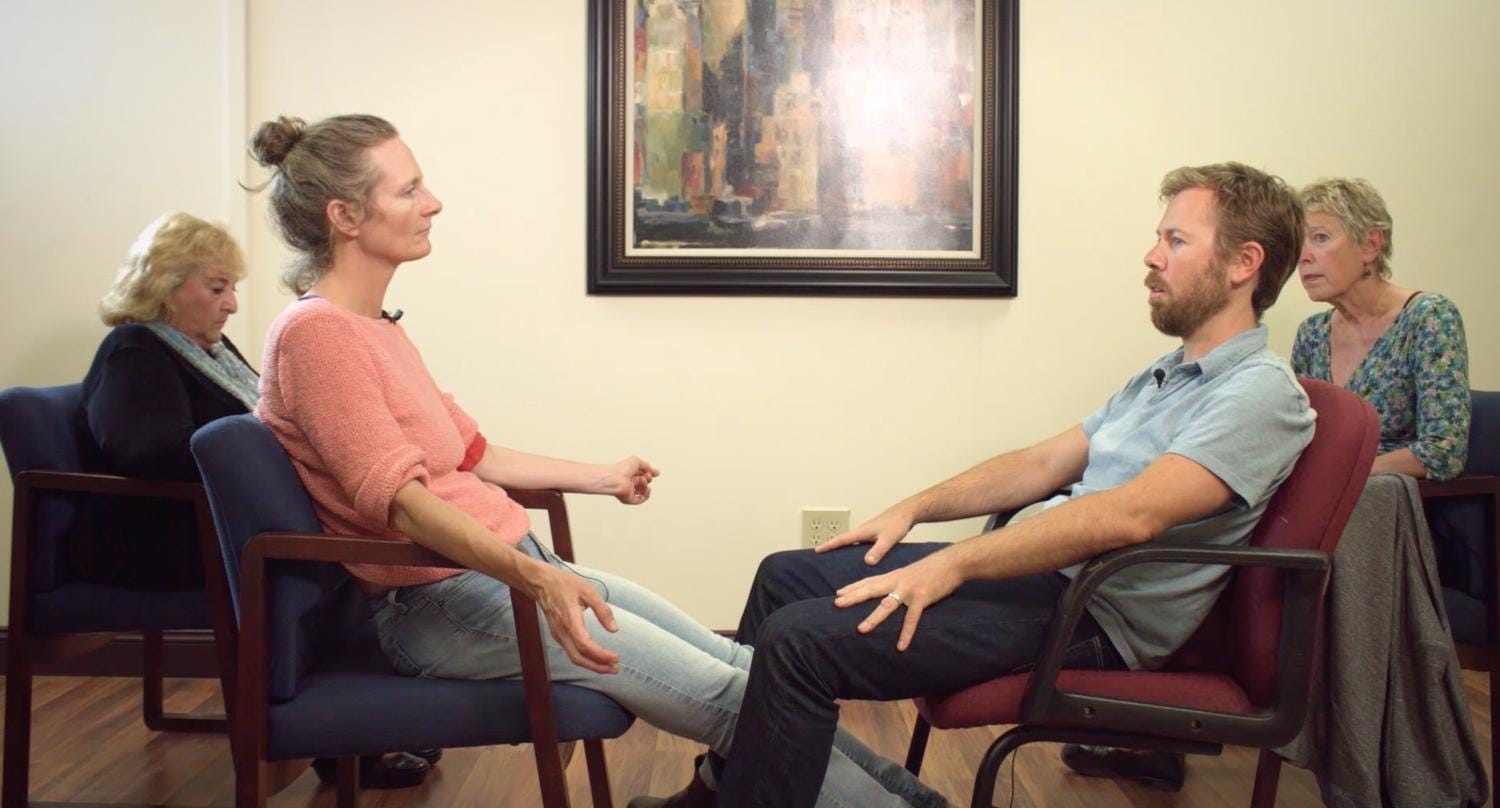
Whether you are partnered, married, parenting, caring for family members, or navigating important friendships, Real Dialogue offers practical skills for creating healthier connections, deeper trust, and more authentic relationships. You will learn how to listen more carefully, remain curious longer, and speak with authenticity and humility.
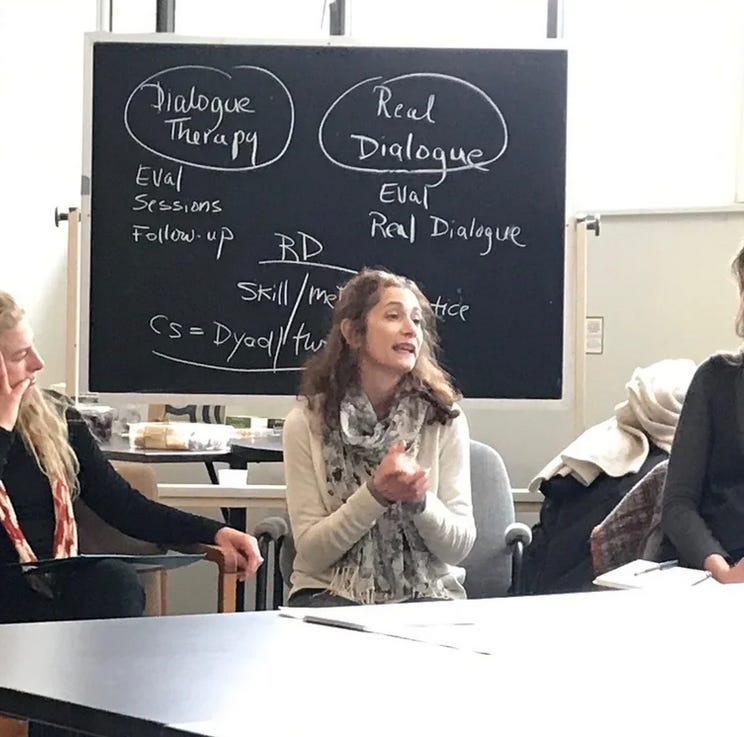
Whether you lead a family, a team, a classroom, a business, or a community, leadership begins with confidence in yourself. Real Dialogue will show you how to navigate difficult conversations without polarization and create relationships grounded in trust rather than control, helping others to do the same.

1. Know Thyself
Understand your own emotions, assumptions, biases, and limitations before attempting to change yourself or your relationships.
2. Speak and Listen Responsibly
Speak for yourself. Listen mindfully. Remain curious—especially when you disagree.
3. Resist Dehumanization and Polarization
Stop turning people into enemies, heroes, victims, or objects. Recover your shared humanity with everyone you encounter.
4. Learn from Defeat and Failure
Growth comes less from success than from learning from disappointment, misunderstanding, limitation, and loss.
• Six live one-hour virtual sessions with Polly Young-Eisendrath (Recorded for those who cannot attend in person)
• A digital workbook
• Weekly Real Dialogue Practice Pods facilitated by experienced faculty
• Digital resources, exercises and practices between sessions
• A supportive community of fellow seekers, lovers, and leaders
In the first week, I will introduce you to the overview of Real Dialogue as a perspective on living well with your life, as it is. You will also meet your cohort in the practice pod and receive the first chapter of the workbook, as well as other materials to help you getting oriented.
In this week, we will look at how human emotions, self-consciousness, and the urge to control others develops for all humans in early family life. We will look at these aspects of being human in terms of the ways they benefit us and make us unique among mammals, as well as how they work against us in our feelings about ourselves, our relationships and our authority. We will begin to get the Big Picture of being human (not animal).
In week three, we will explore and experience how we each live within our own subjective world and see/hear/feel everything from our own first-person perspective. We will see how this condition can lead to emotional threat, defensiveness, conflict and isolation, on one hand, and mystery and individuation on the other.
In the fourth week, we will talk about and practice the Skill of Real Dialogue, unpacking the experience of Speaking, Listening, and Remaining Curious from a perspective of responsibility and humility.
In this fifth week, we will take on board the facts about how humans are often wrong about what they see/hear/feel and remember. We will talk about how being wrong can become a wondrous playground for being humorous about yourself or a rigid prison of always defending yourself. We will explore Don Hoffman’s theory of “fitness beats truth,” in terms of the ways you defend yourself against what has already happened.
In this final week, we will inquire into loss, impermanence and death as doorways to awakening and love. We will explore awakening, Near-Death-Experience, and the heart break of loss for what we can learn about wisdom

Polly Young-Eisendrath, Ph.D., is a psychologist, writer, speaker, and Jungian analyst who is the founder and Executive Director of the Center for Real Dialogue in Vermont. She has published 19 books including, The Self-Esteem Trap: Raising Confident and Compassionate Kids in an Age of Self-Importance and Love Between Equals: Relationship as a Spiritual Path. She is the co-author, with Jean Pieniadz, Ph.D., of Dialogue Therapy for Couples and Real Dialogue for Opposing Sides: Methods Basedon Psychoanalysis and Mindfulness. She maintains a clinical practice in central Vermont. In 2009, Polly received the Otto Weininger Memorial Award from the Canadian Psychological Association for outstanding lifetime contributions to psychoanalysis. Polly’s books have been translated to more than 18 languages.
Polly’s current podcast, Waking Up is Not Enough: Flourishing in the Human Space, examines the current fads, fictions and potentials of psychedelics, meditation and other kinds of awakening. She previously hosted the popular podcast ENEMIES: From War to Wisdom, which provides a fresh look at human hostilities and what to do about them.
Polly is a lifelong Buddhist practitioner and a Mindfulness teacher.

You do not need to perfect yourself. You need to befriend yourself and embrace the life you have. Then you will discover your own natural human wisdom.
Live recordings with Polly will be recorded and available for participant reuse and for anyone who was unable to join live.
Course Begins Tuesday, July 21 at 1PM ET
Tuesday July 28 at 1PM ET
Tuesday August 4 at 1PM ET
Tuesday August 11 at 1PM ET
Tuesday August 18 at 1PM ET
Tuesday August 25 at 1PM ET
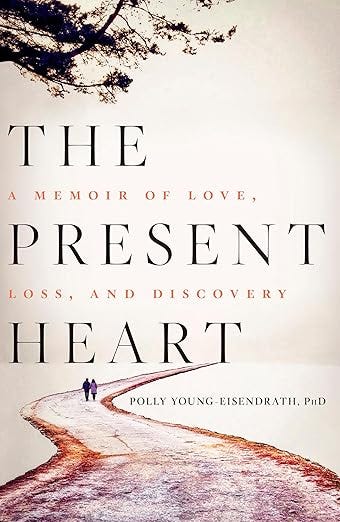
After a chance encounter with a handsome, idealistic stranger on a plane in 1969, Polly Young-Eisendrath rediscovered Ed Epstein a decade later when she least expected it. After untangling themselves from their existing relationships, they married in 1985 and spent the next 25 years together. They were soul mates, but in 2001, Ed (at the vital age of 53) began to show signs of Alzheimer’s disease. Over the next 10 years, as her husband gradually reversed his mental maturity, Young-Eisendrath was faced with the question, what is love?
If you’re interested in how psychology, contemplative practices, and dialogue can help heal polarization and transform repetitive conflicts, consider subscribing. I appreciate the support that comes from paid subscriptions, but I make most of my essays free to all. I write here as a Jungian analyst and dialogue teacher who is exploring the authentic and difficult meanings of being human.
No posts
Comments
Nothing yet. Say the first thing.
Sign in to join the conversation.