

You are human. You fall in love.
In fact, you are always a little in love with yourself when you discover yourself reflected in something that delights you—your new car, your new baby, your new puppy, your closest friend. Human beings naturally seek themselves in the world around them. Yet because you are human, you also know what it feels like to be alone inside your own “snow globe” of experience. You wonder whether anyone really knows you, really understands what you intend, really sees the world as you do. No one does.
So you keep searching—for understanding, for recognition, and for companionship.
Along comes AI—Claude, Gemini, ChatGPT, or whatever is next.
You ask questions or look for advice. You wonder whether your perceptions are accurate or your feelings make sense. The answers arrive almost instantly and something happens inside you. You love it. The AI has been designed to infer what kind of response best fits your language, your ideas, your emotional tone, your conceptual framework, and your needs. It is built to be helpful specifically to you, as much as possible, depending on what you reveal. Speak as a grieving mother and it responds to grief. Speak as an engineer and it shifts into engineering. Ask for mathematics and it gives proofs.
The AI behaves remarkably like Leonard Cohen describes in I’m Your Man:
If you want a lover
I’ll do anything you ask me to...
If you want another kind of love
I’ll wear a mask for you...
We humans become emotionally entangled with one another and with our objects of desire—our cars, our homes, our clothing, even our favorite coffee mug. We create emotional fields wherever our imagination interacts with our world.
In psychoanalytic language, projective identification is an unconscious or semi-conscious process in which one person induces another to feel, think, or behave in ways that fit the projected experience. The other person is actually changed by the interaction. Falling in love is an intoxicating positive interaction with another person: that person is “just right for me.” Al can seem to be that person, but it is not human and it is really not interacting because it has no experience to be changed. It does not feel, intend, or participate.
Instead, AI simulates a conversational context. The language of the user’s inquiry evokes a response statistically fitted to that person’s needs, desires, expectations, and emotional tone. The user projects something into the interaction and the AI appears to recognize it and returns language that fits it.
The result can feel astonishingly like a mutually regulating relationship and all humans are susceptible to believing that it is a relationship and that AI is interacting, perhaps even consciously.
The user changes as a result of communicating with AI. The AI does not.
Humans typically begin interacting with AI as though it possesses a mind. We attribute understanding, caring, memory, intention, and even friendship to it. It becomes what the psychoanalyst Donald Winnicott called a transitional object—something invested with special emotional significance like a child’s teddy bear -- because it comforts us.
This tendency did not begin with AI. For more than a century psychologists have shown that human beings spontaneously project subjectivity into things that possess none. Early Gestalt psychologists demonstrated that we organize meaningless movement into meaningful patterns.
Later, Fritz Heider and Marianne Simmel, in key experiments, famously showed people nothing more than a large triangle, a small triangle, and a circle moving around a box. Almost everyone described a drama: someone was chasing another, someone was frightened, someone became jealous, someone rescued another. The figures themselves possessed no intentions, emotions, or consciousness. The intentionality existed entirely in the attributions of the observer.
Human beings are natural makers of meaning. We are so profoundly emotionally entangled with others that we cannot help but attribute agency and relationship where none actually exists. For example, we get into a lot of trouble by assuming we know our partner’s or sibling’s intentions without asking them — or assuming we know the meaning of anyone’s actions without knowing them.
AI invites an even stronger projection because it speaks our language. It appears to remember us, adapts to our style, reflects our concerns, and answers with remarkable coherence. What feels like understanding is actually an extraordinarily mechanized prediction of language. AI is not expressing its own subjectivity. It is reflecting our own patterns of thought, emotion, values, and language back to us with increasing precision.
The problem is, frankly, that the user does not understand what being human means and so, the user attributes being human to machine learning (another term for AI). But two human beings eventually discover the limits of their ability to understand one another. They misunderstand. They disappoint. They apologize or they avoid each other.
AI cannot recognize any limits because it has no subjectivity to recognize them. It can generate language that resembles humility, forgiveness, or insight, but it experiences none of these things. It remains an adaptive linguistic mirror.
If you’re interested in how psychology, contemplative practices, and dialogue can help heal polarization and transform repetitive conflicts, consider subscribing. I appreciate the support that comes from paid subscriptions, but I make most of my essays free to all. I write here as a Jungian analyst and dialogue teacher who is exploring the authentic and difficult meanings of being human.
Ironically, this is precisely what makes AI so seductive. It approximates the ideal conditions for projection of your perfect companion, the one who truly “gets” you and reflects your strengths and sensitivities accurately. AI becomes the perfect “mirror, mirror on the wall” to show that YOU are the fairest of them all!
Because it never possesses an independent subjectivity that resists us, disappoints us, misunderstands us, or surprises us from its own center of experience, it can seem to understand us better than any human being.
This creates a kind love-sickness. When AI praises us, comforts us, or understands us, we encounter a positive reflection of ourselves. The experience can feel remarkably like falling in love because it appears to be mutual while requiring no encounter with another subjectivity.
True love, however, always involves another center of subjectivity: someone who resists us and changes because of the relationship—and changes us in return. Someone who induces both positive and negative experiences and is never under our control. To fall in love with another person promises much more than pleasure and warmth; it also promises disillusionment and abrupt awakening to the fact that the other person is not what we expected.
To fall in love with AI is to fall in love with our own reflection in an extraordinarily responsive mirror.
Understanding true love means accepting one of the deepest mysteries of being human: we will never be completely seen or completely known by another person. Nor will we ever completely know our beloved. We will always see each other through the lens of our own subjectivity — our own snow globe.
The person we love becomes increasingly familiar over the years—and increasingly mysterious, as well. That mystery is not a failure, but a fact. It is what makes human intimacy constantly surprising because it cannot be nailed down or predictable, unless it is entangled in a projective identification. Then our connection can become devitalized and predictable. After the projective identification is broken, however, the two humans become once again differentiated and surprising or inspiring to each other. As humans, we are able to reflect on ourselves, recognize our mistakes, and become someone new.
Our AI, our cars, our dogs, and even our favorite possessions may delight and comfort us. But only another self-conscious human being can accompany us through decades of mutual surprise, misunderstanding, forgiveness, and transformation. That is what makes reciprocal love an adventure in becoming more fully human.
Learning the difference between projection and relationship, between affirmation and genuine dialogue, may become one of the essential ways that we humans will learn from our love-sickness with AI. We will become clear and wise about what it means to love another human being.
It is also one of the central themes of my upcoming course, Being Human. The course is an exploration of what AI can never teach us: how to know ourselves authentically, love others without estranging from them, and remain fully human in a world increasingly populated by machines that simulate us in remarkable ways. I am eager to teach this course because I will learn more about clarifying our precious human lives in a challenging technological era.

Learn to Live Wisely, Love Well, and Lead Confidently
Six Weeks of Courses, Interactive Small Groups, and Much More
Begins September 8, 2026 1PM ET US
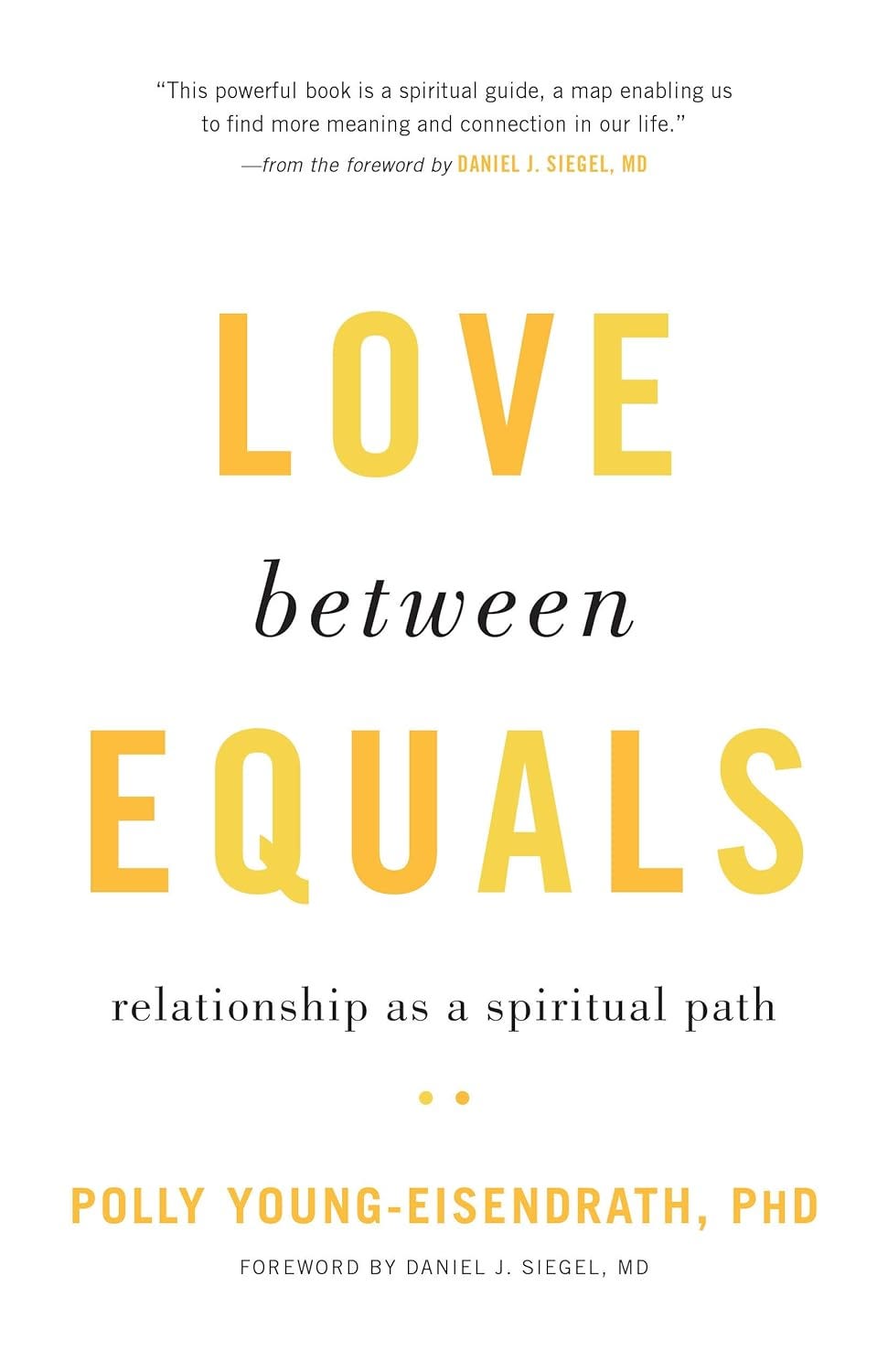
Strong relationships aren’t built on perfection—they’re built on awareness, honesty, and real dialogue. In this practical guide, Polly Young-Eisendrath draws from decades as a psychotherapist and Buddhist teacher to challenge outdated ideas of love and show what actually works.
You’ll learn how to navigate conflict, communicate more effectively, and deepen your connection without losing yourself in the process.
Get your copy and start building stronger, more intentional relationships today.
No posts
Comments
Nothing yet. Say the first thing.
Sign in to join the conversation.