
Hey folks 👋
For two years, the cognitive offloading debate has been quite binary and vague on specifics: we need to ban AI from the learning experience because it erodes cognition, or let’s embrace AI because it helps us get smarter.A number of studies published in 2026 have helped to move the debate beyond the binary and replace it with a more nuanced (but still incomplete) understanding of conditions under which offloading harms learning, the conditions under which AI improves cognition, and how to design for the difference.
A cluster of new studies — most published in the last few weeks in the International Journal of Educational Technology in Higher Education — lets us answer two questions with more precision than ever before:
When does cognitive offloading actually happen?
When does using AI improve cognition?
The answers in turn help us to start to design learning which intentionally uses AI to drive - rather than diminish - learning.
Let’s dive in!
Cognitive offloading doesn’t automatically happen when learners use AI — it happens when they hand the thinking over to AI.
A research team led by Yiran Cui sat down with 24 university students and went through 120 of their real AI conversations — 688 messages in total — asking them to explain the reasoning behind every message they’d sent. Each message was then coded for what kind of thinking it showed. When students used AI as a replacement for their own thinking — paste the assignment in, take what comes out — the two highest forms of thinking (judging the quality of ideas, and building on them) appeared exactly zero times. Not rarely: zero, across all 127 of those messages. The conversations were closed loops — ask, take, ask again — with no thinking happening on the human side at all (Cui et al., 2026).
TL;DR: Using AI doesn’t switch your brain off. Handing AI thinking tasks does.
Cognitive offloading happens when AI gives feedback before a learner reflects.
Ates ran a large randomised experiment: 1,176 first-year science students across four universities, assigned to different feedback designs for ten weeks. In one design, the AI critiqued each draft the moment it was submitted. Those students’ drafts improved fastest — but weeks later, tested without the AI, they performed worst of every group. The reason: when the AI judges first, learners stop judging their own work and simply edit the AI’s opinion. The evaluating — the part that builds the skill — had been handed over (Ates, 2026).
TL;DR: If the AI judges first, the learner never learns to judge.
Cognitive offloading happens when the task rewards only the output.
The same Cui study found that whether students slipped into offloading wasn’t about who they were — it was about what the task asked of them. When students were working to deadlines and grades, 64.6% of their AI use collapsed into replacement mode. When the same students were exploring something out of genuine interest, only 5.3% did. Same people, same tool, opposite behaviour (Cui et al., 2026).
TL;DR: Offloading follows the incentive, not the tool. Reward only the output, and the thinking gets handed over.
Cognitive offloading happens when AI use is unstructured.
Wang and Zhang studied 912 students across China, Europe and the United States — the study behind the “offloading paradox” I covered in April. Their most surprising finding: students who dabbled with AI — fix a sentence here, check a fact there — learned less than students who used no AI at all. Dabblers carried all of the mental workload themselves, plus the extra effort of managing the tool, and freed up no capacity for deeper thinking (Wang & Zhang, 2026).
TL;DR: The worst way to use AI isn’t heavily, it’s using a bit without structure or intention.
Cognitive offloading is currently the default, not the exception.
Across two independent studies, the picture is consistent. In Cui’s conversation data, the genuinely productive way of working with AI showed up in just 7.5% of conversations. Strömberg found the same pattern at population scale: left to their own devices, most learners use AI in ways that weaken their learning, while only a minority use the same technology in ways that deepen it (Cui et al., 2026; Strömberg, 2026).
TL;DR: Left alone, most learners offload. Good AI use has to be designed, not hoped for.
Cognitive offloading hides from immediate metrics — which is why the debate has been so confused.
Back to Ates’s experiment: the feedback design doing the most damage to long-term learning was also posting the best scores on today’s draft. Every dashboard would have called it the winner. Only the delayed test, with the AI switched off, revealed the harm (Ates, 2026).
TL;DR: If you only measure performance with the AI on, offloading doesn’t just go undetected — it looks like improvement.
Cognition improves when the learner judges their own work before the AI does.
Back to Ates’s experiment here. The winning design added one small step: before the AI’s feedback opened, students spent two minutes judging their own draft — strongest point, weakest point, one thing they were unsure about, top revision priority. That group beat the instant-feedback group on immediate improvement — and kept their advantage weeks later, on the test with the AI switched off. The researchers also measured why it worked: roughly 40% of the long-term advantage travelled through the students’ own act of evaluating. And the least experienced students gained the most (Ates, 2026).
One more detail worth sitting with: on that delayed test, the AI-based designs finished both last and first, with human-only feedback in the middle. Same tool, same model, same prompts. So “is AI feedback better than human feedback?” turns out to be the wrong question — the design of the feedback process mattered more than who, or what, wrote it. And the best and worst designs used the same amount of AI. What differed was which piece of thinking changed hands.
TL;DR: Two minutes of self-judgement before the AI speaks protects long-term learning — and design matters more than whether the feedback is human or AI.
Cognition improves when AI extends the learner’s capability rather than replacing their thinking.
In Cui’s conversation data, some students treated the AI as a collaborator: they proposed ideas, pushed back, and treated the AI’s output as material to judge rather than an answer to accept. These were the only conversations showing the complete chain of thinking skills — from understanding the task all the way to judging ideas and building on them — and once students reached the deeper levels, they tended to stay there. The pattern held even inside ordinary “tool use”: students who kept ownership and used AI to extend what they could do still showed real higher-order thinking. Students who handed the work over showed none (Cui et al., 2026).
TL;DR: The line that matters isn’t “is AI present?”. It’s does the human keep the thinking?
Cognition improves when specific types of “learning labour” are delegated — and the freed capacity is reinvested with intention.
This is the other side of Wang and Zhang’s U-curve. Students who handed entire categories of supporting work to AI — summarising sources, first-pass literature reviews, organising data — and then spent the freed time on what AI can’t do for them (questioning assumptions, critiquing frameworks, building original arguments) showed the deepest learning in the study: measurable shifts in how they understood their subject. Delegating labour at scale improved thinking. Delegating the thinking destroyed it. Same word — “offloading” — describing two opposite acts (Wang & Zhang, 2026).
TL;DR: Delegate the labour boldly. Reinvest the freed time in the thinking.
Learner motivation helps mitigate risk significantly.
Dai and Chan ran focus groups with 28 masters and PhD researchers at the University of Hong Kong — some of the heaviest AI users anywhere, working with almost no official guidance. Left alone, they had built their own rulebook, and the line they drew is the same one the experiments point to: AI could support any task, provided the researcher kept decision authority and did the final thinking themselves; it could not substitute for the work that was their real contribution. In their own words, the line separated “being supported in thinking” from “outsourcing thinking.” Nobody taught them this (Dai & Chan, 2026).
TL;DR: Learners who are motivated to learn are far less likely to offload cognitive tasks to AI.
Based on what we know from the research, six principles emerge which help to mitigate the risks and optimise the benefits of learning with AI:
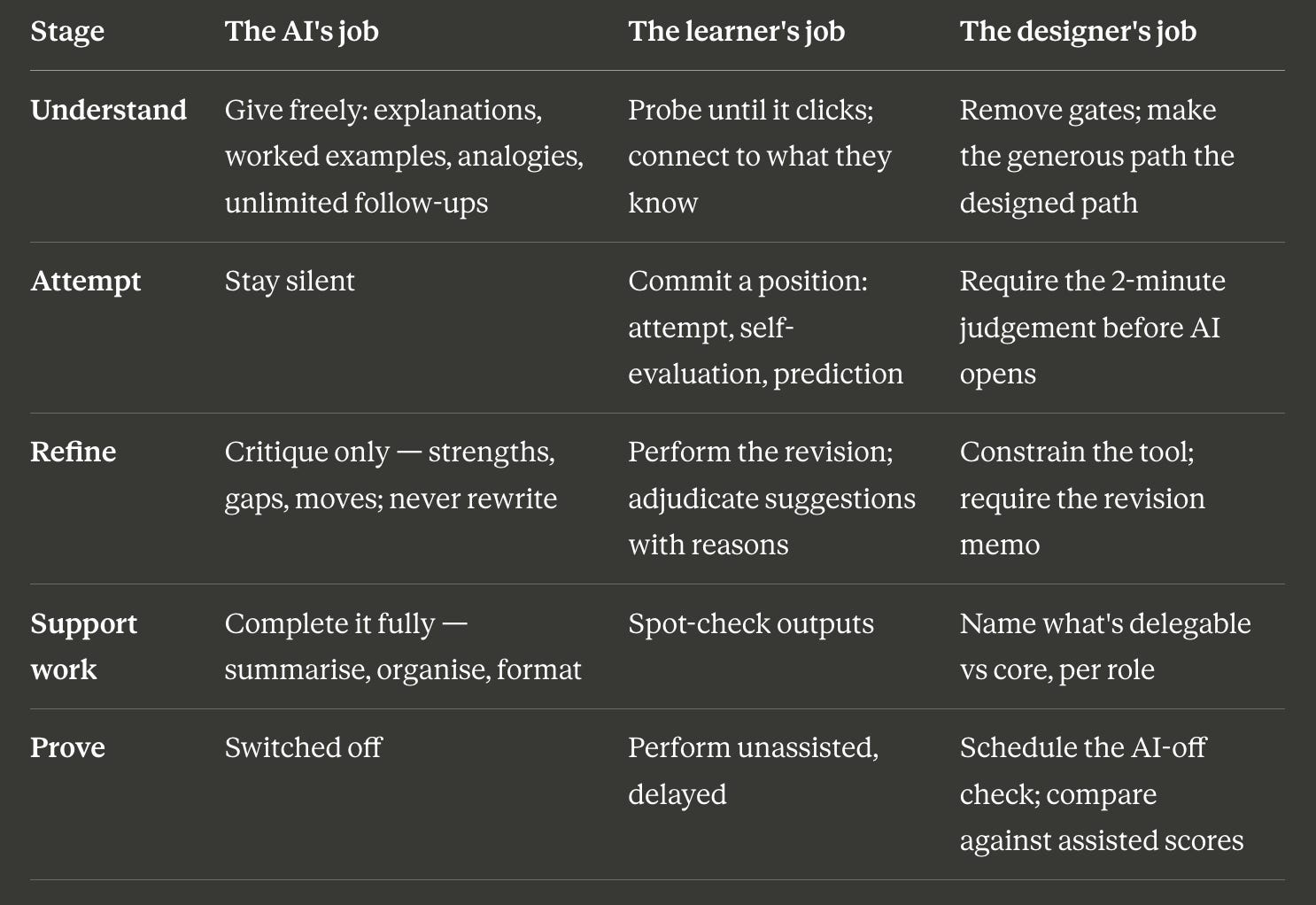
Principle 1: At the comprehension stage, let the AI give freely. Explanations, worked examples, analogies, unlimited follow-ups — no gate. This is the half of the loop learners already invented, and it aligns with what the evidence recommends for novices. Blocking it just drives people back to generic chat, minus your design. (Cui et al., 2026; Tian et al., 2026)
Principle 2: At the production stage, the learner goes first. Before the AI critiques, evaluates, or drafts anything that constitutes the learner’s own contribution, require a committed position: an attempt, a self-evaluation, a prediction. Two minutes is enough — and it’s the single experimentally validated lever, with the biggest benefit for the least experienced. (Ates, 2026)
Principle 3: Configure AI to critique, never to complete. The tool in Ates’s winning conditions was constrained to strengths, weaknesses, missing evidence, and suggested revision moves — full-answer generation switched off. The learner performs the revision; the AI illuminates it. (Ates, 2026)
Principle 4: Make the learner adjudicate, visibly. Accept, reject, or modify the AI’s suggestions — with reasons. A 100–150 word revision memo is where evaluative skill gets built; justifying a rejection is the behavioural signature of the collaborator stance that only 7.5% reach spontaneously. (Ates, 2026; Cui et al., 2026)
Principle 5: Delegate the labour substantially — and keep the thinking. Full delegation is fine — encouraged, even — for work outside the learner’s core contribution: formatting, summarising sources, organising data. Half-hearted delegation is the worst of all worlds. For the thinking that is the contribution, AI extends and challenges, but the learner retains decision authority and could defend the output alone. (Wang & Zhang, 2026; Cui et al., 2026; Dai & Chan, 2026)
Principle 6: Prove it with the AI off. Ates’s rankings fully inverted on the delayed, unassisted test. If you only ever measure performance with the tool on, you cannot distinguish capability from dependence — and the evidence says they can move in opposite directions. One delayed, AI-free check per module is the cheapest insurance in learning design. (Ates, 2026)
I put together a full summary of the research + cheat sheet in a short guide. You can download it here.
For two years the debate has been framed as a tug-of-war between the answers machine and the AI tutor — frictionless help versus imposed rigour. The new evidence says both sides put the design intelligence in the wrong place. And step back from the individual findings, and one principle connects everything in this piece:
AI can support and enhance human cognition when — and only when — the human retains cognitive ownership. Each study conducted so far has located that ownership at three different levels of design:
The interaction: does the learner attempt and judge before the AI intervenes? A two-minute act of self-judgement was the difference between the worst and best AI designs in the study (Ates, 2026).
The human’s role: is AI extending the learner’s capability, or replacing the thinking? That single distinction separated zero higher-order engagement from the deepest in the dataset (Cui et al., 2026) — and it’s the same line postgraduate researchers drew for themselves when nobody was watching: delegate the labour, keep the thinking (Dai & Chan, 2026).
The practice: is good AI use relevant, confidence-building and embedded enough to continue? Because a well-designed experience nobody sustains produces exactly nothing (Tian et al., 2026).
The finding that should shape every L&D team’s AI implementation plan is this: ownership cannot be left to learner discipline. The collaborator stance appeared organically in just 7.5% of conversations (Cui et al., 2026); at population scale, most self-directed AI use weakens learning rather than deepening it (Strömberg, 2026); and under deadline pressure, nearly two-thirds of use collapsed into replacement mode. Ownership has to be designed into the task and reinforced through practice — made the path of least resistance, not an act of learner virtue.
The emergence of AI reinforces a much older pattern: learners abandon the LMS the moment compliance stops forcing them through it. They start MOOCs in their millions and vanish within weeks. Now, they’re switching off learn modes and delegating thinking to LLMs.
Each time we’ve filed these as problems with learner motivation, discipline, grit. The more defensible conclusion is that it was an ownership problem all along: we kept building experiences that either took the thinking away from learners or made them beg for help they’d already earned. Our job now is to build the opposite: experiences that are generous with the help — and uncompromising about who does the thinking.
Happy designing!
Phil 👋
PS: If you want to build these judgement-first AI workflows rather than just read about them, apply for a place on my AI Bootcamp for L&D.
Comments
Nothing yet. Say the first thing.
Sign in to join the conversation.