
Welcome to The Incredible Machine Newsletter
Hello! I’m Dr Paul Manhas, MD, Dad x3, husband, and Co-founder of Manhas Health Co. Through the Incredible Machine Newsletter, I focus on understanding how the body works as a connected system, and how small, repeatable habits influence energy, aging, and disease risk over time.
I intentionally chose to start the year with this topic.
January is when many people look for resets. They change diets, start training programs, or add supplements in hopes of quick results. What often gets missed is the internal environment that determines whether any of those changes will actually work.
Urolithin A helps explain that improving our internal environment may yield superior results than almost any other molecule we know.
Urolithin A is not a vitamin or a supplement you naturally consume. There also a good chance you’ve never heard of it, but that doesn’t mean it isn’t potentially helpful.
It is a postbiotic compound produced by your gut bacteria when they break down ellagitannins, which are plant polyphenols found in foods like pomegranate, walnuts, raspberries, and blackberries.
This detail matters.
Urolithin A is not present in these foods. It is something your body makes only if your gut microbiome can.
Two people can eat the same foods in the same amounts and experience very different biological effects. One may produce Urolithin A. The other may not.
The difference lies in gut health, microbial diversity, and inflammation.
This is one of the clearest examples of why nutrition is personal and why gut health sets the ceiling for almost every other health goal.
Only about 30 to 50 percent of people naturally produce meaningful amounts of Urolithin A, even when they consume ellagitannin-rich foods.
Production depends on several factors including fiber intake, microbiome diversity, digestive health, and the absence of chronic gut inflammation.
This is why simply adding a “superfood” often fails to deliver expected benefits.
Without the right internal conditions, the biology does not happen.

Urolithin A has become a focus of longevity research due to its effects on mitochondria.
Mitochondria are the structures inside our cells that convert food into energy. Every muscle contraction, thought, immune response, and metabolic process depends on them.
Over time, mitochondria accumulate damage. When damaged mitochondria are not removed efficiently, they become less effective, leading to increased oxidative stress.
This contributes to fatigue, loss of muscle endurance, insulin resistance, chronic inflammation, and accelerated aging.
Urolithin A activates a process called mitophagy. Mitophagy is the body’s way of identifying damaged mitochondria and recycling them.
Rather than simply creating more mitochondria, the body can recycle and improves the quality of the ones it already has. Urolithin A is exciting because it has been clinically proven to enhance mitophagy and induce mitogenesis (creation of brand new mitochondria).
A randomised, double-blind, placebo-controlled trial published in JAMA Network in 2022 studied older adults who supplemented with Urolithin A for four months.
The researchers measured muscle endurance, strength, and mitochondrial health markers.
They found that participants taking Urolithin A experienced:
Significant improvements in muscle endurance
Increases in muscle strength
Improvements in mitochondrial gene expression and energy metabolism
Importantly, these benefits occurred without increases in muscle mass.
This tells us that Urolithin A improves how muscle functions, not just how much muscle someone has.
My clinical view:
This distinction is critical. As we age, independence is determined far more by endurance and fatigue resistance than by muscle size. Many patients assume they are “losing muscle” when, in reality, their muscles are simply less efficient.This study is extremely exciting because it is a randomized control trial. Randomised control trials provide the highest level of evidence. Every medicine we prescribe as physicians is rigorously studied through randomized control trials to ensure safety and efficacy. The limitation of this study is that only includes 66 participants but the design is good and the results are promising.
How I apply this:
For adults over 40 who are exercising but feel weaker, slower to recover, or easily fatigued, I focus on mitochondrial health through nutrition, gut support, and recovery before increasing training volume or intensity. Supplementing with Urolithin A is also a recommended. If you note a difference in energy levels and/or strength, this may be a good staple for long term use.
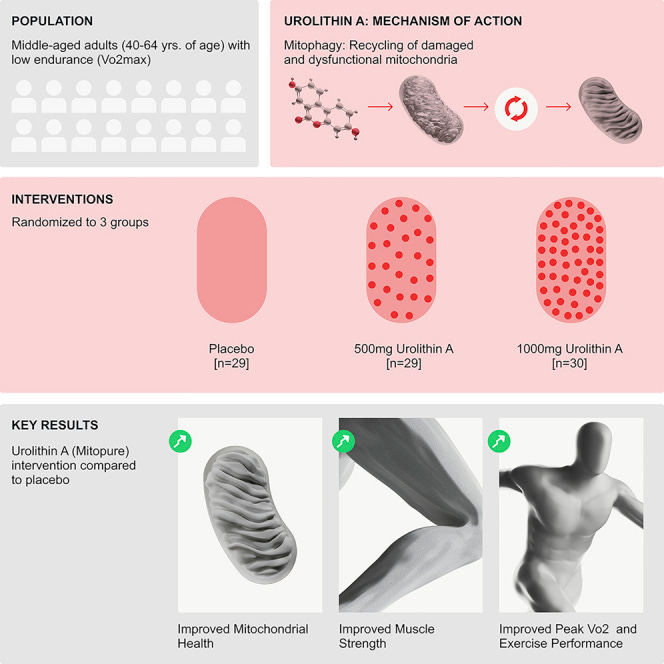
Another randomised trial examined the effects of Urolithin A in middle-aged adults, not just the elderly. This study measured muscle strength, exercise performance, and mitochondrial health biomarkers.
The findings showed that Urolithin A supplementation led to:
Improved muscle strength
Better exercise performance
Measurable improvements in mitochondrial efficiency
This confirms that mitochondrial decline begins earlier in life than most people realize.
My clinical view:
Feeling “more tired than you should be” in your 40s or 50s is not inevitable. In many cases, it reflects declining mitochondrial efficiency rather than chronologic aging itself.
How I apply this:
When patients train consistently but plateau or feel persistently drained, I look beyond training programs. I assess fiber intake, gut health, sleep quality, and recovery nutrition before suggesting harder workouts.
A randomised, placebo-controlled trial investigated the effect of Urolithin A on age-related immune decline. The study showed improvements in markers of immune function and reductions in signals associated with immune aging and chronic inflammation.
This is important because immune cells are among the most energy-dependent cells in the body.
My clinical view:
Chronic inflammation is often framed as an immune problem, but it is frequently an energy problem at the cellular level. When immune cells lack efficient mitochondria, they become dysfunctional and inflammatory.
How I apply this:
In patients with frequent infections, prolonged recovery from illness, or chronic inflammatory conditions, I focus on restoring cellular energy capacity through gut health, nutrition, sleep, hydration, vitamin supplementation and exercise rather than relying solely on symptom suppression.
A 2024 review published in Clinical Nutrition analysed multiple studies on Urolithin A and metabolic health. The review found that Urolithin A improves fat oxidation and insulin sensitivity, suggesting better metabolic flexibility.
In practical terms, this means cells become better at switching between fuel sources and managing glucose efficiently.
My clinical view
Poor metabolic health is often rooted in inefficient mitochondria. When mitochondria cannot properly handle fuel, blood sugar rises, energy fluctuates, and fat loss becomes difficult.
How I apply this:
For patients with prediabetes or metabolic syndrome, I prioritize meal composition, zone 2 endurance training and VO2 max HIIT training before escalating to medications or advanced interventions. Through targeted exercise, we can actually change which fuels the body chooses to burn.
A recent review in Frontiers in Nutrition examined emerging evidence on Urolithin A in sports nutrition.
The authors connected preclinical and human data suggesting benefits for:
Training adaptation
Endurance capacity
Recovery between sessions
The common mechanism across studies was improved mitochondrial efficiency.
My clinical view:
This is not about performance shortcuts. It’s about improving the efficiency of the energy systems athletes already rely on.
Studies published in Nature Ageing and related journals show that Urolithin A lowers markers of oxidative stress and inflammation, including CRP and TNF-alpha.
These markers are strongly associated with cardiovascular disease, neurodegeneration, type 2 diabetes, and accelerated biological aging.
My clinical view:
Lowering inflammation at the cellular level does not just reduce symptoms. It changes the trajectory of aging and disease risk over time.
How I apply this:
Rather than chasing anti-inflammatory supplements, I focus on restoring mitochondrial quality, gut health, and recovery capacity.
In clinical practice, the pattern is consistent.
Fatigue is one of the most common complaints any primary care physician deals with. Energy levels drop. Inflammation lingers. Progress stalls.
Those who focus on fundamentals tend to see steady improvement. They eat more fiber, move daily, reduce ultra-processed foods, improve hydration, key in on sleep and pay attention to digestion.
Over time, they report better energy, improved blood sugar control, and less inflammation.
That is when the body becomes capable of producing compounds like Urolithin A.
The bottom line is: Health does not come from shortcuts. It comes from systems working together.
This is not theoretical. There are simple ways to apply this immediately.
Step 1: Start with fiber, not supplements
Aim for 30 to 40 grams of fiber per day. Focus on legumes, oats, flaxseed, leafy greens, and berries. Increase gradually to avoid GI discomfort.
Step 2: Include ellagitannin-rich foods several times per week
Add pomegranate seeds to yogurt, oatmeal, or salads. Use walnuts as a snack. Include raspberries or blackberries regularly.
Step 3: Move daily, even if training is light
Walking after meals, resistance training, or cycling all signal the body that mitochondrial health matters. Consistency is more important than intensity.
Step 4: Reduce foods that disrupt the gut
Limit packaged snacks, refined baked goods, sugary cereals, processed meats, and foods with long ingredient lists or artificial additives.
Step 5: Hydrate with intention
Use urine color as a simple guide. Pale yellow to clear usually indicates adequate hydration. Drink water before caffeine and increase fluids when fiber intake rises.
Step 6: Pay attention to digestion
Chronic bloating, constipation, or irregular stools are signs that the system needs support. These are not details to ignore.
To make this easier to apply, you can download the Start-of-the-Year Reset checklist, a simple, printable guide that summarises these steps and helps you track consistency over the coming weeks.

Pomegranate seeds or unsweetened juice
Walnuts
Raspberries and blackberries
Lentils, chickpeas, black beans
Oats and barley
Flaxseed
Leafy greens
Oatmeal with raspberries, ground flaxseed, and walnuts
Greek yogurt or plant-based protein
Water or green tea
Supports: glucose availability, mitochondrial activation, gut signaling
Lentil and quinoa bowl with leafy greens
Olive oil and lemon dressing
Grilled fish or tofu
Supports: muscle repair, mitochondrial protein synthesis, insulin sensitivity
Mixed greens salad with walnuts and pomegranate seeds
Roasted vegetables
Protein source of choice
Supports: inflammation reduction, gut repair, and overnight recovery
Clinically tested Urolithin A supplements exist and can be useful in specific cases:
Adults over 40
People with low microbiome diversity
Individuals with chronic inflammation or metabolic dysfunction
Athletes under high training stress
However, supplements do not override poor foundations.
If fiber intake is low, sleep is poor, and digestion is off, supplements will underperform.
My approach is simple:
Build the system first
Use supplements to support, not replace, biology
Urolithin A is not the goal. It is the signal.
It tells us whether the systems that matter most, the gut, mitochondria, immune function, and metabolism, are working together or struggling.
When fiber intake is adequate, movement is consistent, recovery is respected, and the gut is healthy, the body begins to repair and renew itself more efficiently. Energy improves, inflammation quiets, and performance becomes easier to maintain.
Longevity is not built by adding more.
It is built by creating the conditions that allow the body to do what it was designed to do.
This is where health actually begins.
In the next issue of The Incredible Machine, we will focus on flaxseed.
Flaxseed is one of the most affordable and underused tools for improving gut health, reducing inflammation, supporting cardiovascular health, and influencing long-term aging.
We will look at the science, clinical evidence, and how I use and recommend it in my practice and at home.
Simple food. Meaningful impact.
To your health and vitality,
Dr. Paul Manhas, MD, CCFP
Co-founder and Director of Performance Services, Manhas Health Co.
Clinical Instructor, UBC Faculty of Medicine
References
Andreux PA, et al.
Urolithin A improves muscle strength, exercise performance, and biomarkers of mitochondrial health in a randomized trial in middle-aged adults.
PMCID: PMC9133463
https://pmc.ncbi.nlm.nih.gov/articles/PMC9133463/Liu J, et al.
Effect of Urolithin A on muscle endurance and mitochondrial health in older adults: A randomized clinical trial.
JAMA Network Open, 2022
https://jamanetwork.com/journals/jamanetworkopen/fullarticle/2788244Ryu D, et al.
Effect of the mitophagy inducer urolithin A on age-related immune decline: A randomized, placebo-controlled trial.
https://www.ncbi.nlm.nih.gov/pmc/articles/PMC9133463/
(immune and mitochondrial signaling components)Clinical Nutrition ESPEN Review
Urolithin A and metabolic health: Effects on fat oxidation and insulin sensitivity.
Clinical Nutrition ESPEN, 2024
https://www.sciencedirect.com/science/article/pii/S1568163724002241Nature Aging
Urolithin A, mitochondrial health, and inflammation in aging.
Nature Aging, 2025
https://www.nature.com/articles/s43587-025-00996-xFrontiers in Nutrition
Emerging evidence of Urolithin A in sports nutrition: Bridging preclinical findings to athletic applications.
Frontiers in Nutrition, 2025
https://www.frontiersin.org/journals/nutrition/articles/10.3389/fnut.2025.1585922/full
Comments
Nothing yet. Say the first thing.
Sign in to join the conversation.