
Welcome to The Incredible Machine newsletter.
I'm Dr. Paul Manhas, MD — Dad x3, husband, and Co-founder of Manhas Health Co. Here, we explore the science of longevity, performance, and preventive health — and how small, consistent choices can transform your body's "machine" for decades to come.
This issue is the most personal thing I have written here. I debated sharing it for weeks. But if there is one story I believe can genuinely shift how you think about your body and what it is capable of, it is this one.
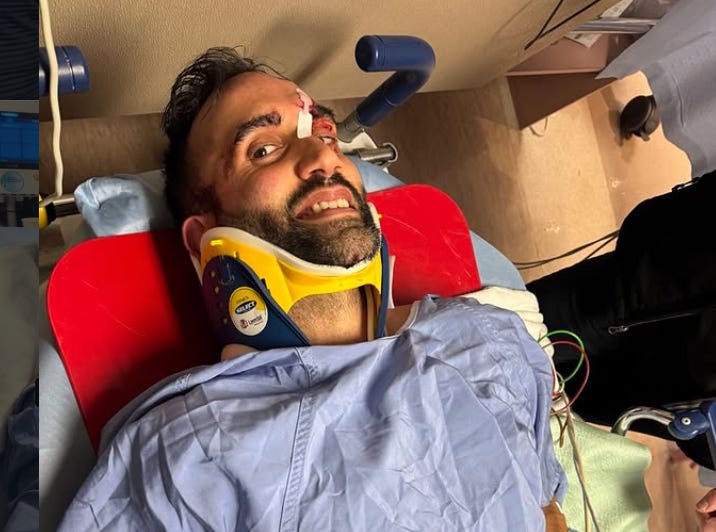
Picture this. It is a recreational hockey game. The kind where you are loose, confident, not thinking about consequences. I am on a half breakaway, carrying the puck at full speed toward the goalie. Rather than drive straight into him, I make a split-second decision — jump, sidestep, go around. Clean. Controlled. The kind of move I had made a hundred times.
Except this time, as I left the ice, my back leg was clipped.
What followed is physics at its most unforgiving. The clip launched me upward, fully vertical, fully airborne, nothing beneath me, and then gravity did the rest. No hands. No time. No warning. I came straight down onto my face at full speed.
The impact was total. I was face down on the ice, motionless, and I could not move my arms. Could not feel them. From the shoulders down, there was simply nothing — no sensation, no response, just a silence where my body used to be.
I am a physician. I knew exactly what that silence meant.
"I did not panic. In fact, I noticed with some detachment that I was completely calm. That surprised me more than the fall."
Lying there, unable to move, my brain began a quiet triage. Not catastrophising. Not spiralling. Four thoughts arrived in order, each one clear and purposeful.
One: I am done with hockey. The decision was made in seconds, without grief or hesitation. I knew the stakes of a cervical spine injury with acute motor loss. It simply was not worth it. Done.
Two: I hope I can hold my kids again. This one landed with a weight I was not prepared for. With no feeling in my arms, I suddenly truly understood that holding my children was something I had done every day without ever once thinking about it. We take for granted the things we love most. That thought changed me.
Three: I will not be a burden. My wife and children would not become my caretakers. That was not a wish. It was a decision. I would fight for every degree of function, whatever it required.
Four: I will work again. Even if I could never return to the clinic in person, I would adapt to a virtual role, writing, and teaching. My purpose is not tied to a single way of practising medicine.
Over the next twenty minutes, the function returned slowly. Toes first. Then legs. Then, finally, my arms announced by sharp, electric pain burning through my hands and fingers.
As a physician, I recognised that pain immediately. It was the nervous system rebooting: axonal signals fighting their way through a bruised and swollen cord, re-establishing contact with the periphery. The machine was coming back online.
The diagnosis confirmed the seriousness of the injury:
C1 vertebral fracture
T1 vertebral fracture
Left rib fracture
Spinal cord contusion
I was fortunate.
Profoundly fortunate.
Injuries at this level of the spine are among the most unpredictable in medicine.
A cervical spinal cord injury, particularly involving the upper vertebrae, can lead to permanent paralysis, loss of independence, and, in severe cases, respiratory failure.
And the statistics are sobering.
Research from spinal injury registries shows that:
Only about 40–50% of patients with acute spinal cord injury regain meaningful motor function
Recovery is most likely when movement returns early, as it did in my case
Approximately 17,000 new spinal cord injuries occur each year in North America
Many survivors require lifelong rehabilitation
Yet there are also powerful stories of recovery.
Athletes like Peyton Manning, who underwent cervical spine surgery and nerve recovery after losing arm strength, returned to elite competition. Patients with severe spinal cord contusions, once unable to move, have walked again after months of rehabilitation.
Not because of luck alone. I was fortunate. Profoundly, incomprehensibly fortunate.
Because of biology, rehabilitation, and mindset work together.
But what stayed with me beyond the imaging, beyond the collar, beyond the weeks of recovery was the quality of my thinking in those ten minutes. And it sent me back to the literature with a question I had never asked so personally before:
Does mindset actually change what happens inside the machine?
When I look back on that moment on the ice, one thing stands out more than anything else.
It wasn’t the pain.
It wasn’t the fear.
It was the speed at which my mind began to make sense of what was happening.
Before the paramedics arrived, before imaging, before diagnosis, my brain was already working.
Not just reacting, but predicting.
Preparing.
Directing.
And that realization led me to a question I now ask many of my patients:
Is your body simply reacting to what happens to you — or is it preparing for what it expects to happen next?
Think of your nervous system like a factory with two communication lines.
One line carries information up from the body to the brain, signalling about pain, pressure, temperature, and movement.
The other line sends instructions down from the brain to every tissue, organ, and muscle.
Most people assume the factory simply responds to what happens on the floor.
That pain shows up first, and the brain reacts afterwards.
But the science tells a different story.
The control room is constantly sending instructions before anything happens.
Your brain is always making predictions, preparing your body for what it believes is coming next.
If the brain expects danger, it amplifies pain signals.
If it expects recovery, it prepares the body to heal.
Your mindset is not separate from your physiology.
It sits upstream of it.
This might sound philosophical, but it is one of the most consistent findings in modern medicine.
Researchers have studied recovery after surgery, injury, and serious illness across dozens of clinical trials and asked a simple question:
Do people who expect to recover actually recover faster?
The answer, repeatedly, is yes.
A large analysis that combined results from 83 controlled studies found that patients who entered treatment with optimism and confidence in their recovery experienced:
Faster healing
Better physical function
Lower stress hormone levels
Less inflammation
Greater participation in rehabilitation
In many cases, mindset predicted recovery outcomes as strongly as, or even more strongly than, the severity of the illness itself.
That doesn’t mean positive thinking replaces medical care.
But it does mean this:
Your expectations become part of the treatment.
David Robson's book The Expectation Effect synthesises this science compellingly. His central argument, grounded in peer-reviewed research, is that the expectations we hold about our bodies and our recovery are not passive beliefs.
They are active biological inputs that alter measurable outcomes: pain intensity, healing speed, immune function, cardiovascular reactivity, and longevity.
To understand this, we need to look at the three systems that quietly run the recovery process every day.
These systems don’t just respond to injury.
They respond to perception.
When the brain perceives threat, whether physical or emotional, it activates the body’s stress response system, releasing cortisol.
Short bursts of cortisol are helpful.
They give you energy to act.
But when stress stays high for too long, cortisol begins to work against you.
It can:
Suppress immune function
Slow tissue repair
Disrupt sleep
Increase inflammation
Drive insulin resistance
Now here’s the key insight:
Your expectations can turn this system on or off.
When you believe recovery is possible, the brain reduces the threat response before it escalates. Healing becomes easier because the body is no longer fighting itself.
Your nervous system has two primary modes:
Fight or flight — survival
Rest and repair — healing
Optimism and confidence shift the body toward the repair mode.
In medical research, this shift is associated with:
Lower inflammation
Better sleep quality
Faster wound healing
Improved heart rate variability
On the other hand, constant worry keeps the body in survival mode — burning resources the body needs for repair.
It’s like leaving the engine running while trying to fix the car.
Your body produces its own pain-relieving chemicals.
These include natural opioids and dopamine — the same biological pathways targeted by many medications.
And here’s the remarkable part:
Expectation alone can activate these pathways.
When you expect improvement, the brain releases chemicals that reduce pain and reinforce recovery behaviours.
This isn’t motivational language.
It’s measurable biology.
The second thought I had on the ice, “I hope I can hold my kids again”, arrived before I consciously chose it.
It was not a strategy.
It was recognition.
A sudden awareness of something I already had — and did not want to lose.
That, I now understand, is gratitude in its purest form.
Not a practice you perform. A clarity that emerges when everything else falls away.
And from a medical perspective, gratitude is one of the most powerful daily interventions we have.
Many people think gratitude is simply about being positive.
But biologically, gratitude is a measurable event.
When you consciously acknowledge something meaningful in your life, your brain releases:
Dopamine — the motivation chemical
Serotonin — the stability chemical
At the same time, stress signals decrease.
In clinical studies, even simple gratitude practices — like writing down a few things you appreciate — have been shown to:
Improve sleep
Reduce fatigue
Increase physical activity
Lower inflammation
In patients with heart failure, an 8-week gratitude intervention produced measurable reductions in inflammatory markers linked to disease progression.
That means gratitude is not just emotional.
It alters the body’s chemistry.
I want to be honest about something.
The calm I found on the ice was not a natural temperament.
It was not physician training.
And it was not luck.
It was the result of years of practising a different question.
Instead of asking:
“Why is this happening to me?”
I learned to ask:
“What can I do from here?”
That shift has a scientific name:
It simply means reframing a situation so the brain sees possibility instead of threat.
And it is one of the most rigorously studied tools in behavioral medicine — consistently linked to:
Lower stress
Better emotional resilience
Faster recovery from injury and illness
We’ve talked about something simple but powerful: your mindset is not just emotional — it is biological. It influences your stress hormones, immune response, pain perception, and recovery.
The brain is constantly predicting what comes next, and those predictions shape how the body prepares to respond.
So the question becomes: what can we do about it — starting today?
Start by setting a clear expectation before difficulty. Before a demanding week, a procedure, or a rehabilitation session, define what progress would look like. Not perfection. Just direction. This gives your brain a target to organize around.
Then, build the habit of noticing what is going right. A few specific gratitudes before sleep, one meaningful moment from the day, can help lower stress, improve sleep, and steady your mood over time.
When challenges arise, replace catastrophic thoughts with practical ones. Instead of asking “Why is this happening?” ask “What is the next right move?” That shift moves the brain from threat into problem-solving.
And remember this: the ability to stay steady in difficult moments is not something you are born with. It is something you train. The brain changes with repetition, just like a muscle. Start small. Start today.
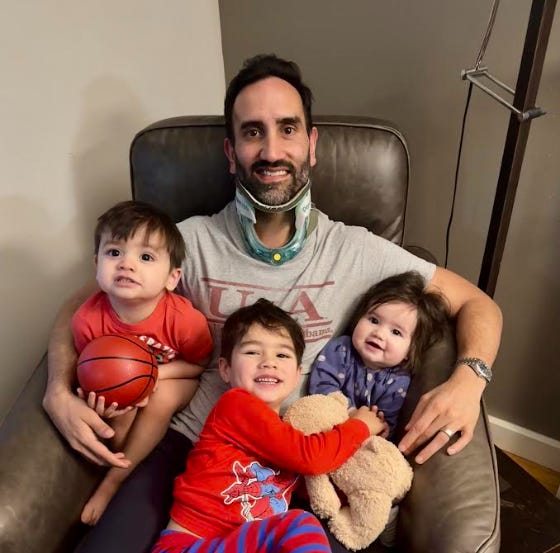
I am writing this in the middle of my recovery, not at the end. Function is still returning. I continue to have nerve pain in both hands, and my left arm remains weak. This week, my cervical collar came off for the first time since the accident.
And yes, I am now able to pick up my children again.
That moment mattered more than any measurement on a medical chart.
I do not share this to minimize what you may be facing. Hard things are hard. Recovery can be slow and uncertain. But one truth has become very clear to me: the orientation of your mind during difficulty matters. It influences your stress response, inflammation, resilience, and recovery.
I was not born with this mindset. I built it slowly by practicing gratitude, reframing setbacks, and learning to ask a better question:
“What can I do from here?”
When I was face down on the ice with no feeling in my arms, the thought that cut through everything was simple:
I want to hold my kids again.
When the stakes are highest, it is always the little things that matter most.
The machine that keeps running when everything is on the line is the one whose software is ready. Build it now — before you need it most.
To your health, longevity, and the moments that matter most,
Dr. Paul Manhas, MD, CCFP
Co-founder & Director of Performance Services, Manhas Health Co.
Clinical Instructor, UBC Faculty of Medicine
Follow me on Instagram for more insights and Q&A: @drpaulmanhas
Comments
Nothing yet. Say the first thing.
Sign in to join the conversation.