
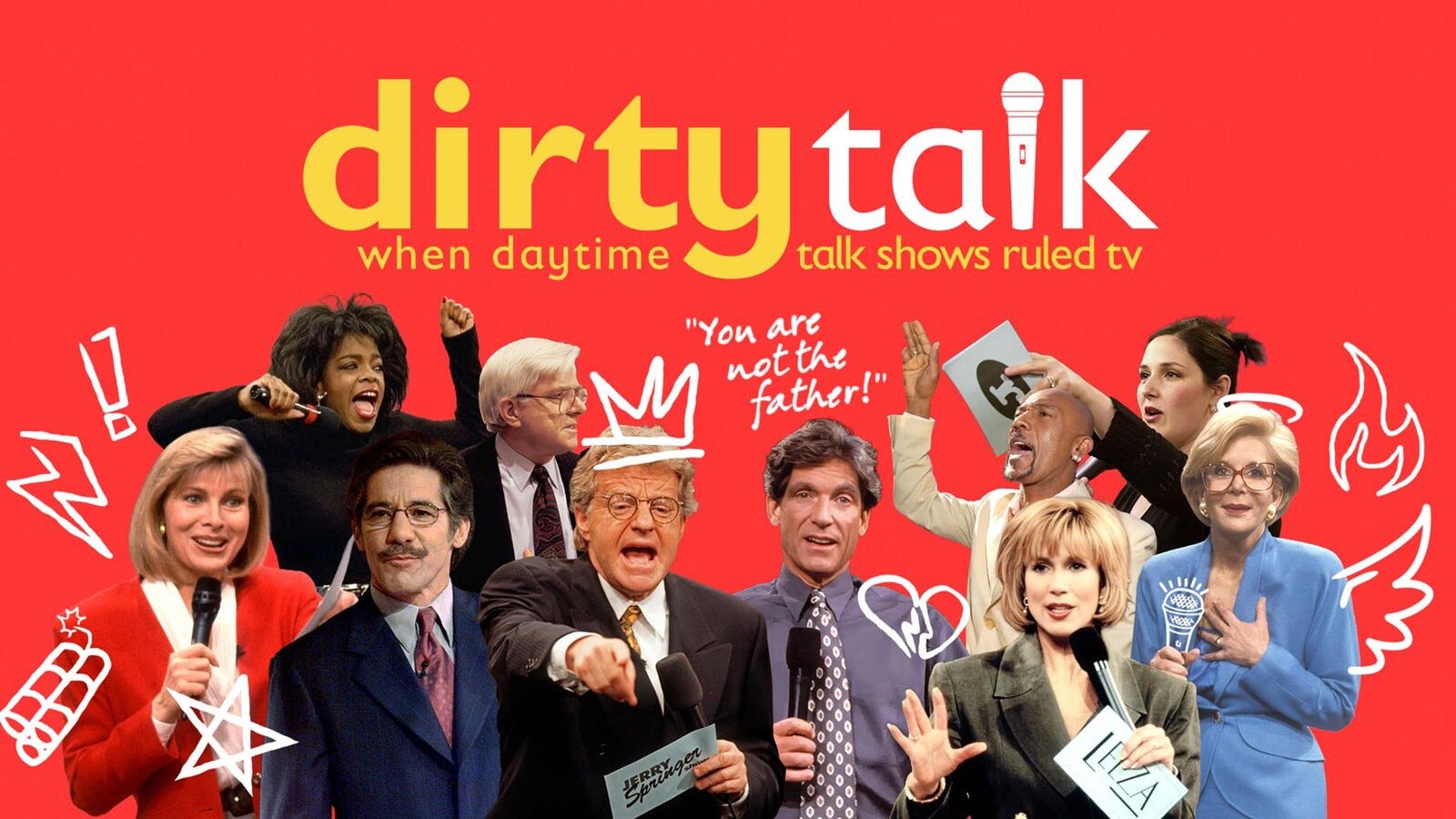
In July 2025, I had the privilege of speaking with Steve Morrison, the director and executive producer of a docuseries on daytime television, about the psychology behind the appeal and evolution of shows such as Jerry Spring and Sally Jessy Raphael. The shows will air on January 14, 2026, on ABC and then stream on Hulu. “Dirty Talk: When Daytime Talk Shows Ruled TV.“ This is one of three posts that draw on my notes from that conversation.
Sensational talk shows relied on social comparison and moral judgment.
Watching others in crisis heightens emotions but feels safe and socially sanctioned.
Parasocial bonds increased loyalty and emotional investment, enhancing belonging.
Social media fuels the same moral outrage, conflict, and spectacle, but with less clear boundaries between fact and entertainment.
In the 1990s, daytime talk shows became a cultural force, not because they were subtle or refined, but because they addressed powerful psychological needs. Millions of viewers tuned in daily to watch confrontations, confessions, and emotional chaos unfold in real time. These programs didn’t succeed despite their excesses. They succeeded because they reliably delivered emotional experiences people were primed to seek.
To understand why this mattered, we need to move beyond moral judgments about “trash TV” and examine the underlying psychology.
One of the strongest drivers of sensational talk shows was downward social comparison. As Festinger’s 1954 theory proposed, people evaluate themselves by comparing their lives to others, especially when objective standards are unclear. When viewers watched guests whose lives crash and burn, it provided immediate emotional relief. Compared to the people on their TV sets, the audience’s own problems felt more manageable, less dire.
This is especially potent during periods of uncertainty. The early 1990s were marked by recession, layoffs, and social change. Talk shows offered a low-effort means of stabilizing self-worth. You didn’t have to solve anything. You just had to watch.
Humans are deeply curious about taboos, the behaviors that violate accepted social norms. Sensational talk shows made that curiosity socially acceptable. They offered access to private conflicts, sexual norms, and moral transgressions without any personal exposure or risk to the viewers.
Psychologically, this kind of mediated voyeurism creates emotional distance. Viewers could feel intense reactions while remaining safely detached. The presence of a studio audience laughing, shouting, and booing created a new norm, reinforcing the exposure of others’ shame and transgressions as entertainment. That framing mattered. It reduced the need for empathy and made judgment easier.
These shows did double duty. They presented (and often amplified) conflict and invited the audience to pass judgment: Who's lying? Who's wrong? What should happen next? This kind of moral positioning makes us the superior, which feels good.
As each narrative unfolded, viewers were the judge and jury. By engaging, they were tasked with deciding who was lying, who was wrong, and what punishment or outcome felt justified. Moralizing about others’ behavior is psychologically rewarding because it reinforces social norms and the sense of belonging that comes from asserting a shared value system.
The studio audience played a critical role. When they chanted “Jerry! Jerry!” during a physical altercation, they gave viewers permission to enjoy the spectacle without guilt. When Oprah’s audience applauded someone’s decision to leave an abusive relationship, they validated that choice and made home viewers feel part of a supportive community. We often rely on others’ opinions to guide our own decisions, assuming that if many people agree, it’s the right thing to do. It’s why reviews and endorsements work so well to sell products. The studio audience provided that social proof; their reactions told at-home viewers what to feel and think, resolving ambiguity by modeling outrage, amusement, disgust, or ostracization.
Daytime talk shows aired daily. Hosts were charismatic, highly energetic and spoke directly to us through the camera. Our brains don’t distinguish between virtual and real when processing social cues, such as perceived eye contact, even when mediated by a camera lens and screen. Many viewers developed strong emotional connections with the hosts. These parasocial relationships are one-sided, yet viewers perceive them as very real, even though there is no reciprocal interaction.
The host often positioned themselves as an ally to the viewer, with guests presented as problems to be managed or judged. Higher emotions mean less critical thinking and more jumping on the bandwagon. The host-as-ally positioning strengthened the sense of “us” versus “them” with clear “good guys” and “bad guys,” deepening viewer loyalty and emotional engagement. You and Jerry Springer were in this together, trying to make sense of these wild people who kept showing up on his stage.
Conflict-driven content reliably captures our attention. We are hard-wired by our survival instincts to look for danger. Emotional arousal heightens focus and increases memory encoding. Sudden revelations, shouting matches, or physical confrontations activate stress responses that make experiences feel urgent and worth noting.
Arousal increases attentional intensity, and when paired with resolution or novelty, it becomes more compelling. Viewers are drawn to emotionally charged experiences that feel significant. You keep watching because your brain registers these moments as mattering, even when rationally you know they don't.
Technology changes much faster than humans evolve. The psychological dynamics that fueled daytime talk shows are still part of us. The medium changed, and the channels proliferated as they migrated to new platforms, like Twitter, TikTok, and Instagram. Social media outrage, viral conflict, and reality-based spectacle draw on the same mechanisms of comparison, judgment, emotionality, anxiety, and parasocial connection.
We still seek emotional experiences that help us evaluate ourselves, satisfy our curiosity, and feel connected to something larger than our daily routines. The difference now is that those experiences come in bite-sized pieces on our phones instead of hour-long episodes on our TVs. The shift to social media and the relentless flow of information have also blurred the distinction between entertainment and fact. The same techniques that talk shows used to attract viewers now sway political opinion.
Cialdini, R. B., & Goldstein, N. J. (2004). Social influence: Compliance and conformity. Annual Review of Psychology, 55, 591–621. https://doi.org/10.1146/annurev.psych.55.090902.142015
Festinger, L. (1954). A theory of social comparison processes. Human Relations, 7(2), 117–140. https://doi.org/10.1177/001872675400700202
Horton, D., & Wohl, R. R. (1956). Mass communication and parasocial interaction. Psychiatry, 19(3), 215–229. https://doi.org/10.1080/00332747.1956.11023049
Zillmann, D. (1996). The psychology of suspense in dramatic exposition. In P. Vorderer et al. (Eds.), Suspense: Conceptualizations, theoretical analyses, and empirical explorations (pp. 199–231). Erlbaum.
Comments
Nothing yet. Say the first thing.
Sign in to join the conversation.