

-Morgan McSweeney, PhD
RFK Jr.’s panel wants to make minimally-tested peptide injections more widely available to Americans.
First, what are peptides? Small, biologically active molecules that are purported to have benefits such as enhancing muscle growth, promoting injury healing, or causing certain death (depending on who you ask) and they are often pitched on social media alongside convenient retail discount codes.
Indeed, individuals who have experimented with such peptides as BPC-157 or KPV are eager to share their personal experiences online.1
I have no doubt that many of these peptides have biological effects.
However, at risk of pointing out the obvious, “having biological effects” is not a compliment in the eyes of a researcher. There have been plenty of unexpected and undesirable outcomes as experimental interventions make the voyage from being “promising in animals” to “tested in humans.”
After all, if the peptide that makes your biceps Instagram-ready also happens to sprout you an extra big toe, you will have trouble putting on your Birkenstocks.
Anyone with the true spirit of science in their heart should remain open to the possibility that some of these peptides may prove to have favorable benefit/risk profiles after rigorous clinical investigation. Plenty of currently-approved medications are peptides, after all, including the GLP-1 drugs (e.g., semaglutide, tirzepatide).
But “after rigorous clinical investigation” is exactly the beans of the issue right now. The list of newer peptides considered last week simply have not been studied very well in humans.
Some of them haven’t been studied in humans at all!
FDA’s scientific reviewers went looking for any published study in which TB-500, MOTS-c, or KPV had been given to a human being, and came back empty on all three.
However, the question in front of the FDA right now is not whether these peptides work, nor whether their benefits outweigh their risks for a specific indication.
Nobody is claiming to know whether these new peptides are safer or effective. That would be a question of FDA approval.
The present question is whether compounding pharmacies should be allowed to prepare them for patients with a prescription.
Those are two completely different decisions and the coverage keeps mashing them together. True - every one of these peptides was nominated to the FDA for a named medical condition: BPC-157 for ulcerative colitis, TB-500 for wound healing, epitalon for insomnia. But, confusingly enough, they are not actually voting on whether these peptides should be approved to manage those conditions, but whether to allow compounding of the molecules, which would just mean that a pharmacist in the US can legally weigh out the powder if someone has a prescription.
That is, as an alternative to what happens right now…
Currently, pioneering individuals with high tolerance for risk and low fear of biological uncertainty can purchase peptides from overseas manufacturers who will happily sell them to you “for research use only” (wink wink). Tales of the peptides’ properties float across the internet with stories of recovery, injury repair, sleep, and longevity.
If these peptides went onto the compounding list, that grey-market internet purchase would be replaced by something that looks a great deal more like actual medicine. A licensed prescriber writes a prescription for you by name, a licensed pharmacist weighs out the powder for you specifically, and you get a labeled vial. That’s pretty much it. The law requires a prescription and a named patient; it does not require a physical exam and it does not care whether rigorous clinical data have shown that the benefits outweigh the risks.
On whether to allow domestic compounding, I have come to see this as a question of harm reduction and of the value and role of regulation in industry. However, that must be weighed against the considerable shortcomings of the current compounding regulations.
For 4.5 years back in graduate school, I worked on a problem almost nobody outside my field has heard of: how the immune system reacts to a common building block used in a lot of modern medicines. My job was to keep the body from treating an otherwise-useful drug like an intruder.
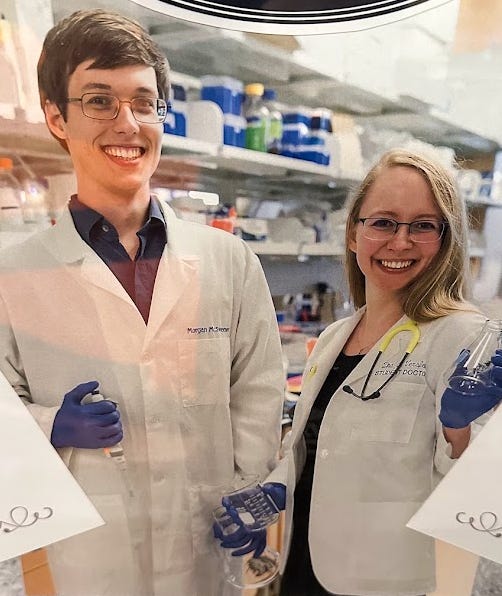
Me and Zina in my grad-school lab.
The approach we developed worked well in animals, extending the circulation time of the useful medications in mice and preventing the severe, anaphylaxis-type reactions that can (rarely) make an otherwise good therapy dangerous for some patients. I am proud of that work, and, in the years since, it has started to attract the support it needs to move closer to testing in humans.
But here is the thing. At the end of the day I have no idea whether it will work in people and whether its benefits will outweigh any potential risks. None. Even though I have spent years as close to that investigational intervention as anyone, I cannot give you a certain answer, and nobody can, until the human trials are run. Everything we saw in the animal data was promising, but a promise is not a result.
Only about 7.9% of drug development programs that enter Phase 1 testing go on to approval, across 9,704 programs tracked over a decade. Roughly 9 in 10 never make it: some fail on safety, some simply do not work very well, and some are dropped for commercial reasons.
So when somebody tells me that I should try a peptide because wellness clinics have used it for years and everyone says it helps, what I am hearing in my ears is a claim that in my field that ends up being wrong about nine times out of ten.
An FDA advisory committee spent two days last week voting on seven of the new peptides, and recommended six be considered allowed for compounding with a prescription. Only emideltide failed, and it failed by a single vote, 6 in favor to 7 against.
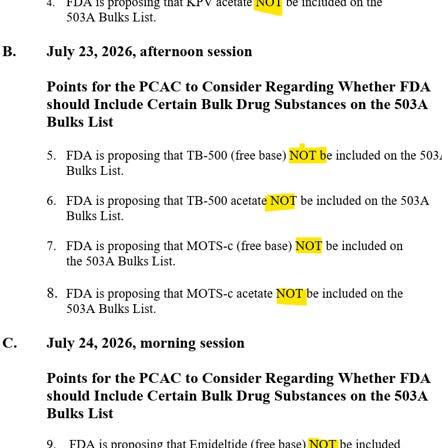
Note that the appointed advisory committee making these votes did not consist of the FDA’s own scientists. The career FDA scientists who wrote the review documents to prepare the scientific briefing for the meeting recommended against all of them, in consecutive sentences of the form:
“FDA is proposing that [substance] NOT be included on the 503A Bulks List.”
As you have probably assumed by now, I would not personally choose to inject myself with these peptides in the absence of compelling data on safety and efficacy in humans.
But who should get to decide that?
Should that be the individual’s choice to take on that risk (or not)?
My paid subscribers are the reason I can dedicate time to writing this letter: as you know, this letter has no ads, no sponsors, and no affiliate links. In return, the extended section of each letter is just for paid subscribers. Today, we discuss:
What did they find when people have actually tested the peptides people buy online. Surprise: the quality of “research grade” peptides sold online by overseas manufacturers is about what you would expect.
RFK Jr.’s argument for letting pharmacies do this, vs. the practical considerations that have kept me from getting on board with that argument.
Shouldn’t people just get to choose for themselves? Why does the FDA exist at all? A troubling account of what can happen in the absence of regulation (leading to the death of dozens of children in 1937).
What a peptide program looks like when it is done properly: what semaglutide, tirzepatide etc. have to prove.

A paid subscription also opens the archive. A few popular deep dive places to start reading:
$8 a month on the annual plan (which works out to about $1 per deep dive letter).
If it is not useful, unsubscribe any time.

Comments
Nothing yet. Say the first thing.
Sign in to join the conversation.