
Dr. Morgan McSweeney, PhD (@dr.noc)
“Artificial sweeteners speed up memory loss.”
That was the gist of recent headlines across The Hill, Harvard Health, and ScienceDaily, all taking aim at the same study.
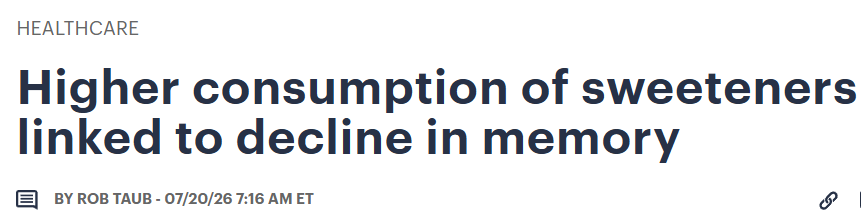

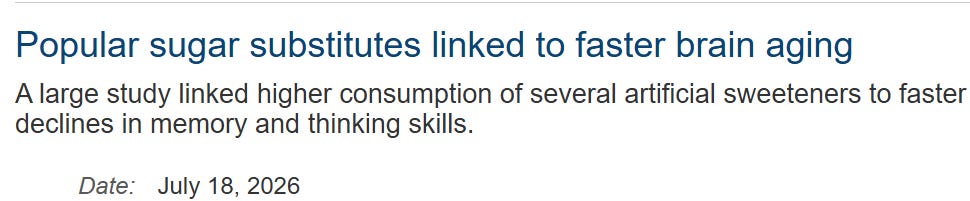
Popular outlets just can’t seem to resist the temptation to pour gasoline on the tiniest spark of evidence about something that sounds frightening about brain health these days. I am sure they have the clickthrough data to back up that decision.
Many of the recent headlines quote the big finding: “62% increased risk of cognitive decline” associated with “high sweetener intake.”
They emphasize that kind of number because they know it will give you a little twinge of minor anxiety and make you look sideways at the drink on your desk.
It’s also the kind of number that should trigger your sniff-test: 62%? That’s a massive effect that should be easy to replicate in other studies. Why are we just hearing about this now?
So, with low expectations, I pulled the actual paper and read through it, tables and figures and all.
Perhaps now is a good time for me to say that I have no ties to the beverage industry, and I am not here to defend soda. I do not drink the stuff myself. Here I sit with a big cup of coffee and an even bigger glass of water. Today, I want to show you the difference between what they found in the paper vs. what you have seen in the headlines.
And just to be fair, they certainly did find a few things in the paper. That’s what makes this tricky to interpret at a glance, and valuable to walk through the biggest and most translatable examples. It’s not as if the entire paper was fraudulent or that it came back with null findings.
Here is what we will cover today:
Where the “62 percent risk of cognitive decline” comes from, and the way that the headlines mislead you about the memory results.
How to recognize the perils of this type of study design - whatdid it not account for?
How much should worry, and what actually moves your brain health risk?
As you know, my letter runs no ads, has no sponsor, and pitches no affiliate links for you to purchase - this is an entirely reader-supported page, which means I answer only to you.
A paid subscription opens access to every deep-dive I’ve written, and everything still to come. If you’re ready to dig back, a few popular starting points are:
Eight dollars a month (via the annual plan, which works out to ~$1 per deep dive letter), and you’ll walk away knowing exactly what’s worth your effort and what’s a marketing trick.
If it’s not useful, unsubscribe any time in one click.
Comments
Nothing yet. Say the first thing.
Sign in to join the conversation.