
Part of the #NoFreeWork Campaign published on June 12, 2026
There is a joke I always tell.
An attorney and a doctor are at a party. They are standing side by side, drink in hand. Before the doctor can take a sip, the doctor has a line of people forming in front of her. They are all asking medical questions. "So what do you think about these GLP's and dementia and losing sight findings? because my doctor prescribed them and I am too scared to take it." Or "can I just ask you one thing?" Types of endless questions. The doctor never gets a sip of her drink. Finally, the line "ends". She turns to the attorney. The attorney is relaxed, first drink complete with a fresh new one in hand. Nobody asked them a single question all night.
The doctor looks at the attorney and says, "What is your secret?"
The attorney says nothing, shrugs and takes a sip of the second drink.
The next day, the doctor gets a bill in the mail from the attorney.
I tell this joke a lot. People find it laughable. But I am not joking. And my colleagues and I are certainly not laughing.
THE EXTRACTION
Doctors are extracted from constantly. Not just by the healthcare system (that is its own extensive conversation). By everyone. By reporters, by old acquaintances, by strangers on the internet, by people at grocery stores, by someone's wife who messages you on a Holiday weekend because she "just wanted to pick your brain" about a medication she got from some company and she is scared to take it and knows you’re the expert
Pick your brain. As if a medical degree is a community resource. As if the years of training, the insurmountable debt, the insomnia and sleepless nights, the boards, the endless continuing education, the liability that certainly isn’t free - all of that is just background noise, and the only thing that’s important is that you are accessible and available immediately. It took a bit for me to calm down and breathe and respond, and I texted back you are free to schedule an appointment to discuss this, and attached my work email address and phone number. Do you think she made an appointment to show she valued my expertise or my time? (No.)
Several times I have had someone I had not spoken to in nearly 30 years reach out to me for medical advice. One person had cancer. I am not an oncologist. I do not know their history nor could I even begin to guess it. We have not had a conversation since high school. But somehow, the fact that I am a doctor meant I was fair game to extract information from.
This happens to doctors regularly. Fudge that. ALL. THE. TIME.
Someone slips into your DMs or social media. Someone corners you at a bbq party. Someone catches you at the store and suddenly you are stuck doing a consult between the produce and the checkout line. And more often than not, we do it. Because you are a doctor and you actually care (shocking, I know) and you were trained to help and saying "no" feels wrong even when saying "yes" costs you something valuable and real.
THE DISTRACTION
Here is what I feel is one of the most important things to discuss. Every single moment t spent on unpaid extraction is a moment taken from something else. From patients who are actually paying for your time to enhancing your SEO by updating your website. From teaching. From filming your own series. From writing your own book. From rest. From sleep. From creativity. From walking your dogs. From cooking for yourself or your family. From seeing your own doctor. From your own health. From your own sanity.
It is not just extraction. It is distraction. It pulls you completely away from the things that nourish you, the things that keep you functional, the things that keep you from burning out entirely or sometimes even at all.
I was recently asked by a major publication to answer a set of medical questions for an article. I was flattered. I said yes as I usually do. It took 5 hours. Then they asked for more. Then more. Three separate sets of questions, each taking three to five hours of my time each time. That is nine to fifteen hours of unpaid labor. And in return-I received no monetary compensation. No SEO benefit. No backlink to my practice website. Not even a photo. Just my name in an article that maybe people will read but more likely not.
I have done this at least eight times now for 1-2 publications alone and hundreds of times in totality. Different outlets. Same arrangement. A byline. Maybe a name. Occasionally a link to my business (I truly appreciate those). No mention of credentials beyond a title. No compensation. And no request to serve on the publication’s own medical advisory board with paid compensation.
I’m going to do the math now, because the math no longer maths…
At my current consultation rate of $500 per hour, spending 9 to 15 hours on a single response means giving away $4,500 to $7,500 worth of expertise. Each time. For free. For a byline (maybe). Sometimes even misquoted completely.
And I kept saying yes and excusing this by telling myself-it is a major publication. I have been in these publications before. Because saying no feels like closing a door that might never reopen. Because what if they do not ask me again? Because of fear.
But at what point do I ask - what am I actually getting back from this? And at what point do I ask the harder questions - why do I feel guilty for even asking that? And do people even read anymore?
THE EMOTIONAL BAIT
Here is what these publications are really tapping into. A physician’s pride. Humility. The feeling of “wow, my words matter." The feeling of "I have never been valued like this and maybe never again will" or in my case “is it possible that this could eventually lead to some compensation?” How many times do I have to prove that I’m a medical expert to prove I have value?
And right there is the trap. Because no real compensation meets that emotional validation. They are offering you the feeling of being seen, and you are paying for it with your time, your energy, and your expertise-not the reverse. The only tangible value is being able to say "I am a published author and medical expert" on LinkedIn or your resume.
That does not feed you. That does not literally pay for groceries.
THE DOUBLE STANDARD
An attorney would never do this. A financial advisor would never do this. An architect would never do this. No other profession gives away its core product, its expertise, time or intellectual labor, for free-on demand, on someone else's timeline, and then feels bad about it!
But doctors do.
We care for everyone. We caretake everyone. We answer questions at parties, in DMs, on holidays, between patients, after hours, on weekends. We do it because we care. And the system knows we care, and it uses that against us.
Maybe doctors should bill like attorneys. Maybe every conversation should start with a no-free-work statement. Maybe the answer to "can I just pick your brain for a second" should be "my consultation rate is $500 an hour. Would you like to schedule?"
Because here is what my brain is actually worth. I offer a visit called "Why Do I Feel This Way?" It is a 90-minute consultation. It costs $950. It is built on years of medical training, additional certifications, additional specialized education, and my personal invaluable lived experience. It is for people who do not need a monthly subscription but who need my brain for an hour and a half. People who value what I know and are willing to pay for it.
And yet a publication with millions of readers and a revenue model built on content expects that same brain for free.
There is a nationwide growing slogan many physicians believe in - no free work. So why are we doing free work all the time?
THE SYSTEM
I think doctors are collectively underpricing themselves. I think we are undervaluing ourselves. I think we have been trained to believe that our worth is in our service, and that asking to be compensated for that service is somehow unprofessional, unseemly, ungrateful or narcissistic.
But medicine does not run on the spirit of service. It runs on people.
And people break.
We are literally standing in the middle of a physician shortage. The United States is projected to be short between 36,500 and 187,000 physicians in the coming years. Attrition rates have been climbing since 2013. Two out of every five physicians now say they intend to reduce their clinical hours. Many physicians have “side gigs” simply to meet ends meet or to actually “feel heard”. One in five plans to scale down or leave medicine entirely. I wish I could say I was not included in this statistic but I can’t. I am exhausted. Doctors are burning out, leaving practice, retiring early, choosing other careers entirely. And yet the expectation remains - be available, be generous, be free. Forever.
From my experience (and published data from studies that support this statement) the publication system is quite skewed. It favors academics and profit-driven content. Editors take money. What gets published is influenced by institutional power, not by the value of what is being said. Independent physicians with powerful or impactful things to say get silenced or overlooked.
The system was not built for us.
It was built on us.
I run a direct primary care practice. Since there is no proper database for DPC doctors (many colleagues are actively building some out) I was using media visibility to build my brand’s awareness by answering questions, contributing to articles, being helpful. It was working and that work was leading to bigger work. Then the corporate and social media landscape completely changed. The asks kept coming, but the value kept shrinking. No backlinks. No traffic. No compensation. Just continued extraction.
And here is the part that is so hard for me to ask out loud- but I do now. Constantly. Would the system treat a white man this way? Would the asks come with the same empty hands? Would the doors open wider, or would they open at all? That is a whole different conversation too, and it too is coming. But the question belongs here, because it is part of the extraction. And it’s become part of of my response.
THE WAIT
Here is something patients need to understand, and honestly, something the public needs to hear.
The average wait to see a specialist in this country is over a month. For neurology, it is 35 to 50 days. Nearly one in five patients waits more than 90 days. For primary care, patients expect to be seen in about five days. The reality is closer to a month. And those numbers are getting worse, not better.
Now imagine you are really sick. You are waiting six months to see your neurologist. You are waiting three months for your primary care doctor. You are waiting six months for your sleep study. And while you are waiting, you are texting your doctor, emailing through the portal, sending messages through the patient app - expecting answers.
Expecting FREE answers.
Most physicians are not paid for those messages. Most health systems do not compensate doctors for the time spent responding to portal questions. When one large system finally started billing for substantive medical responses through the portal, message volume dropped almost nine percent. Patients reconsidered when there was a price tag. That tells us alot. It tells you that people were treating physician time as free until someone said it was not.
And when patients are asked to come into the office - to actually be seen, to have their labs reviewed in person, to have a conversation face to face - most of them complain. They do not understand why the doctor cannot just answer over text. Maybe the doctor needs to explain a cancer diagnosis. Maybe the doctor wants to walk through something that sounds simple but is not. Maybe the doctor just wants to be freaking paid for their time. Because they actually deserve to be.
So here is the question for the public. What is it actually worth to you to jump to the front of the line? What is it worth to be seen tomorrow instead of in six months? What is it worth to have a doctor who has time on the weekend to catch up on the latest research so they can treat you preventively - so you do not end up with a hospital bill that makes an attorney's bill look small?
You would pay an attorney without question. You would pay a your hairdresser. You would pay a contractor. So why not your physician? The person who is going to save your life. The person who is going to make you mentally healthy. The person who is trying to keep you out of the hospital in the first place.
Maybe the answer is DPC. Direct primary care. A model where the doctor actually works for you. Where your monthly membership means access, time, and a physician who knows your name and your history and is not drowning in a system that was designed to extract from both of you. Your life is being saved six months in advance because you are willing to pay the doctor directly and not rely on an insurance system that does not work for you.
THE LAST LINE
If you really valued what I had to say, you would pay me. Or at the very least, you would not act surprised when I say I cannot answer your questions on a holiday weekend while I am running on no sleep and dealing with my own life. Because yes, doctors have lives too. And sometimes those lives are falling apart just like everyone else's.
I have not opted into AI in my EMR. I refuse to for as long as I possibly can. I am not handing over my clinical thinking so a system can learn from me for free and then replace me. I am not doing it. Doctors are already leaving the system. We are already building our own. DPC. Concierge. Cash pay. Consultation models. This is not philosophy. This is survival.
The extraction is real. And it is distracting us from everything that matters.
So here is my no-free-work statement.
My time has a price. My expertise has a price. My years of training, my sleepless nights, my boards, my certifications, my lived experience, my clinical judgment - all of it has a price. And if you are not willing to pay it, that is fine. But do not ask me to pretend it is free. Do not ask me to smile while you try to take it. And do not confuse my generosity with an invitation to keep taking.
The next time someone asks to pick my brain, I am going to remember the attorney at the party.
And the bill will be the response email.
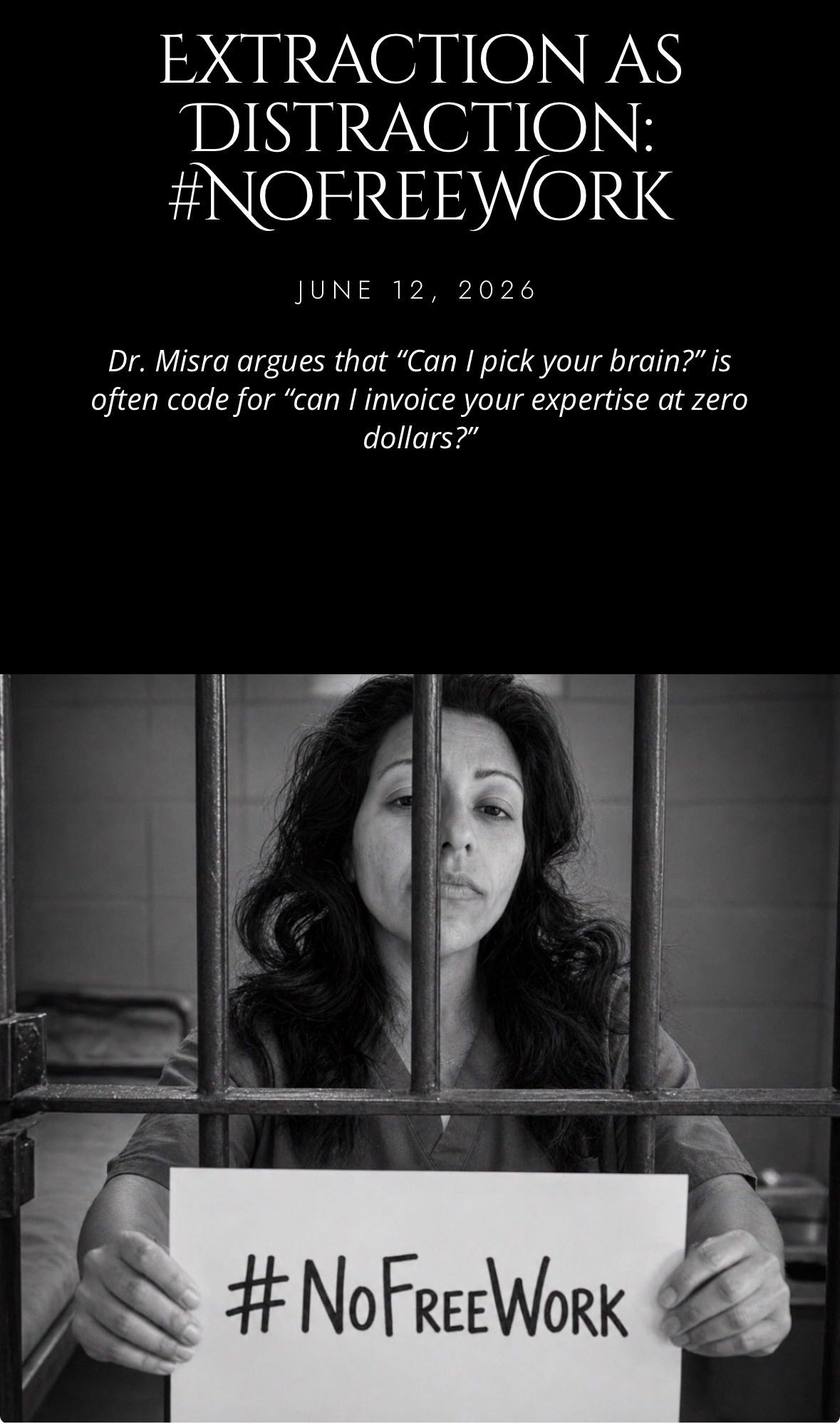
*Photo done with AI
No posts
Comments
Nothing yet. Say the first thing.
Sign in to join the conversation.