
-by Sulagna Misra MD, BCMAS, MSCP
I recently wrote a private and vulnerable piece about a doctor the system can't use called “Dr. Moksha.” I only shared it in a few spaces because I wasn’t ready for my vulnerability “hangover”.
This week, I met a patient the system refuses to hold and well, my vulnerability is ready to build some immunity.
Let me explain.
I do my 15-minute meet and greets virtually. I do this because I have difficulty with maintaining boundaries as a physician and I am ok saying that out loud (now).
I can practice medicine almost anywhere - on a screen, in a room, over a phone call if needed - but my meet and greets are virtual for me to maintain boundaries. I know that if I do them in person, I will end up doing a full consult. I will sit with someone for an hour and a half and order labs and draw diagrams and forget that this was supposed to be a conversation about fit. I will forget that I haven't been hired yet. I will forget that I am not yet the person’s doctor.
Physicians are not taught boundaries. We are taught the opposite. We are taught that the patient in front of you is your responsibility, full stop, regardless of whether you've signed a contract or been paid or slept. Boundaries are for other professions. For us, there is only the patient. And so I do meet and greets on a screen, because the screen is the boundary I cannot set myself.
She appeared on my screen from somewhere in one of the states I practice medicine. She had moved from another state - she didn't say which, and I didn't ask, but I have my suspicions, and they are not generous toward that state. She was Black. She was sharp. She was a force to be reckoned with. And she came from a family of physicians. She had medical knowledge, maybe some professional training - but we never got that far. Either way, she knew things. Most importantly, she knew enough to save her own life.
A few years ago, she was giving birth. She developed preeclampsia. She knew something else was wrong. She asked them to do a workup. They refused. They wanted to discharge her.
She made them draw her liver enzymes.
I am not an OB-GYN. I am a direct primary care physician who sees patients on a screen and in my small office. But I remember HELLP syndrome. Every medical student remembers HELLP syndrome. Hemolysis, Elevated Liver enzymes, Low Platelets. It is one of the things they teach you because if you miss it, people die. Women die. It complicates up to 20% of severe preeclampsia cases and carries a maternal mortality rate of 1-3%. And the women who die most often are Black women. Black women are more than four times more likely to die from pregnancy-related complications than white women. Eclampsia and preeclampsia are leading causes of that disparity, with mortality rates five times higher than for white women with the same conditions.
More than 30% of Black women report experiencing disrespect and mistreatment during pregnancy, labor, and delivery. Up to 40% endure racism during their care. Being ignored. Having requests for help refused. Being dismissed. This is not something I’m making up. This is the data.
She was not a statistic. She was a woman in labor who was told no when she asked for a blood test. And she was right. The enzymes were dangerously high. So high that she actually needed to see a hepatologist, not a gastroenterologist. They sent her home anyway.
Let me say that again. Her liver enzymes were critically elevated in the setting of preeclampsia, and they sent her home.
She was referred to a hepatologist. She started the workup. Then her spouse got a job elsewhere, she subsequently moved, and the workup moved with her-fractured, scattered, piecemeal. She landed in an HMO. Not by choice but by default. By the chaos of relocation and open enrollment and a family trying to survive a transition while she was still trying to survive a diagnosis.
And she had to start the work-up again.
She told me she hated it. Not the doctors - the fragmentation. No one was keeping track. No one was holding the whole picture. No one was looking at the work that was already done, so she’s still stuck with those bills. She now had a hematologist here and a hepatologist there and a PCP she'd never met who existed mainly as a name on a referral form. She simply wanted someone who would sit with her and look at everything and say: here is what we know, here is what we don't, here is what we do next.
That is what I do. That is literally what I do. That is the entire premise of direct primary care. One doctor, one patient, no insurance company in between, no fifteen-minute visit, no referral authorization, no prior auth, no denial. No judgment. Just care.
And I had to tell her I couldn't do it.
Not because I wasn't capable.
Not because she wasn't willing.
Not because the medicine was too complex (sometimes I love being a “body detective”). Because she has an HMO, and DPC does not pair with HMOs, and the system that is supposed to connect patients to doctors is the same system that prevents patients from choosing their doctor.
I sat on my screen and watched her face while I did the math with her. I told her about open enrollment in November. I told her about faith and non-faith based health sharing. I told her about cash pay resources and the MEC penalty, and how to file for an exemption, and that I believe the whole state should file for an exemption, given everything we've collectively been through. I even told her that’s what state legislation told me to do when I met with them trying to fight these issues. I told her about cash pay resources like Radiology Assist and Colonoscopy Assist and Laboratory Assist - websites that exist because the pricing of American medicine is so broken that someone had to build a workaround. I told her that liver enzymes cost about twenty dollars (the phlebotomist needs to get paid). I told her that the system charging her thousands for labs that cost hundreds is not medicine. It is extraction.
And I tried to give her the tools to fight the system back.
I also told her about direct specialty care - the movement to bring specialists outside the insurance system the way DPC brought primary care outside it. I pulled up the website to show her. It was under construction. The infrastructure for the thing she needs is literally being built right now, in real time, and it is not ready, and she needs it now.
I gave her the DPC mapper. I told her maybe someone else in the network could take her on, maybe someone who is still transitioning and might work with her insurance.
I don't know. I was reaching.
I told her everything I could. I gave her every resource I had. I told her I'm not going anywhere.
And then the meet and greet was over, and she was not my patient, and I closed my laptop, and I sat there, still thinking.
Here is what I know in my body and cannot “prove”:
A Black woman in labor asked for a workup and was told no. She insisted. She was right. Her liver enzymes were dangerously high. She was sent home. She survived because she fought. Not because the system caught her…in spite of it.
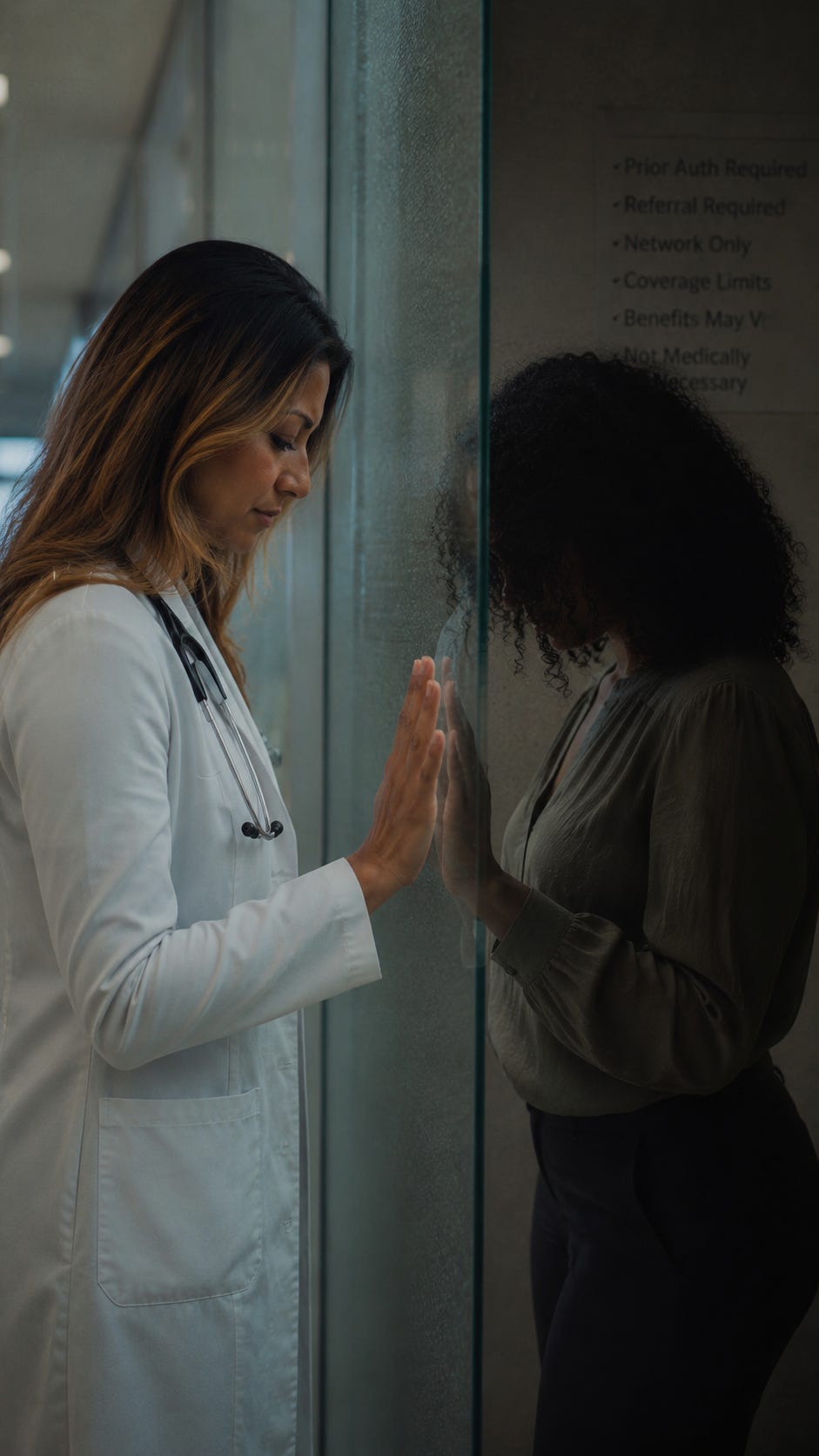
She moved to a state with more rights. She found a doctor willing to coordinate her care and “see” her. The doctor was right there, on the screen, ready. And the insurance product she chose in a moment of transition, an HMO selected in haste, stood between us like an insurmountable wall.
The system that would not draw her blood then will not pay for her blood now.
This is not a system that can't hold her. This is a system that takes her money and doesn't hold her. It collects her premiums and bills her while fragmenting her across specialists who don't talk to each other. It covers the specialist visit but not the labs to get to the specialist. Make that make sense. It uses her. It just doesn't care for her.
I am also a woman of color. I have a face that is general: people can't always tell my ethnicity. I look Middle Eastern, Indian, Mexican, Hispanic, Latina, mixed race, everything. I am brown. And I don't process race the way some people do (even my own), maybe because I'm neuroatypical, maybe because hostility registers louder to me than skin color. But I see race in the data. I see it in the fact that Black women are four times more likely to die in pregnancy. I see it in the fact that this woman had to beg for a blood draw while she was in labor. I see it in the fact that she moved across the country and still can't get coordinated care. And I’ve seen it firsthand in my own lived patient experience as my pain and symptoms were dismissed and I was simply told that I was fat and needed to lose weight, making the issue, the treatment, and the system my fault and my problem to solve. (So I did with the system. And I continue to try. It’s truly exhausting, grueling, thankless work and part of why my social media presence and writing may appear “scattered”.)
I do not need to process someone's race to know they deserve care. She's a woman. She needs care. That's it. Every single human being needs and deserves medical care. But the system looks. The system has always looked. And what it sees determines what it gives.
I have a series I've been sort of writing called “Coverage Collapse”. It is about the slow-motion failure of the American insurance/healthcare system. It’s not just about the dramatic failures that make the news, but also the quiet ones. The ones that happen in meet and greets and waiting rooms and open enrollment windows. The ones where no one dies in actuality, but something dies anyway:
A relationship that should have started.
A diagnosis that should have been followed.
A woman who should have had a doctor and didn't, not because there wasn't one, but because the system told both of us “No”.
I wrote about “Dr. Moksha”, a physician the system could not use. A physician who did everything right and was still locked out. A physician who left the system to practice real medicine and was punished with invisibility and silencing.
Now I have met the inverse of Dr. Moksha… a patient who did everything right, who advocated for herself when no one else would. Who moved to a “safer” state. Who found the doctor she wanted. Who was ready for healing.
The system said no to both of us.
I call myself a body detective sometimes, because I practice internal and integrative medicine and I truly want to dig in. Some call it “over-doctoring,” and that may be true. I want to sit with her and trace the liver enzymes back to the pregnancy and figure out whether this is resolved or ongoing and whether she needs a hepatologist at all or whether she just needs someone who will look at the whole picture and say: you're okay, or you're not okay, and here's what we do or how we prepare. My instinct is that she may ultimately just need clearance and longitudinal follow-up. And that’s when I hope she can come back. And I will be waiting with open arms, because I want to give her the medicine she deserves.
The medicine she deserves. I say that all the time. I've written about it before. She's paying into the system. She's just not receiving what she's paying for.
In my prior article, Dr. Moksha got up and went to see her one patient. Not because the system deserved her. Because the patient did.
Yesterday, the patient got up and went back to her HMO. Not because the system deserved her. Because her survival did. Because her liver enzymes are still being watched by people who if she’s lucky remember her as a number. Because she has no choice.
I do meet and greets because I want to make sure I can meet the patient's needs. I almost never say no. I didn't say no yesterday. The system said no for me. And that is a kind of systemic corruption and violence I was not trained to name, but I am learning to write and speak about, because if I don't, I will carry it in my body the way she carries her medical trauma and uncertain diagnosis in hers… unresolved, uncoordinated, alone and in pain.
Many DPC doctors are trauma-informed doctors. I say this because we left the abusive system knowing that both we need to be treated better and our patients deserve better care. We are a nationwide growing movement. But we're just not there yet. We're not there yet to take care of someone like her. The Direct Specialty Care movement needs to pick up, not only because primary care can't do everything (though we want to), but because patients deserve specialty care, and specialists also deserve to be paid, and we need to access them outside of the system. The website is under construction. So is the future. The patient and I both need it now.
November is open enrollment.
I told her I'll be here.
I'm not going anywhere.
No posts
Comments
Nothing yet. Say the first thing.
Sign in to join the conversation.