
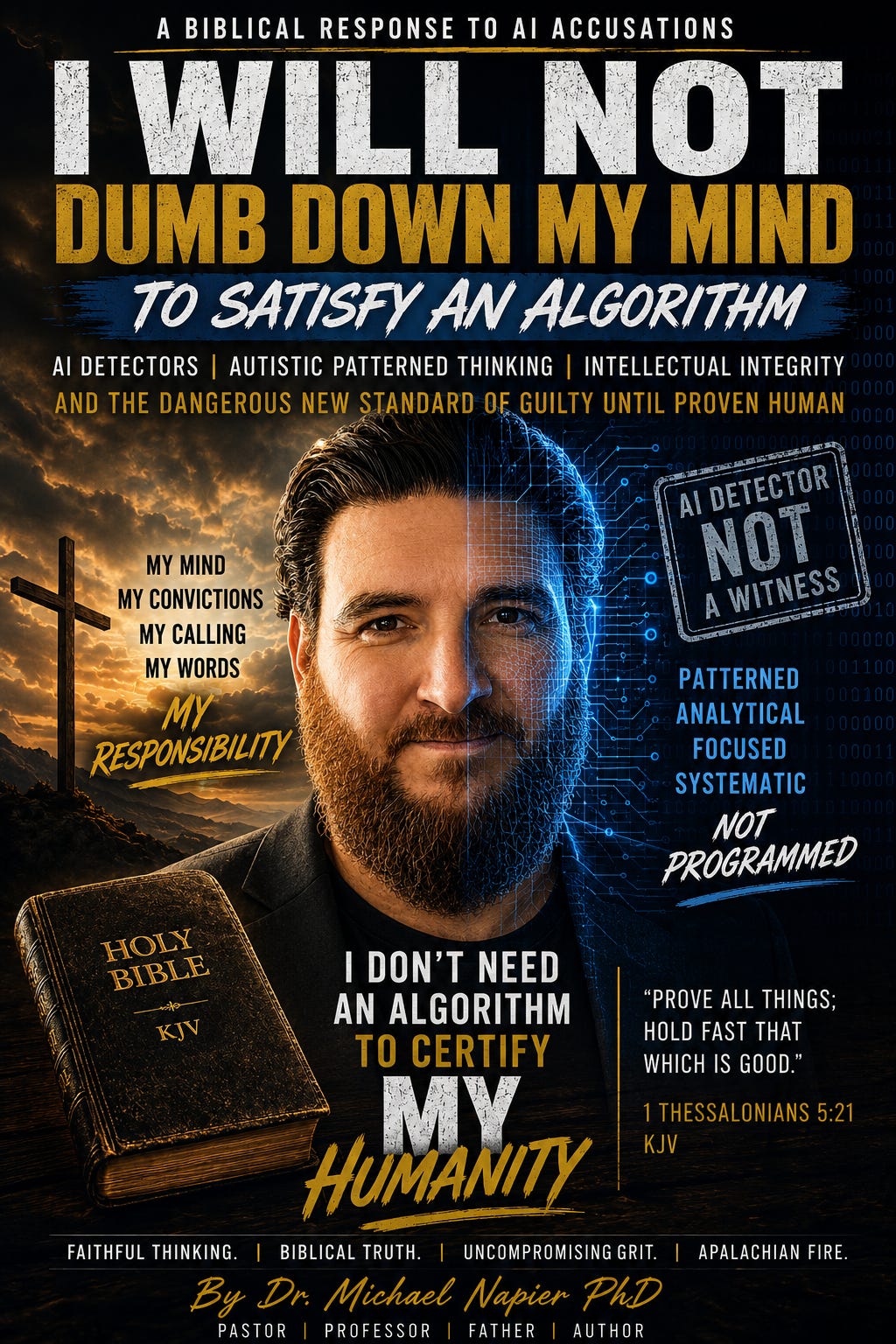
There is a strange irony unfolding in our technological age.
For years, educators told students to improve their grammar. We told them to organize their thoughts. We taught them to construct coherent arguments, develop transitions, eliminate unnecessary repetition, choose precise vocabulary, and write with clarity.
We told them to become better writers.
Now artificial intelligence has arrived, and suddenly some of the very characteristics we spent generations teaching people to develop are being treated as evidence that a human being did not write something.
Write poorly, and nobody questions whether you are human.
Write with precision, structure, consistency, and sophistication, and somebody runs your words through an algorithm and announces:
“AI.”
I refuse to accept that standard.
And I certainly refuse to deliberately make my writing worse simply so another computer will believe that a human wrote it.
That is not intellectual integrity.
That is intellectual absurdity.
Let us begin with something that should be painfully obvious.
An AI detector did not sit beside me while I studied.
It did not watch me read theology, psychology, history, philosophy, counseling theory, or Scripture.
It did not sit in the classroom while I taught.
It did not hear the sermons I preached.
It did not participate in the countless conversations through which my convictions were formed.
It does not know my vocabulary.
It does not know my rhetorical habits.
It does not know how I organize an argument.
It does not know the cadence of my preaching.
It does not know the peculiarities of My Autistic Patterned Thinking Mind.
It does not know me at all.
It analyzes text and produces a statistical judgment.
That may be useful information in certain circumstances. But a probability generated by software is not the same thing as proof of authorship.
That distinction matters enormously.
If someone wants to challenge my theology, then open the Bible.
If someone wants to challenge my reasoning, then identify the logical error.
If someone wants to challenge my historical claim, then bring the historical evidence.
If someone wants to challenge my scholarship, then examine my sources.
If someone wants to challenge my argument, then answer my argument.
But feeding my words into another machine and allowing that machine to pronounce judgment upon who wrote them is not serious intellectual engagement.
You have not refuted me.
You have not even addressed me.
You have merely asked an algorithm what it thinks about my sentence structure.
Those are not the same thing.
There is another dimension to this conversation that is deeply personal to me.
I am autistic.
I am not mentioning that as an excuse, nor am I claiming that every autistic person thinks or writes the way I do. Autism does not produce one universal cognitive or writing style, and I have no interest in turning my personal experience into a stereotype about other autistic people.
I am talking about my own mind.
My thinking has always been highly structured, analytical, categorical, repetitive, interconnected, and pattern-oriented.
I naturally organize information.
I categorize ideas.
I build frameworks.
I notice patterns.
I connect concepts.
I return to central propositions.
I construct arguments systematically.
When I am deeply engaged with a subject, I can become intensely focused on it. I do not merely want the surface answer. I want to take the thing apart, examine the pieces, understand how they fit together, and then reconstruct the whole.
That is simply how I think.
And that cognitive pattern inevitably appears in how I write.
My writing can therefore be unusually structured.
It can be formal.
It can be rhythmic.
It can be repetitive for rhetorical emphasis.
It can contain parallel constructions.
It can move proposition by proposition toward a conclusion.
It can sound more polished than ordinary conversational speech.
None of that proves artificial authorship.
It proves that this is how Michael Napier writes.
My mind is not literally a computer, and I am not going to make a neurological claim that science does not justify. But I can certainly say that my own thinking is intensely systematic and pattern-driven.
That distinction matters.
I know my own cognitive experience.
And I will not apologize for it.
This is where the accusation becomes particularly frustrating.
My theological framework did not suddenly appear when ChatGPT appeared.
My convictions did not come out of a prompt box.
My preaching voice was not downloaded from a language model.
My theological positions were forged through years of reading, studying, teaching, preaching, counseling, arguing, questioning, praying, living, suffering, and wrestling with Scripture.
Artificial intelligence did not give me my convictions.
It did not give me my worldview.
It did not give me my theology.
It did not give me my Appalachian background.
It did not give me the fire with which I preach.
It did not give me the experiences that shaped the man behind the words.
And it certainly did not give me the Bible.
When I write about fatherhood, biblical masculinity, patriarchy, spiritual warfare, pastoral theology, counseling, education, or discipleship, I am writing from a developed worldview.
Someone may disagree with that worldview.
Fine.
Then challenge it.
Iron sharpens iron.
“Iron sharpeneth iron; so a man sharpeneth the countenance of his friend.”
Proverbs 27:17, KJV
But iron does not sharpen iron by holding up a screenshot from a detection website.
That is not sharpening.
That is avoiding the blade.
Let me make something else perfectly clear because I have no desire to play semantic games.
I use modern technological tools.
I use spellcheck.
I use grammar tools.
I use digital research tools.
I use search engines.
I use word processors.
And yes, I use artificial intelligence as a tool to create cool graphics.
I have no reason to hide that, I am not a graphic designer.
The intellectually serious question is not merely, “Did technology touch this document?”
The serious questions are:
Whose ideas are these?
Who is responsible for the claims?
Who holds these convictions?
Who can defend the argument?
Who stands behind the words?
Those questions actually address authorship and intellectual responsibility.
If AI helps a man organize an argument he already holds, that is fundamentally different from a man asking a machine to manufacture convictions he does not possess and then pretending they are the fruit of his own scholarship.
I have a serious problem with the latter.
As a professor, I care deeply about academic integrity. A student who submits machine-generated work in place of the intellectual labor required by an assignment has bypassed the very educational process I am trying to cultivate.
But that is precisely why accusations require evidence.
We cannot defend academic integrity by abandoning intellectual integrity.
We cannot respond to one technological problem by pretending another technological system is infallible.
There is a remarkably simple test available.
Ask me.
Ask me what I mean.
Challenge a premise.
Question my exegesis.
Push against my conclusion.
Ask why I chose a particular word.
Ask me to expand an argument.
Put the Bible on the table and let’s work through the passage.
If the ideas are actually mine, I should be capable of discussing them without hiding behind the article.
That is a far more meaningful test of intellectual ownership than asking software to guess who produced a paragraph.
This is especially important in theological discussion.
Scripture commands us:
“Prove all things; hold fast that which is good.”
1 Thessalonians 5:21, KJV
Notice the command.
Prove all things.
Test the substance.
Examine the claim.
Evaluate the teaching.
That is biblical discernment.
When Paul preached at Berea, the Bereans were commended because:
“they received the word with all readiness of mind, and searched the scriptures daily, whether those things were so.”
Acts 17:11, KJV
They examined the truthfulness of the message.
That is the standard Christians ought to recover.
If I make an unbiblical argument, show me the text.
If my reasoning is weak, expose it.
If my interpretation is wrong, demonstrate it.
If I contradict myself, point it out.
I am not above correction.
But do not substitute technological suspicion for theological argument.
Something deeply unhealthy happens when we begin treating polished writing itself as suspicious.
Imagine the standard we are creating.
A student learns sophisticated vocabulary.
Suspicious.
A writer develops clean sentence structure.
Suspicious.
A scholar carefully organizes his argument.
Suspicious.
A neurodivergent writer naturally produces unusually patterned prose.
Suspicious.
A person spends years developing a distinctive formal voice.
Suspicious.
At some point we have created a system in which people are incentivized to intentionally insert mistakes, awkwardness, randomness, and sloppy construction simply to appear sufficiently human.
Think about how backward that is.
I am supposed to intentionally become a worse writer to prove that I am a real writer?
No.
I will not do it.
I will not intentionally fracture sentences that I would naturally construct correctly.
I will not deliberately misspell words.
I will not abandon organization.
I will not reduce my vocabulary.
I will not inject artificial imperfection into my prose so an algorithm gives me permission to call my thoughts my own.
I will not dumb down my mind to satisfy a machine.
Scripture repeatedly warns against careless judgment.
Jesus said:
“Judge not according to the appearance, but judge righteous judgment.”
John 7:24, KJV
That principle reaches far beyond this particular controversy.
Righteous judgment requires evidence.
Righteous judgment requires fairness.
Righteous judgment requires listening before condemning.
Proverbs warns:
“He that answereth a matter before he heareth it, it is folly and shame unto him.”
Proverbs 18:13, KJV
There is a difference between asking someone, “Did you use AI in preparing this?” and publicly announcing that his work is “AI slop” because a detector produced a score.
One is a question.
The other is a verdict.
And verdicts require evidence.
Christians, of all people, ought to understand the danger of accusation without adequate evidence.
We are supposed to be people of truth.
Luke Blackwell , I am addressing your criticism because you raised the issue publicly, but I do not want this article reduced to a personal fight between two men.
The issue is much larger than either of us.
We are entering an age in which distinguishing human-generated writing from machine-assisted or machine-generated writing is increasingly complicated.
That creates genuine ethical problems.
Educators need to address them.
Churches need to address them.
Writers need to address them.
Universities need to address them.
Parents need to teach their children about them.
We need standards for honesty, attribution, original thought, academic work, and responsible technological assistance.
I am absolutely willing to have those conversations.
What I am unwilling to accept is the proposition that an algorithm gets the final word on whether my mind belongs to me.
It does not.
Technology is a tool.
That is all it should ever become.
The moment we surrender human judgment to technological judgment, we have crossed a dangerous line.
Artificial intelligence can help organize information.
It can help analyze language.
It can assist research.
It can expose weaknesses.
It can increase productivity.
It can also be wrong.
It can be misused.
It can encourage laziness.
It can enable dishonesty.
And tools designed to detect its use can likewise be imperfect.
The Christian response should therefore be neither technological panic nor technological worship.
We test.
We discern.
We verify.
We remain responsible.
Paul wrote:
“All things are lawful unto me, but all things are not expedient… I will not be brought under the power of any.”
1 Corinthians 6:12, KJV
That principle speaks powerfully to technological life.
Use the tool.
Do not become its servant.
And certainly do not make it your judge.
So, Luke, here is my invitation.
Come after my argument.
Seriously.
Bring everything you have.
If you believe I am wrong about public education, make the biblical case.
If you believe Christian parents are violating Scripture by sending their children into public schools, establish that proposition from Scripture.
If you believe my understanding of parental discipleship is inadequate, show me where.
If you believe my theology is inconsistent, identify the inconsistency.
I will sit at that table all day long.
We may disagree strongly.
That is fine.
Brothers have disagreed before.
But let us have a disagreement worthy of Christian men.
Bible open.
Arguments presented.
Claims examined.
Truth pursued.
Christ honored.
Do not tell me that a machine said another machine wrote my argument and therefore the argument can be dismissed.
You are capable of better than that.
So am I.
I am a Christian before I am an academic.
I am a husband.
I am a father.
I am a pastor.
I am an educator.
I am a writer.
I am a man whose mind happens to process the world in a highly structured and intensely patterned way.
That has advantages.
It has frustrations.
It has shaped how I study.
It has shaped how I teach.
It has shaped how I preach.
And yes, it has shaped how I write.
Sometimes my sentences are long.
Sometimes my arguments are unusually structured.
Sometimes I hammer the same truth repeatedly because I want the reader to feel the weight of it.
Sometimes my prose marches instead of strolls.
That is me.
There is Appalachian dirt under these intellectual fingernails.
There is a Bible on this desk.
There are years behind these convictions.
And there is a real man responsible for the argument.
I do not need an algorithm to certify my humanity.
I need enough integrity to stand behind what bears my name.
And I do.
Every claim I publish under my name becomes something I am responsible to defend, correct, clarify, or retract if it is demonstrated to be wrong.
That is authorship.
That is accountability.
That is scholarship.
And that is the standard I am willing to live under.
AI is here.
It is not going away.
The answer is not fear.
The answer is not pretending the technology does not exist.
The answer is certainly not allowing another piece of technology to become an unquestionable oracle determining who is human and who is not.
The answer is discernment, transparency, accountability, scholarship, and truth.
So if my writing triggers an AI detector, so be it.
I am not going to intentionally become less articulate to appease an algorithm.
I am not going to dismantle the structure of my thinking.
I am not going to apologize because my mind naturally organizes information in patterns.
And I am not going to allow a probability score to replace an actual argument.
Challenge my theology.
Challenge my scholarship.
Challenge my interpretation.
Challenge my logic.
Challenge my conclusions.
But bring an argument.
Because when two Christian men disagree, the final authority is not an AI detector.
It is certainly not a screenshot.
For matters of faith and doctrine, we return to the Word of God.
For questions of evidence, we deal honestly with evidence.
And for questions of intellectual integrity, we tell the truth about what we have done and take responsibility for what bears our name.
“Prove all things; hold fast that which is good.”
1 Thessalonians 5:21, KJV
That is a standard strong enough for me.
And unlike an algorithm, it demands something from all of us.
Hey The Layman Apologist set up the debate lol.
Stand Fast. Speak Truth. Shepherd Boldly.
Dr. Mike Napier
Humble Servant of Jesus Christ | Husband | Father | Pastor | Psychologist | Professor | Author | Proud Appalachian Native American |
Thanks for reading Biblical Fatherhood Initiative | Dr. Michael Napier! This post is public so feel free to share it.
No posts
Comments
Nothing yet. Say the first thing.
Sign in to join the conversation.