
“Hope is in the HAB” – Mark Randell, retired police officer, Nature Watch Foundation and driver of the campaign “Protect Animals, Protect People”.
Yes, I agree. And everywhere I go I am seeing hope in the form of people supporting the Human Animal Bond. It’s actually mind and heart blowing.
During my recent visit to the UK, I was able to deep dive into contextualised care, community outreach, activism, history, connection, sheltering, and veterinary social work emergence.
My meeting with Ruth Serlin set the tone perfectly. I caught the train to where the lovely Ruth met me at the station and we headed to a traditional country estate for a long lunch. Ruth is also a vet and we are of the same vintage, so plenty of synergy from the moment we started talking. Ruth has spent years teaching communication skills at the Royal Veterinary College and doing her Masters in Applied Linguistics (yes, a vet linguist!). We had a rich conversation around the power of language and how we need to get better at contemplating the words that come out of our mouths! Ruth was also one of the people who has helped to shape the Contextualised Care movement, which grew out of Veterinary Humanities UK, an organisation founded by Drs Alison Skipper and Carol Gray during the pandemic. They wanted to develop a framework that goes beyond just financial constraints when planning care — really taking into account the full context of patient, client, vet team and the wider society, and published this article in 2021. This conversation – and the movement away from Gold Standard – has led to debate and discussion around Contextualised Care, Spectrum of Care and Standards of Care, which is a theme popping up across many conversations and one that I will come back to post Fellowship.


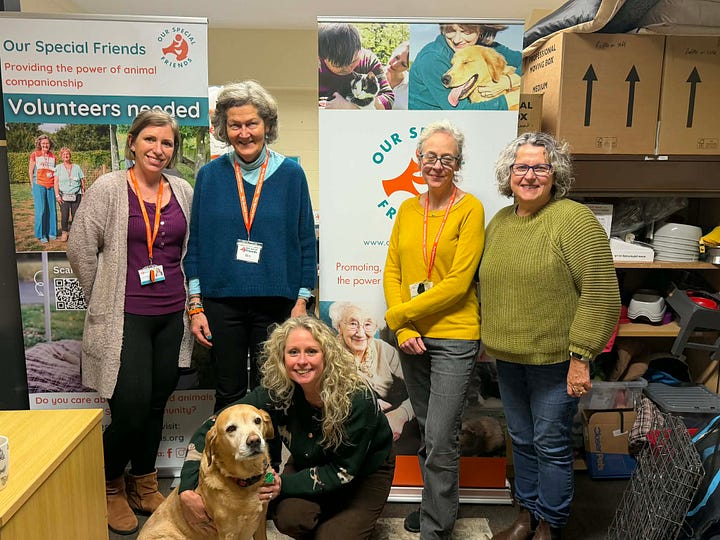
Another train ride and big day out to Bury St Edmunds to hang out with the formidable two: Rebecca Stephens, who is driving Veterinary Social Work in the UK, and Bin Johnston, Founder and CEO of Our Special Friends. Bin and I first met in 2016 at the IAHAIO conference in Paris, where we co-presented a workshop on Bond-Centred Vet Practice alongside Dr Elizabeth Ormerod (who I caught up with in Scotland). Speaking of synergy – Bin is also a vet, same vintage and also the mother of three daughters. I am loving some of the full circle moments arising! Our organisations are similar and different .. and it was extremely wonderful to take a deep dive and discuss service delivery, funding, vet bill assistance, staffing and impact measurement. We continued our conversations over a pub lunch where we happened to bump in to two of her volunteers, and a little dog who had been rehomed through OSF when his owner died. Because that’s what programs like OSF and Cherished Pets do – build community connections.
The massive hot topic in the UK right now is vet bill affordability. While I was in London it was making headline news – the controversy and public perceptions of veterinary costs, corporatisation in the industry and the current Competition and Markets Authority (CMA) Investigation into the vet industry. In fact I can rightly say that I have not had one conversation where this issue was not raised! It is what everyone is talking about. And it matters deeply to the work I am exploring — because the question of who can afford to keep their pet healthy sits right at the heart of the human-animal bond. Sustainable models for social veterinary services cannot be designed in isolation from this broader affordability crisis, and I will be returning to this theme throughout the fellowship.
Here are some “down the rabbit hole” links FYI:
A news piece that aired while I was there:
Announcement from British Veterinary Nurses Association:
Royal College of Veterinary Surgeons (RCVS) response to BBC Panorama
Through a complete twist of serendipity I crossed paths with Tamara Whiteside through Sieske Valk of Autumn Animals — but it also turns out that Tamara is the daughter of one of our special clients at Cherished Pets. What are the chances. It was so wonderful to arrange an impromptu coffee and to talk to a young (2021) graduate about life as a locum vet in London. Tamara also runs a home End of Life service as a side gig, riding her bike to calls in her district! She’s sharp, self-aware, and carries the kind of quiet weight that comes from doing this work without much of a net. She finds the 15-minute consult model challenging at times — not because she can’t do the clinical work, but because there’s no time to actually connect with people, which is what lights her up. In recent times she has had a couple of really challenging, morally loaded cases, that I sensed are still weighing on her. She mentioned a few times that the money conversations are the hardest part of being a vet in practice. She’d never heard of veterinary social work before our chat — but she got it immediately. That gap in awareness, especially among younger grads, feels like something worth paying attention to. Ensuring they have support through debriefing and formal supervision could be part of the solution.
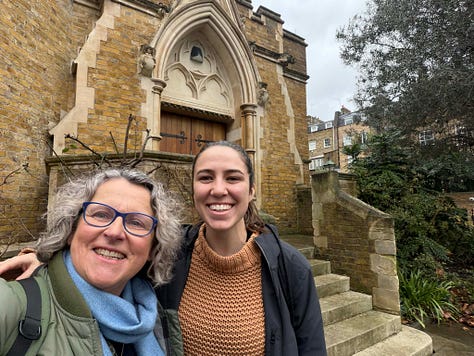
Let’s get back to Rebecca Stephens. Her trajectory as a trailblazing social worker and academic bringing Vet Social Work to life in the UK is next level and after spending time with her gorgeous self I understand better where she gets her passion and energy from. She is a true blue Aussie in many ways (so we shared lots of laughs) who has lived in the UK for decades and sees the need to incorporate a social worker’s lens of care in to the vet world. I am in awe of what she is accomplishing – and her support of others is inspiring.
With over 30 years of experience, Rebecca juggles life as a University of Sussex lecturer, Director of Education for the International Association of Veterinary Social Work (IAVSW), and a trustee for The Links Group UK and Our Special Friends. We now have a global community of professionals seeking to bridge the gap between animal welfare/veterinary services and human and social services. These connections are the beginning of the next chapter of this global movement .. and Rebecca and I will continue to support each other for sure.
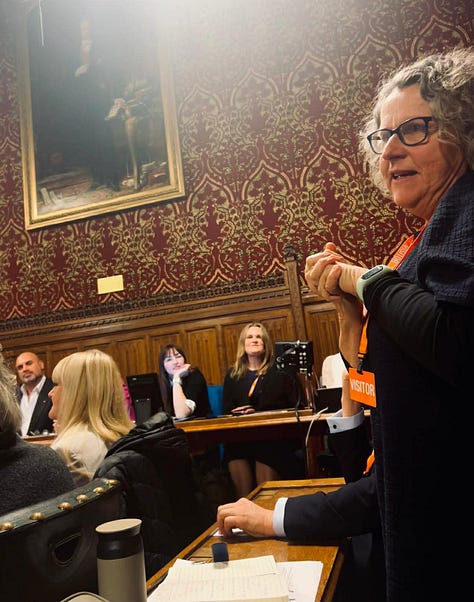
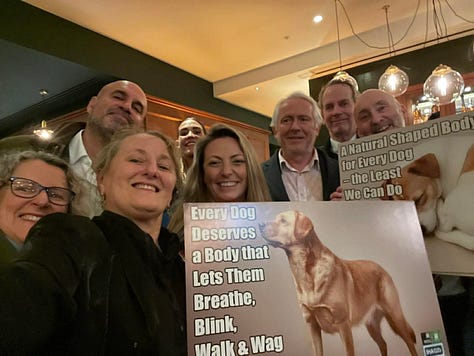
It was Rebecca who managed to arrange an invitation for me to attend the All-Party Parliamentary Dog Animal Welfare Group’s January meeting at Westminster. It was a pinch me moment to be invited to speak for 5 minutes at the beginning of their Q&A, where I reflected on the role of the Human-Animal Bond and social issues on the problem of the day, which was the Extreme Conformation Crisis in Dogs. A real pinch me moment.
In preparing for this event I did some research around Brachycephalics, Breeding and Humans .. and was grateful to be supported with some opinions and content from Dr Arthur House, who is a specialist surgeon based in Melbourne with a huge interest in brachycephalics. I also worked with Arthur when he was a young vet fresh out of Murdoch Uni, and I went to Uni with his big brother. I am loving the serendipity in my life. It’s everywhere at the moment. This experience at APDAWG and considering the role of the HAB in the whole brachycephalic universe is a topic for a future piece – so I will park that one right here other than to say it’s a huge issue, people are talking about it across the siloes of breeding and welfare, and change is coming, I hope.
There were some fabulous people at the APDAWG event. I had great conversations, made new connections and my Linkedin feed has exploded with content from the UK. Which I love.
It was also supremely wonderful to cross paths again with Rebeca Garcia Pinillos, Founder of One Welfare who is such a treasure for her untiring work with the One Welfare movement.
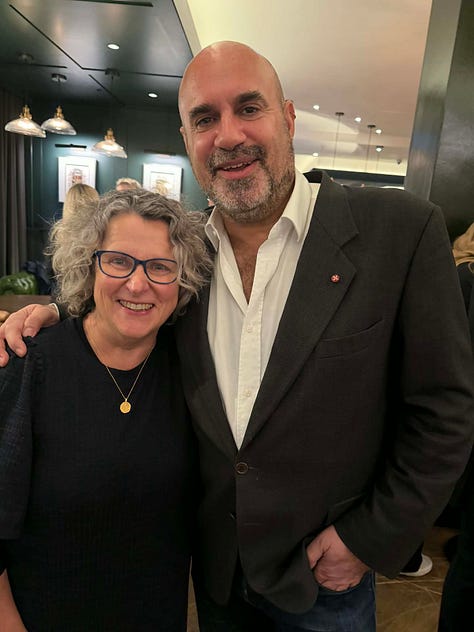
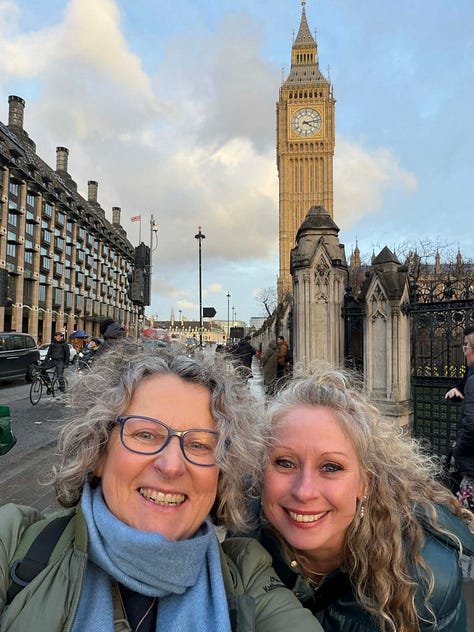
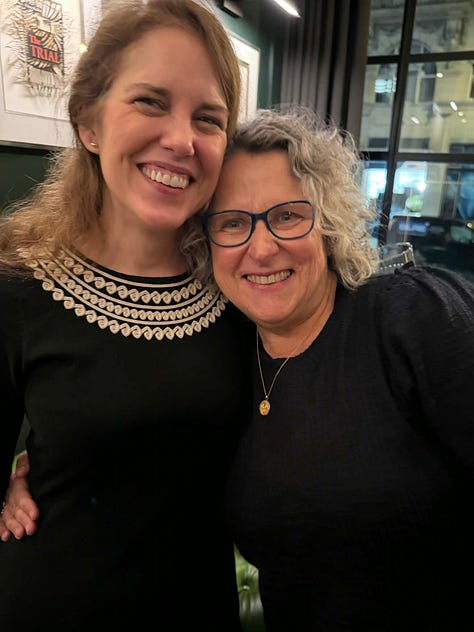
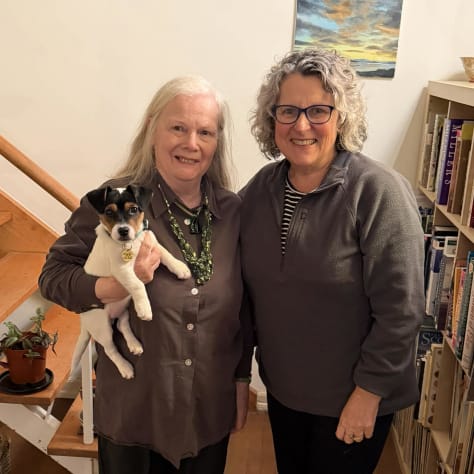
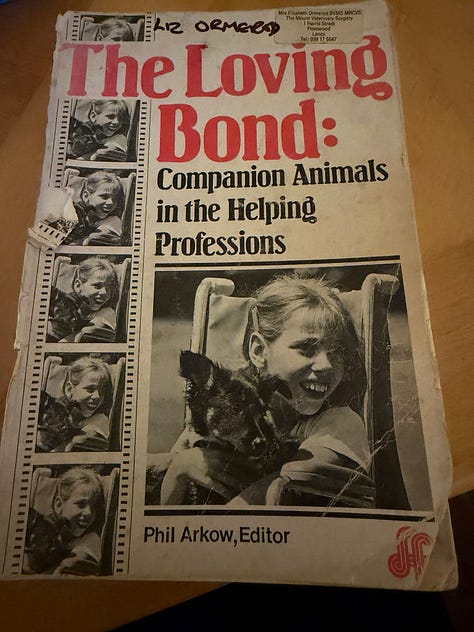
Dr Elizabeth Ormerod is a pioneer in the HAB space and a true legend indeed. I felt deeply honoured to spend the day with her in her cosy home in Scotland’s countryside.
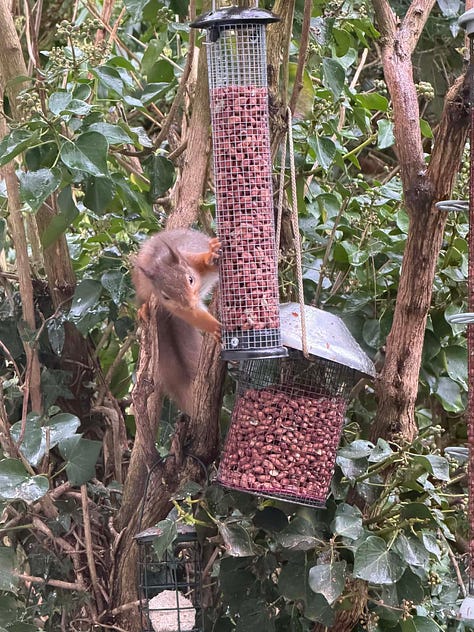
Hanging out with her two dogs and seeing a Red Squirrel for the first time made it extra special.
We chatted for hours about her Churchill Fellowship in 1988, her experience running a bond-centred practice in the UK and leading global conversations around why the HAB matters in society. Liz is on the Board of Our Special Friends and Society of Companion Animal Studies, and we also met in 2016 through IAHAIO.
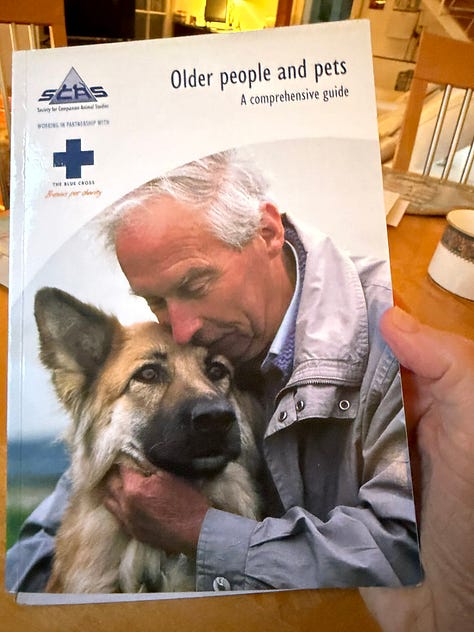
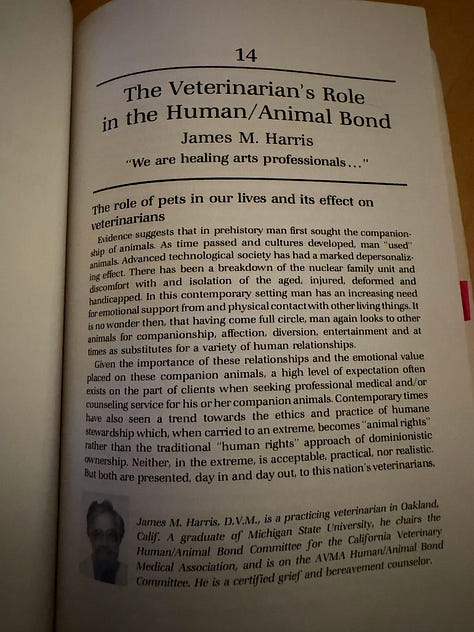
We spent time going back in time, looking through her impressive collection of books and proceedings from across the decades.
Some of our takeaway quotes:
“Vets are at the heart of a community”
“If every practice had access to a social worker our profession would be completely different”
“We need to see education about the HAB across all care sectors — health, social, law, education, vet, housing and so on”
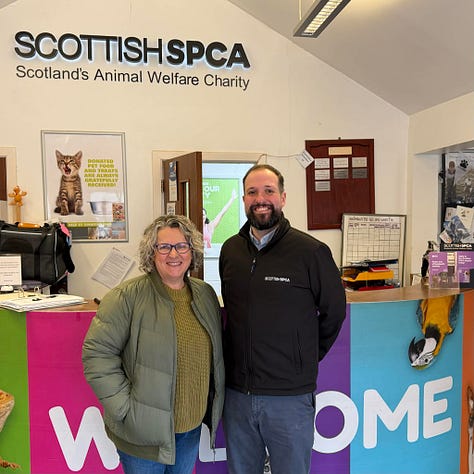
My final official visit in the UK was in Edinburgh where I ventured out to the SSPCA site about 30 minutes out of the city and met with Dr Tom Underwood, Chief Veterinarian, and Heather, one of the regional inspectors. The SSPCA is Scotland’s equivalent of the RSPCA — an entirely independent charity, receiving no government funding, and yet the first call when there’s a wildlife emergency, a farm welfare concern, or a companion animal in crisis. Tom has spent his entire career in the charity veterinary sector, including significant time at PDSA, and brings a rare whole-of-system perspective that I found genuinely refreshing. What struck me most in our conversation was the familiar story playing out in a different landscape — inspectors filling the void where social workers can’t reach, animals seized because human lives have unravelled, and a team of deeply committed people holding it all together without nearly enough structural support. Tom is doing fascinating work building partnerships and rethinking how the SSPCA can focus on what only they can do — while building pathways to other services for everything else. Sound familiar? The HAB is everywhere here, even when it doesn’t yet have a name. And it left me sitting with the question that keeps surfacing everywhere I go — the people and the passion are there, but where does the money come from, and what does a truly sustainable model look like?
One of the most illuminating conversations of my UK visit was with a senior advisor from an impact investment firm behind The Vet — a bold experiment launched in 2013 to create an accessible, lower-cost veterinary care model across the UK. The concept was compelling: take the principles behind a successful low-cost gym model and apply them to veterinary care. And for a time, it worked. But the model carried a human cost — vets had a higher case load which impacted efficiencies, there was a retention suffered, and the venture was eventually sold to CVS in 2021. The CMA investigated the acquisition, and CVS ultimately divested at a significant loss. What does it tell us that even well-resourced, mission-aligned impact investment couldn’t crack the sustainable low-cost vet model? Plenty, I think — and it’s a question I’m carrying forward.
Everywhere I go, the same question keeps surfacing beneath the passion and the purpose: what does a sustainable model actually look like? The people are there. The need is undeniable. The evidence is growing. But the money question — who funds this work, how, and for how long — remains beautifully and frustratingly unresolved. I’m collecting threads, and I’ll be weaving them together as the fellowship unfolds.
That’s it for this instalment. Noting too that this substack post is my reflections as I go on my Fellowship. My thoughts and feelings evolve :)
I will be preparing a Report for the Churchill Trust by June this year which will become available on their website.
If you want to stay in touch with my progress please sign up for my Substack and/or admin@socialheartedvet.com
Next edition: Netherlands, then Canada and USA!
Comments
Nothing yet. Say the first thing.
Sign in to join the conversation.