
Your phone buzzes. You glance at the screen. A few seconds later, you’ve unlocked your phone.
It happens so quickly that most of us never stop to question it. How can a few words on a screen interrupt whatever we were doing just moments before? We often blame social media, algorithms or our lack of self-control. But I don’t think any of those explain what’s really happening.
The psychology behind notifications has very little to do with the sound they make. It has everything to do with how our brains respond to uncertainty.
Imagine someone walks over to you and says, “I need to tell you something...” before turning around and walking away.
You’d probably spend the next few minutes frustrated and eagerly anticipating what they were about to say. Not because you know the information is important, but because the conversation feels unfinished.
Our brains naturally seek closure. When information is incomplete, it creates a small amount of psychological tension that lingers until we find the missing piece.
Notifications take advantage of exactly the same response.
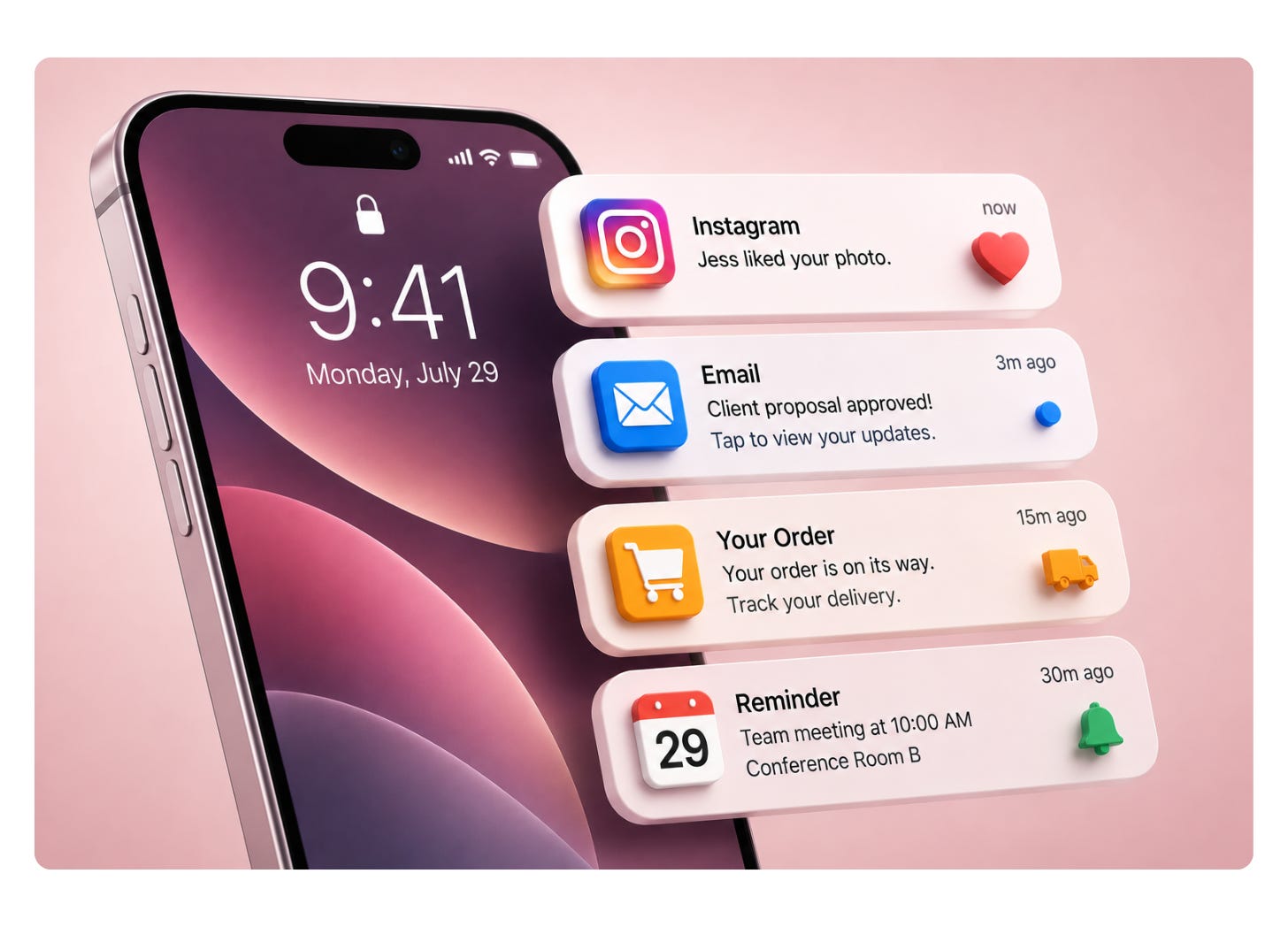
Think about some of the notifications you’ve received recently. Perhaps someone liked your post, your order has been updated, or your phone reminds you of an old memory. None of those messages tells you the full story. Instead, they leave your brain trying to fill in the gaps.
Who liked it?
What changed with your order?
Which memory is waiting for you?
The notification hasn’t really given you information. It’s given your brain a question it wants to answer.
For years, marketers believed personalisation was the key to capturing attention. Use someone’s name. Reference something they’ve done. Make the message feel personal.
But think about how many emails begin with “Hi Sarah” or “Hi John.” Most of us barely notice them anymore. Personalisation alone isn’t enough. What captures our attention is specificity.
Imagine your phone sends a notification that simply says, “Check out your old photos.” You’d probably ignore it.
Now imagine it says, “Four years ago today, you were hiking in the Blue Mountains.”
Suddenly it feels different. Before you’ve even opened the app, your brain has already started replaying the memory. Behind that single sentence is an extraordinary amount of engineering. The app has analysed dates, locations, photos and patterns before deciding what to show you.
But all of that technology exists for one purpose. To create a moment that feels impossible to ignore.
Not every notification promises you’ll gain something. Many quietly suggest you’re about to lose something instead.
Think about the language used by fitness apps, language-learning platforms or loyalty programs. Rather than inviting you back with the promise of a reward, they remind you that your streak is about to end, your membership is expiring, or there’s only a short time left to act.
This taps into one of the most well-established principles in behavioural psychology: Loss Aversion. Losing something we already have usually feels more significant than gaining something new. The notification isn’t simply asking you to come back. It’s making you wonder what might happen if you don’t.
It’s easy to assume the purpose of a notification is to bring you back into an app.
That’s only the beginning.
The real goal is to build a habit strong enough that one day you open the app before it even reminds you.
Think about the apps you check every morning without thinking. Chances are, they didn’t need to notify you today. Somewhere along the way, opening them simply became part of your routine. That’s the moment behaviour changes. The notification has done its job so well that it no longer needs to appear.
We often say our phones steal our attention. But attention can’t actually be stolen. It has to be given. The most effective notifications don’t arrive at random. Many learn when you’re usually active, when you’re most likely to respond and when enough time has passed that a reminder feels helpful rather than intrusive. In other words, timing isn’t really about the clock. It’s about context. The notification appears when your brain is most likely to welcome the interruption.
It’s tempting to think this is simply a story about smartphones. It isn’t.
Notifications work because they tap into psychological principles that have shaped human behaviour long before smartphones existed. Our curiosity makes us want to complete unfinished stories. Our dislike of uncertainty pushes us to seek answers. Our fear of losing something valuable encourages us to act before it’s too late. Over time, repeating those behaviours creates habits that feel automatic.
Technology didn’t invent any of these responses. It simply found remarkably efficient ways to activate them. That’s why the same psychology appears everywhere from marketing and sales to leadership and everyday conversations.
Whenever someone sparks curiosity, leaves a question unanswered, or makes us feel we’re about to lose something important, they’re drawing on exactly the same behavioural principles that underlie the small red dot on your phone.
The next time a notification appears, pause for a moment before you unlock your phone. Instead of asking whether it’s important, ask yourself something different. What made me want to look? Was it genuinely the information? Or was it the question your brain suddenly wanted answered? Because that’s the part most of us never notice.
The most powerful notifications aren’t the ones that give you information. They’re the ones that leave you looking for it.
Know someone who might like this article? Let’s not keep it to ourselves…
Comments
Nothing yet. Say the first thing.
Sign in to join the conversation.