
Have you ever found yourself halfway through an argument wondering how you ended up here again, and again, and again?
Maybe this week’s disagreement started because the dishwasher wasn’t emptied, your partner forgot to pick something up on the way home, or one of you made a comment that landed the wrong way. Before long, you’re both reacting in ways that feel strangely familiar, and you find yourself wondering, Why does this keep happening?
After more than thirty years of working with couples, I’ve noticed something that surprises almost everyone.
The issue that brings couples into my office is rarely the thing that’s actually keeping them stuck.
A disagreement about chores usually isn’t about chores. An argument about being late usually isn’t about the clock. Even conflict around sex or money often has much less to do with the surface issue than with what that issue represents emotionally.
So why do we keep having the same argument?
Because without realizing it, we keep stepping into the same pattern.
Psychologist Stephen Karpman called it the Drama Triangle, and I still think it’s one of the most useful ways to understand why loving couples can become trapped in painful cycles they don’t know how to escape.
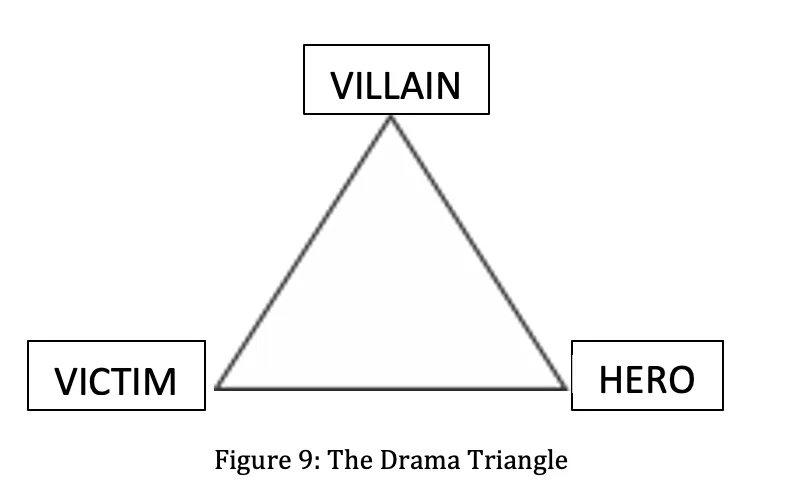
The triangle has three roles: the Victim, the Villain, and the Hero.
The Victim sees themselves as being at the effect of someone or something outside themselves. Victims often feel powerless, misunderstood, unsupported, or trapped. Their thoughts are filled with “if only.” If only my partner would listen. If only they appreciated me. If only they would change. Victims may have difficulty expressing their needs directly, expect others to know what they need, or interpret neutral situations as personal rejection. When a partner casually asks if they’d like to go for a run together, the Victim may hear, You think I’m out of shape.
The Villain believes they know exactly what the problem is and who is causing it. Rather than expressing hurt or fear, they criticize, blame, judge, or attack. Underneath the anger is often vulnerability, but it rarely gets expressed that way. If their partner comes home with the wrong cheese from the grocery store, it isn’t treated as a simple mistake. It becomes evidence that they’re irresponsible, careless, or never paying attention. The Villain isn’t trying to be cruel. They’re trying to protect themselves. Unfortunately, criticism almost always pushes the other person farther away.
The Hero feels responsible for everyone else’s well-being. Heroes smooth things over, solve problems, anticipate needs, and take on far more than is theirs to carry. They often see themselves as loving and helpful, but they can unintentionally communicate something very different: I don’t trust you to handle this. The Hero is the partner who quietly takes over the bills, the planning, and the emotional labor, and the difficult conversations, because they’re convinced it’s easier than relying on anyone else. Or they’re the parent who rushes in to solve a child’s problem before the child has a chance to struggle through it. Heroes usually aren’t trying to control others. They genuinely want to help. But over time, they often become exhausted because they’ve made themselves responsible for everyone else’s well-being.
Most of us have one role that feels especially familiar, but all of us move through all three at different times.

What makes this a triangle instead of three separate roles is that none of them can exist on their own.
A Victim can only exist if someone is villainizing them or rescuing them.
A Hero needs someone to rescue or protect.
A Villain must have someone to blame or punish, someone willing to take the blame or punishment.
The roles sustain one another. They only work if everyone keeps accepting the part they’ve unconsciously been assigned.
Imagine a couple where she feels like she’s carrying most of the responsibility at home.
She feels overwhelmed and unsupported, stepping into the Victim role while seeing him as the Villain who keeps letting her down.
As her frustration grows, she begins criticizing him for everything he forgot to do. Now she has become the Villain.
Eventually she gives up asking for help altogether. She starts anticipating everyone’s needs, taking over responsibilities he could handle himself, and making sure nothing falls through the cracks because she no longer trusts anyone else to do it. Now she’s the Hero.
Meanwhile, he’s having an entirely different experience. He feels like nothing he does is ever good enough. He withdraws because every attempt seems to end in criticism. Now he’s the Victim, while seeing her as the Villain.
Notice what happened.

Neither of them stayed in one role.
Each reaction pulled the other person deeper into the triangle. Each believed they were responding to the other’s behavior, when in reality they were keeping the entire system alive.
That’s how the Drama Triangle works.
Once you’re on it, you’re no longer responding from your wisest, most grounded self. Your nervous system has shifted into self-protection. Your perspective narrows. Curiosity disappears. You become convinced that you’re seeing the situation clearly.
In fact, one of the clearest signs you’ve stepped onto the triangle is that you’re certain you’re right.
The Victim knows without a doubt they’re being mistreated.
The Villain is certain they see things clearly, and they’re simply telling the truth.
The Hero is certain they’re the only one holding everything together.
Everyone on the triangle feels justified.
That’s why no one can change the relationship from there.
The way off the triangle begins with awareness.
The next time you find yourself in a familiar argument, pause and ask yourself, What role have I stepped into?
Not, What role is my partner playing?
Start with yourself.
If you’re feeling powerless, ask yourself what you need and whether you’ve clearly expressed it.
If you’re criticizing, ask yourself what hurt or fear is underneath the anger.
If you’re rescuing, ask yourself whether you’re truly helping or whether you’ve stopped trusting your partner’s ability to carry their share.
One of the most powerful shifts you can make is to stop telling your partner who they are and start sharing your own experience.
Instead of saying, “You never listen to me,” try, “When that happened, I felt hurt.”
Instead of saying, “You don’t care about me,” try, “The story I’ve been telling myself is that I don’t matter.”
If you’re too activated to have that conversation, take a break. Take a walk. Take a few slow breaths. Take the next 12 hours if you have to.
Give your nervous system time to settle, then come back when you’re capable of being curious again.
Here’s the beautiful thing about the Drama Triangle: it only works when everyone keeps accepting the role they’ve been handed.
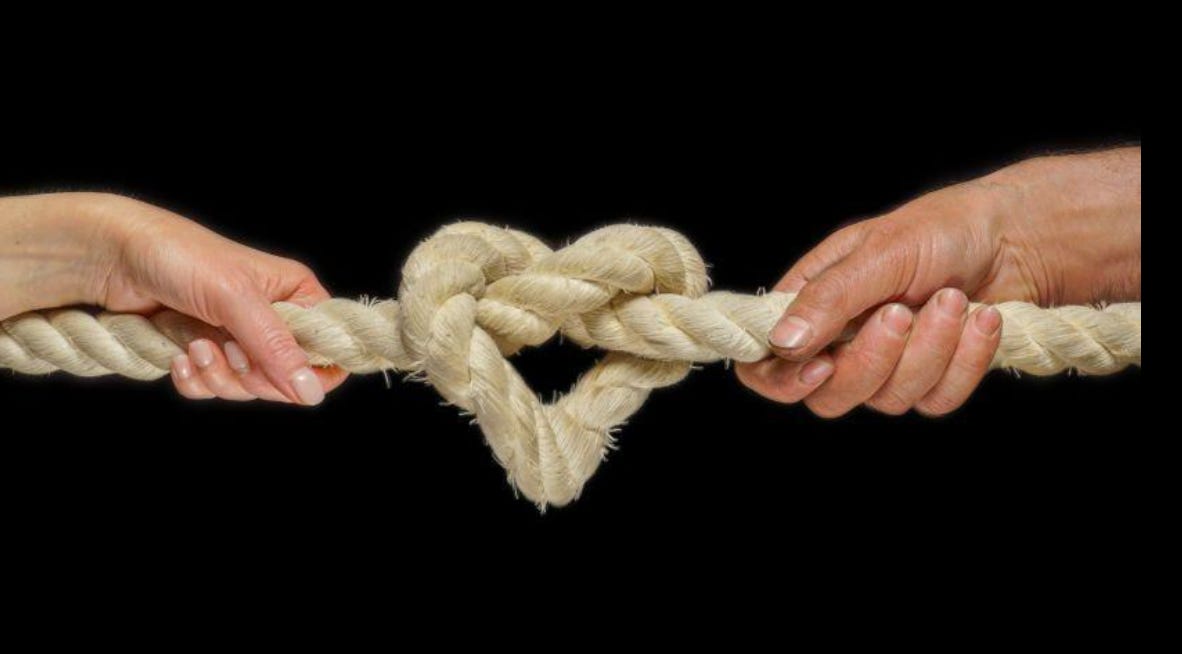
The moment one person steps off the triangle, the old pattern begins to lose its grip.
Your partner’s behavior may still pull you back toward your familiar roles. They may criticize, withdraw, or expect you to rescue them.
You don’t have to accept the invitation.
That doesn’t mean the conflict disappears. It means you’ve interrupted the pattern that’s been keeping both of you stuck.
If you’d like to learn more about how to sustain lasting love through life’s challenges, read Dr Berman’s book, Quantum Love. I get into the Drama Triangle there, and you’ll find many other practical tools throughout to help you break old patterns, deepen connection, and create the kind of love and relationship you truly desire. And if you’d like to learn more about healing and sustaining love through loss, make sure to order Dr Berman’s newest book Crying Out Loud: A Path Through Grief Into a Life Reimagined.
No posts
Comments
Nothing yet. Say the first thing.
Sign in to join the conversation.