
“In life, the challenge is not so much to figure out how best to play the game;
the challenge is to figure out what game you’re playing.” — Kwame Anthony Appiah
Science is often portrayed as people’s quest for truth. Yet beneath this common pursuit, scientists often chase fundamentally different goals—what I call "games" with distinct "Orientations" (-O). “The Inner Game of Tennis” by Timothy Gallwey illustrates that while on the surface, tennis players all seem to be playing the same game on the tennis court, internally they could be in completely different games: one person's playing to stay in shape, another's gunning for the regional championship, and someone else just wants to look good hitting forehands.
The same thing happens in science. You might see two researchers working side by side in the lab, but one could be chasing academic fame while the other just wants a stable job and salary for the family. None of the games is inherently good or bad. Self‑awareness, however, lets you decide which games to join, which to sidestep, and how to collaborate with others whose motives differ from your own.
First, Know the Games That People Play in Science
Scientific careers encompass multiple simultaneous “games”, each with distinct prizes and rules. Most researchers are juggling several games at once, and priorities can shift based on a scientist’s career stage, life circumstances, and surrounding environments. Recognizing these patterns—in yourself and in others—empowers you to choose what’s best for your career. The following archetypes (Numbered 1-7) represent some -Os I observed among scientists. Rather than cataloging every possible motivation here, I provide illustrative stories and AI-generated cartoons to demonstrate how different these games can be. You may recognize yourself and your colleagues in some of these. These Orientations highlight the different factors that drive individuals to pursue science, as well as the challenges and opportunities that arise in each type of “play”.
1. Reputation-O
Core Drive: Validation through prestigious markers recognized by the scientific community—high-impact publications, elite institutions, and distinguished awards.
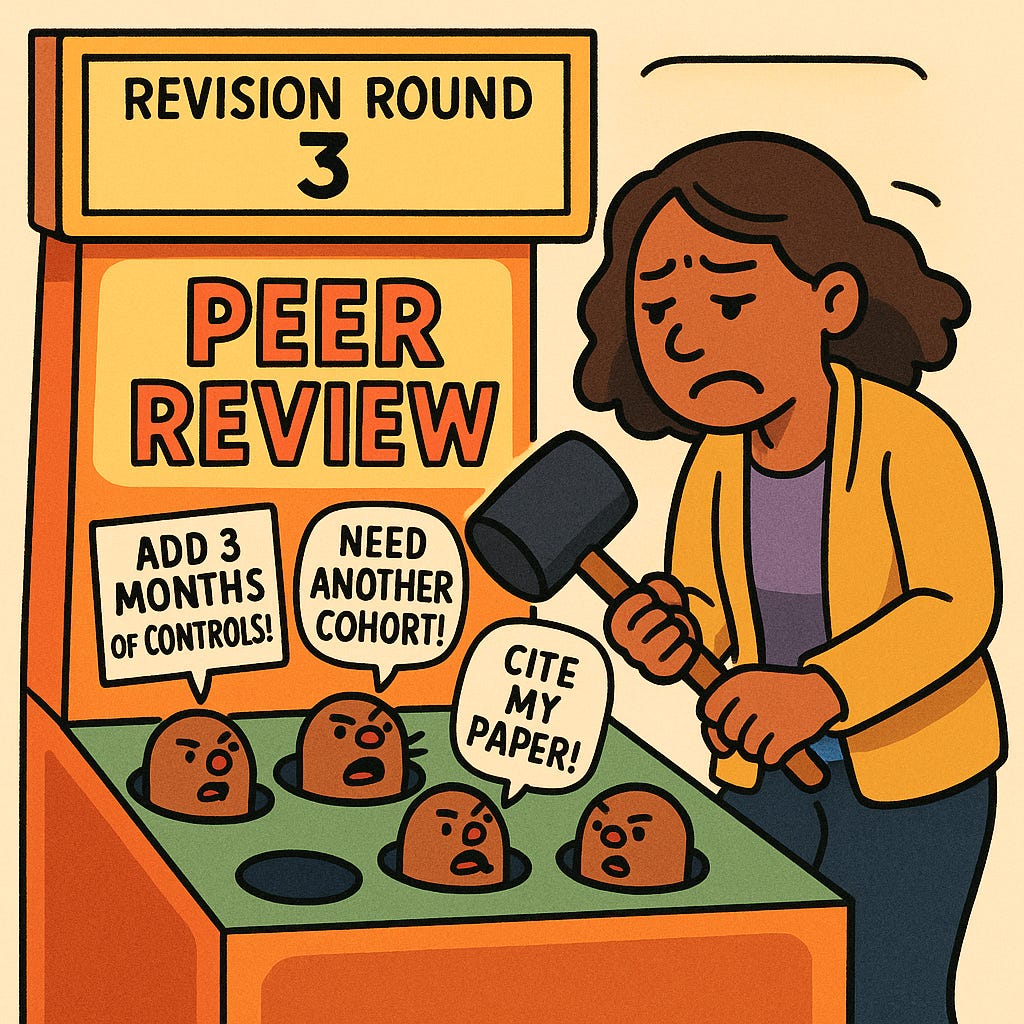
Subgame A: Chasing Papers with High Journal Impact Factors
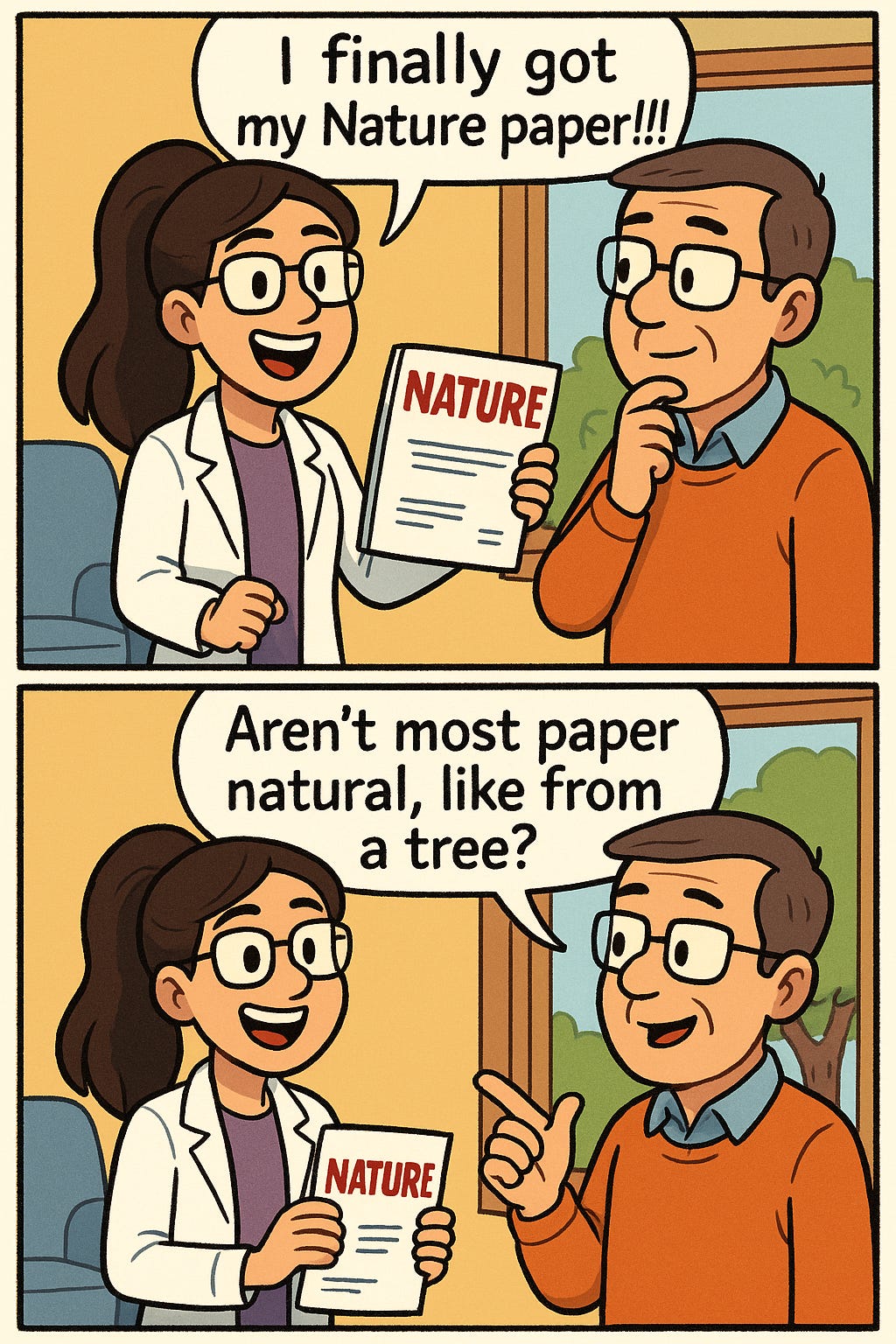
Maria Gonzalez had been working as a research technician in Dr. Lee's chemical engineering lab for years, gradually taking on bigger responsibilities. Maria’s dream was to become a first author on a paper published in the most prestigious scientific journal called Universe. She'd been working on this enzymatic synthesis pathway discovery that seemed perfect for it.
One day, Maria learned that another research group was on the verge of publishing similar findings. Her heart sank as she realized that if her team didn’t act quickly, their work would be scooped, and her dream of leading a high-impact publication would be shattered. Dr. Lee, sensing Maria’s disappointment, suggested that they rush to complete and submit the project before it got scooped. As the days went by, Maria found herself working long hours in the lab, trying to expedite the last experiments. Meanwhile, she also worries that the rush may compromise the rigor of their study. Moreover, she has already missed several gatherings with her friends and family. Most days, she grabs quick take-out meals for lunch and dinner, so she can quickly return to her bench for the next experiment. She was stressed, but the thought of "Gonzalez et al." gracing Universe’s cover, potentially garnering hundreds of social media shares, was too hard to resist.
Subgame B: Chasing Prestigious Institutions
Dr. Marcus Washington had dedicated his career to studying ecosystem responses to climate change, working directly in the Amazon rainforest alongside indigenous communities and local scientists. His research could profoundly impact global conservation efforts, and he formed deep friendships with indigenous tribes and local scientists. Yet Marcus sometimes felt overshadowed by colleagues at prestigious institutions. When he met people at conferences, they rarely recognized his smaller institution's name.
Thus, when the Purple University in Cambridge came calling with an endowed professorship, Marcus could practically hear his family's reaction: "Our Marcus, endowed professor at the world-renowned Purple University!" The prestige was undeniable, and the move delivered on its promises: world-class facilities, famous collaborators, and institutional prestige. But Marcus soon missed the close-knit community surrounding his previous position, where colleagues felt like family and he enjoyed freedom from institutional expectations. The prestigious brand came with unexpected constraints.
2. Power-O
Core Drive: Climbing the ladder to get influence and control, whether in academia or industry, and to become the ones making the big decisions.
Subgame A: The Corporate Ladder Climb
Dr. Emily Carter loved her job as a research scientist at BioNexTech. She had genuine friendships with her colleagues—they'd brainstorm together, share lab frustrations, and grab drinks every Friday. But Emily was also ambitious, and she had her eye on a management position. Slowly, her approach changed. She started networking more aggressively with senior leadership and volunteering for high-profile projects that the CEO wanted done. Her colleagues noticed the shift. What used to be authentic collaboration started feeling more calculated. Emily was still friendly, but now every interaction seemed to have an agenda.
When Emily finally got promoted to research team manager, the congratulations from her former colleagues were polite but cold. She'd gained the power she wanted, but at the cost of the relationships she'd once treasured. Now she found herself missing the authentic connections she'd sacrificed for influence.
Subgame B: Ascending the Ivory Tower
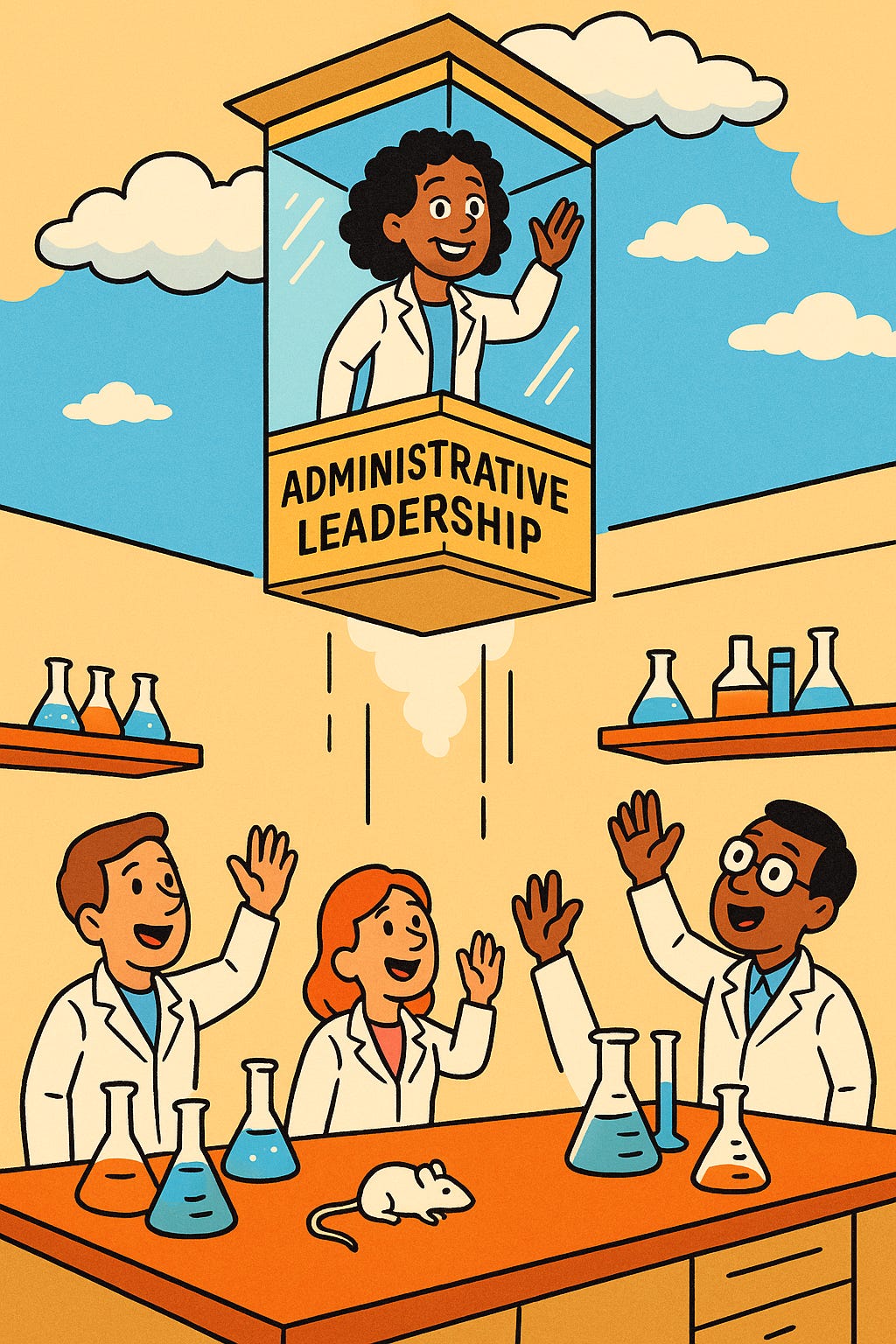
Dr. Michelle Thompson started as a passionate neuroscientist who'd spend 12-hour days in the lab just because she loved figuring out how the brain worked. But after a few years, she noticed something: the people making the real decisions—about funding, research directions, hiring—weren't always the ones doing the best science. They were the ones in administrative positions. Michelle began volunteering for committees, serving on hiring panels, and taking on more administrative duties. The Department Chair position seemed like the ultimate goal—finally, she could shape policy and support young scientists the way she wished she'd been supported.
But as Michelle climbed higher, the further she drifted from the science that had originally excited her. Committee meetings replaced lab meetings. Budget discussions replaced research discussions. She found herself making decisions about research areas she hadn't actively worked in for years. The final straw came when a graduate student asked for her advice on a newly discovered brain structure, and Michelle realized she didn’t even know about it. The field had moved on without her. Now she was torn: stay in the administrative track she'd worked so hard to build, or return to what had originally drawn her to science?
3. Money-O
Core Drive: Pursuing financial gain to elevate living standards, fund ambitious research projects, or achieve other markers of material success.
Subgame A: The Salary Maximizer
Priya got into machine learning (ML) because, honestly, the money was incredible. After finishing her Master's, she landed a coveted ML Engineer position at a lucrative social media company, OnlyVans. The salary was amazing, and the promotion opportunities seemed endless.
As Priya's experience grew, competing companies kept offering more money. The financial rewards were undeniable, but a troubling pattern emerged: everything she worked on was basically about getting people to click more ads. The initial excitement of building efficient algorithms gradually faded as she realized her legacy might just be making people scroll more.
This realization hit hard. Priya started questioning whether chasing higher salaries had led her away from work that actually mattered. So she made a change: she began donating a third of her income to public health organizations and started tutoring disadvantaged students remotely. Suddenly, her work felt meaningful again, even if the core job hadn't changed.
Subgame B: The Grant Chaser
Dr. Maya Green had discovered the Leo pathway six years ago, and it had made her career. Now running her own lab, she understood the brutal reality: grant funding equals survival. Her institution made it clear: bringing in money was the primary measure of success.
When Maya discovered another potentially revolutionary pathway, she faced a tough choice. The science was fascinating, but it was also risky. Pursuing this new direction meant abandoning the well-established Leo pathway research that virtually guaranteed significant funding. Her department chair's advice was clear: stick with what works. Focus on Leo pathway research, secure the grants, keep the lab financially stable. The novel research would have to wait. In a competitive and conservative funding environment, playing it safe was the smart money move.

4. Mission-O
Core Drive: Solving specific problems that matter deeply to humanity, often driven by personal experience or a profound sense of purpose that transcends other rewards.
Finding the Cure for Polio
In the early 1950s, Dr. Jonas Salk witnessed the devastating impact of polio epidemics that struck terror into American families. In 1952, about 58,000 cases and more than 3,000 deaths were reported in the United States alone. Parents lived in fear, keeping their children away from swimming pools and public gatherings during the summer months. For Salk, this wasn't just a scientific challenge; it was a moral imperative.
In 1947, Salk was appointed director of the Virus Research Laboratory at the University of Pittsburgh School of Medicine. With funding from the National Foundation for Infantile Paralysis—now known as the March of Dimes Birth Defects Foundation—he began to develop the techniques that would lead to a vaccine to wipe out the most frightening scourge of the time: paralytic poliomyelitis. While most scientists believed that effective vaccines could only be developed with live viruses, Salk developed a "killed-virus" vaccine by growing samples of the virus and then deactivating them by adding formaldehyde so that they could no longer reproduce.
The pressure was immense during the Polio outbreak, but Salk's commitment to his mission was unwavering. Salk tested his experimental killed-virus vaccine on himself and his family in 1953. The trial expanded a year later to 1.6 million children in Canada, Finland and the USA–the Polio Pioneers. The mass field trials showed that the vaccine was safe and highly effective. In the Spring of 1955, the vaccine was announced, and within a few years, the number of US polio cases dropped dramatically to just 910 in 1962.
When the vaccine proved successful, Salk faced questions about commercializing his breakthrough. When asked in an interview, "Who owns this patent?", Salk replied, "Well, the people, I would say. There is no patent. Could you patent the sun?' The Mission-O player had achieved his goal—the end of a childhood scourge. As Salk said, “hope lies in dreams, in imagination and in the courage of those who dare to make dreams into reality."
5. Science-O
Core Drive: Devotion to uncovering natural truths, even when they lie beyond mainstream sources of recognition.
Discovery of the Green Fluorescent Protein (GFP)
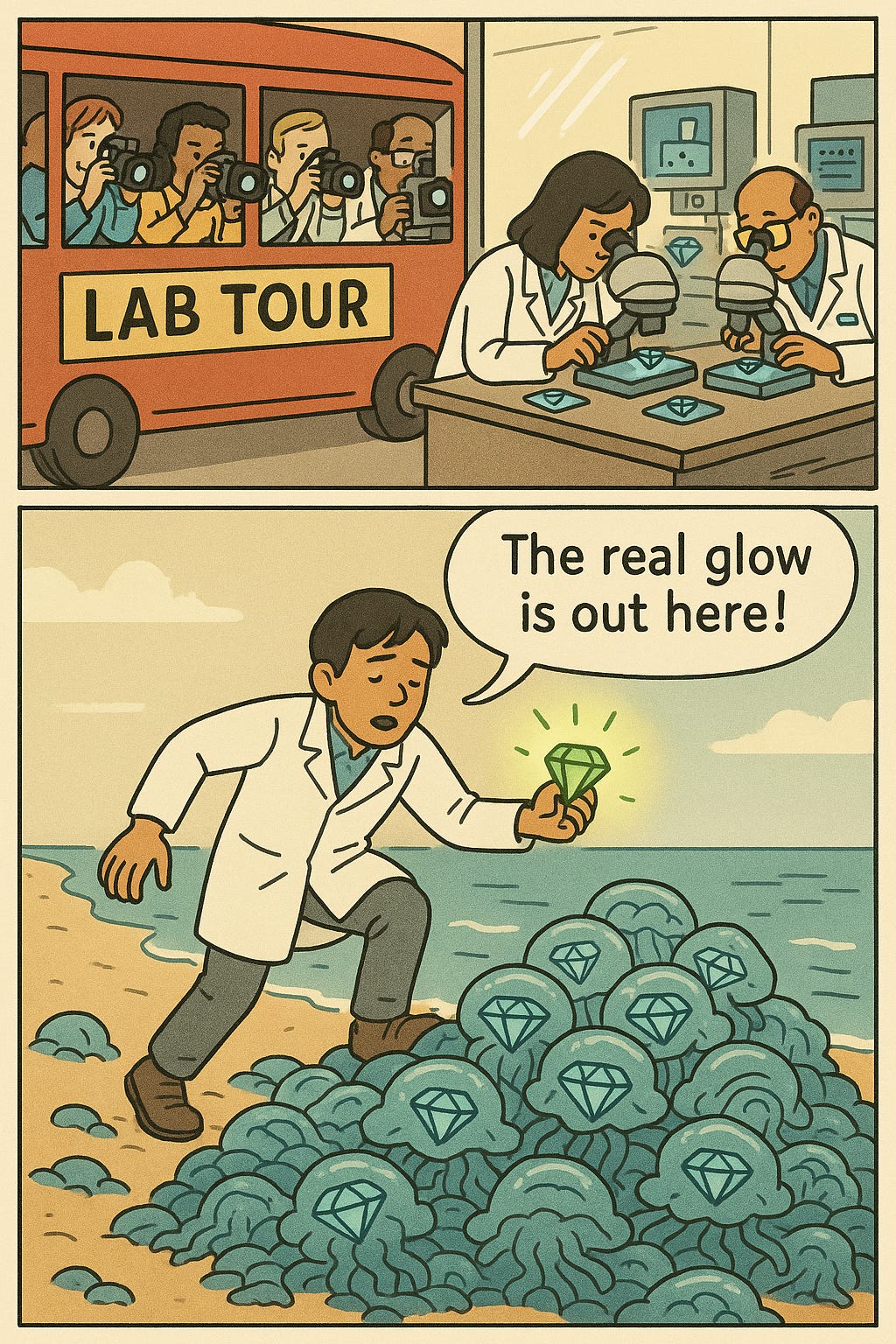
Dr. Osamu Shimomura's story is legendary, but here's what makes it remarkable: he spent 19 summers collecting hundreds of thousands of jellyfish near Friday Harbor, Washington, not because he had a grand plan to win a Nobel prize, but because he was genuinely curious about how these creatures made light. Picture this: while other biochemists were chasing the latest hot topics in biochemistry, Shimomura was knee-deep in seawater, carefully extracting proteins from jellyfish. People probably thought he was wasting his time on some obscure marine biology project. Through painstaking work, he identified two proteins: aequorin (producing blue light) and what we now call Green Fluorescent Protein (GFP).
Here's the kicker: GFP just sat there glowing green under UV light, seemingly useless. Shimomura published his findings in fairly obscure journals. No one cared. It was just another weird protein from a weird jellyfish studied by a guy who seemed obsessed with bioluminescence. But decades later, other scientists realized you could attach GFP to other proteins and literally watch cellular processes happen—it was like having a microscopic flashlight that could illuminate the invisible machinery of life. Suddenly, Shimomura's "useless" protein became one of the most important tools in modern biology.
In 2008, Shimomura shared the Nobel Prize in Chemistry for this discovery. What had once been an overlooked phenomenon in jellyfish had transformed biological research. In his 2017 autobiography, Luminous Pursuit: Jellyfish, GFP, and the Unforeseen Path to the Nobel Prize, Shimomura reflected on his journey from curiosity-driven investigation to revolutionary scientific impact. His story reminds us that the most transformative breakthroughs come from following your curiosity, even when everyone else thinks you're studying something trivial.
6. Relationship-O
Core Drive: For some people, science is fundamentally about connections—whether it's making family proud, building networks, or creating meaningful relationships through shared work.
Subgame A: Making the Family Proud
Dr. Rosa Martinez grew up in a small town where her parents ran a corner grocery store. They'd immigrated from Mexico with nothing, working 16-hour days so Rosa and her siblings could have opportunities they never did. When Rosa got into graduate school for molecular biology, her parents threw a party for the whole neighborhood—their daughter was going to be a "doctora”. But PhD life was isolating. Rosa spent years studying cancer therapy resistance in a windowless lab, surrounded by people who spoke a language her parents couldn't understand.
The breakthrough came when Rosa's research led to a potential new treatment for the type of aggressive breast cancer her aunt had died from. For the first time, Rosa could explain her work in terms her family understood: "I'm trying to help people like her Auntie Annie." When Rosa invited her parents to her thesis defense, her father's and mother’s eyes welled up with pride. They may not understand all the technical details, but they understood that their daughter had spent years fighting cancer. Rosa realized that her success wasn't just measured by publications or citations. It was measured by the moment her parents finally understood that their sacrifice had created something meaningful for the world.
Subgame B: The Network Builder
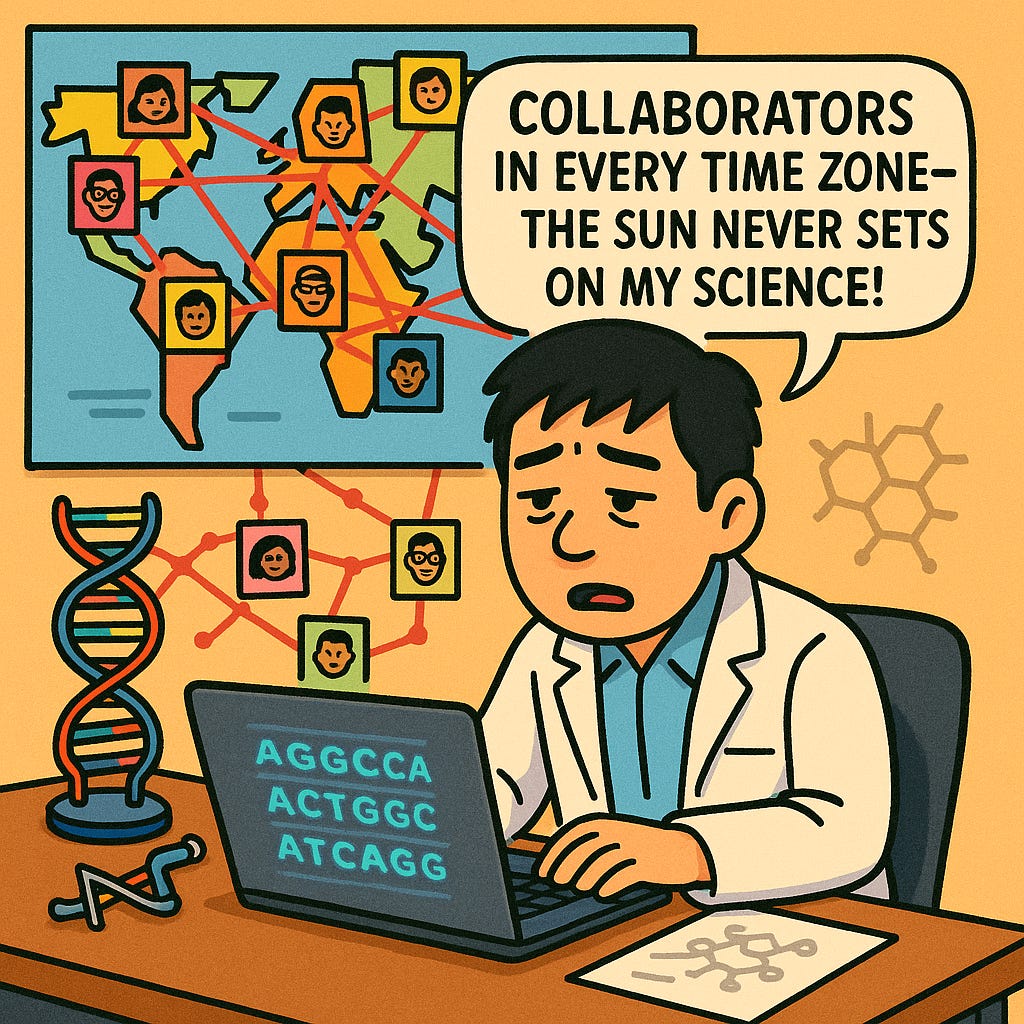
Dr. James Lin believes that the future of evolutionary biology lies in interdisciplinary collaboration. For years, James built bridges between fields, frequently attending conferences outside his expertise to connect with physicists, mathematicians, and computer scientists and explore new collaborations. His project meetings featured lively debates among scientists from various disciplines, each contributing unique perspectives. One of his most significant projects—investigating the evolutionary dynamics of microbial communities—emerged from a chance encounter with a theoretical physicist and a microbiologist at a symposium. This collaboration led to groundbreaking work, but for James, the true victory was the strong, lasting relationships built with collaborators.
However, maintaining these relationships required significant time and energy. James would spend multiple hours on virtual meetings across time zones every day. Still, he considered it worthwhile—the connections he fostered didn't just enhance his work; they created a support network that helped him navigate the challenges of academic life.
7. Lifestyle Balance-O
Core Drive: Integrating professional and personal lives harmoniously, prioritizing mental health, well-being, and relationships while maintaining scientific achievement.
The Career-Family Juggler
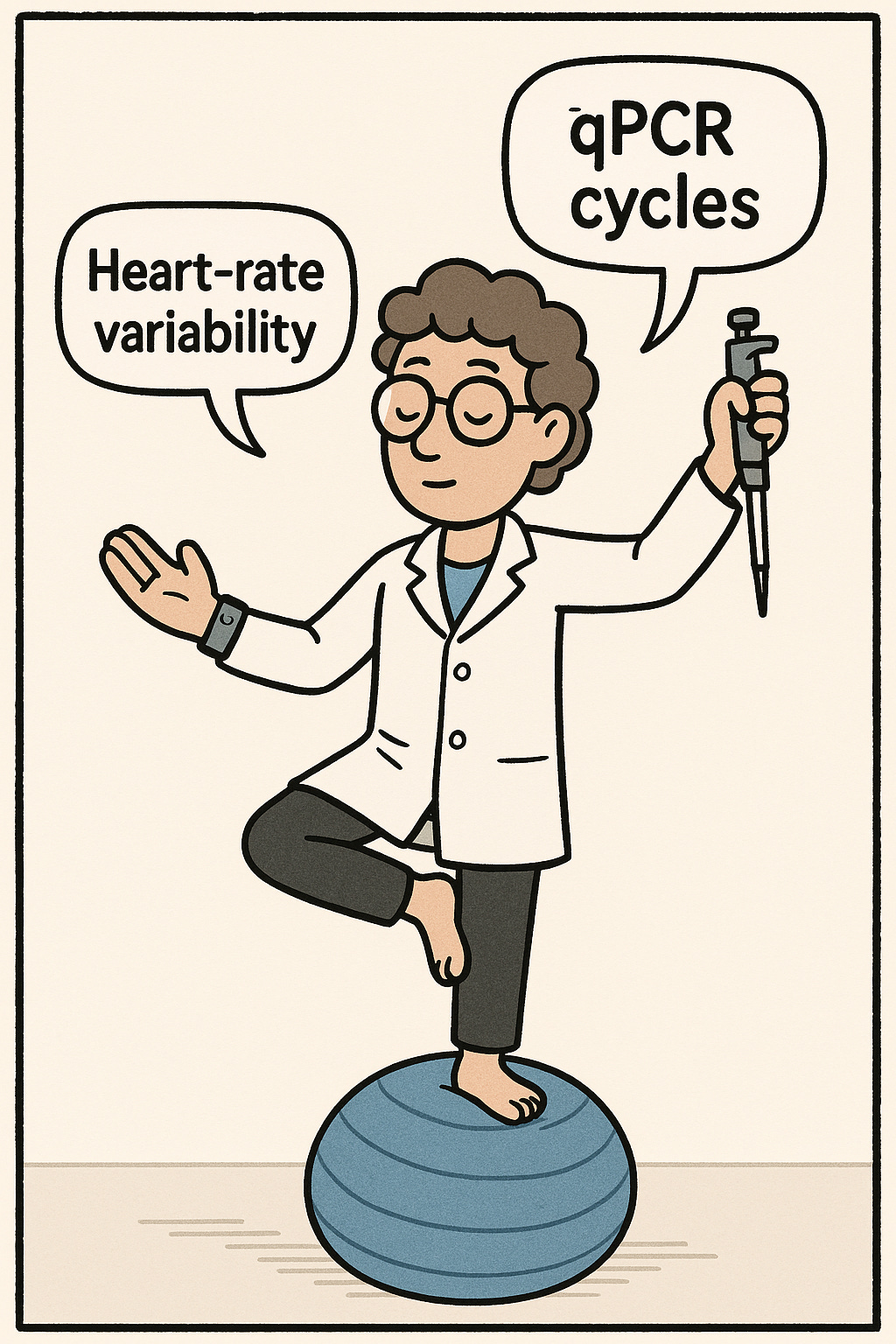
Dr. Jessica Kim was an accomplished geneticist. Meanwhile, as a mother of two young children, she grappled with pressure to meet grant deadlines and publish findings while wanting to be present for her family. One afternoon, after a particularly hectic week of meetings and late laboratory nights, Jessica realized she had missed her daughter’s pickup from school. The disappointment on her daughter’s face was a wake-up call.
Jessica started setting boundaries—blocking off evenings and weekends for family time, even when colleagues expected her to be available 24/7. She felt guilty at first, especially when she'd leave work early to pick up her kids while others stayed late. Achieving balance wasn’t without challenges. Jessica encountered resistance from colleagues who worked late and expected similar commitment from everyone. Yet as she fostered conversations with her team about work-life balance, Jessica realized she wasn’t alone in these struggles. Over time, she inspired colleagues to adopt similar practices, creating a more supportive lab environment. Jessica learned that maintaining harmony between professional ambitions and personal life wasn't just possible—it was essential for success in both realms.
Be Yourself—You Don’t Have to Climb the Same Ladders as Others
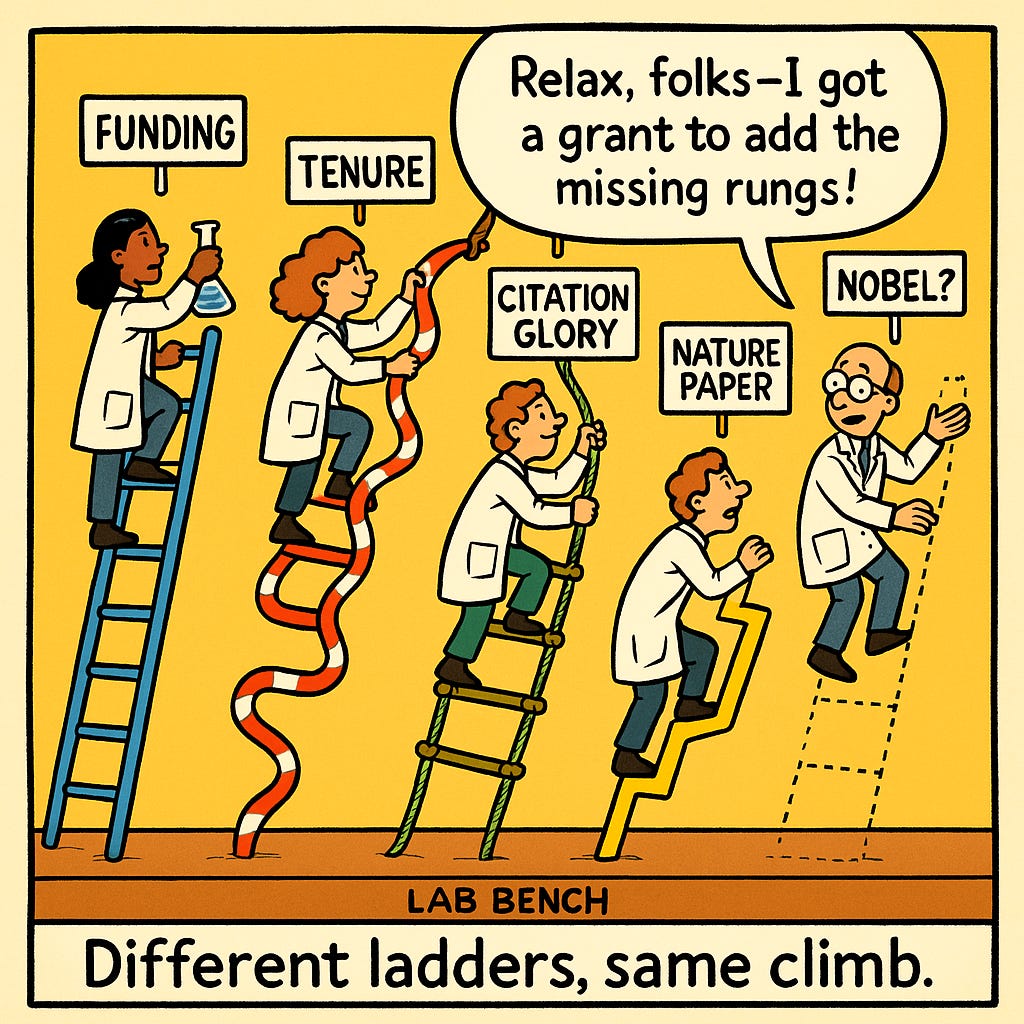
Scientific careers are guided by different combinations of "-Os." You might see your colleague Sarah chasing Power-O, gunning for that Department Chair position in a twenty-year plan, while your lab mate Alex is all about Money-O and always going for that high-paying industry job. Meanwhile, you're more like Dr. Thompson from earlier—you want that Purple University professorship to make your family proud, and honestly, you don't care as much about the money.
And that's perfectly fine! Each person's path reflects their unique values, goals, and life circumstances. There's no single "correct" way to pursue science. Social pressures and peer comparisons can mess with your head. That internal conflict is normal, but embracing your authentic values while staying true to your motivations is what leads to genuine fulfillment.
Understanding different "-Os" helps you realize that there are many ladders to climb, each representing different values and objectives. While following someone else's path might seem appealing, having faith in finding and climbing your own ladder—with its distinct challenges and rewards—often leads to the greatest satisfaction and meaningful career contribution.
Finding Synergies With “Players” Across Different “-Os”
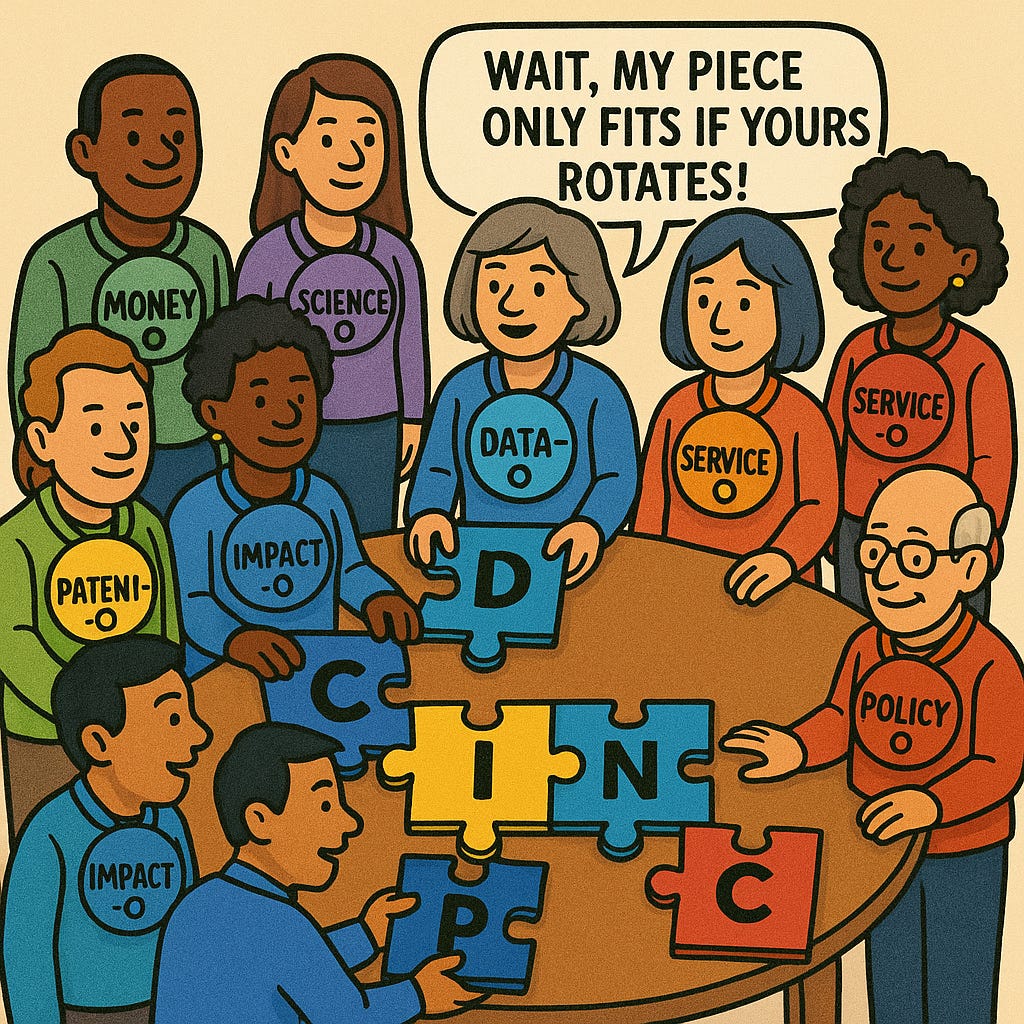
In research, collaboration is often the key to achieving greatness. However, not all scientists share the same “-Os” or mix of motivations. These differing goals and values don’t have to be divisive. Instead, recognizing and understanding these variations can lead to productive collaborations. Think about it: a scientist driven by Science-O may team up with another scientist who has mastered Money-O to secure funding to supercharge their groundbreaking research. The Science-O person gets to pursue their passion for discovery, while the Money-O person gets to exercise their grant-writing skills and build their funding track record. Win-win.
Learning to identify and harmonize these diverse goals is more than just a strategy—it’s a skill that fosters respect, empathy, and openness within a team. When you actively seek synergies and leverage each team member's unique strengths, you create an environment that encourages growth, creativity, and success. Embracing diversity in motivations and working together across different "-Os" enriches the scientific community and leads to achievements that individuals working in isolation could never reach.
Embrace the Joy of Play in Science
At the end of the day, science is supposed to be fun. It's a journey of exploration, curiosity, and creativity that can be approached as an enriching game. As you navigate different "-Os," don't lose sight of why you got into science in the first place. Whether you're chasing publications, climbing ladders, or just trying to understand how the world works, there should be some element of joy in what you do. Science thrives not only on individual achievements but on the shared joy of discovering the wonders hidden within ourselves and the universe. When we maintain this sense of wonder and playfulness, we honor both the pursuit of knowledge and the human spirit that drives us to explore, create, and understand our world.
Conclusion
By recognizing different "-Os" in yourself and other scientists, you can make more conscious career decisions, build stronger collaborations, and maintain the integrity and joy that make science a worthy pursuit. The bottom line: there's no single "correct" way to pursue science. Maybe you're like Rosa, wanting to make your parents proud. Maybe you're like Priya, realizing that chasing money isn't everything. Or maybe you're like Dr. Shimomura, content to spend decades studying something others consider trivial because it fascinates you. The key is understanding your authentic motivations, respecting others' different paths, and finding ways to create synergy across diverse goals. When we do this, we build a scientific community that's not only more productive and inclusive, but also more fulfilling for everyone involved.
ACKNOWLEDGMENTS
I thank Dr. Jason E Mcdermott and Dr. Jennifer Yokoyama for reading and providing invaluable feedback for drafts of this work. Large language models (LLMs), including ChatGPT and Claude, were used in the drafting and editing of the work, and multi-modal AI models were used to generate all cartoon figures. All final texts have been extensively edited and validated by the author.
No posts
Comments
Nothing yet. Say the first thing.
Sign in to join the conversation.