
Imagine a world where Jensen Huang, Lisa Su, and Sundar Pichai never got a chance to pursue their graduate degrees in the US and pursued their careers elsewhere.
No NVIDIA. No AMD. No Google as we know it.
Imagine their families staying behind in Taiwan, India, or Thailand—not because they lacked talent, but because the U.S. no longer offered compelling opportunities in science and engineering. Imagine if these future tech leaders started their graduate studies elsewhere because American labs had too little funding to take them in. Imagine if they had built their families and started their early careers in Asian or Europe. Imagine if they were never welcomed, never trained, never empowered in the US.
It’s not just hypothetical. It’s the future we’re building—unless we change course, fast.
Today, America is on the verge of sabotaging the very engine that made it the world’s scientific and technological leader: public investment in research. With growing threats of budget cuts to the National Institutes of Health (NIH), the National Science Foundation (NSF), and world-class institutions, we’re playing a dangerous game—not just with our economy, but with our identity as a nation that dares to lead.
Jensen Huang was born in Taiwan, spent part of his childhood in Thailand, and moved to the U.S. at age 9. He would go on to earn engineering degrees from Oregon State and Stanford. In 1993, he co-founded NVIDIA and helped ignite the AI revolution. His chips now power everything from ChatGPT to autonomous vehicles.
Lisa Su, the CEO of AMD, immigrated from Taiwan as a toddler because her father came to the U.S. to pursue graduate studies. She earned her PhD in electrical engineering at MIT and rebuilt AMD into a semiconductor powerhouse.
Sundar Pichai grew up in a modest home in Chennai, India. He came to the U.S. for graduate school—first Stanford, then Wharton. Today, he leads Google.
None of them were born into American privilege. What they were given was opportunity—access to a country that invested in research, education, and the promise that brilliance could come from anywhere.
They came. They stayed. They built. And America prospered.
In 2024, NIH’s budget was $48.6 billion. NSF’s was $9.5 billion. Combined, that’s less than 0.3% of federal spending. By contrast, NASA received over 4% of the federal budget during the Apollo era. The payoff? We put a man on the moon, invented the modern semiconductor industry along the way, and inspired a generation of the best engineers and scientists to build for America.
Today, we’re facing existential challenges that demand Apollo-scale ambition: climate change, pandemics, antibiotic resistance, AI safety, aging populations. Yet science funding is stagnant or shrinking in real terms.
Meanwhile, China is spending aggressively. Its R&D investments have grown over 10% annually for the past decade, and it is now on pace to surpass U.S. research spending—if it hasn’t already. The Chinese government has launched initiatives to lure back expat scientists, fund entire research cities, and strategically dominate technologies like AI, quantum computing, and biotech.
If we defund NIH and NSF, we’re not just cutting projects—we’re cutting off our own supply of talent. We’re telling the next Jensen, Lisa, or Sundar: go elsewhere.
Historically, the U.S. didn’t need to fear brain drain because we were the magnet. Over half of America’s Nobel Prize winners in science since 2000 were born outside the U.S. Today, 60+% of top AI researchers working in the U.S. are immigrants, many of whom completed their graduate education at U.S. institutions (MacroPolo, AI Talent Tracker). Among billion-dollar startups, more than 55% have at least one immigrant founder, while ~80% have at least one immigrant in a key leadership role, such as CEO or CTO (National Foundation for American Policy, 2022).
Many of these leaders arrived in the U.S. on student visas, attracted by federal investments in research and graduate education, such as NSF/NIH-funded assistantships and fellowships. In fact, nearly 70% of full-time graduate students in AI-related fields in U.S. universities are international students (NFAP, 2023).
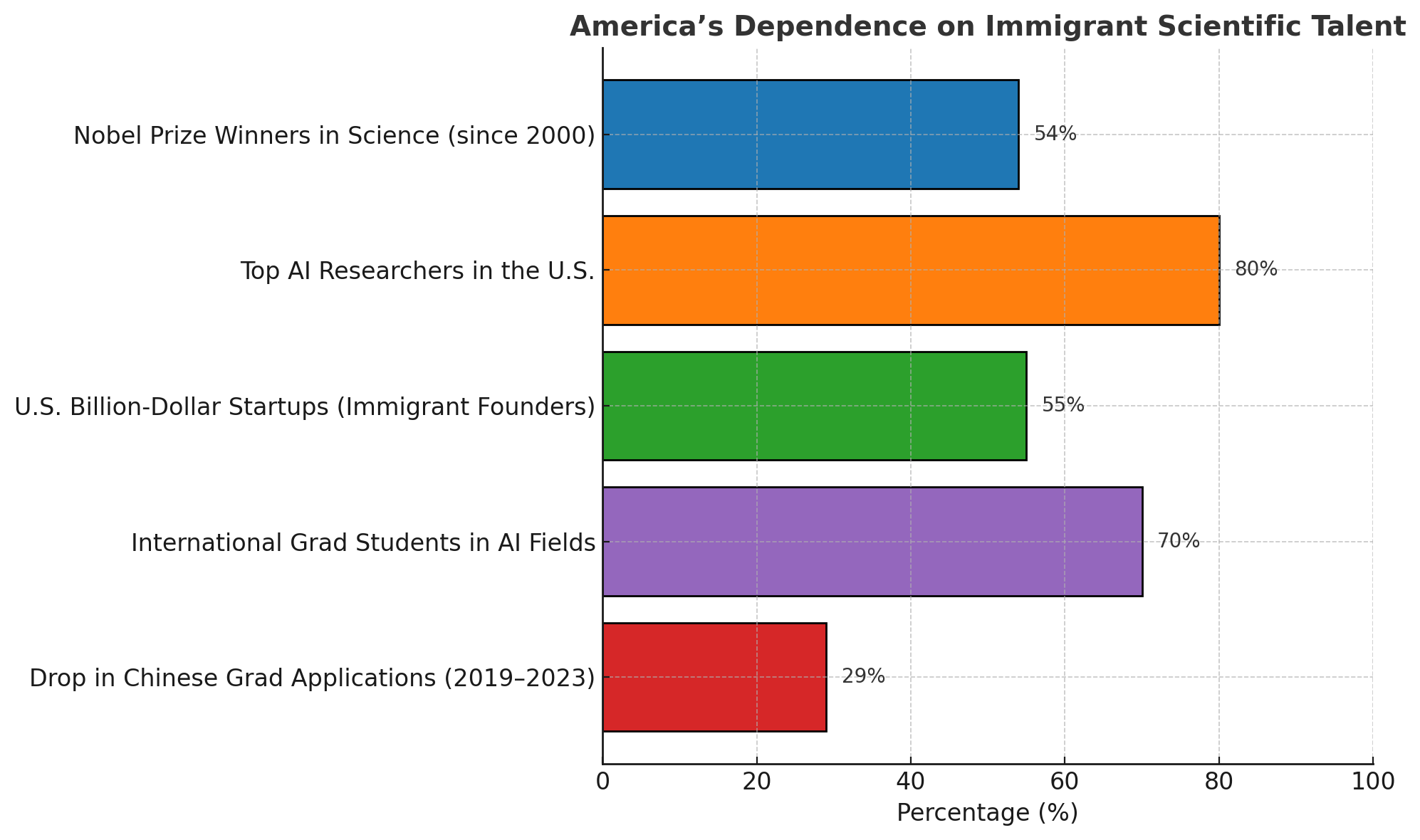
But that tide is turning. The number of international graduate applications to U.S. programs has declined in recent years, with a 29% drop in applications from Chinese students between 2019 and 2023 (Council of Graduate Schools, 2023). Simultaneously, countries like Canada, Germany, and the United Kingdom have ramped up STEM talent recruitment through fully funded fellowships, expedited work permits, and permanent residency pathways (OECD, “Attracting International PhD Students,” 2022). These policy shifts signal a global talent race—and the U.S. is no longer the uncontested leader.
If you’re a brilliant 22-year-old from Lagos, Manila, or São Paulo, you now have choices. And if the U.S. makes it harder to get funded, mentored, or stay after graduation—well, you won’t.
If we’re serious about remaining the world’s scientific and economic leader, flat funding isn’t enough. We need a moonshot mindset again.
We should 10x science funding.
Yes, tenfold. That’s not hyperbole—it’s how we win. Here’s what it would enable:
Fund every promising graduate student and postdoc in biomedical and physical sciences, no matter where they come from.
Offer top-tier salaries and visas for global scientific talent in quantum, biotech, and climate science.
Train the next generation of founders and innovators, ensuring they build their companies here, hire here, and pay taxes here.
This is not wasteful spending. It’s the best investment a nation can make. Every dollar we put into science returns many times over in economic growth, public health, and national security.
We already know how this story goes. America became great because it invested in knowledge. We funded basic science that led to the internet, space travel, GPS, CRISPR, and mRNA vaccines. We welcomed talent from around the world and turned that brainpower into billion-dollar companies, Nobel prizes, and public good.
But if we turn away from that legacy, if we treat science as an expense rather than the foundation of progress, we’ll lose something much bigger than any single grant.
We’ll lose our edge. We’ll lose the future.
And the next Jensen Huang? He’ll build the next NVIDIA somewhere else.
Thanks for reading The Variant! This post is public so feel free to share it.
No posts
Comments
Nothing yet. Say the first thing.
Sign in to join the conversation.