
In this week's Ambassador Anniversary celebration, the Foundation for Social Connection interviewed a few of its Ambassadors, asking them about their experiences with advancing social connection.
In this interview, we are featuring Dr. Krystal L. Culler, DBH, MA, who turned a "crazy idea" during the early pandemic into a global movement for brain health. Read Krystal's article below and stay tuned throughout this week to hear from our other ambassadors.
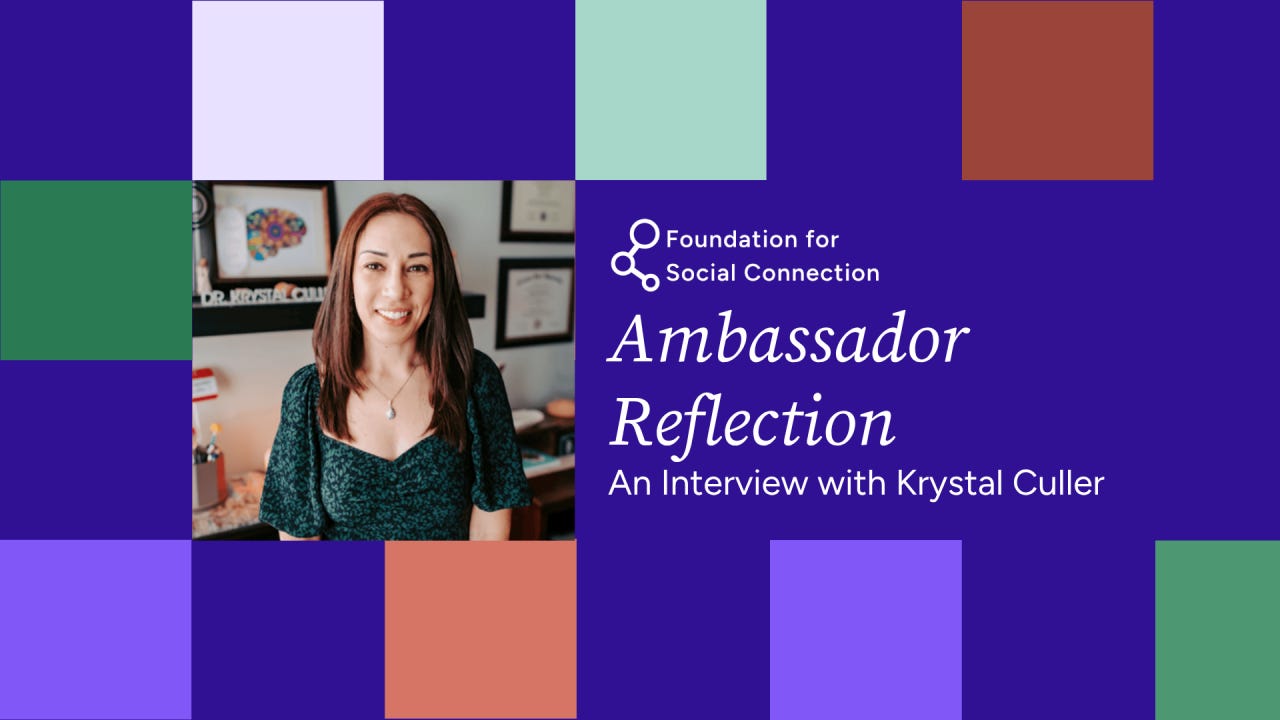
When I first heard about the initial shutdown in response to the COVID-19 pandemic, I knew what that meant for aging adults and their carers across the aging care service continuum. Isolation, disrupted routines, and loss of access to community-based support were about to compound existing risks to brain health, and fast. (For many this happened overnight!) From my experience and training in behavioral health, cognitive aging, and gerontology, I also knew this would not be a “short-term” response but a longer-term one, likely taking years to turn around, even though at the time, people scoffed at that insight. I remember thinking that the systems we relied on for social connection among aging adults simply weren’t built to withstand a prolonged disruption like what we all collectively experienced. And the impact still lingers with us today.
I simply wanted to help in some way, so I reflected on how my eclectic knowledge and skills could be of service to others. I did an online search to see if anyone had created a ‘virtual brain health center.’ The simple idea was a virtual community where people could gather and learn about brain health science from a wide variety of experts from their homes. Oddly enough, the name and domain were available, so I started a project plan alongside two colleagues, and we brainstormed the foundations of the Virtual Brain Health Center. We drafted a model of brain wellness emphasizing the research-informed areas of brain health we felt we could genuinely support in a “virtual space”: social connections, cognitive engagement, physical activity, and personal well-being. We built our philosophy of brain care around one core belief– that brain health is for everyone, and a fundamental right to all, not a privilege reserved for those with access to specialists or academic institutions. That belief is still at the heart of our work today, 5.5+ years later.
Brain health encompasses your lifestyle, behavior, and daily habits– essentially, it’s ALL the things– so it lends itself naturally to collaboration with mission-aligned experts and organizations who want to help others care for their brilliant brains. We’ve built our community on collaborative partnerships since our inception, and we’re known for our annual Brain Week event each March, where we raise awareness about how neuroscience impacts everyday life. We partner with industry leaders, academics, and organizations who share expert insights and practical applications with the individuals we attract from across the world. Last year, the Foundation for Social Connection was one of our 20 collaborative partners on our mega event of the year, bringing together brilliant minds and generous hearts to help others learn how to care for their brains, while spotlighting organizations people can turn to as resources, educators, or services on their lifelong path to better brain health. From my perspective, these partnerships aren’t just programming; they’re proof that no single organization can carry this work alone. We’re better together, reaching more people through shared purpose– brain care for all.
When the VBHC launched from my home office in Northeast Ohio, I simply emailed the people I’d personally networked with over the years. There was no advance marketing, no large funding, and as a geriatric millennial, I hadn’t been growing a social media presence or following. I had to start from scratch. I even had to learn how to use a hashtag, oye! (And now we don’t even use them.) What began as a handful of emails has grown into a global community, and what became possible was proof of concept: that brain health education could live and thrive entirely in a virtual space, reaching nearly 50,000 people who never would have found us otherwise– across 125+ countries and nearly every US state to date.
Never underestimate or discredit yourself before you begin. I once thought that to have an impact or be of service, I needed to be tethered to an established organization or hold a faculty title at a university. I’d held those kinds of positions before, but when I launched the Virtual Brain Health Center, I was between jobs and the world had shut down, so this became my ‘give-back’ project. Today, the VBHC is still a social enterprise venture, growing its international and national reach through educational outreach including a podcast offering free continuing education credits to 10 accredited healthcare providers, a popular and ever-growing Neuro Nook book club, free select virtual programs, resource curation, and brain health science communication centered around helping people find actionable, everyday ways to care for their brains.
I never imagined how far this initial “crazy idea” of a virtual brain health center would go, or how we’d grow into a trustworthy source in our community alongside our collaborative partners. That’s something I don’t take lightly, and it’s what keeps me going– still learning, still growing, every single day. Through this work, I’m able to intentionally curate opportunities for connection and small ripples of change that I want to see in the world. My brain and my heart are grateful to have the creative space, time, and energy to be in alignment with my purpose and in service of others, because when you get down to it, everything leads back to the brain.
Comments
Nothing yet. Say the first thing.
Sign in to join the conversation.