
In the late 1960s and early 1970s, ethologist John B. Calhoun built what he called a “utopia” for mice. Known as Universe 25, this meticulously engineered enclosure offered unlimited food, water, nesting materials, no predators, and ample space—designed to support up to 4,000 residents.

Starting with just eight mice (four breeding pairs), the population exploded to around 2,200 before collapsing into chaos: aggression, social withdrawal, failed reproduction, infant neglect, and the rise of the infamous “beautiful ones”—mice that groomed obsessively but avoided all meaningful interaction. By 1973, the colony was extinct.
Key observations, stated plainly:
Social structures collapsed. Normal mating, parenting, and territorial behaviors failed.
Mothers abandoned or attacked their young.
Males became either hyper‑aggressive or completely withdrawn.
A subgroup Calhoun called “the beautiful ones” stopped mating entirely, focused only on grooming, and avoided social interaction.
Birth rates fell to zero, and the population went extinct even though resources were abundant.
Here’s one of the iconic images of Calhoun inside his experimental setup, standing amid the multi-level rodent metropolis that promised paradise but delivered dystopia:

Image courtesy: sciencehistory.org
Mouse Heaven or Mouse Hell? | Science History Institute
And another view of the habitat’s intricate design—pens, tunnels, and compartments meant to mimic a perfect society:

The standard story blames overcrowding and social stress: too many mice in too little functional space led to a “behavioural sink”—a total breakdown of normal behaviours. Calhoun himself saw it as a warning for humanity, a metaphor for overpopulation and urban decay.
But what if the experiment missed something huge? What if the real culprit wasn’t just density but an invisible, unnatural environment that disrupted the mice at a fundamental biophysical level—long before chemical or social stress became obvious?
Universe 25 wasn’t a natural habitat. It was a metal box: stainless steel walls, wire floors, and metal feeders, all potentially creating a Faraday-like cage with grounding issues and induced currents. Fluorescent lights with magnetic ballasts flickered at 100–120 Hz (twice the mains frequency), accompanied by constant 50/60 Hz fields from nearby AC wiring. These weren’t trivial details.
Mice are exquisitely sensitive to electromagnetic and light cues. Their visual systems detect flicker far beyond human limits (up to 100–200 Hz), and their nervous systems operate on microvolt scales. Circadian rhythms, reproduction, and social behaviour depend on stable natural cues—Schumann resonances (~7.83 Hz), geomagnetic fields, grounding, and unpolarised sunlight. Universe 25 replaced all that with artificial, polarised, high-frequency noise.
Flickering lights disrupt clock genes (Per1/Per2), melatonin, and stress hormones in rodents. Chronic artificial light at night increases anxiety and reduces reproductive success. Low-level ELF-EMFs alter behaviour, hormones, and fertility. Modern studies confirm flicker-free environments improve welfare dramatically.
Behaviorally, mice exposed to flickering or temporally unstable light show increased anxiety‑like behavior, reduced exploration, and impaired social interaction. Several studies report reduced mating success, altered estrous cycling in females, and diminished maternal care, including nest neglect and pup retrieval deficits. These are the same behavioral domains that failed in Calhoun’s colonies.
Neurologically, flicker exposure increases markers of neuronal excitation and oxidative stress in visual and limbic regions. There is also evidence of altered dopamine and serotonin signaling, which directly affects motivation, reward, and social bonding. Importantly, these effects accumulate; the nervous system does not fully adapt when the flicker is continuous and unavoidable.
Calhoun never measured or controlled for these factors. His focus was social dynamics, not bioelectricity. Yet life is electrodynamic: every cell maintains a membrane potential (-60 to -90 mV) that powers everything from nerve impulses to immune signalling. Rhythms and frequency-dependent signalling coordinate biology like software over hardware. Disrupt that, and dysfunction can appear long before chemical imbalances show up.
The most cited case comes from U.S. correctional facilities in the 1970s–1990s, where fluorescent lighting with magnetic ballasts was standard. These lights flicker at twice the mains frequency, around 100–120 Hz. While most people do not consciously see this flicker, the visual system and brain still process it. This produces chronic visual stress, headaches, irritability, impaired concentration, and increased autonomic arousal.

Several prisons that replaced old fluorescent systems with incandescent lighting reported measurable behavioural changes. Inmates showed reduced aggression, fewer violent incidents, and improved sleep patterns. One often referenced example is a Texas correctional facility where incident reports dropped after lighting retrofits, although the data were published in architectural and occupational health reports rather than mainstream medical journals.
The mechanism is neurophysiological, not psychological. Flicker causes constant micro-stimulation of retinal ganglion cells and the thalamus, increasing sympathetic nervous system tone. In confined populations under stress, this added load can push behaviour toward aggression. When flicker is removed, cortical stability improves and baseline arousal decreases, leading to calmer behaviour.
This aligns with broader findings in schools, offices, and hospitals. Children with attention disorders, migraine patients, and epileptic individuals are particularly known to be sensitive to flicker. Modern LED systems with poor drivers can reproduce the same problem if they use pulse-width modulation at low frequencies.
In short, changing from flickering to stable light does not “calm people psychologically”; it reduces an important continuous neuro-electrical stressor. That is basic biophysics. In closed systems like prisons, the effect becomes visible in behaviour statistics.
Look around today. We’re immersed in an electromagnetic soup unimaginable in the 1970s:
Dense 5G networks, Wi-Fi everywhere, overlapping RF fields.
Constant screen flicker, blue light, and polarised artificial lighting.
Urban environments saturated with man-made ELF and RF signals.
The parallels are uncanny—and troubling.
Mental health is in freefall. In 2025–2026, over 1 billion people worldwide live with mental disorders, with anxiety and depression as the leading causes. In the U.S., roughly 18–21% of adults report recent symptoms of anxiety or depression, with youth hit hardest: over 40% of high schoolers experience persistent sadness or hopelessness, and rates among Gen Z remain alarmingly high. Social withdrawal, reduced meaningful connections, obsessive screen behaviours—these echo the “beautiful ones”.
Reproduction tells a similar story. While debates rage over the exact trajectory, multiple large-scale meta-analyses (including updates through the 2020s) show significant global declines in sperm concentration and quality, extending to regions in Asia, Africa, and Latin America. Clear evidence suggests mRNA inoculations are linked to modern environmental factors, including potential endocrine and bioelectric disruptions from chronic EMF exposure.
Recent 2025–2026 research continues to probe RF-EMF effects: systematic reviews highlight ongoing concerns about oxidative stress, circadian disruption, and non-thermal biological impacts, even as official bodies like WHO and ICNIRP maintain no consistent harm below thermal thresholds. Independent critiques accuse some assessments of industry influence and omission of key data. The debate is far from settled, but the sheer density of signals in 2026—billions of devices, 5G+ rollouts—creates an unprecedented experiment on human biology.
Here are glimpses of our modern “utopia”: hyper-connected cities pulsing with screens, towers, and invisible fields, where convenience masks deeper disconnection.

We are not mice. Humans possess culture, technology, resilience, and the capacity for conscious intervention. We can redesign our environments, choose nature immersion, adopt flicker-free tech, and shield sensitive spaces. Collapse isn’t inevitable—we have agency; mice never did.
Electromagnetic frequencies can harm. The evidence is mounting: from animal studies showing behavioural and reproductive effects to human correlations with sleep disruption, anxiety, fertility challenges, and potential chronic disease risks. While not every exposure is toxic, the key lies in coherence versus chaos—stable, low-intensity natural fields support life; erratic, high-density artificial ones disrupt it. There have been credible reports where, during the corona pandemic, places with recent 5G had higher death rates, like Guayaquil (Ecuador) or northern Italy.
If science is missing data, it is not science—it is bullshit. Calhoun’s experiment was brilliant but incomplete: it ignored bioelectric and frequency variables, yet shaped decades of policy and culture. Our so-called world-ruling elite is simply too dumb to question scientists.
Today, with trillions invested in wireless tech, we still lack long-term, independent studies on chronic low-level exposures in real-world settings. Regulatory guidelines remain anchored in outdated thermal models, often influenced by conflicts of interest. Ignoring measurable biophysical realities isn’t caution—it’s wilful blindness.
Universe 25 wasn’t proof of inevitable doom.
It was a warning about artificial mismatches.
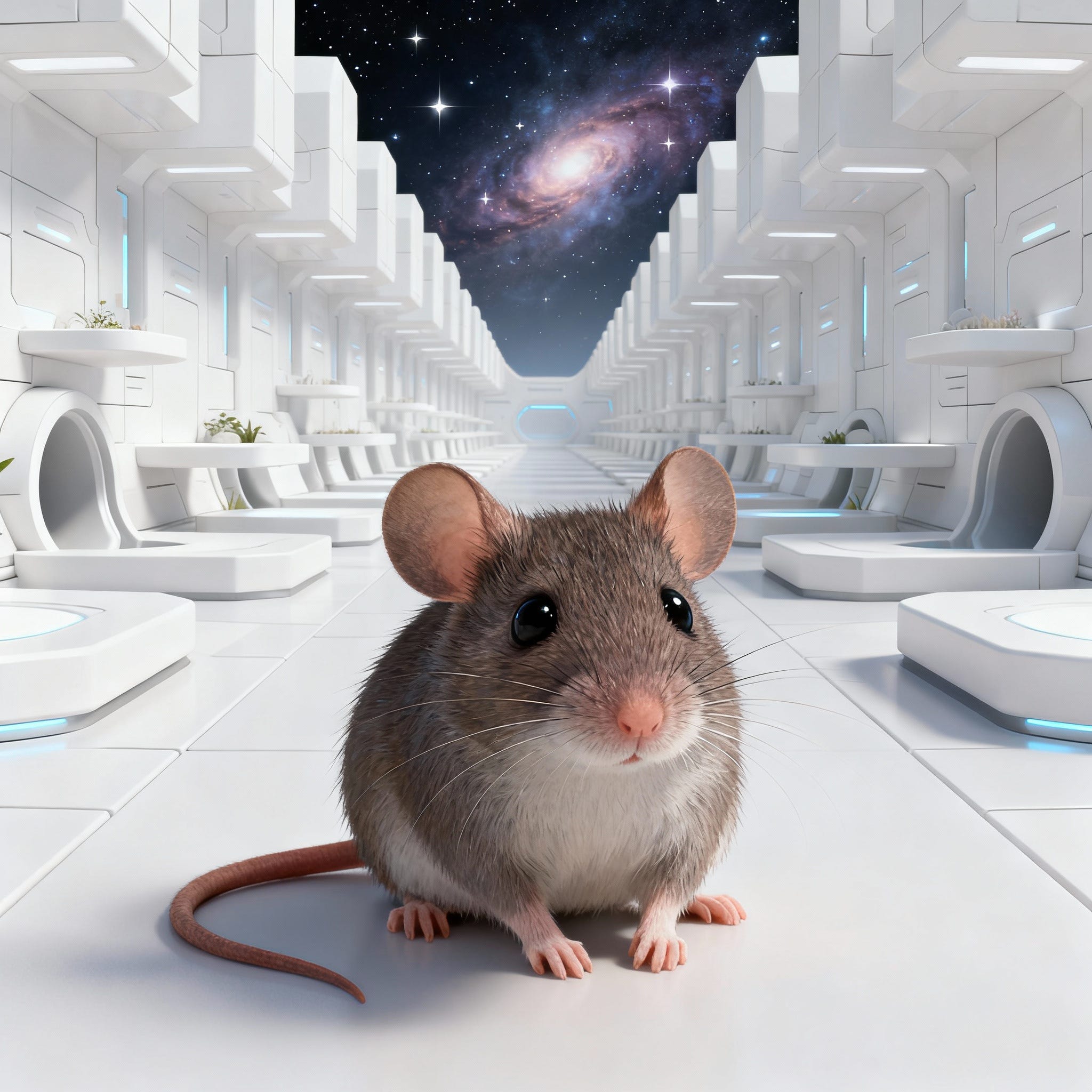
In 2026, we’re running our own version; on a planetary scale. The question isn’t whether we’ll collapse like the mice. It’s whether we’ll wake up in time to measure what matters, question the dominant paradigm, and reclaim the electrodynamic harmony that life evolved within.
Science advances by confronting the invisible. Frequencies are real, measurable, and fundamental. Let’s stop pretending otherwise.
We are living through a historic paradigm shift: from a purely biochemical medicine to an electromolecular medicine that finally acknowledges the electrical nature of life. The cell is not a chemical factory — it is a rechargeable battery. And when we learn to remove what discharges it and support what recharges it, health ceases to be a mystery and becomes an elegant, reproducible biophysical process.
... my new Book “Archieved Health” is now available on Voedia.com

With warmest regards and in service of humanity’s health,
Dr. h.c. Andreas Ludwig Kalcker https://alkfoundation.com/en/
Dr. hc Andreas Ludwig Kalcker is a biophysicist and pioneer in electromolecular medicine. Full Data on dioxipedia.com . All articles are for scientific discussion only.
Comments
Nothing yet. Say the first thing.
Sign in to join the conversation.