

You know this experience. You have been working on something for hours — a problem, a piece of writing, a decision, a creative block that will not move — and nothing comes. You step away. You get in the shower, or go for a walk, or lie down meaning to rest for ten minutes, and somewhere in that unguarded space the thing arrives. The solution you couldn’t force. The sentence that had been hiding. The clarity that hours of deliberate effort hadn’t produced.
Most people experience this as a pleasant accident. The neuroscience says it is something much more deliberate — not a coincidence but a predictable output of a specific brain state that most of us spend almost no intentional time cultivating.
The brain operates in two fundamentally different modes. The first is the focused mode — directed, effortful, analytical attention. This is the mode most of us equate with work: the state of concentrated engagement with a specific task, with the prefrontal cortex running the show. It is excellent for executing known processes, solving problems with clear parameters, and moving through tasks that require sequential logical thinking. It is what most of the modern workday is designed to produce and sustain.
The second mode is what neuroscientists call the Default Mode Network — the brain state that activates when directed attention relaxes. This is the mode of the shower, the walk, the idle afternoon, the half-asleep moment before full waking. It was long assumed to be the brain idling — doing nothing in particular while waiting for real work to resume. The last two decades of research have overturned this completely.
The Default Mode Network, it turns out, is not the brain at rest. It is the brain doing a different and in many ways more sophisticated kind of work: making connections across distant domains, integrating information from disparate sources, running simulations of possible futures, and surfacing insights that focused attention — by its very nature — cannot produce. Focused thinking narrows. The DMN expands. Creativity, genuine insight, and the kind of thinking that changes something require both.
The relationship between effort and creative output is not linear. Beyond a certain threshold, more focused effort on a creative problem actively suppresses the DMN activity that would produce the insight being sought. The harder you try to force a creative breakthrough, the more completely you shut down the neural mode in which breakthroughs occur.
This is not a motivational failure. It is neurological. The prefrontal cortex, when fully engaged in directed effort, inhibits the DMN almost entirely. The two modes are largely anti-correlated — when one is active, the other is suppressed. This means that the solution to a creative block is almost never more focused effort. It is deliberate, strategic disengagement — not as a reward for having worked hard enough, but as a necessary condition for the kind of thinking that effort cannot reach.
What the research on incubation — the term for the period of apparent inactivity between focused work and creative insight — consistently shows is that the break is not passive. The DMN continues processing the problem in the background, making associations and testing configurations that focused attention never would have reached. The insight feels like it comes from nowhere because the work that produced it was invisible. It was happening below the threshold of conscious awareness, in a brain state that most people have been taught to treat as unproductive.
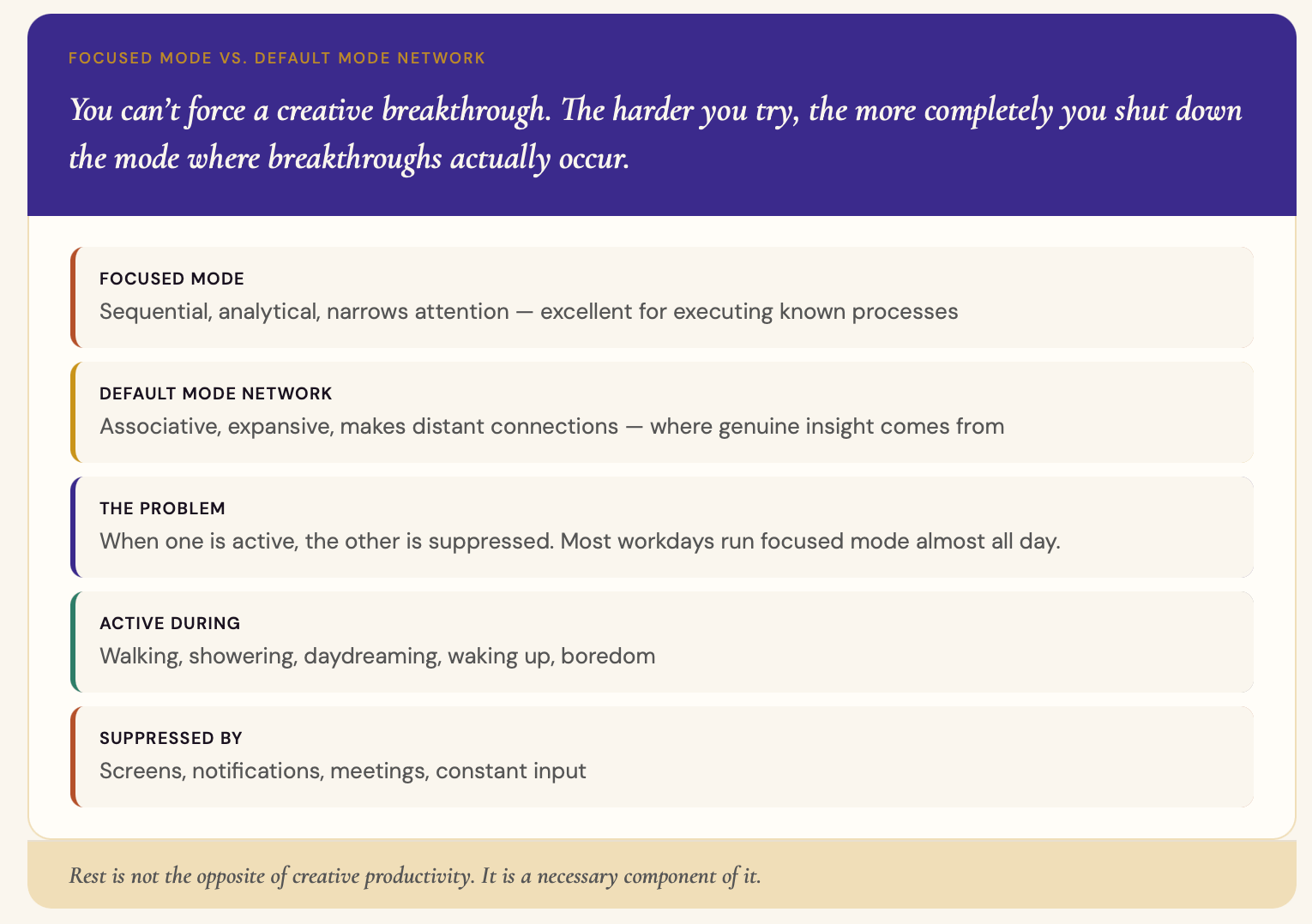

The structure of modern knowledge work is almost perfectly designed to suppress creative output. Back-to-back meetings, constant notification, the expectation of continuous availability, the cultural equation of busyness with productivity — all of these produce the sustained focused-mode engagement that executes existing processes efficiently, and all of them systematically eliminate the conditions under which the DMN can do its work.
The result is a particular kind of professional stuck: highly productive in the execution sense, generating significant output, and yet somehow not producing the genuinely new thinking that the work actually requires. The emails get answered, the meetings happen, the deliverables land on time. But the idea that would change something — the solution to the problem that has been sitting there for months, the creative leap that would make the difference — never quite arrives. Because it cannot arrive in the mode that is running almost all day.
What I see consistently in clinical practice, particularly with high-achieving clients who feel creatively blocked or intellectually stagnant, is not a deficit of effort or capability. It is a deficit of DMN time. These are people who are very good at focused work and have structured their lives to maximize it. They have inadvertently structured out the mental state that their best thinking depends on.

Stanford researchers Marily Oppezzo and Daniel Schwartz found that walking increased creative output by an average of 81 percent compared to sitting — and that the effect persisted even when participants were walking on a treadmill facing a blank wall, ruling out environmental novelty as the cause. The movement itself, not the scenery, was doing something neurologically significant.
Separate research on sleep and creativity has established that the hypnagogic state — the transitional period between wakefulness and sleep — is among the most creatively generative brain states available. Thomas Edison famously napped in a chair holding steel balls, which would drop and wake him when he fell fully asleep, allowing him to harvest the insights arising in the half-sleep state before they disappeared into deeper unconsciousness. Salvador Dali reportedly used the same technique with a key and a plate. Whether or not these stories are entirely accurate, the neuroscience underlying them is solid: the hypnagogic state produces a distinctive pattern of loosely associated, highly novel thinking that waking consciousness rarely replicates.
The practical implication is significant. Rest, walks, boredom, daydreaming, and the intentional absence of stimulation are not the opposite of creative productivity. They are a necessary component of it — one that most high-achieving people have been taught to feel guilty about and have systematically eliminated from their working lives.
The goal is not to work less. It is to work in a way that includes both modes deliberately — protecting focused time for execution and protecting DMN time for the thinking that execution cannot produce. Here is what that looks like in practice.
01 WORK ON HARD PROBLEMS BEFORE YOU STEP AWAY
The incubation effect requires prior focused engagement with the problem. The DMN cannot make connections around something that hasn’t been loaded into working memory first. Spend focused time on the problem — genuinely engaging with it, getting stuck, noticing where the edges are — and then deliberately step away. The walk, the shower, the rest period works best when it follows concentrated effort, not as a substitute for it. Load the problem first. Then let go.
02 PROTECT ONE UNSTIMULATED PERIOD EVERY DAY
A walk without headphones. A shower without mental planning. Ten minutes sitting without a screen. These are not rewards for having done enough work — they are productive time in a different mode. The single most consistent finding in creativity research is that insight requires periods of genuine mental quiet. Not meditation necessarily, not enforced emptiness — just the absence of the constant input that keeps the focused mode running and the DMN suppressed. One period per day, treated as non-negotiable.
03 KEEP SOMETHING TO CAPTURE IDEAS WITH YOU ALWAYS
The insight that arrives in the diffuse state is often fragile. It surfaces at the edge of sleep, mid-walk, in the shower, in the brief space between tasks — and it can disappear within minutes if not captured. This is not a character flaw; it is a feature of how DMN-generated insight works. It comes up through a different channel than deliberate thought and it does not always wait. A small notebook, a voice memo app, a note on your phone — the tool matters less than the habit of using it immediately, before the focused mode resumes and the insight fades.
04 USE BOREDOM DELIBERATELY

Boredom — genuine, unstimulated boredom, not the kind that reaches for the phone after thirty seconds — is one of the most reliable DMN activators available. Research by Sandi Mann at the University of Central Lancashire found that people who performed a boring task before a creative task significantly outperformed those who went straight to the creative work. The boredom itself was doing something. Waiting rooms, commutes, repetitive physical tasks, sitting quietly without agenda — these are not wasted time. They are incubation. Treat them accordingly rather than filling them reflexively with stimulation.
05 SCHEDULE CREATIVE WORK AFTER PHYSICAL MOVEMENT
The Stanford walking research is actionable in a straightforward way: if you have creative work that requires genuinely novel thinking — writing, problem-solving, ideation, strategic planning — do it after physical movement rather than before. A twenty-minute walk, a brief run, even a few minutes of movement will have shifted your brain state in ways that favor the loose associative thinking creativity requires. The effect is not subtle. It is among the most robust findings in the creativity literature, and it costs nothing to implement.
Until next week,
Dr. Judy Ho
Clinical & Forensic Neuropsychologist · drjudyho.com
P.S. — If this resonated with you, forward it to someone who might struggle with negative self-talk.
Share The Dr. Judy Ho Newsletter

I’m thrilled to share that I’ve just launched my new podcast, Savvy Psychologist — and the first episode is live now. Each week, I break down a psychological phenomenon in plain language, explain why it’s happening to you, and give you science-backed tools you can actually use.

Listen/watch my Savvy Psychologist podcast!
Take my attachment styles quiz
About me:
Dr. Judy Ho, Ph. D., ABPP, ABPdN is a triple board certified and licensed Clinical and Forensic Neuropsychologist, a tenured Associate Professor at Pepperdine University, television and podcast host, and author of Stop Self-Sabotage. An avid researcher and a two-time recipient of the National Institute of Mental Health Services Research Award, Dr. Judy maintains a private practice where she specializes in comprehensive neuropsychological evaluations and expert witness work. She is often called on by the media as an expert psychologist and is also a sought after public speaker for universities, businesses, and organizations.
Dr. Judy received her bachelor’s degrees in Psychology and Business Administration from UC Berkeley, and her masters and doctorate from SDSU/UCSD Joint Doctoral Program in Clinical Psychology. She completed a National Institute of Mental Health sponsored fellowship at UCLA’s Semel Institute.
No posts
Comments
Nothing yet. Say the first thing.
Sign in to join the conversation.