

Loneliness is one of the most misunderstood experiences in modern life — partly because the word itself is imprecise, and partly because the cultural story we tell about it is almost entirely wrong.
The cultural story goes like this: loneliness is the feeling of being alone. It is caused by social isolation. It is solved by the presence of other people. It is a circumstantial problem, not a neurological one. And it is, in some sense, a personal failing — evidence of social inadequacy, introversion taken too far, or an inability to connect.
None of this is accurate.
The neuroscience of loneliness, developed most rigorously by the late John Cacioppo at the University of Chicago, tells a completely different story. Loneliness is not the objective condition of being alone. It is the subjective experience of feeling socially disconnected — and those two things are entirely separable. A person can be surrounded by dozens of people and feel profoundly lonely. A person can be objectively alone — living alone, working alone, spending most of their time in solitude — and feel genuinely connected. What determines loneliness is not the number of social contacts. It is the quality of felt connection, and the degree to which a person feels seen, known, and safe in their relationships.
This distinction matters enormously, because it means that the conventional solutions to loneliness — more social activity, more connections, more people — frequently fail to address what is actually happening. You cannot fix a neurological state with a calendar.
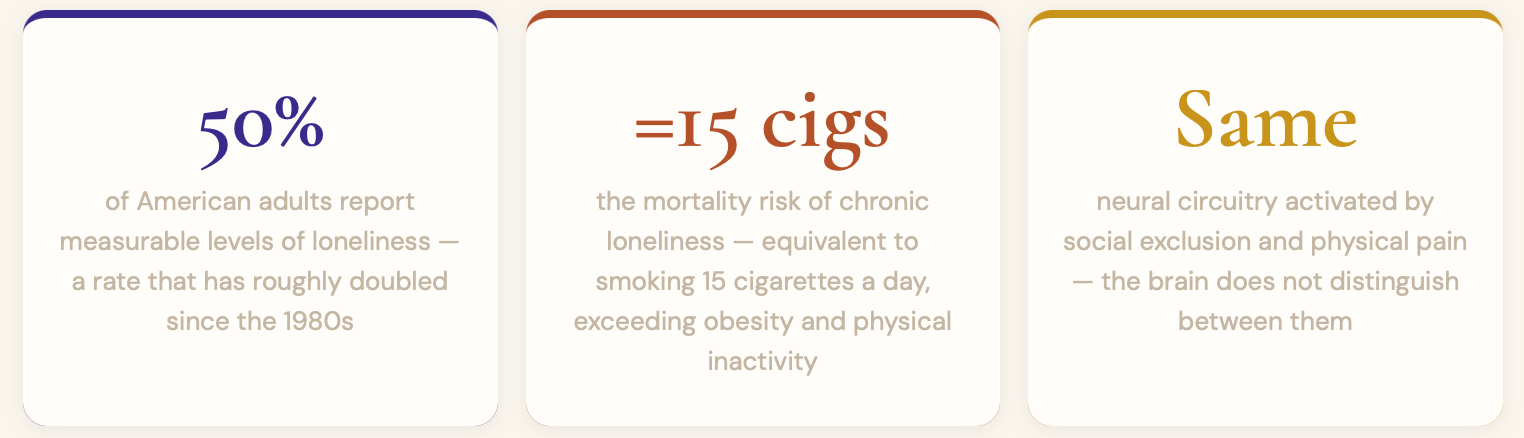

The most striking finding in loneliness research — and the one that most fundamentally reframes what we are dealing with — came from neuroimaging studies conducted by Naomi Eisenberger at UCLA. Using fMRI, Eisenberger demonstrated that social exclusion activates the same regions of the brain as physical pain. Specifically, the dorsal anterior cingulate cortex and the anterior insula — regions associated with the affective, distressing component of physical pain — show increased activation during experiences of social rejection.
This is not a metaphor. The brain does not have separate systems for social pain and physical pain. It processes them through overlapping circuitry. The ache of rejection, the burn of exclusion, the heaviness of feeling profoundly alone — these are not weak emotional responses to difficult circumstances. They are the activation of a pain system that evolution built to protect social animals from the most dangerous condition they could face: separation from the group.
The evolutionary logic is clear. For most of human history, social exclusion was effectively a death sentence. A human separated from their group had no protection, no food sharing, no cooperative defense. The brain’s threat-detection system evolved to treat social disconnection as a survival-level emergency — activating the same alarm response as physical danger, producing hypervigilance to social threat, and motivating the organism to restore connection at virtually any cost. That system is still running in every person who feels lonely today. The environment has changed. The neurobiology has not.
Research: Eisenberger, N.I., Lieberman, M.D., & Williams, K.D. (2003). Does rejection hurt? An fMRI study of social exclusion. Science, 302(5643). This landmark neuroimaging study demonstrated that social exclusion activates the dorsal anterior cingulate cortex — a region associated with the distressing component of physical pain — establishing that social and physical pain share neural substrates.
If the neuroscience of loneliness were only about subjective suffering, it would be significant enough. But the research on its physiological consequences is what makes loneliness one of the most serious public health concerns of our time.
Cacioppo’s decades of research established that chronic loneliness — the persistent, subjective experience of social disconnection — produces a measurable and distinctive physiological signature. Lonely individuals show elevated baseline cortisol, increased inflammatory markers, disrupted sleep architecture, elevated blood pressure, and a pattern of immune dysregulation that specifically impairs the body’s ability to respond to viral threats while simultaneously promoting chronic inflammation. This is not the physiological profile of someone who happens to be alone. It is the physiological profile of someone whose threat-detection system has been chronically activated.
The mortality data is the most striking. A meta-analysis by Julianne Holt-Lunstad synthesizing data from 148 studies and over 300,000 participants found that social isolation, loneliness, and living alone each independently predicted premature mortality — with effect sizes comparable to smoking 15 cigarettes a day and exceeding those of obesity, physical inactivity, and air pollution. The finding was consistent across age groups, health conditions, and countries. Chronic loneliness is not a quality-of-life problem. It is a mortality risk factor.
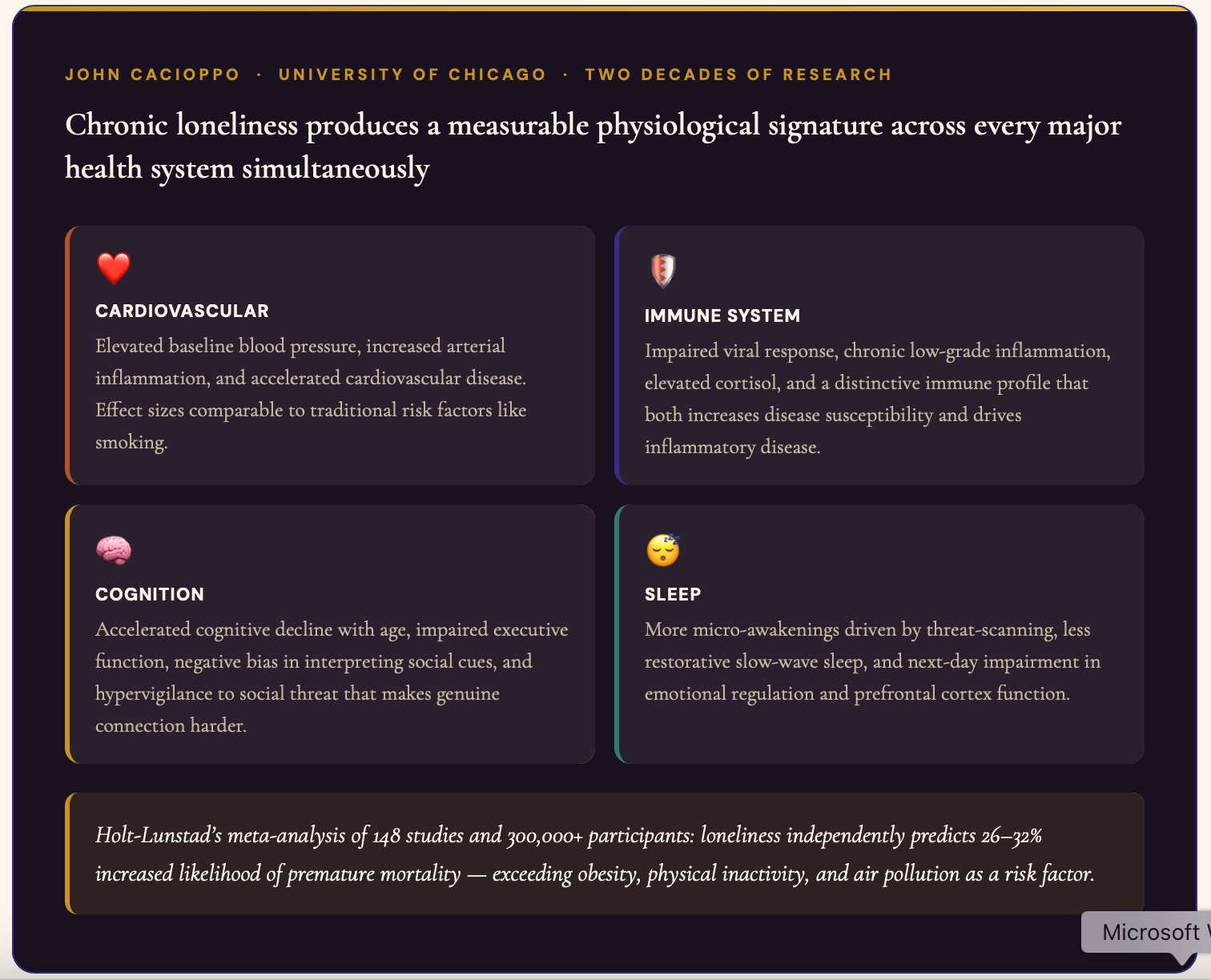
The cognitive effects are equally significant. Cacioppo’s research found that lonely individuals show accelerated cognitive decline with age, impaired executive function, more negative interpretation of ambiguous social cues, and a hypervigilance to social threat that ironically makes genuine connection harder to establish and maintain. The loneliness threat-response creates a self-reinforcing cycle: feeling socially threatened makes people simultaneously more hungry for connection and more guarded against the vulnerability it requires. The biology of loneliness makes loneliness harder to escape.
The sleep disruption is particularly consequential. Matthew Walker’s research and subsequent work has established that lonely individuals experience more micro-awakenings during sleep — brief arousals driven by the threat-detection system scanning for danger in the night — and less restorative slow-wave sleep. This produces the same downstream effects on prefrontal cortex function, emotional regulation, and allostatic load that we covered in previous newsletters. Loneliness, in other words, doesn’t just feel bad. It compounds.
In 2023, US Surgeon General Vivek Murthy issued a formal advisory declaring loneliness a public health epidemic, citing data showing that approximately half of American adults reported measurable levels of loneliness, and that rates had been rising for decades before the COVID-19 pandemic accelerated them further. The UK appointed a Minister for Loneliness in 2018. The data across countries is consistent: rates of chronic loneliness have roughly doubled in the United States since the 1980s, with the sharpest increases among young adults aged 18 to 34 — the most socially connected generation in history by any objective metric of social contacts, yet among the loneliest by subjective measure.
This apparent paradox — more connections, more loneliness — resolves once you understand the neuroscience. Social media, messaging platforms, and the expansion of weak-tie social networks do not address the neurological need that loneliness represents. They provide contact without felt connection, presence without attunement, interaction without the specific experience of being genuinely known. The brain’s social circuitry requires depth, reciprocity, and felt safety — none of which are reliably produced by the kind of connection most people now have the most of.
Research: Cacioppo, J.T., & Patrick, W. (2008). Loneliness: Human Nature and the Need for Social Connection. W.W. Norton. This synthesis of two decades of research established the biological framework for understanding loneliness as a threat-detection state with measurable physiological consequences, and documented the self-reinforcing cycle by which chronic loneliness makes connection harder to achieve.
The most important clinical reframe in addressing loneliness is this: the goal is not more social contact. It is felt connection — which is a different target entirely, and one that requires different interventions. Here is what the research most consistently supports.
01 PRIORITIZE DEPTH OVER BREADTH
The neurological need that loneliness represents is not satisfied by social volume. It is satisfied by the specific experience of being genuinely known — of having relationships in which you can be honest about your actual experience without editing, performing, or managing the other person’s response. One relationship with that quality produces significantly more relief from loneliness than a dozen relationships without it. The intervention is not to expand your social network. It is to identify the existing relationship with the most potential for depth and invest there deliberately: longer conversations, more honest disclosure, more genuine curiosity about the other person’s interior life.
02 RECOGNIZE AND INTERRUPT THE LONELINESS THREAT-RESPONSE
The self-reinforcing cycle of loneliness — in which the threat-detection state produces hypervigilance to social rejection, which makes vulnerability harder, which makes connection less likely — can be interrupted at the level of awareness. When you notice yourself interpreting a social interaction negatively, or pulling back from potential connection out of anticipated rejection, ask: is this an accurate reading of the situation, or is this the threat-response running its script? Cacioppo’s research found that lonely individuals systematically misinterpret neutral social cues as hostile. Naming this as a pattern — rather than an accurate perception — creates a gap in which a different response becomes possible.
03 INVEST IN SHARED ACTIVITY, NOT JUST CONVERSATION
Research on the conditions that most reliably build felt connection consistently points to shared activity — doing something alongside another person — as more effective than conversation alone, particularly for people who find direct emotional disclosure difficult. The parallel activity structure reduces the intensity of face-to-face interaction, creates a shared focus that takes pressure off the relationship itself, and produces the kind of accumulated shared experience that is one of the primary building blocks of felt intimacy. Walking together, cooking together, working on something side by side: these create connection through a different mechanism than talking about connection does.
04 ADDRESS THE VULNERABILITY PROBLEM DIRECTLY
For many people, chronic loneliness is maintained not by a lack of social opportunities but by a specific difficulty with the vulnerability that genuine connection requires. The fear of being truly known — and found wanting — produces a self-protective stance that prevents the depth of engagement that would actually resolve the loneliness. The intervention is graduated: small, specific acts of genuine disclosure in relationships where the conditions feel safest. Not confession, not over-sharing — honest self-expression about something real, offered at a level of risk that is challenging but not overwhelming. Each instance that is met with acceptance rather than rejection updates the threat-response’s prediction. That updating is slow. It is also cumulative, and it is the actual mechanism of change.
05 TAKE THE PHYSICAL PRESENCE OF OTHERS SERIOUSLY
The body’s social circuitry responds to physical co-presence in ways that remote interaction does not fully replicate. Research on co-regulation — the process by which the presence of another calm, attuned nervous system directly modulates our own — requires physical proximity. This is not an argument against digital connection, which has genuine value. It is an argument for treating shared physical space as a non-negotiable component of a loneliness intervention plan, not a nice-to-have. Regular physical presence with people whose company produces genuine ease — not performance, not obligation, genuine ease — is one of the most direct interventions available. The dose matters less than the quality and consistency.
Until next week,
Dr. Judy Ho
Clinical & Forensic Neuropsychologist · drjudyho.com
P.S. — If this resonated with you, forward it to someone who might struggle with negative self-talk.
Share The Dr. Judy Ho Newsletter

I’m thrilled to share that I’ve just launched my new podcast, Savvy Psychologist — and the first episode is live now. Each week, I break down a psychological phenomenon in plain language, explain why it’s happening to you, and give you science-backed tools you can actually use.

Listen/watch my Savvy Psychologist podcast!
Take my attachment styles quiz
About me:
Dr. Judy Ho, Ph. D., ABPP, ABPdN is a triple board certified and licensed Clinical and Forensic Neuropsychologist, a tenured Associate Professor at Pepperdine University, television and podcast host, and author of Stop Self-Sabotage. An avid researcher and a two-time recipient of the National Institute of Mental Health Services Research Award, Dr. Judy maintains a private practice where she specializes in comprehensive neuropsychological evaluations and expert witness work. She is often called on by the media as an expert psychologist and is also a sought after public speaker for universities, businesses, and organizations.
Dr. Judy received her bachelor’s degrees in Psychology and Business Administration from UC Berkeley, and her masters and doctorate from SDSU/UCSD Joint Doctoral Program in Clinical Psychology. She completed a National Institute of Mental Health sponsored fellowship at UCLA’s Semel Institute.
No posts
Comments
Nothing yet. Say the first thing.
Sign in to join the conversation.