
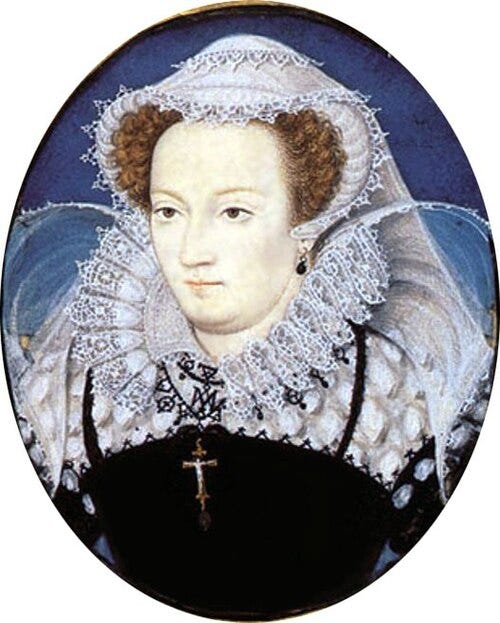
If Mary, Queen of Scots, accepted Elizabeth I’s proposal, Ambrose Dudley, earl of Warwick, would find himself brother to the King of Scots. If Elizabeth I accepted the Scottish Queen’s counter-proposal, he would be King of Scots himself.
Reporting from London, ambassadors were sure that Elizabeth was ‘determined to take th’one’ - Robert - ‘and give [Mary] th’other’ - Ambrose, using the Dudley brothers to exert control over the whole of Britain.1 Mary, for her part, took it all as a bit of fun, scandalising her secretary of state. ‘She wished to God the earl of Warwick,’ he reported, ‘had the grace and good looks of Lord Robert, in which case each could have one.’ As it was, though he was ‘not ugly either, and was not ungraceful’ and ‘was so brave, so liberal and magnanimous that truly he was worthy of being the husband of any great princess’, she could not overlook his brusque soldier ways. His manner, she commented ‘was rather rough and he was not so gentle as Lord Robert.’2
One cannot escape the conclusion that the Queen of Scots was teasing her secretary, and by extension those who heard the tale, including Elizabeth. Neither party seemed to take the suggestion of the pair of Dudley consorts that seriously, but the gossiping ambassadors did.
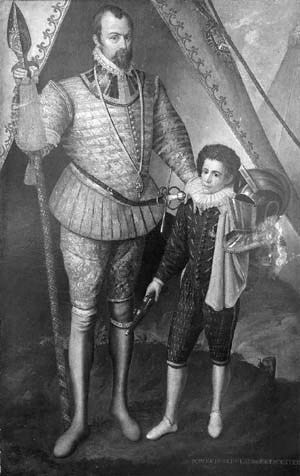
Ambrose’s court career after his return from Le Havre was not as glamorous or scandalous of that of his brother, but he still played a critical role in some of the most important and dramatic moments in Elizabeth’s reign - especially those to do with the Queen of Scots - and, perhaps most movingly, in his own brother’s life. Ambrose and Robert were a pairing throughout Elizabeth’s reign, and the Dudley dominance in Warwickshire particularly comes from their shared power. The bear and ragged staff, associated with the earldom of Warwick, was shared between the two brothers in a way that was entirely unprecedented in English history.3 It is no wonder that in his will, Robert Dudley broke with convention and became emotional, leaving to his ‘dear and noble brother… as dear an affection as as ever brother bear to other.’4
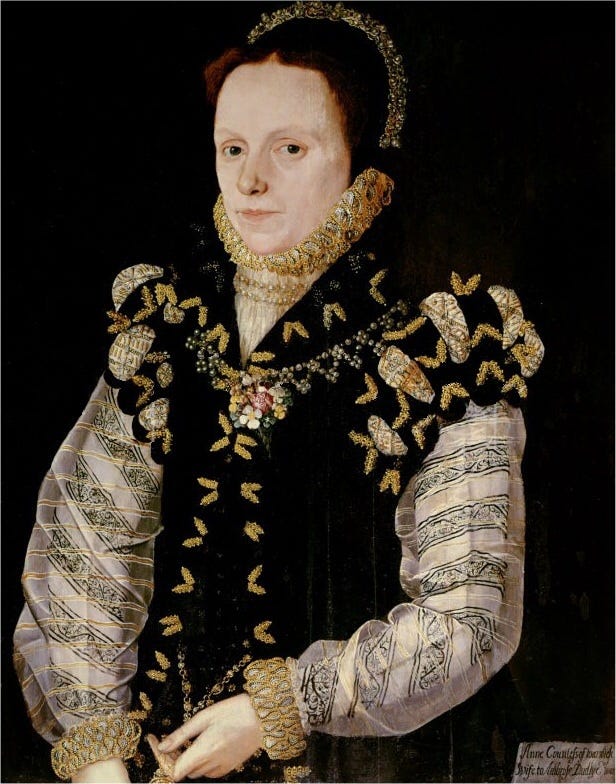
Not long after Ambrose’s name was bandied around in regard to the Queen of Scots, he became maritally unavailable. On the 11 November 1565, the Earl of Warwick married Anne Russell, the daughter of the earl of Bedford.5 Aged just 16, she was almost half his age and his third wife. No living children had resulted from his first two marriages, the second of which had ended miserably. Anne’s age and pedigree lent new hope to the prospect of a Dudley heir. The wedding was celebrated as if the couple were members of the queen’s own family. Anne and Ambrose wore matching purple velvet - Anne’s embroidered in silver and Ambrose’s in gold. The bride wore a caul of gold over her auburn hair. Once Anne and Ambrose were in place, the queen herself entered, giving her royal blessing to the marriage.
Prime in everyone’s minds, as they watched the grand wedding, was whether the queen might also enter a state of holy matrimony, perhaps with the man who gave the bride away, Ambrose’s brother, Robert. A year into his marriage, Ambrose was instrumental in the preparation and delivery of a petition from parliament to the queen regarding her marriage and the succession. In the past, the queen had taken this kindly, but been firm in her refusal. Now, several years into her reign, she was less accommodating. ‘When I call to mind,’ she railed against them, ‘how far from dutiful care, yea, rather how nigh a traitorous trick this tumbling cast did spring, I muse how men of wit can so hardly use that gift they hold.’6 Ambrose Dudley, grandson, son and brother of executed traitors, would not have taken ‘traitorous trick’ lightly. He had been instrumental in involving the House of Lords in the petition, and was banned from the presence chamber as a result.
This had little effect on Ambrose, however, who dedicated much of his time to provincial over court politics. In Warwickshire, the Dudleys reigned supreme, and Ambrose Dudley was the key presence in the region. This extended, as we might expect, to Stratford-upon-Avon, and Dudley had direct dealings with members of William Shakespeare’s family, which is perhaps why, Shakespeare took advantage of a reference to an earlier Earl of Warwick to warn his audience to ‘hide thee from the bear’.7
Ambrose made an attempt to return to the field in 1569, in opposition to the Northern Rebellion, which had been formed against ‘new set up nobles about the queen’s Majesty’, which almost certainly included the Dudley brothers.8 Mary, Queen of Scots, had fled to England the year before, and several northern Catholic-leaning earls sought to advance her claim over that of Elizabeth’s. In the end, there was only a minor skirmish and the Earl of Warwick requested permission from the queen to disband his troops only a month after they had been commissioned, in part due to ‘sickness’, perhaps related to the wound he had suffered at Le Havre.
The spectre of the Queen of Scots did not cease to haunt the Earl of Warwick, however, and the entirety of the English court. He was a member of the committee that laid out the nature of the Ridolfi Plot - another conspiracy to replace Elizabeth with Mary - and recommend a course of action in response, namely that the deposed Scottish queen be tried for treason. Though this bill passed both Houses of Parliament, it was vetoed by the queen, who did not want to execute a fellow anointed sovereign.
She had no such qualms about members of her own family, however. In 1572, Ambrose Dudley was a member of the jury that tried Thomas Howard, 4th Duke of Norfolk, for scheming to marry Mary and overthrow Elizabeth. The trial lasted 12 hours, but the duke was convicted of treason and sentenced to die, including by Ambrose and his brother. This might have felt like justice in more ways than one, as the Howards had hated the Dudleys for generations, and gloated each time they fell. Though Robert had once sided with this particular Howard, he joined his brother in condemning him to a traitor’s death. It would be almost a hundred years before another Duke of Norfolk graced the English court.
‘If I were as you,’ Ambrose wrote his dear brother in March 1586, ‘I would go to the furthest part of Christendom rather than ever come to England again.’9 Ambrose had not heard from his brother in some months, since he left for the Netherlands before Christmas. But he had heard the reports that Robert Dudley had taken on the role of Governor of the United Provinces, a princely title, without permission from the queen, and incurred her wrath. ‘Our mistress’s extreme rage doth increase rather than in any way diminish’, he warned his younger brother, ‘and giveth out great threatening words against you’. In short, ‘her malice is great and unquenchable.’ Ambrose had been unable to travel to the Netherlands with his brother and other members of their family; he was too infirm. All he could do was write letters that might never reach Robert, warning him of the deep and dangerous trouble he was in, and do his best to intercede with the queen.
In the end, a combination of pleading with the queen and scapegoating Robert’s poor secretary worked, and Robert was returned to the queen’s favour. The mission to the Netherlands was disastrous all the same, and cost the life of Ambrose’s nephew and protege, Sir Philip Sidney.10 As Philip lay dying in Arnhem, three hundred miles away, at Fotheringhay Castle, Ambrose Dudley attended the arraignment of Mary, Queen of Scots, who had once joked would be his bride. She said little throughout her trial, though, perhaps reminded of that exchange two decades before, reportedly turned to Ambrose specifically and told him ‘that she had heard he was an honourable gentleman’, and wished him ‘not to believe all things he had heard of her’.11 Ambrose did not attend the Star Chamber meeting that determined Mary’s guilt, and it was his brother who was instrumental in delivering the execution order that killed her.
Robert himself died on the 4 September 1588, weeks after preparing troops to face the prospective invasion of the Spanish Armada. Ambrose Dudley had been too ill to participate. He was named in as his younger brother’s heir, but died only 18 months later, reportedly in great pain and his wife distraught. In his final will, written a month before his death, he bestowed most of his lands and properties to his wife, who was also named as executrix, largely to pay off his substantial debts. Bequests also went to his nephews, Thomas Sidney and Robert Sidney and Ambrose’s sister, Katherine, countess of Huntingdon, as well as providing financial protection for his niece, Elizabeth Sidney. Neither Dudley brother left behind a legitimate son, and both their titles died with them.
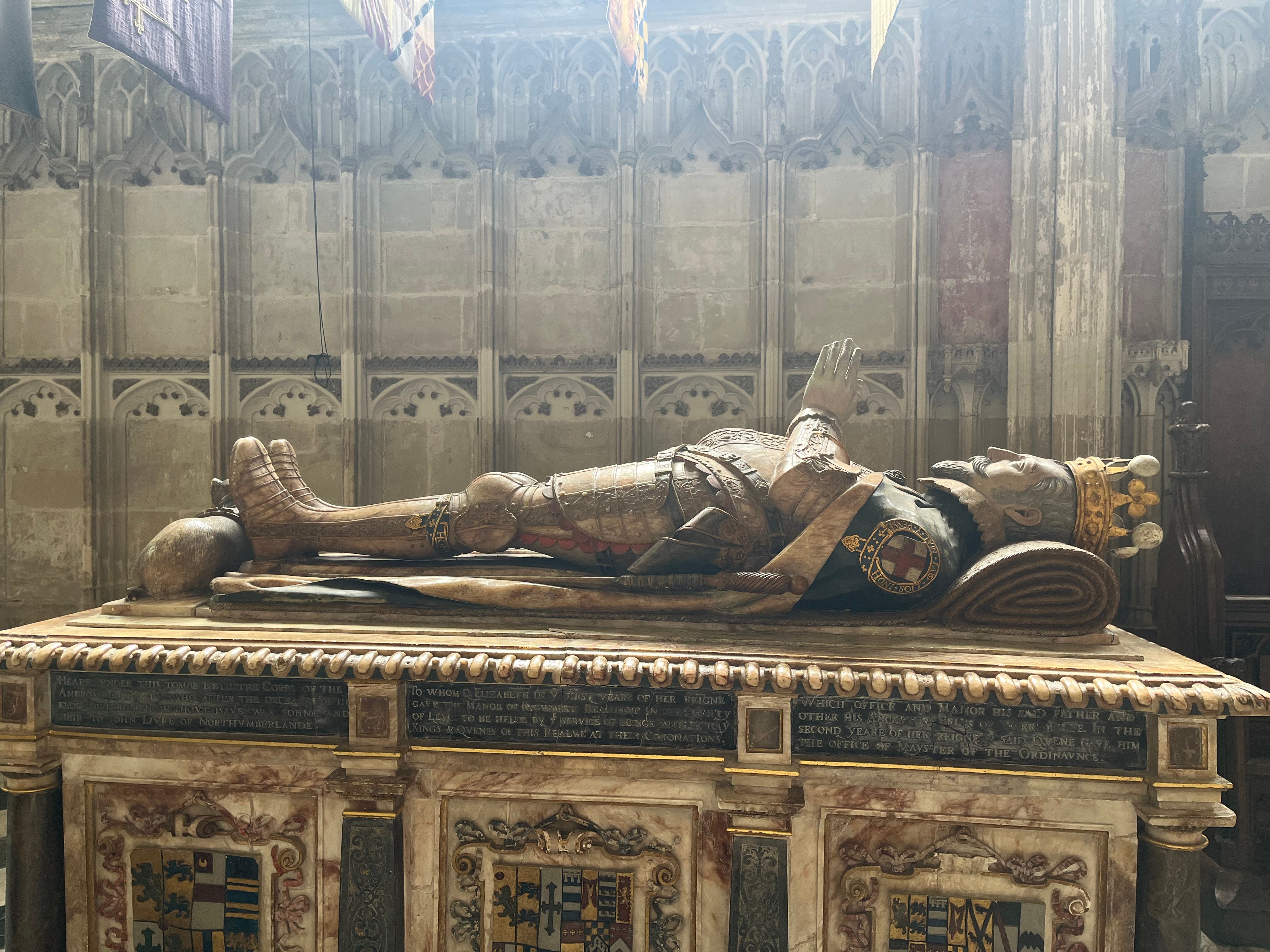
Ambrose was buried just feet away from his brother in the Beauchamp Chapel, St Mary’s Church, Warwick. There you can find a life-sized effigy of the earl as he wished to be remembered to posterity, in full armour, his sword by his side. The marble tomb is inscribed with the titles and honours he received from his queen.
Ambrose Dudley’s life lacks the glamour of that of his younger brother, as the Queen of Scots well recognised. He was rougher, less graceful, and perhaps for that reason has been overlooked by histories and left out of screen representations of the period. He could be unfeeling, as he appears to have been to his second wife, but also had a great capacity for affection. He endured great hardships as a Dudley son and served his queen with unrivalled dedication. He was the son of a traitor, and very nearly the brother of a king (and perhaps even one himself). His deepest loyalty was to his family - namely his beloved brother, and one of his last acts before pain and death took him was to ensure the care of his son’s illegitimate son… but that’s another story.
CSP Scot. 1563-9, p. 37.
CSP Sim. 1558-67, no. 216.
Glyn Parry and Cathryn Enis, Shakespeare Before Shakespeare: Stratford-upon-Avon, Warwickshire, and the Elizabethan State (OUP Oxford, 2020), 35-8.
Account from Paul, The House of Dudley.
Terence Hartley, ed., Proceedings in the Parliaments of Elizabeth I, Vol. 1: 1585-1589 (Bloomsbury Academic, 1981). i. 145; Longleat, DP/III, ff. 33-9.
Parry and Enis, Shakespeare Before Shakespeare, 7; 2 Henry VI, 5, iii, 200-8.
Anthony Fletcher and Diarmaid MacCulloch, Tudor Rebellions (Routledge, 2015), 166; Stephen Alford, The Early Elizabethan Polity: William Cecil and the British Succession Crisis, 1558–1569 (Cambridge University Press, 1998), 207.
John Bruce, ed., Correspondence of Robert Dudley, Earl of Leycester: During His Government of the Low Countries, in the Years 1585 and 1586 (Camden Society, 1844), 150-1.
Ambrose shared his position of Master of the Ordinance with Sidney from July 1585.
Cott., Caligula C IX/2, f. 474.
No posts
Comments
Nothing yet. Say the first thing.
Sign in to join the conversation.