
‘You, also,’ Robert continued, ‘have so carelessly discharged your part, in the due declaration of all things as they stood in truth.’
‘I appeal,’ Davison retorted, ‘to the testimony of others.’
‘For by the letters, and message I have received by Mr Heneage, neither doth her majesty know, how hardly I was drawn to accept this place before I had acquainted her.’
‘He’ – Thomas Heneage – ‘was dispatched the same night I arrived.’ Had Heneage misinformed the earl, or did the earl simply not care?
‘I did,’ Robert pressed on the matter of the absolute governorship, ‘very unwittingly come to the matter.’
‘Hereof let the world judge,’ was all Davison replied.
- THE HOUSE OF DUDLEY, Joanne Paul (Penguin, 2022)
How can you make your non-fiction book read like a novel? There are a number of strategies, and I am sure I will come to many of them in subsequent posts. One of the most important, however, is the inclusion of dialogue.
This becomes very tricky, of course, when you are writing about subjects hundreds of years old. Making the dead speak ought to be approached with caution (and I loved this recent article that questioned our right as historians to bring to light the secrets of the dead at all). WORD OF WARNING: you always need to frame (and cite) your ‘dialogue’ appropriately, so that the source and its limits are clear.
So here are some strategies I have employed in my books to enliven my narrative with speech.
Texts and Letters
This is the easiest way to make sure that, every so often, you include some quotation marks (/inverted commas) to break up your writing. Using bits from letters to provide contemporary commentary or - if you’re very lucky - emotional insights is an essential strategy of the narrative non-fiction writer. This was especially important to me in writing my biography, Thomas More. I wanted to tell his story, at least partially, ‘in his own words’, as words were so important to More. He produced millions of them in his lifetime (‘why do you write like you’re running out of time’ indeed!) and though there are levels of self-fashioning to work through, this is still part of understanding the person he was.
This does allow your characters to ‘speak’, but not directly to each other, and not in a way that was ever intended as speech. For that, you need some other strategies.
In-Text Dialogue
This might not come up unless you’re writing about a writer. Thomas More wrote books known as ‘dialogues’ (the beginning of Utopia, for instance, is one), where two characters engage in a discussion/debate. In my biography, I was able to lift such conversation and present it as dialogue. It helped that in many of his dialogues, there was a figure identifiable with More himself engaging with a less informed interlocutor (though Utopia is more complicated than that). More also wrote a History of King Richard III which included invented speeches and dialogue, which I pulled from, in describing those years, with an acknowledgment, of course, that these were More’s recollections/inventions.
Again, this won’t come up often, and you are dealing with fictionalised speech and often fictionalised characters, even when they are identified with the author. “More” is not always More.
Ceremonies and Rites
‘If anyone knows of any impediment to the marriage,’ Gardiner intoned, ‘he should declare it.’ There was silence – previously existing ‘impediments’ had put an end to all but one of the king’s last five marriages – followed by relieved applause.
Henry then took Catherine’s right hand and, repeating after Gardiner (though surely the king knew the words by now), ‘I, Henry, take thee, Catherine, to my wedded wife, to have and to hold from this day forward, for better for worse, for richer for poorer, in sickness and in health, till death us depart, and thereto I plight thee my troth.’
- THE HOUSE OF DUDLEY, Joanne Paul (Penguin, 2022)This is probably the most straightforward source for speech/dialogue. Given how much was invested in the choice of vocabulary for important ceremonies, we can be pretty certain that what was on the page was what was actually uttered. Religious ceremonies and rites like weddings or baptisms require getting one’s hands on the appropriate liturgy. Likewise, secular ceremonies like coronations usually have a formula which is written down to follow. You do want to be careful with this from a narrative standpoint, however, as these ceremonies can get wordy and repetitive, especially when dealing with a king who marries six times.
Epistolary Exchanges
Here’s where you can get a little more creative. I’ve already mentioned letters, which can be used to enliven the narrative and bring depth to your characters. Of course, letters are often part of an on-going dialogue, so the trick becomes presenting them in a way that allows that dialogue to take place, without presenting huge blocks of text. Connecting the bits of the letters that are speaking to each other together allows this dialogue to live directly on the page.
NOTE: With great creativity comes great responsibility. You want to be careful here to be transparent; this is not a ‘conversation’ that happened directly. You are pulling out the relevant statements from the letters and bringing them together to present to the reader. But unlike the ceremonies above, these were not words spoken, and were not intended to be.
Reported Speech
You have to be very lucky to get your hands on this, and be very careful how you use it. There are three main ways that this comes up for me. The first is reports of speeches: the opening of parliament, sermons, scaffold speeches, etc. These are not dialogue, but they can be useful all the same. The aren’t usually verbatim, and when you have more than one source for a speech (even rarer!) they don’t usually wholly agree. When they do, there’s probably an agenda. Chronicles also fall into this category.
The second source needs to be treated with even more caution. Ambassadors are great sources for reported speech, as it is expected that they will relate everything back to their rulers, without editing. This, of course, they might well do and we at a distance of centuries might not know. That being said, this is where the juicy stuff happens, and as long as you handle it with care and transparency, it’s the best dialogue you’re likely to get.
My favourite example of reported speech that I used in The House of Dudley was Thomas Blount’s reports of his discussions with townspeople and servants after the death of Amy Robsart Dudley. Talk about juicy.
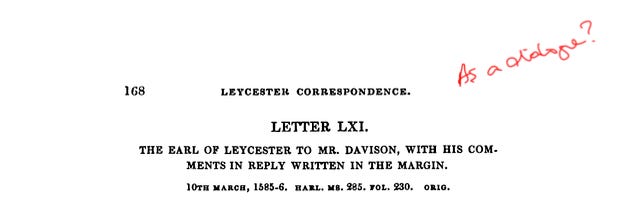
Special Mention: Leicester and DavisonThis was a fun one - it’s the dialogue I included at the top of this article. This was a letter that Robert Dudley wrote in disgrace, after agreeing to become Governor of the Netherlands and enraging Elizabeth I. He blamed it all on his secretary, William Davison, who had spent the previous weeks in London, pleading Leicester’s case to the Queen. In other words, it was a real d**** move and Davison was beside himself. He wrote in the margins rebuttals to each of Leicester’s accusations against him. I presented this like dialogue (while of course, acknowledging what the source actually was) to give it the sense of emotion that actually lay behind it, and emphasise the depth of Leicester’s betrayal. Talk about throwing someone under the coach.

My notes when I came across the Leicester-Davison letter (Bruce, ed., Correspondence, 168–171.)
What strategies have a missed? What other questions do you have about writing lively stories about the dead?
No posts
Comments
Nothing yet. Say the first thing.
Sign in to join the conversation.