
Hi everyone. I hope you’re having a good weekend.
I’m on a plane with my husband and kids as we head to San Diego to spend the week with my mom.
The news has been full of especially chaotic headlines this week, making it easy to miss some important stories.
So, let’s get into it.
Cases of cyclosporiasis continue to rise across the country, and federal investigators have now identified shredded iceberg lettuce supplied by Taylor Farms de Mexico to Taco Bell restaurants as the likely source of one of the ongoing outbreaks.
Michigan alone has reported more than 5,000 probable and confirmed cases and more than 100 hospitalizations, far more than any other state. Nationally, health officials estimate that there are nearly 7,000 cases, although the exact number remains unclear. As of July 14, the CDC had confirmed 1,645 domestically acquired cases and was reviewing more than 5,100 additional reports to determine whether they met the federal case definition. The CDC has acknowledged that state totals may be higher because they can include probable cases and reports that have not yet been incorporated into federal surveillance data.
Federal investigators have identified 1,644 illnesses associated with the outbreak in Indiana, Kentucky, Michigan, Ohio, and West Virginia, including 94 hospitalizations. No deaths have been reported. Among 190 people in Michigan who became sick and reported eating at Taco Bell, 90% said they had eaten iceberg lettuce. The FDA’s traceback investigation then identified Taylor Farms de Mexico as the common supplier of shredded iceberg lettuce to the Taco Bell locations where people had eaten before becoming ill.
In response, Taco Bell stopped using lettuce from Taylor Farms de Mexico, and the company began removing all iceberg lettuce sourced from central Mexico from the U.S. market. Taylor Farms also recalled iceberg lettuce distributed to restaurants, retailers, and food-service customers in at least 27 states. The recall includes some Marketside iceberg salad and shredded lettuce products sold at Walmart. Consumers, restaurants, and retailers should discard any recalled products immediately. For a complete list of recalled products and affected dates, check the FDA’s updated outbreak page.
This is not the first time Taylor Farms has been connected to a major foodborne illness outbreak. In 2013, salad mix produced at the company’s facility in Guanajuato, Mexico, was linked to a Cyclospora outbreak in Iowa and Nebraska. In 2015, a Taylor Farms celery-and-onion blend used in Costco chicken salad was linked to an E. coli outbreak. And in 2024, slivered onions supplied by Taylor Farms were identified as the likely source of the McDonald’s Quarter Pounder E. coli outbreak, which sickened more than 100 people and resulted in one death.
The current investigation remains ongoing as the FDA and CDC determine the full scope of the contamination and whether additional restaurants, retailers, brands, or distribution channels are involved. Federal officials are also investigating other clusters of Cyclospora illness that may have separate sources. People have already filed lawsuits against Taco Bell alleging that they became seriously ill after eating at its restaurants.
Fortunately, Cyclospora does not usually spread directly from one person to another. If you develop persistent watery diarrhea or other symptoms, contact your healthcare provider and ask whether testing for Cyclospora is appropriate. It may not be included in a standard stool panel, but the infection can be treated with antibiotics.
A coalition of public health organizations, parents, and pediatricians sued the FDA over its decision to allow certain unauthorized e-cigarettes and nicotine pouches, including flavored products that appeal to young people, to be sold without completing the scientific review normally required for federal authorization.
The group argues that the FDA violated the Tobacco Control Act by allowing unauthorized products to remain on the market and failed to provide a public comment period before issuing the policy.
The move came shortly after the agency separately authorized the first fruit-flavored e-cigarettes for adults, marking the first time it had authorized vape flavors beyond tobacco and menthol. The FDA has rejected more than 1 million flavored vape products in recent years, largely because of concerns about youth use and nicotine addiction.
Allowing unauthorized nicotine products to remain on the market, shortly after authorizing the first fruit-flavored e-cigarettes, is another example of this administration weakening tobacco oversight while siding with an industry that profits from addiction.
The bipartisan 21st Century Road to Housing Act became law this week after Trump refused to sign it.
Lawmakers from both parties have called it one of the most significant housing bills passed in decades. Trump had said he would delay signing the legislation unless Congress also passed the SAVE America Act, a separate voting bill that would require documentary proof of citizenship to register for federal elections, impose photo-identification requirements, and severely restrict mail-in voting.
Once Congress sends a bill to the president, the president has 10 days, excluding Sundays, to sign or veto it. If the president takes no action and Congress remains in session, the bill automatically becomes law without a signature. Trump allowed that deadline to expire, and the housing bill became law on July 11.
The law is designed to increase the country’s housing supply by encouraging new home construction, reducing some barriers to development, limiting additional purchases of single-family homes by large institutional investors, and expanding access to small-dollar mortgages. The law will not directly lower mortgage rates or inflation, and many of its effects will depend on how it is implemented. But increasing the housing supply could help improve affordability over time.
Housing is a major driver of health, and stable, affordable housing is associated with better health outcomes. While this law does not singlehandedly solve the housing affordability crisis, increasing access to affordable homes could have meaningful public health benefits in the years to come.
Last year, the Trump administration eliminated the office supporting the U.S. Global Change Research Program, the federal program responsible for producing the congressionally mandated National Climate Assessment and coordinating research on how climate change affects the United States.
Now, the administration has reinstated the program (likely because federal law requires the government to continue producing the National Climate Assessment) under the leadership of Matthew Wielicki, a geologist who has repeatedly rejected central conclusions of mainstream climate science.
Wielicki has accused climate scientists of manipulating data to make global warming appear worse than it is and has questioned the role of human greenhouse-gas emissions in rising temperatures. He describes himself as a “professor in exile” and has claimed that universities have become overly influenced by diversity initiatives. He has no background in climate science research.
In this role, he will oversee the U.S. Global Change Research Program, which is responsible for the National Climate Assessment. The report has historically been used to help states and health leaders prepare for increasing risks from extreme heat, flooding, drought, and wildfires. But last year, the Trump administration dismissed nearly 400 scientists working on the next edition, and that work remains halted. The administration has also removed past editions of the report from federal government websites.
Ironically, the White House argued that the USGCRP has been used as “a vehicle for political agendas instead of sound science,” even as it placed the program under the leadership of someone who has repeatedly rejected central conclusions of climate science.
The National Climate Assessment is one of the most important resources for understanding how climate change affects public health, agriculture, and disaster preparedness. Communities rely on it to prepare for future risks, so its credibility depends on scientific independence and the best available evidence.
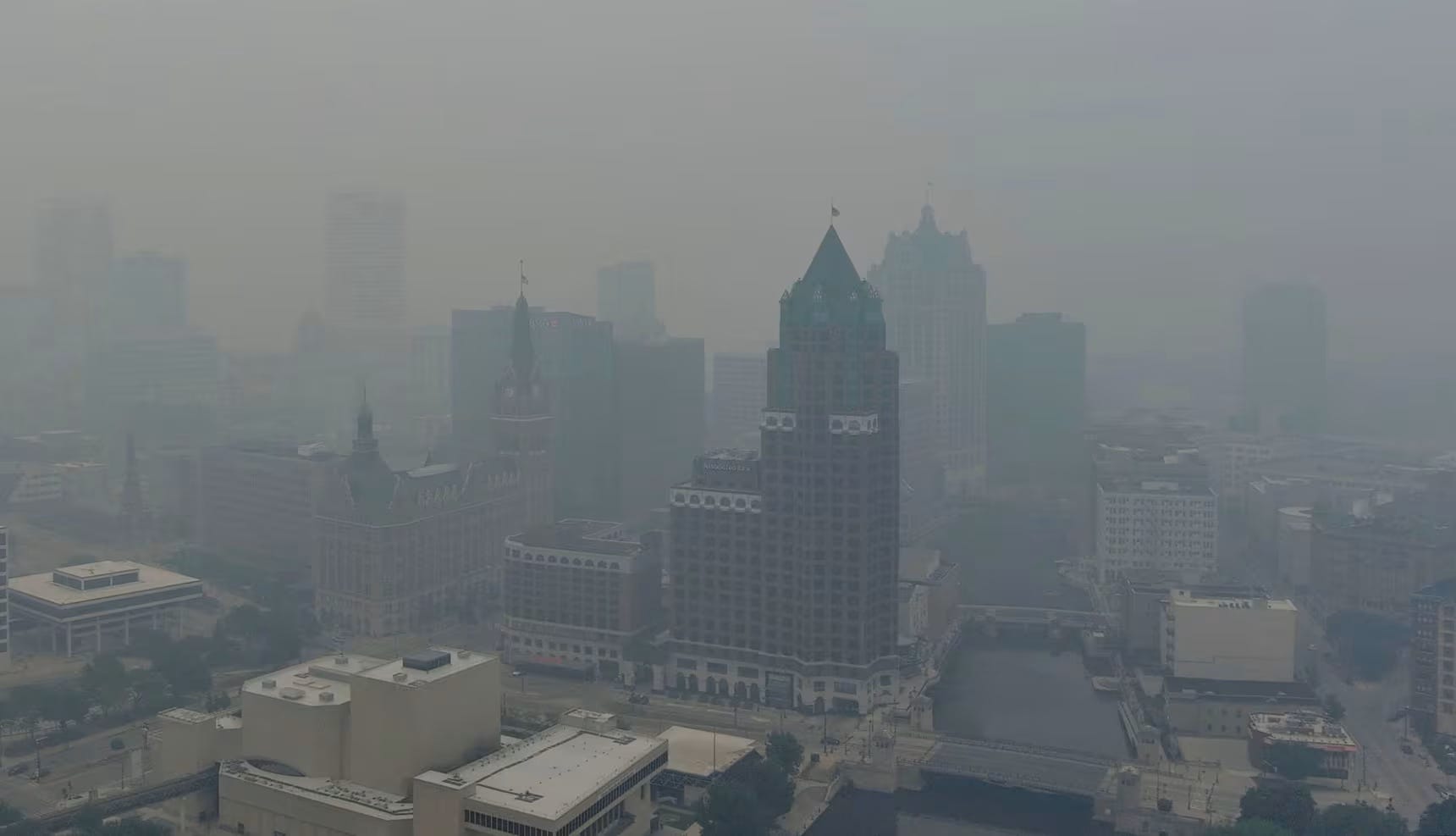
Smoke from wildfires burning in Canada and Minnesota created hazardous air quality across much of the Midwest and Northeast, with Detroit, Chicago, and Minneapolis recording some of the worst air quality in the world this week.
An Air Quality Index over 300 is considered hazardous. At its highest point this week, Detroit had an AQI of 728, and parts of Minnesota had an AQI of 934.
Shifting winds carried the smoke into New York, Philadelphia, Washington, Boston, and parts of the Southeast. Conditions improved in some areas over the weekend, but hundreds of wildfires remain active across Canada, meaning smoke could continue affecting parts of the Midwest for days.
Wildfire smoke contains tiny particles that can travel deep into the lungs and enter the bloodstream. Exposure can cause coughing, shortness of breath, headaches, dizziness, fatigue, and worsening of asthma or heart disease. People with chronic medical conditions, young children, older adults, and pregnant people are especially vulnerable, although air this polluted can affect anyone.
If you live in an affected area, health officials recommend limiting time outdoors, keeping windows closed, running an air purifier or air conditioning, if available, and wearing an N95 mask if you need to be outside. Checking your local Air Quality Index before spending a lot of time outside can help determine when conditions are safest.
Wildfire smoke can travel hundreds or even thousands of miles, extending the health effects far beyond the communities where the fires are burning. And as climate change contributes to hotter and drier conditions that increase wildfire risk in many regions, severe smoke events are becoming an increasingly widespread public health threat.
If you found this helpful and are able to support this work, please consider becoming a paid subscriber. Your support helps me keep spending the time it takes to research, write, and share pieces like this, and I’m genuinely grateful for it. Thank you for being here.
Comments
Nothing yet. Say the first thing.
Sign in to join the conversation.