
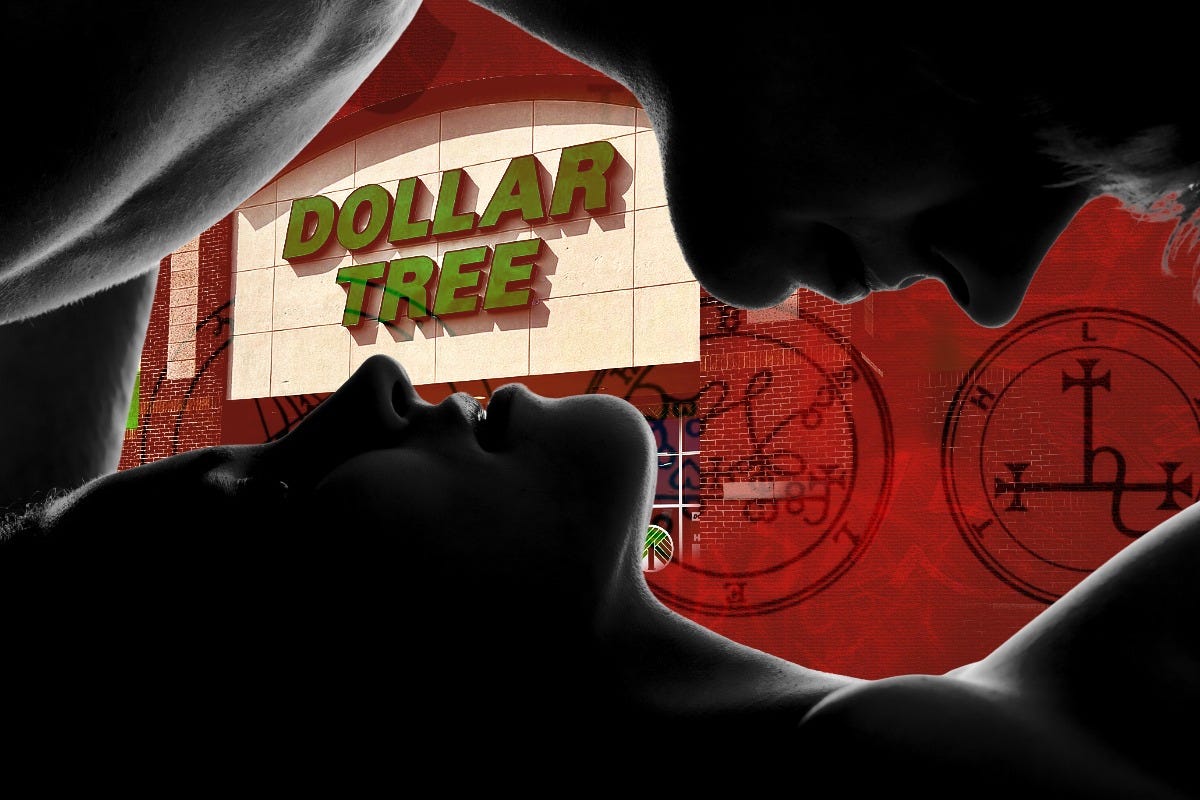
In December of 2023, at a Dollar Tree in Houston, a woman was shopping for cheap Christmas decorations when a man stepped in close behind her and ejaculated on her without her knowledge or her consent. She left. Hours later, on the advice of a relative in law enforcement, she retrieved the soiled leggings from her trash, carried them back to the store, and reported what happened. A clerk heard her out and, not realizing she understood Spanish, called across to a coworker in the back: Tenemos otra. We’ve got another one. Not “call the police.” Not “are you hurt.” Another one.
What did she mean by “another one?” To understand, you need two internet slang terms: gooning and sharking.
Gooning is prolonged masturbation built around the practice of edging. This is when arousal is held to near climax, sometimes even for hours, until the practitioner enters a trance-like state. The goal is not to climax but to sustain the state the plateau produces. Sharking, on the other hand (no pun intended), is also called tagging.Gooning has a history older than the internet, and in some ways these men are performing occult rituals perhaps without knowing it. This is when the act of gooning becomes criminal. This is when a man masturbates near an unsuspecting woman or ejaculates on her, often while he records the assault for an online audience of fellow “incels.”
Gooning has a history older than the internet, and in some ways these men are performing occult rituals perhaps without knowing it. Most occult traditions use prolonged arousal and the withholding of climax to produce altered states. They then direct that state toward their intent, vision, discipline, or will. Gooning is then the profaning of this ritual as it runs in a closed loop that serves no end beyond the means.
This week's free H File is very much what tracing the occult architecture beneath modern power looks like. If this sort of analysis interests you, subscribe for more.
Writing in MEL Magazine in 2020, Michael Stahl let them speak for themselves. A moderator of several of the practice’s subreddits, who goes by Christfister, called gooning “a sort of modernized version of tantric sex/masturbation without the spiritual aspects.” He is not being flip. He described reaching the brink of climax and trying to remain in that state for hours, claiming in some cases to have lasted fourteen hours.
Daniel Kolitz, in his 2025 Harper's article, described the so-called “goonstate” as a zone of “total ego death or bliss.” Some practitioners compare it to advanced meditation, which quiets the mind through attention and stillness. There is even a psychotherapy practice in Berlin that refers to the goonstate in a more clinical way, as an “emptying of the mind.” However, gooning appears to produce this quieted state through compulsion, repetition, and exhaustion.
Did these incels stumble into an occult practice? The methods they are using have been documented for well over a century, just under different names. For example, in 1896, Alice Bunker Stockham published Karezza, a manual on prolonged sexual union in which orgasm is intentionally withheld and the resulting state, not the release, is reframed as the spiritual goal. In Taoist and tantric practice, climax is conserved and the held sexual charge is recirculated as energy in the body rather than spent on the release. The point here is this, the holding back of the climax amplifies the charge and the resulting energy can be redirected internally or externally.
The word energy comes from the ancient Greek energeia, meaning activity, operation, or something being put into effect. The term is related to ergon, meaning work.
In modern contexts, energy appears in many different forms and is understood as the force or capacity behind action and transformation. In psychology, energy can be an inner drive, motivation, or the capacity to bring about change. In physics, energy has a more precise meaning. It refers to the capacity to perform work or produce change. Even apparently solid matter is composed of particles and fields in constant activity.
Within an esoteric understanding, everything is therefore seen as energy: connected, flowing, and continually influencing everything around it. If we begin with the assumption that everything is energy, then magic can be understood as the art of directing and transforming that energy in order to achieve a particular result or unlock a particular potential.
But what does that really mean?
You have an expectancy bias, meaning your subconscious holds on to established patterns you learned throughout your life that still shape how you think of the world. Everything you see, hear, and experience passes through this biased filter first before it decides what gets your attention. This puts necessary limitations on our perspective so we can simply navigate our lives.
In this sense, magic can serve as a tool for overcoming these limitations and building a bridge between the conscious and subconscious mind. By breaking down mental barriers, you allow energy to flow more freely and create more room to act authentically.
This is similar to sigil magick. A sigil is a visual representation of an intention. The intention could be a desire, goal, or aspiration. The roots of sigil magick may stretch back to prehistory, for instance, some believe that storytelling was not the only reason our ancestors painted on cave walls but that these paintings may also have been used in an attempt to bring about positive changes in the future. Images of successful hunts, for example, may have functioned as symbolic lucky charms. In anthropology, this is referred to as sympathetic magic or analogical magic. By representing a desired outcome before it happened, our ancestors may have hoped to influence the future in their favor.
Alchemists embraced a similar idea through the principle:
“As above, so below; as within, so without.”
This principle existed long before modern neuroscience, but it expresses the idea that our internal state and external reality are connected. What happens within the individual affects how that person experiences and responds to the world outside.
Sigil magick also developed through systems in which the signs used in Western magic were collected, organized, and assigned particular meanings.
Through these systems, magical formulas or spells could be created using the elemental qualities associated with signs and numbers. The forms created within the microcosm were believed to influence the macrocosm, because the microcosm was understood to reflect the macrocosm.
There are two main types of sigils: mental and physical.
Mental sigils are created, activated, and then burned, hidden, or forgotten so that they can operate within the subconscious without continued conscious interference.
Physical sigils remain visible in the external world. Because of this, they are particularly suitable for brand design. They can be used digitally, printed, worn as jewelry, or carried as a talisman.
Whether intentional or not, this sort of sex magick is what we are seeing acted out by desperate men online. Sigil magick is similar in that it has three stages:
Setting the intention
Charging it (through intense orgasm and in some cases extreme pain)
Releasing it (orgasm or sometimes blood letting in the case of extreme pain)
English artist and occultist, Austin Osman Spare, wrote The Book of Pleasure (Self-Love): The Psychology of Ecstasy, in 1913 codified the sigil method as anyone practices it today. He had the sigil in front of him and stamped it into the mind at the moment of orgasm, then destroyed the drawing so his waking self would forget it and stop interfering with what he had set in motion. That forgetting is the release, and it is a discipline rather than an afterthought. A charge does no work while you are still holding on to it.
However, the phenomenon is not limited to men. I recently came across a young woman on TikTok who walks her followers through what she calls “the O method,” a type of intentional sex magick akin to sigil magick. In this case, though, it is framed more like manifestation or self-help. As she instructs, you have to start by setting your intention. It can be spiritual or even material, like money or a boyfriend. Then, you begin to masturbate while focusing on that desired intention. At climax, you “release it into the universe,” as she says, and then go on with your day as if you know it is already fulfilled.
This TikToker, as well as many others, calls the orgasm the most potent energy the body makes because it is the same force that creates life. Videos about the O method are running to millions of views, and many of them call it sex magick outright and trace it to tantra and to the ceremonial magicians of the nineteenth century. The supposed sacredness of this sort of practice has been reduced to a shopping list for things like bigger paychecks and Hermès bags. Gooning, then, can be seen as just a next step down the same ladder of incrementalism. Additionally, normalizing this occult practice, whether knowingly or not, is part of the Revelation of the Method.
If we were to accept the premise of sex magick, then what women are being taught is to turn sex into power. Men are being taught to turn power into porn.
In 1954, scientists James Olds and Peter Milner attached an electrode to a rat’s brain, and then ran a wire to a lever that the rat could press, which would send a signal to the pleasure center of the rat's brain. The rat kept pressing the lever, in some experiments thousands of times an hour. It would ignore food, water, sleep, and every other basic need until it collapsed. From these experiments, we learned the science of the brain's reward system, the septal region, “the pleasure center.”
Later, Kent Berridge’s research would show that the brain actually has two separate systems for desire and liking, showing that what happened with the rats and the lever had more to do with wanting than with enjoyment. Nearly two decades after Olds and Milner, at Tulane University, researcher Robert Heath ran a similar study, but this time on a person. He put electrodes in the brain of a young man and gave him a button that would give him a pleasure sensation. The result? He pressed it about 1,500 times in one three hour session. When Heath’s team took the button away, the man pleaded for more time with it.

Finally, in 1986, Russell Portenoy and his colleagues published an article in the journal Pain, about the case of a forty-eight-year-old woman who was given a thalamic electrode to treat her chronic pain. She found out the current produced an orgasmic sensation, so she began using it compulsively. She started stimulating herself to the point that she neglected her family, friends, and her own hygiene. She suffered cardiac episodes and neurological symptoms, as well as an open sore on the finger she used to press the button!
In all of these cases, the goon state was experienced even without pornography or fantasy. These were cases of digitally assisted gooning. What happens to an entire population when the environment itself becomes the electrode?
This Saturday, for paid subscribers, I’m going to discuss the mice in the Universe 25 experiments from Calhoun and analyze “behavioral sink.” What happens when a community is given access to unlimited food and safety, with nothing left to do? What happens once an animal’s purpose and any societal role worth having has been taken away?
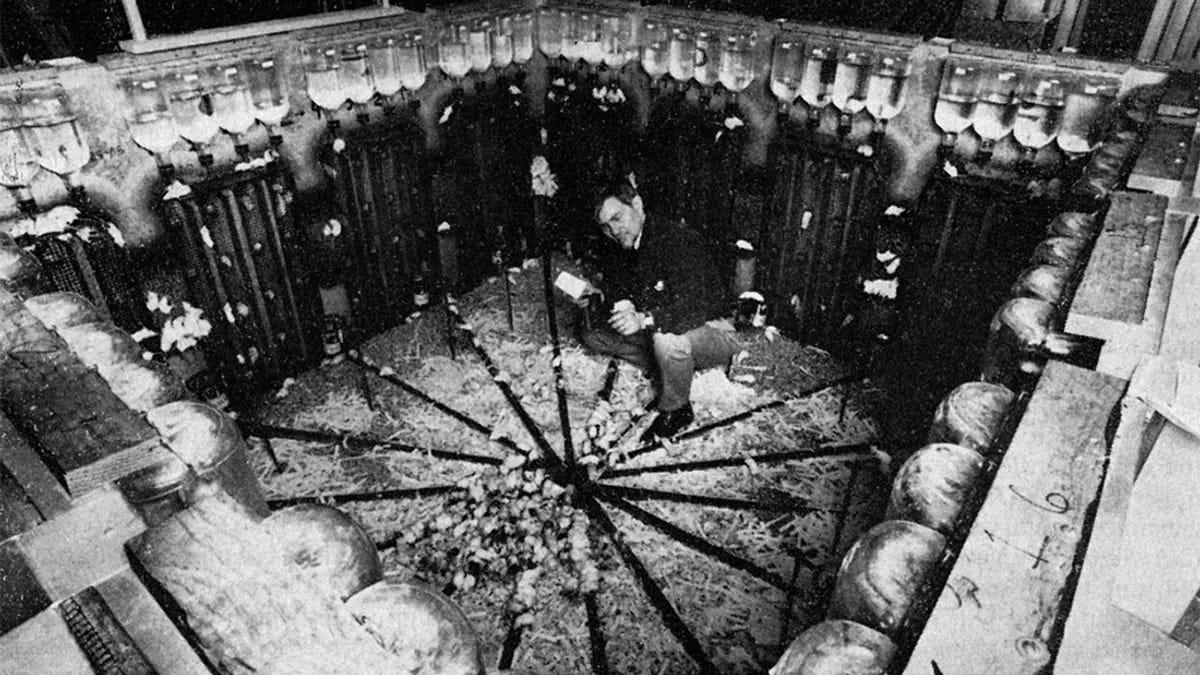
We’ll look at what Calhoun called “the beautiful ones,” who withdrew from their societal roles and spent all of their time at the very top of the perches in their colony, grooming for no audience at all. We call it looksmaxxing and rejecting mating. They would go on to not breed or neglect their babies if they had them. At the same time, the male mice either withdrew completely, or engaged in extreme violence and in what Calhoun termed “pansexual behavior,” meanng they would have sex with anything including the neglected juveniles
The so-called utopia started coming apart at the seams and the population declined. Was Calhoun recording a warning against overpopulation as he was hired to do, or was this an accidental prediction? Perhaps it turned into a blueprint.
Perhaps we are now living in Universe 26.
I will investigate that and more for paid subscribers.
To hear more on the occult connection to “gooning,” “temple sluts,” ritual cannibalism among the so-called “elites,” scapegoats, the quest for immortality, and so much more check out the latest episode of Tin Foil Hat podcast with the great Sam Tripoli. Special thanks to The Swarm!
The H Files is a fully independent publication written by Dr. Heather Lynn.
Dr. Heather Lynn is a historian tracing the occult architecture beneath modern power. She is the creator and host of The H Files podcast and the author of five books, including Baphomet Revealed and Evil Archaeology. Her forthcoming book is Codex Machina: How AI Is Decoding Ancient Civilizations, Technologies, and Lost Languages in Our Search for Meaning. Be sure to visit thehfiles.com to access subscriber benefits.
Subscribe on YouTube: https://www.youtube.com/@DrHeatherLynn
Bataille, Georges. Erotism: Death and Sensuality. 1957. On transgression and the bond of the broken taboo.
Berridge, Kent C., and Terry E. Robinson. “What Is the Role of Dopamine in Reward: Hedonic Impact, Reward Learning, or Incentive Salience?” Brain Research Reviews 28, no. 3 (1998): 309-369. The wanting-versus-liking distinction.
Berridge, Kent C., and Terry E. Robinson. “Liking, Wanting, and the Incentive-Sensitization Theory of Addiction.” American Psychologist 71, no. 8 (2016): 670-679.
Crowley, Aleister. Magick in Theory and Practice. 1929. The definition of magick, and the operative role of the sexual “elixir” in the higher degrees.
“The Disturbing Rise of ‘Gooner’ Assaults at Dollar Tree Stores: ‘They Find It Funny to Degrade Women.’” The Guardian, 20 July 2026. The Houston case, the terms “tagging” and “sharking,” the lawsuits, and the cryptocurrency, Pokémon card, and noise-band track.
“Gooning: Masturbation, Sex Trend or Trance State?” Praxis für Psychologie Berlin (praxis-psychologie-berlin.de), 2025. Clinical description of the state as an “emptying of the mind.”
Heath, Robert G. “Pleasure and Brain Activity in Man.” Journal of Nervous and Mental Disease 154, no. 1 (1972): 3-18. The self-stimulation sessions of patient B-19.
Kolitz, Daniel. “The Goon Squad.” Harper’s Magazine, November 2025. The goonstate as ego death likened to meditation, and the Gooneral memorial for a man with no apparent connection to the subculture.
Olds, James, and Peter Milner. “Positive Reinforcement Produced by Electrical Stimulation of Septal Area and Other Regions of Rat Brain.” Journal of Comparative and Physiological Psychology 47, no. 6 (1954): 419-427. The founding self-stimulation finding.
Olds, James. “Pleasure Centers in the Brain.” Scientific American 195, no. 4 (1956): 105-116. Source for the extreme self-stimulation rates and the pressing to the exclusion of other drives; the 1954 paper establishes the effect, the higher figures come from this and later work.
Portenoy, Russell K., Jens O. Jarden, John J. Sidtis, Richard B. Lipton, Kathleen M. Foley, and David A. Rottenberg. “Compulsive Thalamic Self-Stimulation: A Case with Metabolic, Electrophysiologic and Behavioral Correlates.” Pain 27, no. 3 (1986): 277-290.
Spare, Austin Osman. The Book of Pleasure (Self-Love): The Psychology of Ecstasy. 1913. The death posture.
Stahl, Michael. “The Psychedelic Science of ‘Gooning’ — Or Masturbating Into a Trance.” MEL Magazine, November 2020. The Christfister quotation and the fourteen-hour sessions.
Stockham, Alice Bunker. Karezza: Ethics of Marriage. 1896.
Wile, Douglas. Art of the Bedchamber: The Chinese Sexual Yoga Classics. 1992. For the Taoist and tantric retention disciplines.
“With the O Method, Some TikTokers Claim They Can Manifest Via Orgasm.” Bustle, 2025. On the O Method of orgasm-based manifestation, popularized on TikTok by Sara Perl (@hothighpriestess); much of the coverage traces the practice to tantra and nineteenth-century sex-magic literature.
Comments
Nothing yet. Say the first thing.
Sign in to join the conversation.