
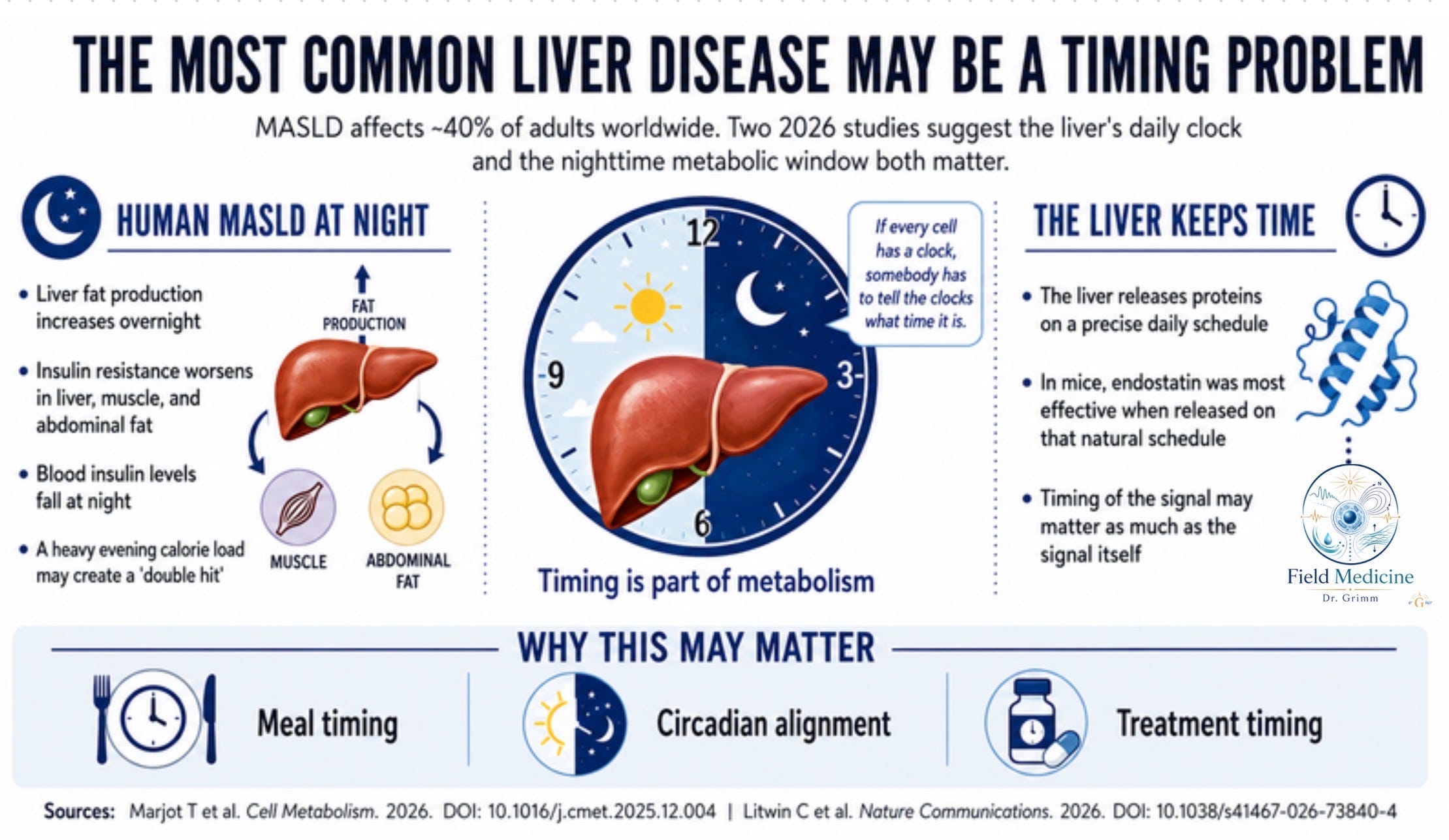
There is a good chance you have heard of fatty liver disease. There is also a good chance you have never thought much about it. My typical patient interaction is bringing in copies of lab results for some complaint. “Labs look good other than elevated liver function tests (AST/ALT). You probably have fatty liver”. It presents with no pain. No dramatic symptoms. Maybe that mildly elevated ALT, maybe an ultrasound finding that gets buried in the chart, maybe nothing at all. And yet metabolic dysfunction associated steatotic liver disease, MASLD, now affects a very large portion of the adult population, with some estimates putting it around 40 percent. That alone should get our attention. Why doesn’t it? No reliable, risk free pharmaceuticals yet….
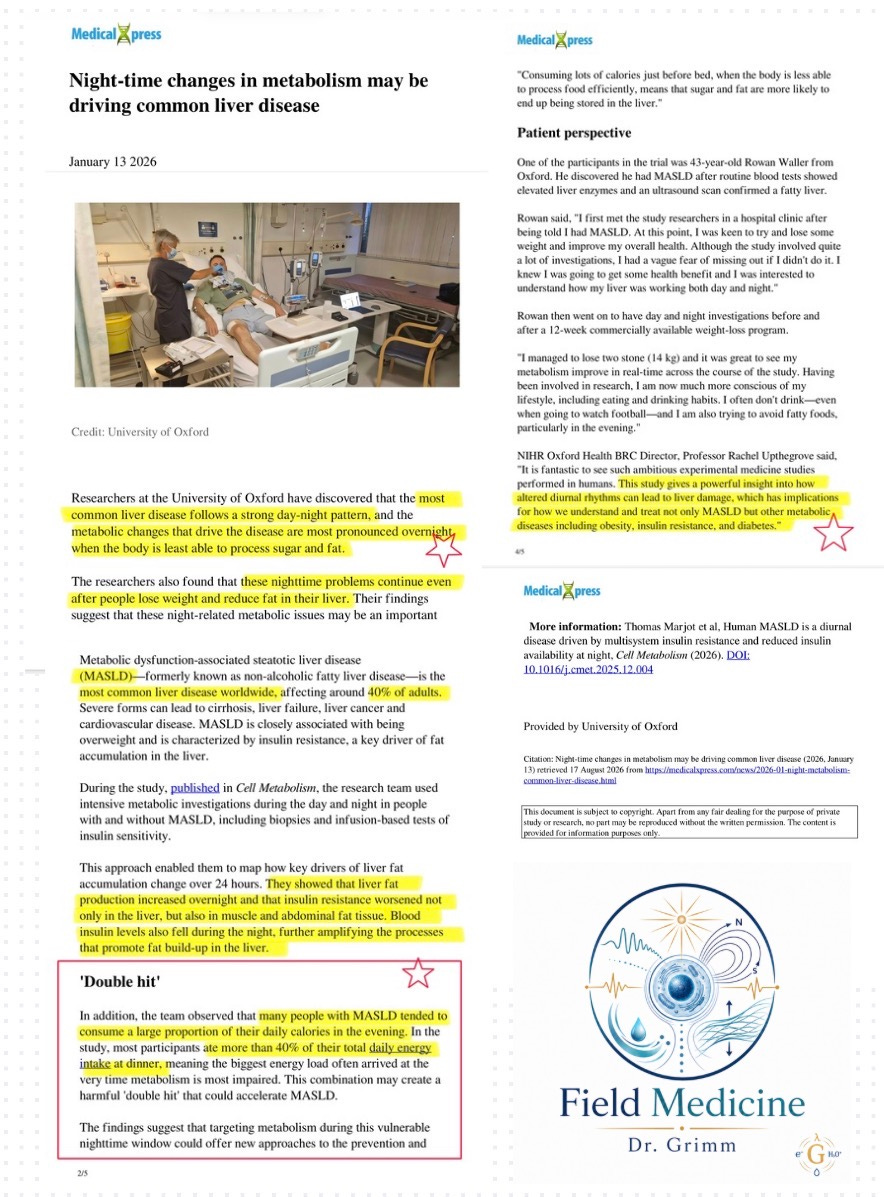
A recent study made the story much more interesting. Researchers studying people with MASLD found that the disease has a strong day and night pattern. Sort of like rheumatoid arthritis and asthma (did you know that?). Liver fat production increased overnight. Insulin resistance worsened not only in the liver, but also in muscle and abdominal fat. Blood insulin levels fell during the night, which may further favor processes that promote liver fat accumulation. Then came the part that was super interesting. Many of the participants were also eating a large portion of their daily calories in the evening. So their biggest energy load was arriving during a period when their metabolic machinery was already handling glucose and fat less efficiently. The researchers referred to this as a potential double hit.
That makes sense, but I think it may also be trying to tell us something bigger. “Doc, Why should the liver metabolism care so much about time?”
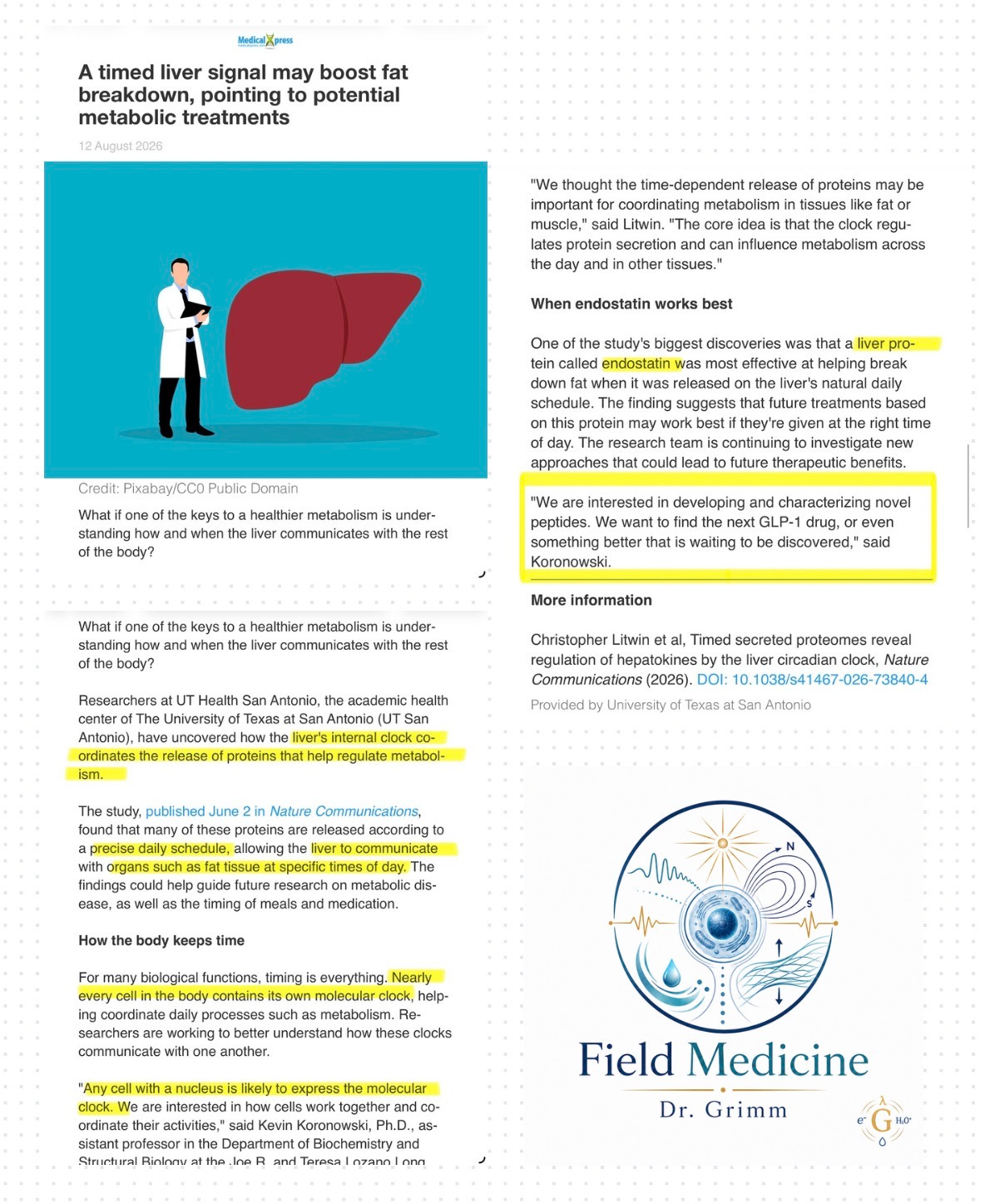
Another 2026 paper gives us a clue. Researchers looking at the liver’s circadian clock found that the liver releases proteins according to a surprisingly precise daily schedule. These proteins communicate with other tissues, including fat tissue, and the timing of their release matters. One of those proteins was endostatin.
In this study, endostatin seemed to work best when it showed up at the right time of day, during the fasting phase. When that happened, fat tissue was more willing to release stored fat.
So think of endostatin like your liver sending a text that says, “We are fasting now. Open the fuel tank.” That is interesting because it suggests the body may care about more than how much of a hormone or protein you have. It may also care about when that signal shows up. Same message, wrong time, different effect.
Here is a little Field Medicine Fasting Secret that I tell my patients…Do you really think fasting is simply the time since you stopped eating?
And that gets back to the bigger Field Medicine idea in this article. If the liver is trying to send timed instructions, then the clocks that control those instructions have to be set correctly. Light, darkness, meal timing, temperature, activity and sleep may all help tell the body what time it is.
Maybe some of the metabolic confusion we see happens because the signals are still there, but the timing is getting sloppy. Your liver may still be sending the text. The question is whether the rest of the body knows what time it is when the message arrives.
It appeared to help regulate fat breakdown more effectively when it arrived at the appropriate time in the liver’s normal daily rhythm. Same signal. Different time. Different response.
That is where things get interesting. Nearly every nucleated cell in the body contains some form of molecular clock. You hear this all the time. Your liver has clocks. Your muscle has clocks. Your fat has clocks. Your skin has clocks. Your brain is full of them. So at what point did our body clocks run out of batteries?
Or maybe they didn’t. Maybe the clocks still work perfectly well. Maybe we stopped giving them the correct time. It’s not like your liver has eyeballs right!
In medicine and on podcasts now we talk constantly about hormones, peptides, GLP 1, insulin, cortisol, adipokines, hepatokines and all of the chemical messages floating around the body. We measure them. We try to manipulate them. We develop drugs around them. And all of that has enormous value. But somebody or SOME-THING has to tell those molecules when to show up and your biology has to recognize it.
One of the researchers in the liver clock study even mentioned that they are interested in finding the next GLP 1 type therapy. Fair enough. Reading that made me wonder whether we occasionally start one floor too low in the building. Before finding the next metabolic signal, maybe we should spend a little more time asking what sets the timing of the signals we already have.
This is where our modern environment becomes interesting. For nearly all of human history, biology lived in a very obvious time zone. Bright days. Dark nights. Temperature rising during the day and falling at night. Sunrise. Sunset. Long periods without food. Movement during daylight. Seasonal changes in light and temperature. Then we built really comfortable caves. We wake up indoors. We work indoors. Windows alter the spectrum of sunlight reaching us. Air conditioning keeps summer afternoons remarkably cool. Heaters keep winter nights warm. Artificial lighting extends daylight deep into the evening. Phones and televisions continue sending photons into our eyes long after sunset. Then we eat a large dinner at 8 or 9 PM and somehow expect the liver, retina, muscle, fat and brain to all agree that it is nighttime.
This part of the story is on very solid ground. Light entering the eye and on the skin are two of the major signals setting the central circadian clock. That is what is called photonic field signaling. Feeding time influences peripheral clocks, particularly in organs such as the liver. Physical activity, temperature, hormones and autonomic signaling all help coordinate timing throughout the body. So think about what happens when those signals disagree. Your retina sees bright light at 10 PM. Your liver sees dinner at 9 PM. Your bedroom stays the same temperature it was at 3 PM. Your muscles have barely moved all day. The clock genes themselves may be intact. The problem is that the clocks are receiving conflicting information.
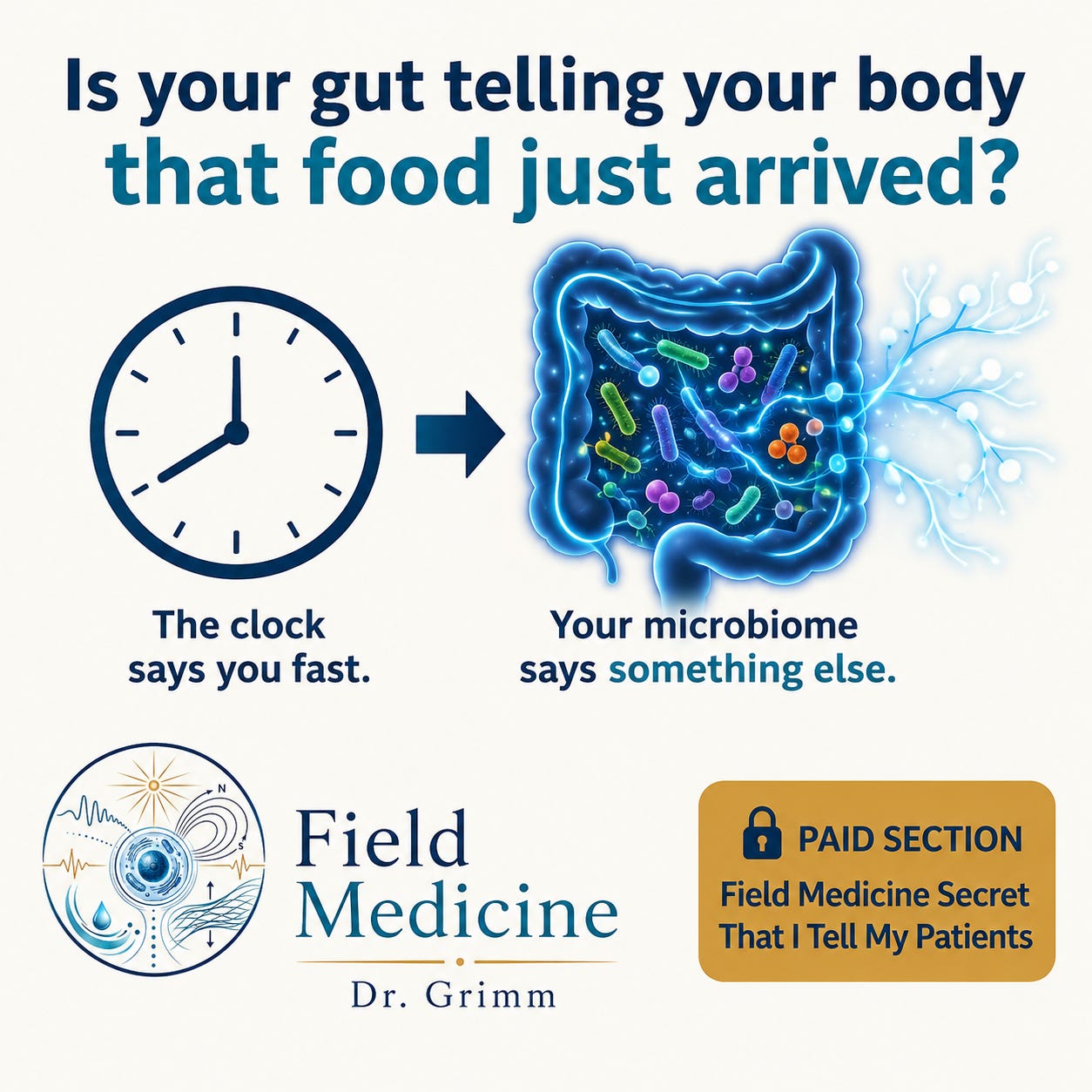
Here is a little Field Medicine Microbiome Secret that I tell my patients…What if your microbiome helps tell the rest of your body that food has arrived before the nutrients even reach your bloodstream?
You think jet lag is rough? Imagine your retina living in one time zone, your liver in another, your skin in another, and your mitochondria trying to keep everyone’s schedule.
That possibility becomes harder to ignore when studies are showing us that metabolic disease itself behaves differently depending upon the time of day.
There is another layer here that I think deserves investigation. We tend to talk about light almost exclusively as a visual signal, but sunlight is an enormous electromagnetic environment. Visible light is only part of it. Infrared and near infrared wavelengths are present throughout natural daylight, and the balance of wavelengths changes over the course of the day. Our indoor environment is very different, and how much that difference matters biologically is still being worked out.
We know that there is established evidence that red and near infrared light can affect mitochondrial signaling in certain tissues and experimental systems. There is also established evidence that water associated with proteins, membranes and biological surfaces behaves differently from bulk water and participates in electrostatics, protein conformation and proton movement. Gerald Pollack has taken that idea further (get his new book by the way “Charged”), proposing that radiant energy, especially infrared, can increase ordered water adjacent to hydrophilic surfaces. How directly those experimental findings translate to living human tissues remains an open question, and I think that distinction matters.
But it is also reasonable to ask whether removing large portions of our normal radiant environment from daily life could have consequences beyond circadian timing alone. Mitochondria themselves operate in an incredibly water rich environment surrounded by photonic, phononic, magnetic, bioelectric fields. Electrons move through the electron transport chain. Protons are separated across the inner mitochondrial membrane. ATP synthase rotates. Heat is generated. Water is produced. Proteins constantly change configuration. Our mitochondrial flywheel is operating inside a molecular ocean in a way.
Could temperature, radiant energy, hydration architecture and circadian signaling all interact at that level? Probable. Proven as a unified mechanism in humans? Not yet. That is exactly why I think it is worth studying.
I also wonder whether we underestimate temperature as information. Human physiology naturally expects temperature to vary. Core temperature changes over the day. Skin temperature changes. Sleep itself is tied closely to thermoregulation. Yet we have engineered houses where July and January can feel almost identical from the neck down. I am not suggesting anyone throw away the air conditioner. I am suggesting that biology may care about contrast. Bright and dark. Warm and cool. Fed and fasted. Movement and rest. Day and night. Negative potential and positive potential.
That brings me back to fatty liver. We often interpret MASLD as a problem of excess calories, insulin resistance, obesity, fructose, alcohol, sedentary behavior and metabolic dysfunction. All of those remain important. But perhaps the liver is telling us something additional. Fatty liver is also a timing problem.
The issue is not simply how much energy entered the system, but when it arrived and whether the organism was physiologically prepared to handle it.
And maybe that is why two separate lines of research, one looking at nighttime metabolic dysfunction and another looking at timed liver signals, feel like they belong in the same conversation.
We keep changing the hands on the clock while ignoring some of the signals that set it in the first place. Before we search for another peptide, another receptor or another downstream target, maybe we should occasionally ask a very basic question. Does the organism know what time it is? Because the liver may know. The retina may know. The muscle may know. The fat may know. The problem begins when they stop agreeing with each other. And honestly, maybe one of the secrets this incredibly common liver disease is trying to tell us is that YOUR METABOLISM HAS A TIME ZONE. We should probably start paying attention to it.
Thanks for your retinas!
Dr. Grimm
Field Medicine
References and Further Reading
Fatty Liver, Circadian Timing, and Liver Metabolism
Marjot T, Smith K, Westcott F, et al. Human MASLD is a diurnal disease driven by multisystem insulin resistance and reduced insulin availability at night. Cell Metabolism. 2026;38(3):474–492.e6. doi:10.1016/j.cmet.2025.12.004. This human study showed that nighttime metabolic dysfunction is a hallmark of MASLD, with increased hepatic de novo lipogenesis, worsening hepatic and peripheral insulin resistance, and greater systemic fatty acid exposure at night.
https://pubmed.ncbi.nlm.nih.gov/41529695/
Medical Xpress. Night-time changes in metabolism may be driving common liver disease. January 13, 2026. This is the reader friendly summary of the Marjot study, including the discussion of large evening calorie intake arriving during a metabolically vulnerable nighttime window.
https://medicalxpress.com/news/2026-01-night-metabolism-common-liver-disease.html
Litwin C, Zhang Q, Tsialtas I, et al. Timed secreted proteomes reveal regulation of hepatokines by the liver circadian clock. Nature Communications. 2026;17:7089. doi:10.1038/s41467-026-73840-4. This study identified hundreds of liver secreted proteins that vary with time of day or circadian clock state and characterized endostatin as a clock regulated hepatokine with time dependent metabolic effects.
https://www.nature.com/articles/s41467-026-73840-4
Medical Xpress. A timed liver signal may boost fat breakdown, pointing to potential metabolic treatments. August 12, 2026. This is the article that started our discussion about liver clocks, endostatin, fat metabolism, and the search for new peptide therapies.
https://medicalxpress.com/news/2026-08-liver-boost-fat-breakdown-potential.html
Microbiome, Gut Signaling, and the Field Medicine Secret
Kaelberer MM, Buchanan KL, Klein ME, et al. A gut-brain neural circuit for nutrient sensory transduction. Science. 2018;361(6408):eaat5236. doi:10.1126/science.aat5236. This study showed that specialized enteroendocrine cells can form synaptic connections with vagal neurons and rapidly transmit information about nutrients in the intestine.
https://pubmed.ncbi.nlm.nih.gov/30237325/
Yano JM, Yu K, Donaldson GP, et al. Indigenous bacteria from the gut microbiota regulate host serotonin biosynthesis. Cell. 2015;161(2):264–276. This study showed that metabolites produced by gut microbes can stimulate serotonin production by host enterochromaffin cells.
https://www.cell.com/cell/fulltext/S0092-8674(15)01178-2
Tolhurst G, Heffron H, Lam YS, et al. Short-chain fatty acids stimulate glucagon-like peptide-1 secretion via the G-protein-coupled receptor FFAR2. Diabetes. 2012;61(2):364–371. doi:10.2337/db11-1019. This work demonstrated that microbial fermentation products such as short chain fatty acids can stimulate GLP 1 secretion from intestinal L cells.
https://pubmed.ncbi.nlm.nih.gov/22190648/
Larraufie P, Martin-Gallausiaux C, Lapaque N, et al. SCFAs strongly stimulate PYY production in human enteroendocrine cells. Scientific Reports. 2018;8:74. doi:10.1038/s41598-017-18259-0. This study showed that propionate and butyrate can increase PYY production and secretion in human enteroendocrine models.
https://pubmed.ncbi.nlm.nih.gov/29311617/
Bacterial Bioelectric Communication
Prindle A, Liu J, Asally M, et al. Ion channels enable electrical communication in bacterial communities. Nature. 2015;527(7576):59–63. This landmark study demonstrated long range electrical communication within bacterial biofilms through propagating potassium waves.
https://pubmed.ncbi.nlm.nih.gov/26503040/
Humphries J, Xiong L, Liu J, et al. Species-independent attraction to biofilms through electrical signaling. Cell. 2017;168(1–2):200–209.e12. doi:10.1016/j.cell.2016.12.014. This study showed that electrical signaling from bacterial biofilms can influence and attract bacteria outside the biofilm, including other species.
No posts
Comments
Nothing yet. Say the first thing.
Sign in to join the conversation.