
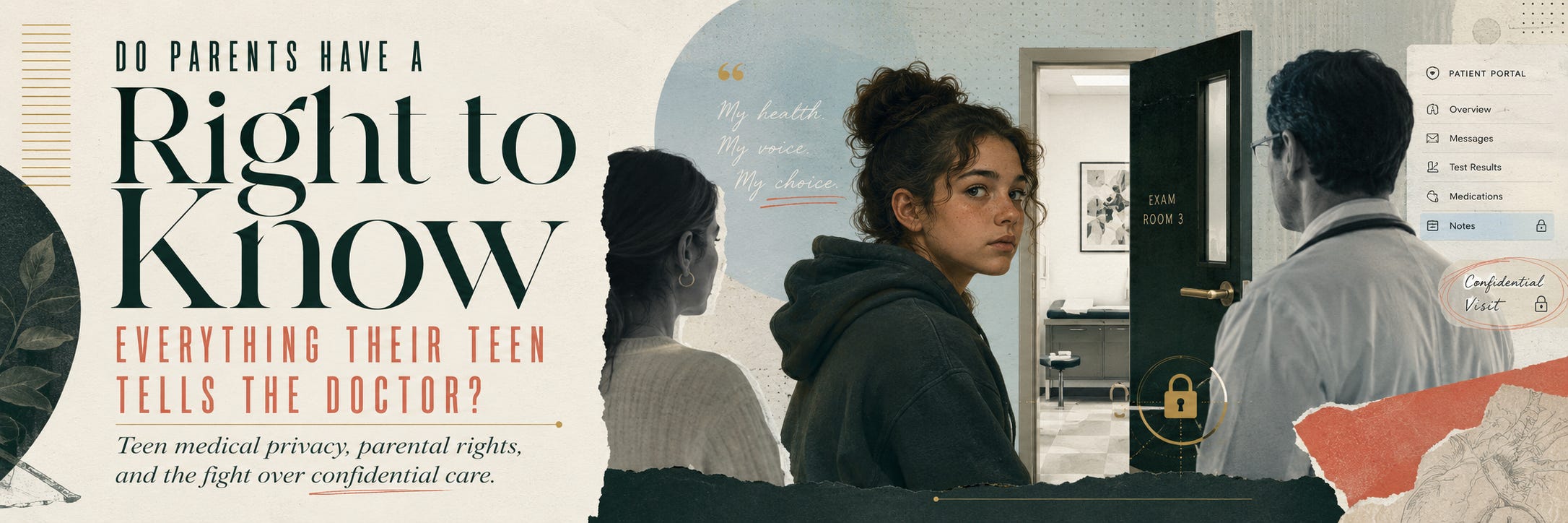
If you have an adolescent and your pediatrician has suddenly started asking you to step outside for part of the visit, you may have had a very normal parental reaction: Wait, what? This is my child. I made the appointment. I drove them here. I filled out seventeen forms asking whether anyone in the family has ever sneezed near a walnut. I am probably paying the bill. And now I’m the person being asked to leave?
For decades, pediatricians have routinely recommended spending at least a few minutes alone with teenagers during well visits. This did not originate with transgender medicine, TikTok, puberty blockers, Republicans, Democrats, Donald Trump, Gavin Newsom, or whatever political controversy is currently winning the Internet for the afternoon. The basic idea is much older and much less exciting: teenagers sometimes tell doctors things they will not say with Mom or Dad sitting three feet away.
But it might also involve vaping, alcohol, drugs, bullying, depression, anxiety, an eating disorder, an abusive boyfriend or family member, a dangerous relationship, questions about puberty, being hit at home, suicidal thoughts, or the fact that they have been taking somebody else’s Adderall before calculus tests. Teenagers are complicated creatures. Anyone who has asked one, “How was school?” and received the comprehensive medical history of “fine” already understands the problem.
The American Academy of Pediatrics continues to consider confidentiality an important component of adolescent healthcare and recommends developmentally appropriate private time between clinicians and adolescents. That is how I was trained, though the lines of alone time have been blurred of late.
The justification is not simply philosophical. Research going back decades suggests adolescents are more willing to disclose sensitive information and sometimes more willing to seek healthcare when they believe some degree of confidentiality exists. In a randomized trial, assurances of confidentiality increased adolescents’ willingness to disclose sensitive information and seek future care, and other studies have similarly found an association between perceived confidentiality and adolescents’ use of healthcare services.
That is the strongest argument for teen privacy.
But there is another side to this conversation that medicine has sometimes been far too quick to dismiss.
Before everyone begins throwing tomatoes at each other, we need to separate several concepts that are constantly mashed together.
Giving a teenager three minutes alone with their pediatrician does not automatically mean the teenager suddenly possesses the healthcare autonomy of a 37-year-old accountant from Ohio.
There is a difference between private conversation, confidential medical information, and legal authority to consent to medical treatment.
I can ask Mom or Dad to leave the room and ask a 15-year-old whether he drinks alcohol. That does not mean I can therefore perform any medical procedure he requests without parental consent. I can ask a teenager whether she feels safe at home without somehow emancipating her before dessert.
And despite the widespread belief that HIPAA contains a secret “parents are no longer allowed to know anything after age 12” clause, that isn’t how HIPAA works either.
Federal HIPAA rules generally treat a parent as the personal representative of a minor and therefore generally give parents access to their child’s medical information when that access is consistent with state law. There are important exceptions, particularly when state law gives the minor the legal authority to consent independently to a specific category of care, when someone other than the parent is legally authorized to consent, or in certain situations involving abuse, neglect or danger. State law matters enormously.
And that is how we ended up with the American adolescent-health legal masterpiece known as: it depends where you live.
A 2022 review in Pediatrics found substantial state-to-state variability in minor consent and privacy laws. Different states permit minors to independently consent under different circumstances for things such as sexually transmitted infection testing and treatment, contraception, pregnancy-related care, substance-use treatment and mental-health services. The details—including ages, disclosure rules and parental-access provisions—vary considerably.
Simple, right?
Only slightly easier than understanding your health-insurance deductible.
Imagine a 16-year-old who started having sex and is terrified her parents will find out. You may very reasonably believe she should tell her parents. I would generally love teenagers to have relationships with their parents where they feel comfortable talking about difficult things.
But now imagine she absolutely will not.
The policy question isn’t simply, “Should teenagers talk to their parents?”
Of course we want strong parent-child communication.
The harder question is: What happens if the alternative to confidential care is no care at all?
That is where much of adolescent confidentiality originated.
In one frequently cited study of girls younger than 18 attending family-planning clinics, researchers asked what they would do if parental notification became mandatory for obtaining prescription contraception. A substantial group said they would stop using sexual-health services rather than involve their parents, while relatively few said they would stop having sex. That distinction has driven much of the medical community’s position on confidentiality.
The same logic can apply outside reproductive medicine.
A teenager might tell me privately that he is vaping every day. Now I can talk to him about nicotine dependence. He might tell me he’s been getting drunk every weekend. She might tell me she has started making herself vomit after meals.
A teenager might tell me that the reason he hasn’t been sleeping is because kids at school have been threatening him online. Or somebody might disclose sexual abuse. Those conversations can change what happens next.
There are obviously limits. Confidentiality is not a sacred vault where a pediatrician hears that a child is in immediate danger and responds, “Cool, doctor-patient privilege. See you next year.” Clinicians have legal and ethical obligations when a young person faces serious safety threats, including mandated reporting requirements that vary depending upon the circumstances and jurisdiction.
The goal of private time was never supposed to be doctor versus parent.
Ideally, it is doctor + teenager + parent, with slightly different conversations at slightly different moments. In fact, much of what I do privately with teenagers is trying to help them communicate more with their parents, not less.
“Have you talked with Mom about this?”
“No.”
“Would you be comfortable if we talked about it together?”
Sometimes the answer is yes.
Sometimes it is absolutely not. But hopefully, you can gain the teens trust, which can help you move them to a place where they are comfortable discussing with their parents.
Welcome again to pediatrics.
Let me put this another way. This is the part I think gets lost in the debate. The main reason MD’s want a few minutes alone with a teenager is not because we are trying to exclude the parent. It is because sometimes that is the only way I am going to hear the thing the teenager is too embarrassed, scared, ashamed, or unsure how to say in front of Mom or Dad. We are another set of ears. Another safe adult in the room.
If a teenager tells me privately that they are being bullied, vaping, having sex, feeling depressed, struggling with food, using substances, or dealing with something difficult at home or school, my first instinct is usually not, “Great, let’s keep this secret forever.” Quite the opposite. Most of the time, the next conversation is: Is there a world where we can talk about this with your parents? How can I help you tell them? Would you like me to be there when we do?
Sometimes the teenager just needs help finding the words. Sometimes they are terrified of disappointing their parents. Sometimes they have convinced themselves the reaction will be far worse than it actually is. The private conversation gives us a chance to uncover the information first and then, whenever it is safe and appropriate, help bring the parent into the conversation. Without that alone time, we may never get the information at all. And if we never get the information, we certainly cannot help the family address it. That is the irony of adolescent confidentiality: at its best, it is not designed to keep parents out. It is often the tool that ultimately helps us bring them in.
Because something has changed.
Not necessarily the original reasoning behind confidential adolescent medicine—but the stakes parents believe confidentiality can now carry.
For years, many parents accepted that their 15-year-old might privately discuss condoms or marijuana with the pediatrician even if it made them uncomfortable. What has dramatically intensified the debate is the perception that the same confidentiality framework can now be used around much larger questions involving mental-health treatment, gender identity, social transition, medications, medical records and parental involvement.
That has caused some parents to ask a completely reasonable question: Where exactly is the line?
And I don’t think medicine should roll its eyes at them for asking.
If healthcare professionals want parents to trust adolescent confidentiality, healthcare needs to clearly explain its boundaries. There is a gigantic difference between:
“I’m going to ask your daughter privately if she’s being bullied.”
and
“We are making consequential decisions about your child’s medical treatment and gender identity that you aren’t permitted to know about.”
Those are not ethically equivalent propositions simply because both contain the word privacy. Parents remain responsible for their children in almost every imaginable way. They feed them, house them, protect them, monitor their medications, respond when they’re suicidal at 2 AM and generally receive the phone call when everything goes sideways.
It is therefore understandable that some parents find the idea of being intentionally excluded from important healthcare information deeply unsettling. And legislatures are responding.
Several states have recently considered or enacted stronger parental-rights frameworks surrounding minors’ healthcare.
Florida’s Parents’ Bill of Rights requires written parental consent for many healthcare procedures performed on minors, subject to statutory exceptions. Tennessee enacted a broad parental-rights framework establishing parental authority over many physical and mental healthcare decisions, while legislation there has also addressed parental consent for vaccination and access to certain medical information.
North Carolina lawmakers considered a “Parents’ Medical Bill of Rights” that would substantially expand parental involvement and access while narrowing circumstances in which minors could independently obtain treatment. Supporters framed the proposal as restoring parents’ authority over their children’s medical care; opponents warned that teenagers would simply stop seeking treatment for sensitive conditions.
And in Michigan, House Bill 5974, introduced in May 2026, proposed changes to state medical-record law that would prevent a minor from broadly restricting a parent or guardian from accessing the minor’s medical records, while retaining specified exceptions.
The details matter enormously because these proposals are not identical. “Parental rights law” can mean anything from requiring consent before treatment to changing access to records to limiting minors’ ability to independently obtain particular services.
Again: consent, confidentiality and access to the chart are different questions. Which apparently means we need lawyers to attend pediatric well visits now. Perfect.
This is the part where the conversation became approximately 900 percent more combustible. Gender medicine did not create adolescent confidentiality. I want to make that very clear. Private teen interviews existed long before the contemporary fight over gender identity. The traditional rationale largely involved sexual health, pregnancy, substance use, mental health, abuse and other sensitive adolescent issues.
But gender-related controversies have become wrapped into the broader parental-rights debate, particularly around whether parents should be notified when a child adopts a different name or gender identity at school or seeks gender-related services or procedures.
And those questions have produced major litigation.
In Mirabelli v. Bonta, for example, litigation over California school policies reached the U.S. Supreme Court amid challenges involving parental notification when students socially transition at school. That is primarily an education and parental-rights case—not a traditional doctor-patient confidentiality case—but it demonstrates how rapidly the broader fight over whether institutions may withhold sensitive information about children from parents has moved into constitutional litigation.
Likewise, litigation involving Washington laws concerning runaway minors has challenged circumstances under which young people may receive services—including gender-related services—without the degree of parental notification some parents believe the Constitution requires. A petition reached the Supreme Court in 2026.
You do not have to take a position on gender medicine to recognize what these cases have done politically. They changed the question in many parents’ minds from:
“Should my teenager be able to tell the pediatrician she drank at a party without me hearing every word?”
to:
“Can the government, school or healthcare system intentionally keep significant information about my child from me?”
Those are emotionally—and legally—very different questions. And when medicine pretends they are identical, medicine loses credibility.
Then we added electronic medical records because apparently this wasn’t confusing enough. In the old days, confidentiality was largely a conversation between a doctor and a teenager behind a closed door.
Now we have Electronic Medical Records.
Everything is somewhere.
Diagnosis codes.
Prescriptions.
Lab results.
Visit summaries.
Appointment names.
Billing codes.
Messages.
One innocent notification popping onto Dad’s phone can turn “confidential healthcare” into an extremely uncomfortable Tuesday evening. Electronic portals therefore have to somehow determine which pieces of an adolescent’s record a parent can see, which pieces may legally belong to the adolescent, whether particular services were independently consented to under state law, and whether releasing one seemingly harmless piece of information inadvertently reveals protected information elsewhere.
Major medical organizations have specifically recognized this problem and in 2026 issued recommendations regarding health-information technology and adolescent confidentiality. But there is a competing concern: health systems can also become too restrictive and block parents from information they are legally entitled to receive.
HHS has recently emphasized that HIPAA generally provides parents access to their minor children’s records as personal representatives unless state or other applicable law says otherwise. So no, HIPAA does not mean the hospital gets to press a giant button when your child turns 13 that says:
DELETE PARENTS.
This is one of those issues where I think both extremes lose the plot. I don’t want a frightened 16-year-old avoiding medical care for gonorrhea because he thinks calling the pediatrician automatically triggers a family meeting with a VHS sex ed tape from 1995.
I want teenagers to tell their doctors when they’re depressed. I want them to tell us if they’re using fentanyl. I want them to tell us if someone is abusing them. I want them to tell us if they’re having unsafe sex. Sometimes giving them a few minutes without a parent sitting beside them makes those conversations possible.
But I also understand the parent who says: This is still my child. Parents are not random strangers wandering into the exam room. We have enormous moral, legal and practical responsibility for the welfare of our children. If medical systems want to meaningfully exclude parents from increasingly consequential healthcare decisions, that deserves serious scrutiny.
And “trust the experts” isn’t sufficient.
Where confidentiality protects a teenager’s ability to disclose something important, I see tremendous value. Where confidentiality starts transforming into systematically excluding good parents from major decisions about their child’s medical or psychological care, I get much more uncomfortable.
Those two positions can exist simultaneously. We have somehow forgotten that nuance is permitted (see I can mention that in a context that isn’t always about vaccines hahahahaha).
When kids reach adolescence, I generally explain the process to everybody. At some point during these visits, I’ll talk with your teenager alone if the family and teen would like
Not because I’m replacing you. Not because I’m forming a secret pediatric alliance against you. And definitely not because we are ordering a new family on Amazon Prime. It is because learning how to speak privately with a physician is itself part of becoming an adult..
I want them to understand that someday Mom is no longer going to schedule every appointment, explain every symptom and remember which antibiotic caused a rash when they were four. Adolescent medicine is partly about gradually transferring responsibility.
If something important is happening, I want to help you talk to them whenever it is safe and reasonable to do so. That, to me, is the middle path.
Not parents control every sentence.
Not teenagers live inside an impenetrable medical fortress.
Trust.
Privacy where appropriate. Parents involved whenever possible. Clear boundaries. And transparency about what those boundaries actually are. Because adolescent confidentiality works best when it helps build communication rather than destroy it.
Gender medicine may have poured gasoline onto this debate, and politics has certainly thrown several matches at it, but the underlying issue is much older.
How do we create a safe place for teenagers to reveal things they desperately need help with without unnecessarily undermining the parents responsible for them? And how do we distinguish a private conversation about vaping from a consequential medical decision?
Those aren’t easy questions.
Which is probably why they deserve something better than a slogan. And maybe—just maybe—we can discuss them without throwing things at each other or calling doctors evil.
Although now that we’re talking about teenagers, I’m not sure most parents actually want to know everything going on in those growing brains that we have to hear about haha
This article is for educational purposes only and is not medical or legal advice. Minor-consent, confidentiality and parental-access laws vary substantially by state and circumstance.
No posts
Comments
Nothing yet. Say the first thing.
Sign in to join the conversation.