
There is one force that has never lost an election, never been filibustered, never been vetoed, and never been overturned by the Supreme Court.
Biology.
It does not care whether you’re a Democrat or a Republican. It does not care how many elections you’ve won, how many books you’ve written, or how many committee gavels sit in your office.
Time comes for everyone.
Yet our political system operates as though biology is optional.
We have convinced ourselves that the people making decisions about artificial intelligence, quantum computing, cybersecurity, climate policy, and the economy of 2050 should often be the same people whose formative political experiences were the Reaganomics, the Cold War, the Persian Gulf War, and the Clinton administration.
Experience is valuable.
It is not a substitute for the future.
If you’re reading this hoping I’ll attack only Donald Trump, who is now 80 years of age and currently serving as President of the United States, you’re going to be disappointed.
If you’re hoping I’ll attack only Joe Biden, who turned 80 while serving as the 46th President of the United States, you’ll be disappointed again.
This is bigger than personalities.
Justice Ruth Bader Ginsburg died while serving on the Supreme Court at 87.
Senator Dianne Feinstein died in office at 90 after months of obvious health concerns.
In recent years, members of Congress from both parties have died while still serving the American people.
Today, Senator Mitch McConnell, now 84, has spent weeks away from the Senate following hospitalization. For much of that time, the public knew very little about his condition. He has since disclosed that he suffered a fall, briefly lost consciousness, and developed pneumonia while hospitalized. I wish him a full recovery.
But that is not the point.
The point is that the functioning of the United States Senate should never depend on hope, secrecy, or crossed fingers.
Public office belongs to the public.
If the CEO of a Fortune 500 company disappeared for a month, shareholders would demand answers.
If an airline pilot suffered a serious medical event, regulators would intervene.
If a surgeon became medically unavailable indefinitely, patients would be informed.
Corporate America plans for succession because it understands a basic truth.
Nobody is indispensable.
Many corporations impose mandatory retirement ages for executives or directors. Military officers face mandatory retirement. Numerous professions recognize that immense responsibility requires institutional safeguards.
Yet the people who write our laws, confirm Supreme Court justices, authorize military action, oversee intelligence agencies, and influence nuclear policy often have fewer structural limits than the people running corporations.
Read that sentence again.
The people with the greatest power often face the fewest institutional guardrails.
Supporters of the status quo always reach for the same argument.
“But experience matters.”
Of course it does.
No serious person argues that wisdom has no value.
But wisdom is not the same thing as permanence.
The world being governed in 2026 bears little resemblance to the world of 1986.
Artificial intelligence will reshape work.
Cyber warfare threatens national security.
Biotechnology is rewriting medicine.
Quantum computing could redefine encryption.
The lawmakers regulating these technologies should understand them as more than briefing documents prepared by staff.
If your understanding of the Cold War is deeper than your understanding of artificial intelligence, perhaps it is time to mentor the next generation instead of governing it and exit stage left.
This is where the debate stops being theoretical.
The President of the United States carries the authority to order the use of nuclear weapons.
Congress authorizes wars.
The Senate confirms military leaders.
The Supreme Court can redefine constitutional rights for generations.
These are not symbolic jobs.
These are the most consequential positions on Earth.
If corporations believe leadership requires succession planning, if airlines believe public safety requires age and health standards, if the military believes leadership has limits, why would we exempt the people who control the largest military and nuclear arsenal in human history?
That is not common sense.
That is political malpractice.
This should not be controversial.
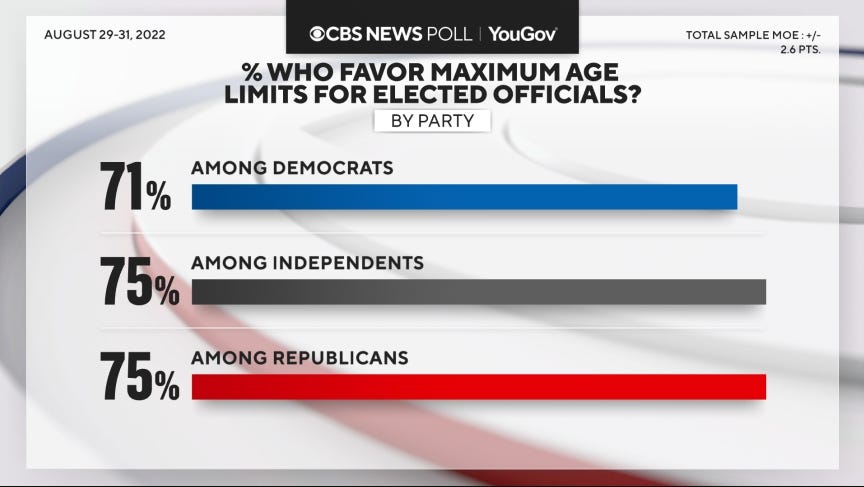
Congress should have term limits. Supreme Court justices should serve fixed terms instead of lifetime appointments.
Federal officeholders should face meaningful age limits or mandatory, independent medical and cognitive evaluations with complete public transparency.
None of these ideas are radical.
They recognize a reality every family understands.
Every generation eventually hands the keys to the next.
Except, apparently, in Washington.
This debate is uncomfortable because it forces us to confront mortality. No one likes to imagine that the leaders they admire will eventually become less capable. But refusing to acknowledge biology does not defeat it. It only delays the inevitable until the consequences become public.
America was built on the idea that no individual is bigger than the republic.
That principle should apply to age just as much as it applies to power.
Public office is not a lifetime achievement award.
It is a temporary trust.
Biology remains undefeated. Our Constitution and our political culture should finally start acting like it.
No posts
Comments
Nothing yet. Say the first thing.
Sign in to join the conversation.