
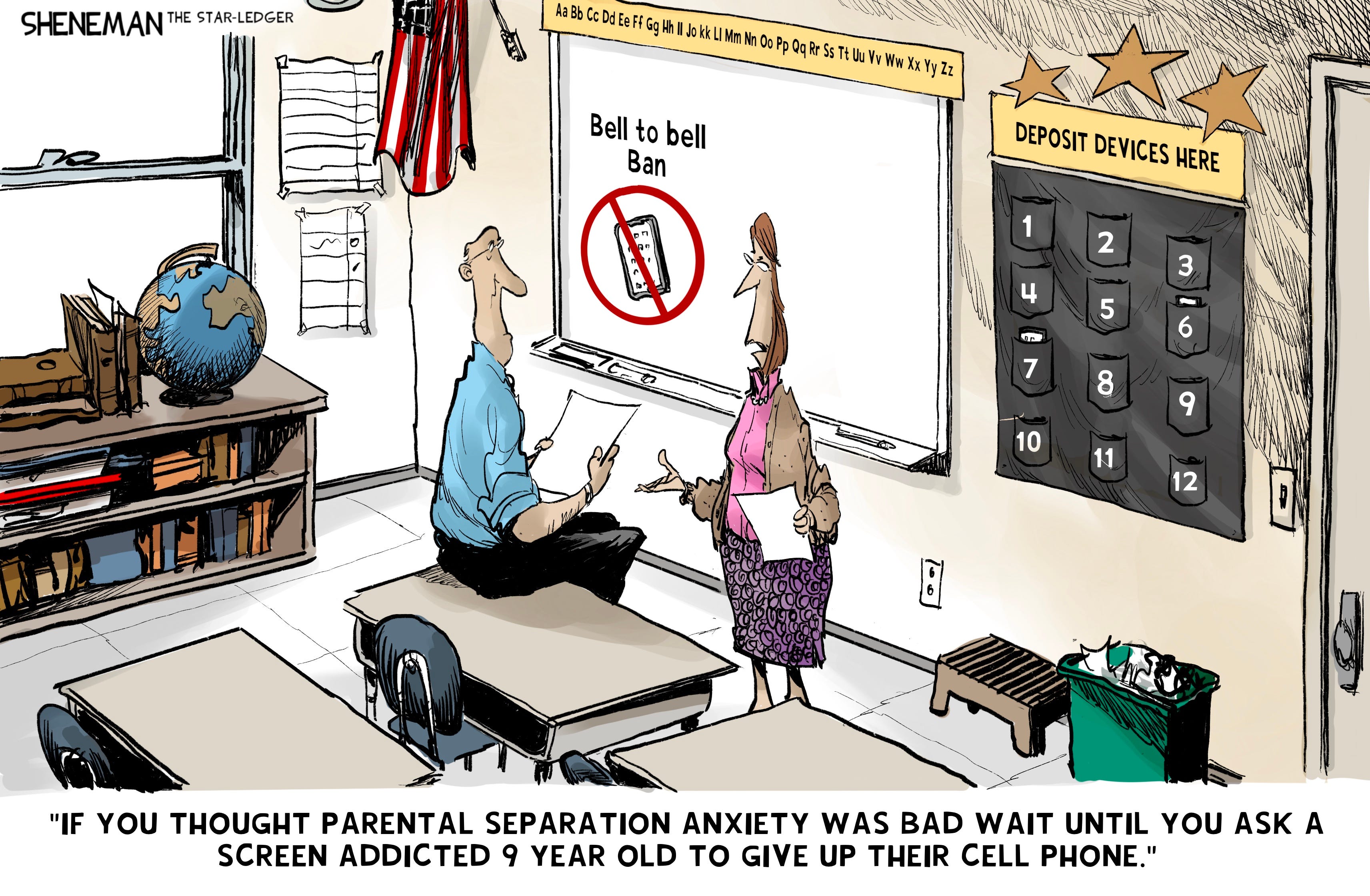
Prior to leaving office earlier this year, former governor Phil Murphy signed a law that wouldn’t take effect until after he was safely ensconced in his Tuscan villa thousands of miles away from ground zero. That bill was the bell-to-bell cell phone restriction, a new law that goes into effect this school year that bans student cell phone usage for “any non-academic use” during the school day. That’s right: Over the course of the next few weeks, millions of school-age children will be forcibly removed from the matrix and forced to make eye contact with other human beings.
Just to clarify, I’m 100 percent in favor of restricting cell phone use during school hours. The verdict is in; the peer-reviewed studies are piled sky-high. There’s just about nothing worse for a mushy, preadolescent brain than soaking it in the unending torrent of self-esteem-destroying social media “content” pulsating through the screen of the pocket-sized supercomputer in your child’s pocket. Attention span, sleep, posture, and—most critically—anxiety and depression: Your phone makes all of it worse. If the state has the ability to limit student exposure to the brick of doom slowly replacing real thought processors with silicon, it should. In fact, officials probably should have done it years ago—just be prepared for an adjustment period.
Let’s take a minute to pour one out for the teachers and administrators who are tasked with enforcing the new restrictions. Surly is the baseline for your average teen; now try prying the phone out of their gnarled claws and see how their mood changes. Screen addiction is a real thing, and so are withdrawals. According to the National Bureau of Economic Research, schools can expect to see a short-term increase in suspensions during the first year of phone restrictions. Students may even report dips in their well-being during the initial adjustment period, but that typically dissipates as the fragile nervous system of the collective student body detoxes from the crippling dopamine stupor of social media.
According to early returns from school systems that have already put bans in place, the long-term prognosis is excellent. Your mileage will vary, but generally speaking, the longer students are deprived of their phones in a classroom setting, the more likely they are to engage with teachers and classmates. That’s called socialization—remember socialization? In the least surprising conclusion in the history of academic studies, mental health, social dynamics, and classroom environments improve when phones are removed from the equation.
Comments
Nothing yet. Say the first thing.
Sign in to join the conversation.