
Twice a year I step away from Second Brain, and next week is one of those weeks. Instead of finding me knee-deep in research papers, I’ll be hiking across the Lake District.
I take these breaks because I need them. Nature gives me - time to slow down, recharge and a a chance to be grateful for all the small things in life that are already all around us. And return refreshed and inspired!
If you leave a comment before I go I’ll try to get back to you, and if I miss you, I’ll reply as soon as I’m home. And next week’s newsletter will be a round-up of some of my favourite previous posts rather than the usual deep-dive.
I’ll be re-treading the steps of my grandmother, who passed away over 10 years ago. She’d take me up to the fells as a child and teach me to water-paint rocks, sheep and the sun shimmering across the lakes. When we got back, we'd always have sticky toffee pud, slathered in gooey, rich caramel sauce. It’s still my favourite to this day.
There’s a topic I’ve been avoiding writing about, because honestly, I was a little bit hesitant to.
And that’s seed oils.
Not hesitant about the science, no, but of what happens when you say you’re not anti-seed oils out loud.
And I say this from experience, from seeing others torn down for sticking their head above the parapet, and when I had my own small taster last year, when I posted about my Daily Mail column (busting the myth that seed oils are inflammatory).
Cue a mob-like pile-on…not a conversation, just who could shout the loudest, tear down my credibility, question my motives, and have the last word - everything but the science itself. Angling so hard to prove I'd been "bought" by "Big Oil" that even my research funding from world-renowned cancer charities became proof I was in on it, because apparently they're in the pocket of “Big Oil” too.
I welcome a different opinion, and an open, balanced discussion. This wasn’t that.
I can also see why so many of us think that seed oils are harmful, when it’s coming at us from every direction, podcasts, headlines, and Instagram. And normally, when most people are saying one thing and a few are saying another, I’d be one of the first to say that’s roughly where the truth tends to sit.
But this is one of those cases where it’s not.
Because in the best studies we have, seed oils are tied to lower rates of disease, not higher.
So if you’ve binned your canola (rapeseed) oil, or swapped it for butter or tallow thinking that’s the safer choice, this is exactly why it matters. Here’s what the research actually shows, including which oils I cook with at home. It’s a long one, so feel free to scroll down to the end if you want to skip straight to it.
Before we get into the why, one thing you can do today
Eat more omega-3s. Aim for oily fish at least once or twice a week (think S.M.A.S.H. that stands for salmon, mackerel, anchovies, sardines and herring), or try adding in an extra handful of walnuts or a spoonful or two of ground flaxseed each day.
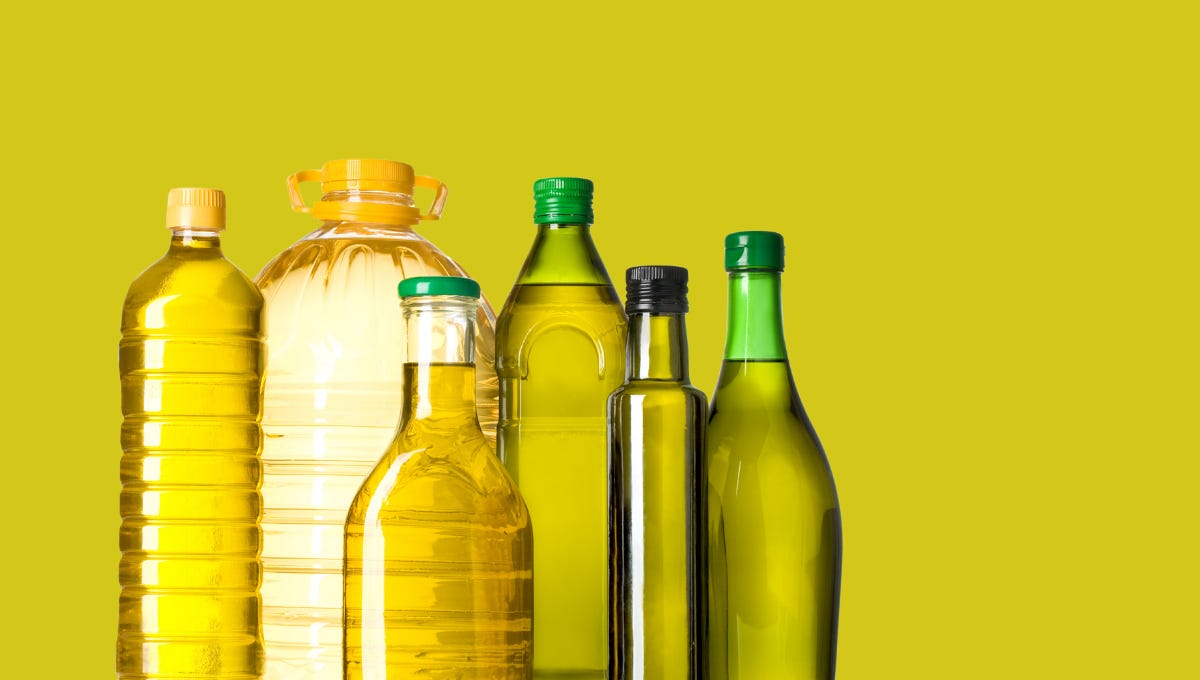
Extra virgin olive oil you can picture the olive being plucked from the tree, the fruits crushed, and the oil carefully collected.
For seed oils (sunflower, rapeseed/canola, corn, soybean) the process is very different, and more industrial.
The seeds are cleaned, heated, and the oil is pressed or drawn out with a solvent called hexane, then refined, bleached and deodorised into a pale neutral liquid.
Yes, that does seem unappetising and alarming.
But some of it sounds worse than it is. Bleaching isn’t bleach, nothing whitening is added. Instead the oil is passed through a natural clay that soaks up the colour, then filtered out. And deodorising is just done by passing steam (from water) through, carrying off the strong smells.
Hexane is the one that’s a fairer worry, being a petroleum-derived solvent. Most of it though is driven off during refining, it has a low boiling point (around 65-70°C), meaning the heat of those stages evaporates it away, though it may leave a small amount of trace residues.
The reassurance is thinner than it looks on the potential impact of those leftover amounts. The US sets no legal ceiling for how much hexane can remain in oil, and doesn’t require testing for it. The EU caps residues at 1mg per kg, but the safety testing behind that figure is old, and looked mainly at hexane breathed in in factories, not the tiny amounts eaten in food, and a fresh EU review is due in 2027.
It’s also worth saying that the long-term effect of eating trace hexane residues hasn’t been well studied, but as these oils have been eaten and studied for decades, a signal from the trace amounts left behind would have had plenty of time to surface.
Until we know more on hexane specifically, it's useful to look at what the research actually says about seed oils and health over time.
To find cause and effect, we need controlled trials, where people are assigned to eat more or less of something and followed to see what happens.
People given oils and margarines to cook with, swapping out saturated fat (e.g. butter) for seed oils, found coronary heart disease events dropped by 19% (8 trials, over 13,000 people). That’s because swapping saturated fat for seed oils improves heart health measures like your cholesterol profile (60 controlled trials).
What about your metabolic health? When researchers pooled 102 trials in over 4,000 people and swapped some of their sugar and starch for the fat that seed oils are rich in, blood sugar control improved and insulin resistance eased, not the reverse.
Let’s zoom in, to a particular type of omega-6 present in seed oils, called linoleic acid.
Scientists gathered every US study they could find, from 1959 to 2008, that measured the levels of linoleic acid in people's body fat.
Body fat is a slow-turnover tissue, so what's stored in it can be a decent record of what someone has been eating for years.
The finding is striking and real, the amount of linoleic acid in Americans' body fat has more than doubled over that half-century, closely mirroring the rise in seed oils in the food supply. By the late 2000s our body fat held about 136% more linoleic acid than it did in the 1960s, a clear signal of how our modern eating habits have changed, written into our tissues.
What it can't tell you, and what the study authors honestly don't claim, is whether that shift is good, bad, or neutral for health.
If carrying more linoleic acid were the danger, the people highest in it should fare worst, yet they consistently fare best, linked to lower cardiovascular disease and stroke (across 30 cohorts), lower risk of type II diabetes (across 20 cohorts) and lower mortality (across 44 cohorts and more than 800,000 people) at the highest levels. A marker of intake that tracks with less disease, and not more.
Both omega-6 and omega-3 are fats your body can’t make, so you have to eat them. Omega-6s, like linoleic acid, are found in seed oils, whereas you’ll find omega-3s in oily fish, and in a less easily used form, in walnuts and flaxseeds.
The theory is that we evolved eating them in roughly equal amounts, about one to one, and that modern diets have drifted to something more like fifteen or twenty parts omega-6 to one part omega-3, as we eat more omega-6 and less omega-3.
On the surface, yes, a UK study of more than 85,000 people found that a higher ratio, meaning a lot of omega-6 compared to very little omega-3, was linked to a higher risk of dying over the following years, and that result often gets passed around as proof that seed oils are the problem.
But in the same study, when the researchers looked at blood levels of omega-6 and omega-3 on their own, both were linked to living longer, not dying sooner. More omega-6 went with lower risk, and so did more omega-3.
So that high ratio that looks bad for health? It’s the low omega-3 that’s really being picked up here, not the omega-6. In other words, a high ratio isn’t a red flag for omega-6, it’s mostly a sign of low omega-3.
So the useful move is the one from the top of this email, topping up your omega-3, making oily fish a weekly priority, or taking an omega-3 supplement.
Critics of seed oils point to a biochemical pathway seen in cells and studies on mice and rats, where linoleic acid raises arachidonic acid, the raw material for molecules that drive inflammation.
What happens in cells, mice and rats doesn’t always translate to humans, and in this case it wasn’t simply that rodents and humans are different species, it’s also the way these studies were designed.
Many of those rodent diets stripped out the other essential fats, then fed linoleic acid against that unnatural background, sometimes at doses far beyond a real human diet. Feed animals a realistic diet with all the fats present and push linoleic acid up across a wide range, and the rise doesn't appear, there's no meaningful change in arachidonic acid, matching what's seen in humans.
In reality, the body converts only a tiny fraction of linoleic acid to arachidonic acid, roughly 0.2%. Consistent with this, a systematic review of controlled trials found that increasing dietary linoleic acid up to six-fold produced no meaningful change in tissue arachidonic acid.
So the mechanism that was held up as the problem, isn’t happening.
On the best evidence we have, it doesn’t.
A review of 15 randomised trials found no significant change in a wide range of inflammatory markers, a finding echoed by a meta-analysis of 30 trials in nearly 1,400 people, and a study of nearly 2,000 people found a higher proportion of linoleic acid in the blood was linked to lower levels of several inflammation markers.
It’s also too simplistic to call arachidonic acid harmful, the molecules it makes don’t just switch inflammation on, some switch it off again.
And arachidonic acid itself is a building block your cells, immune system and blood vessels need to work.
Push any fragile oil hot enough for long enough and it starts to break down and oxidise, forming reactive compounds such as 4-HNE. In lab studies, in high enough amounts, they can damage cells and drive inflammation.
A quick note - this isn’t related to an oils smoke point, the temperature an oil starts to smoke. The smoke point of an oil is a useful cooking guide, where a higher smoke point at a hot heat means your kitchen is less likely to fill full of smoke, or turn your food bitter. But it’s not necessarily related to how easily an oil oxidises.
While seed oils tend to have a high smoke point, they are also more prone to oxidation, because the polyunsaturated fat in them has more of the fragile bonds that oxygen attacks. These compounds build up most with sustained high heat and repeated reheating over multiple hours, the kind more closely resembling oil reused for days in some commercial fryers, than home cooking.
A lot of the scary-sounding oxidation research in rodents uses oil that's been prepared in a way that just isn't reflective of how we cook in real life, like being baked low and slow for 4 weeks straight. That’s about as far from a home stir-fry as you can get.
Standard home cooking times puts little into your food, and it's repeatedly reusing the same oil or cooking for very long stretches that can drive the levels up.
If you do fry at home, simply do this instead:
Match the oil to the job. For everyday cooking, a quick shallow fry or a sauté, any of these oils is fine, seed oils included. If you're cooking for a longer time, a more monounsaturated oil like olive or avocado holds up better, since it has fewer of the weak spots where oxidation starts.
Avoid reusing oil. These compounds build up the more times oil is reheated, so start with a fresh batch each time rather than the same one over and over.
Keep the heat medium-high or below. The hotter the oil and the longer it’s held there, the more of these compounds form.
And again, if seed oils were meaningfully harmful here, you'd expect them to track with disease, and on the best evidence we have, they do not.
Some of the confusion around seed oils comes from looking at patterns in a population, where some studies seem to show that seed oils track with disease.
On the surface, it looks like it’s the seed oils causing harm, until you dig a bit deeper.
Instead the seed oils are a marker for ultra-processed foods, with seed oils in almost everything ultra-processed - from crisp, biscuits, takeaways and ready meals. So as ultra-processed food intake goes up, seed oil intake goes up along side it.
Take that oil out of that pattern and test it on its own in a rigorous trial, and health markers either remain the same or improve.
So it’s when the large part of your diet is made up from ultra-processed foods that’s the real problem, and not the seed oils per se as an ingredient.
So if you’ve cut out seed oils and feel better, it’s almost certainly because you cut back on the ultra-processed foods they come in, and added in more whole foods instead.
The move the evidence backs isn’t finding the perfect oil, it’s swapping saturated fats like butter and tallow out for plant oils. Among the plant oils it’s more about what suits the job than which is best. Olive oil is my personal default, but the seed oils have their place too.
Olive oil
This is my go-to, for dressings, roasting and shallow frying, though not really because trials rank it above the seed oils. On cholesterol they match it and canola even edges it, so what really sets olive oil apart is its polyphenols, which in a randomised trial lowered LDL and modestly raised HDL. Extra virgin olive oil is eyewateringly expensive, so I tend to cook with plain olive oil, and keep extra virgin olive oil for dressings and finishing touches.
Canola / rapeseed oil
Neutral flavour and cheap, so a real all-rounder for frying and baking. I tend to use this or vegetable oil for Asian-style dishes where olive oil isn’t the right flavour profile. It’s one of the best-studied seed oils and lowers total and LDL cholesterol.
Vegetable oil
Usually soybean or a blend in the US, more often rapeseed in the UK, so it behaves like whichever it is, and again it’s a cheap, neutral flavoured workhorse for frying and baking.
Soybean oil
The most-used oil in the US, with a neutral flavour. It also lowers LDL cholesterol when it replaces saturated fat.
Avocado oil
High in monounsaturated fat like olive, also a good option for high-heat cooking. But there aren’t many studies yet on avocado oil itself, so there’s nothing directly concrete to say yet about it’s supposed benefits. For now, fine rather than better, and unfortunately, like olive oil, very expensive.
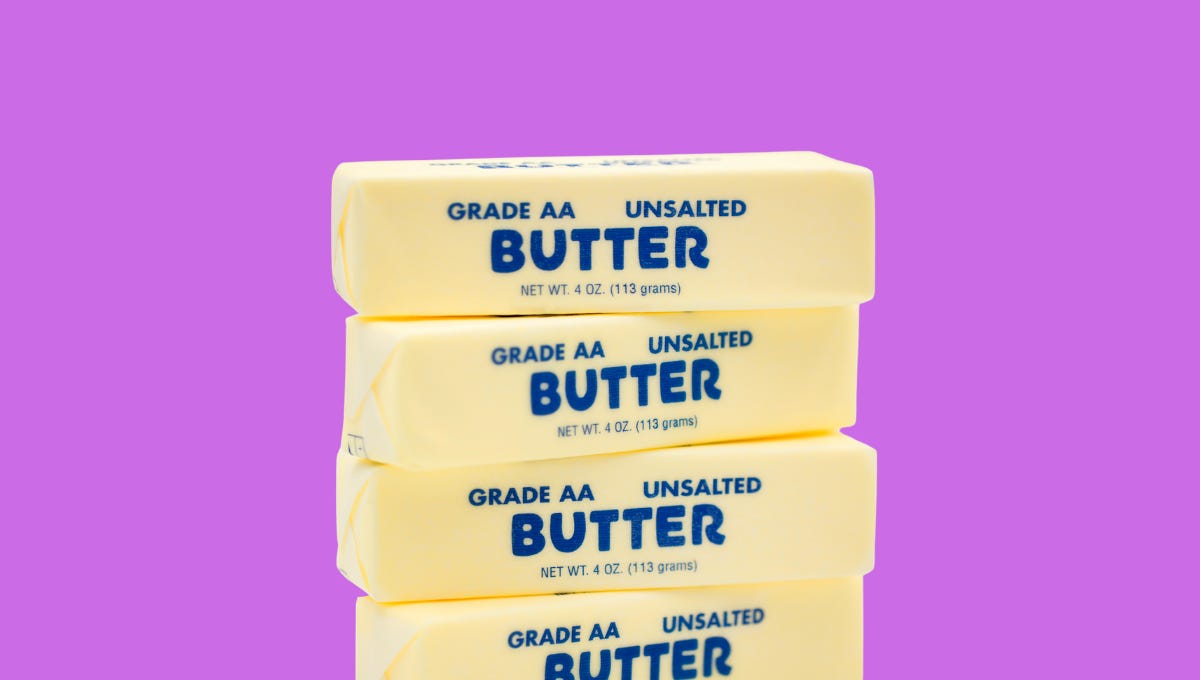
Butter
Mostly saturated fat, lovely for flavour and baking, and all foods fit, so I’m not anti-butter. But in a UK trial against olive oil, four weeks of butter raised LDL more, so move to enjoying it occasionally, and switching to a plant oil most days for your health.
Tallow
Again mostly saturated fat, lovely for flavour and high-heat frying, but as with butter, not a health upgrade. To be fair to it, in a small study it raised LDL less than butter. But it still raised LDL more than olive oil, so the same logic applies, swapping a plant oil out for it isn’t the move for your heart.
Let me know what you think in the comments, what oil do you use when you’re cooking?
Chat soon (when I’m back)
Emily xx
No posts
Comments
Nothing yet. Say the first thing.
Sign in to join the conversation.