
I'm back from my holiday break in the Lake District! And wow it was a great one. Even though I’ve spent time with family there before, it was only by spending days walking through the vastness of the fells, that I fully appreciated its wild and magical beauty. And of course, yes, I did finish with that sticky toffee pudding.
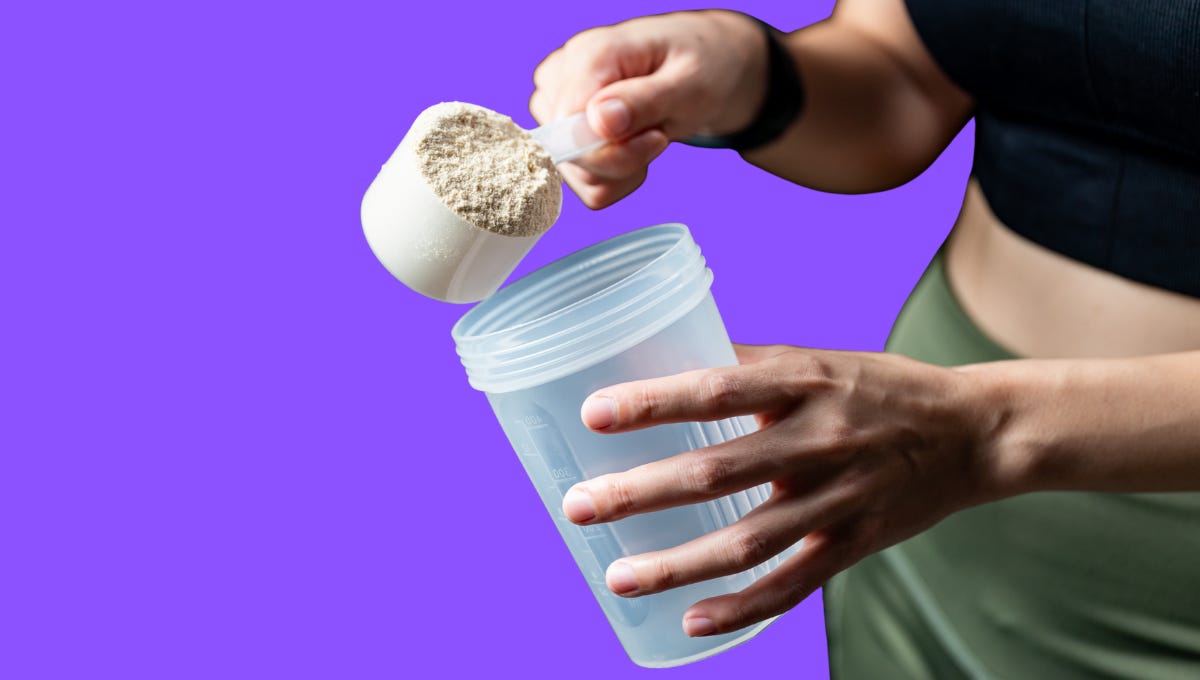
There’s a tub of protein powder in my cupboard.
Which might surprise you, given how much time I spend telling people to get what they need from food first.
Most of us do get enough protein from meals alone for our base needs, but that may not be quite enough if you're active or an older adult.
For me it's a trusty convenience. I'm not a particularly big meat eater, and coupled with the summer heat which has axed my morning appetite, a protein and fibre smoothie for breakfast has been really handy. Particularly as I'm making an extra effort to build strength and functionality through resistance exercise, kickstarted by some backache niggles last year which made me realise that daily walks weren't quite enough.
As we get older we lose muscle, around 0.5% a year and closer to 1% after 75. But we lose strength two to five times faster than that. And it's strength that predicts how well we age.
The supermarket wall of protein powders can be baffling - which should you choose?
There’s a huge variety available, whey, casein, pea, soy, isolates, blends, and often a price range that makes next to no sense.
So here’s what’s actually in them, and the ones I’d buy.
Strength is what keeps you steady on your feet, gets you back up off the floor if you do fall, and gets you through an illness or an operation without losing your independence.
To maintain or build muscle and strength, even if you’re getting plenty of protein, you need to do resistance exercise at least twice a week.
There’s no recommended length of time, instead it’s working your muscles until the last couple of repetitions are a struggle. The closer you get to that point, the more you get out of the set. If you're starting from scratch though, you'll gain from a lot less than that, so don't let it put you off.
That could be:
Bodyweight moves like squats, or standing up out of a chair without using your hands
Resistance bands
Dumbbells, or carrying heavy shopping bags
You don't have to go to a gym, there are plenty of exercises you can do at home. Try this free NHS resource which has pictures and written descriptions.
So protein is only half of it, the other half is asking your muscles to do something.
While most of us are meeting our basic protein needs, the official recommended amount is 0.8g of protein per kg of body weight in the US, and 0.75g/kg in the UK.
But a growing amount of research is pointing to the optimal target being higher still, at 1.2-1.6g of protein per kg of body weight.
If you weigh 60kg (132lb) then that’s aiming for around 72g to 96g of protein a day.
Or if you’re 75kg (165lb) then that’s aiming for around 90g to 120g of protein a day.
I’ve written about this in more detail here:
Note that if you have kidney disease, check the right amount with your doctor first.
A protein supplement only works if there’s a gap.
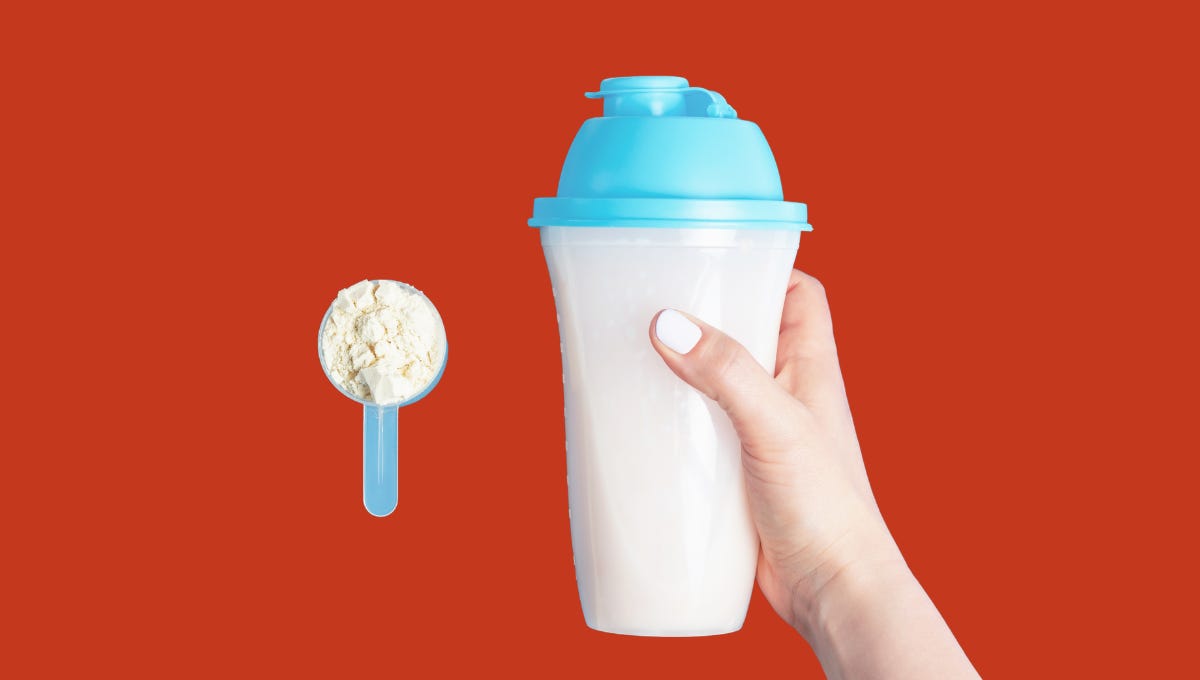
If you’re over 60 and not meeting your protein needs. Older muscle responds less strongly to protein, so needs go up with age rather than down, just as appetite tends to fall. Adding protein powder (you could try as a shake or stirred into porridge) is an easy way to close that gap.
If you’re doing resistance training and not meeting your protein needs. Training raises how much protein your body can usefully put to work.
If you’re struggling to meet your protein needs through food. That might be a low appetite, or higher needs than usual, or both.
If you’re eating in an energy deficit, whether that’s deliberate weight loss or a GLP-1 medication. When you eat less overall, some of the weight you lose comes from muscle rather than fat. Eating enough protein and doing resistance exercise helps to limit that.
If it’s the difference between eating protein at breakfast and not. Breakfast is often the weak link when it comes to protein. Convenience is a legitimate reason to add protein powder into your routine, and a smoothie you’ll actually make beats missing breakfast altogether.
Who doesn’t need one? If you're already hitting your protein through meals without much thought, a powder isn't doing anything for you that your dinner isn't.

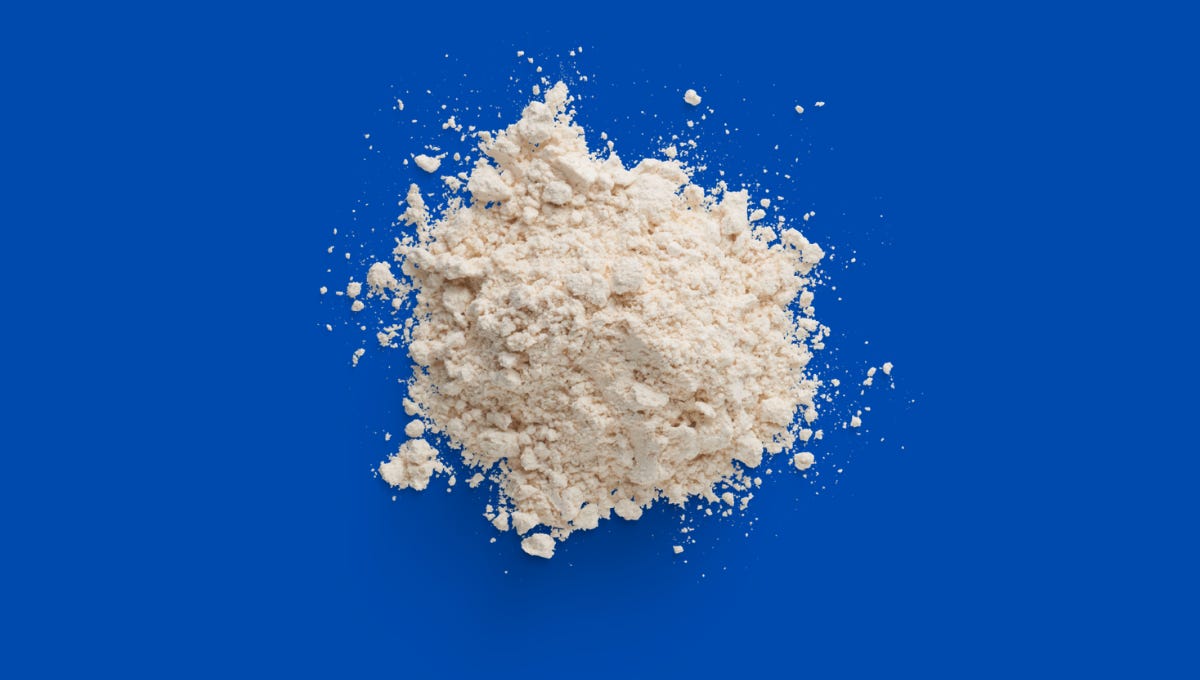
Protein powders are made by extracting the protein from a food, and processing it into a powder. They aren’t 100% protein though, there’s usually some carbohydrate, a little fat and moisture in there too, plus for some, whatever’s been added for flavour and texture.
There are two main types, dairy and plant protein powders.
Dairy protein powders are either casein-based or whey-based. When milk is curdled into cheese, it separates into solids (casein) and a watery liquid (whey).
For pea, soy, and rice, the beans or grains are milled, then the starch and most of the fibre are washed out, leaving mostly protein behind. Hemp is made differently, the seeds are pressed to take the oil out and what's left is milled, so it keeps much more of its fibre.
You’ll often see the labels “concentrate” and “isolate”:
Concentrate. Filtered once, so it keeps some carbohydrate and fat. In whey that’s mostly lactose, in plant powders it’s mostly fibre. Around 70 to 80% protein.
Isolate. Filtered further to strip most of that out, usually 90% protein or more.
There's no good evidence that isolate builds more muscle than concentrate, gram of protein for gram of protein. So isolate isn’t “better” protein, it just means you get more protein in one scoop, and it’s usually more expensive.
Eating protein tells your muscles to start building, and how strongly depends on the protein.
Your body breaks the protein you eat down into amino acids, and reassembles them into muscle. Building muscle needs the full set, and falling short on any one of them slows the whole process down. Leucine in particular acts as the switch that turns the whole thing on.
Dairy protein powders like whey and casein have the essential amino acids in the quantity we need. Plant proteins like pea and rice tend to be low in one or more of the essential ones.
In theory that should hold the whole process back. But a powder isn’t the only protein you eat all day. Amino acids from everything you eat go into a shared pool your muscles draw on, so being short on lysine in one food matters very little if another food that day is rich in it. Rice and beans are the classic example, rice supplies the methionine that beans are short on and beans supply the lysine that rice is short on.
In studies comparing dairy to plant protein powders, soy performs just as well as dairy for building muscle. Rice, oat and chia did less well, though people taking them alongside resistance exercise still built muscle, just a bit less than those on dairy protein.
What counts most is getting enough total protein overall. The amino acid spec does matter, just not as much as companies would like you to think, because most of us eat a varied diet that fills the gaps across the day.
Below for paid subscribers:
Whey, casein, soy, pea, rice and hemp, and which one is right for you
How to work out the cost per gram of protein, and why the cheaper tub often isn’t
What to check on the label before you buy
The protein powder I use myself
Comments
Nothing yet. Say the first thing.
Sign in to join the conversation.