
Most forecasts for the microfinance industry today stop at 2030. Beyond that horizon, standard forecasting methods stop describing changes to the architecture of the system itself.
But the period between 2030 and 2040 is where the most interesting structural shifts may take place.
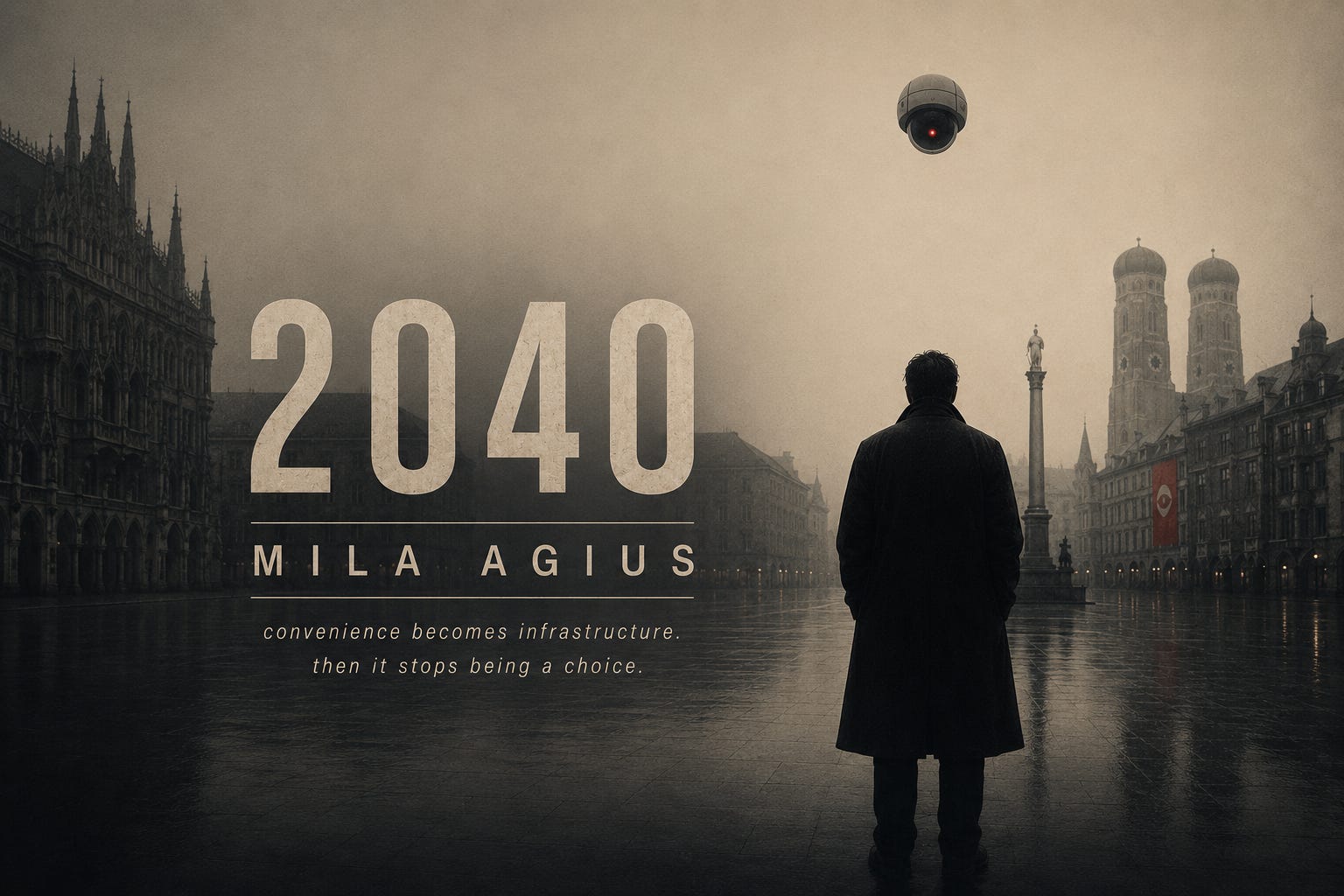
The purpose of this article is to model what global microfinance could look like in 2040. That requires not another forecast, but a ready-made model of the world in which the behaviour of a specific industry can be tested.
The instrument is the analytical frame set out in the novel 2040. The main elements of the frame come from documented technological, regulatory and institutional processes that exist today.
The result is not a description of an inevitable future. It is a model of a future that can still be avoided.
Everything that refers to 2040 describes not a proven future but the behaviour of the industry inside an analytical model.
Commercial research firms still promise the industry a golden age. One of the more optimistic forecasts puts global microfinance at $876.5 billion by 2035, growing at around 11% per year.
The 2040 model does not disprove commercial growth forecasts. The market may reach the stated volumes. It will just become a system that has nothing to do with what people today call financial inclusion.
Further Reading: 2040 — The Model · A prognostic novel by Mila Agius
The architecture of capital is shifting at the same time. The Gates Foundation’s Inclusive Financial Systems programme will close in 2030. CGAP, a thinktank housed at the World Bank, has identified 2,015 new capital providers for financial inclusion, 90% of them private. Venture funds, commercial banks and asset managers are the most visible names on the list. This does not mean the automatic end of philanthropy. It means the centre of gravity moves: from mission to infrastructure, from grant to capital, from a promise to reduce poverty to the need to measure returns, scale and client behaviour.
Inside the 2040 model, that shift is the point of assembly. Artificial intelligence, digital ID, instant payments and the concentration of financial infrastructure do not build a single global market. They split it into three dominant systems and two shadows that appear in response.
1. The Global North and “civilised” Asia: algorithmic morality and retroactive rule
In the high-tech core of the world, Europe, North America, Japan, South Korea and other countries, the classic microfinance organisation is gradually losing its status as a standalone institution. Its functions dissolve into banking platforms, government support programmes, credit marketplaces and technology infrastructure where a loan becomes one of many services inside a digital profile.
The Global North’s main role in this architecture is to be the institutional beneficiary of poverty without ever having to touch it. The ideology of social impact turns into a separate asset class. Inside the 2040 model, this instrument is called the Impact Certificate. It packages not the loan itself but the right to a claimed social result: the number of women financed, the number of jobs created, the share of clients who ‘improved their quality of life’.
AI makes the production of such evidence almost unlimited. It does not have to literally fabricate answers. It only has to industrialise cheap phone surveys, synthetic summaries, automated success stories and metrics that are divorced from real exits from poverty. A European retiree buys the instrument, expects a modest return and honestly believes they are part of a humanitarian mission. A long chain of intermediaries separates them from the end borrower, who may be using a product with an effective interest rate in the triple digits.
Further Reading: The 2040 Crowdfunding Campaign Is Live - by Mila Agius
Documented prototypes already exist in 2026. In Mexico, a specific SOFIPA product carried a rate of up to 109.9% per year excluding VAT. A published TiendaPago offer showed an annualised total cost of 857.2%, again excluding VAT. These are not portfolio averages and not a characterisation of the whole industry. They show how far apart the language of impact investing and the price of a loan at the last link of the chain can drift.
In the Asian wing of the Global North, control takes a softer state-corporate form. On 31 March 2025, the micro-business division of Japan Finance Corporation was serving about 1.15 million enterprises. The average outstanding loan was 8.22 million yen ($50,000). More than 90% of the loans were unsecured. In 2026, South Korea announced a plan to raise annual funding for Miso Finance from roughly 300 billion won ($200 million) to 600 billion won over three years, with roughly half of the programme directed at young borrowers.
This is not predatory business in the usual sense. In the 2040 model, systems like these turn into an infrastructure of social retention. Assistance, monitoring, credit history and life-viability scoring gradually merge into one continuous loop. A person stays inside the system not because of open coercion but because outside it the subsidised rate disappears, refinancing disappears, the next loan disappears, and the ability to prove that you are financially normal disappears.
The European AI Act already places credit-scoring systems for individuals into the high-risk category. In May 2026, the Council of the EU and the European Parliament reached a preliminary agreement to move the application of the corresponding requirements for standalone high-risk systems to December 2027. The law shows both sides of the architecture to come at once. Scoring becomes powerful enough that it has to be regulated, and the right to an explanation of a decision becomes a separate legal right.
In the 2040 model, the most dangerous mechanism is the retroactive reassessment of the person’s position. The loan formally stays the same. The system changes everything around it: it lowers the limit, closes off refinancing, raises the price of the next loan, moves the client into a different risk category, or blocks access to products used by the family and the business. The trigger does not have to be a missed payment. It can be a change in the pattern of purchases, in device behaviour, in travel geography, or in the risk profile of the social network.
The contract has not been rewritten. The person has.
The investor bears no direct responsibility, the lender points to the model, and the model stays opaque even when it produces a formal explanation. That is how retroactive rule becomes legally clean.
2. The Global North: elite isolation
When the universal system of observation becomes ordinary, a paid specialisation appears next to it. Inside the “civilised” world, one of the ways to stay out of the Payment Integrity Graph is voluntary financial isolation.
The Northern underground is not necessarily people at the margin. It is entrepreneurs, professionals and wealthy families who can afford to pay for privacy. They reduce their dependence on the universal smartphone, close down digital trails, use separate devices for payments and communication, and bring back analogue cameras, e-ink tablets and standalone audio systems. But the technology is secondary.
The main product of this shadow is not a gadget. It is a human decision. Closed subculture-type societies emerge, of the kind described in the novel 2040, organised around the old idea of cognitive and financial privacy. This is not a rejection of money and not a romantic escape into the analogue world. It is the purchase of the right to remain not fully readable. In 2040, financial invisibility in the North becomes a luxury: another asset available only to those who can pay in advance for the absence of algorithmic convenience.
3. The Global South: the “licence to live”
If the North becomes the façade and the recipient of rent, then Latin America, Africa and South and Southeast Asia turn into the global beta version of digital behavioural control. Thousands of local microfinance organisations will not necessarily disappear. But their core functions, identification, scoring, disbursement, collection and access to capital, will concentrate around a small number of global and regional infrastructure platforms.
Microcredit stops being a separate financial service. Inside the 2040 model it becomes a mode of access to the economy: an algorithmic licence to exist that the precarious class has to renew regularly through behaviour.
Further Reading: Moving Communities: Antifragility’s Oldest Tool
The core of this architecture is India. According to MFIN, on 31 December 2025 the total microfinance portfolio had shrunk to 3.147 trillion rupees ($33 billion), down 7.3% in a single quarter. The industry body estimated that around five million clients may have lost access to formal finance. At the same time, portfolio quality improved. Portfolio at Risk (PAR) 31 to 90 days fell to 1.6%, and PAR 91 to 180 days to 2%. This is an important signal: the industry is contracting, cleaning out risk and redistributing clients between MFIs, banks and large non-bank lenders.
The publicly stated target of roughly 7.5 trillion rupees by 2030 depends on the absence of new shocks and on the recovery of wholesale funding. In the logic of the old world, this is a forecast of returning growth. In the logic of 2040, it is a window in which the traditional industry either integrates into a larger digital infrastructure or hands over a significant part of its functions to it.
CGAP cited India’s United Payments Interface (UPI) and its biometric identification system Aadhaar as examples of how microfinance client acquisition costs can be pushed down close to zero. The main asset stops being the credit product and becomes the person’s profile.
For people without premium devices and long banking histories, the core of control becomes the Behavioural Collateral Graph. The algorithm assesses not the borrower’s property but their connections, the regularity of transfers, the rhythm of payments, the structure of contacts and the social network’s ability to absorb their default.
Early signals of that architecture have already appeared in African digital lending. In Nigeria, after years of complaints about abuse, new rules for digital lending came into force in 2025. They require transparent terms, personal data protection, ethical collection and a proper assessment of repayment capacity. In January 2026, the regulator began to remove operators that had not completed legalisation from the official register, and connected app stores and payment providers to the enforcement mechanism. This regulation did not answer a theoretical risk but was a response to accumulated harm.
This does not prove the existence of a global conspiracy. It shows something less comfortable: markets with a low cost of causing harm let business models pass tests that would be politically impossible somewhere else. The language of inclusion becomes moral cover for the experiment.
The second node of control is translocal collateral. A study on Cambodia, published in late 2025, showed how information about migrant workers’ remittances can enter borrower assessment and sustain the debt regime of the whole family. Remittances here are not the sole reason for issuing every loan. They serve as evidence that a debt can be serviced through the labour of a person in another country.
In 2040 this mechanism becomes automated. Repayment is deducted from an international transfer before the money turns into food, rent or medicine. A missed transfer changes the risk profile of the entire family. Humanitarian aid, digital ID and scoring gradually run on the same infrastructure. Charity does not disappear. It becomes another channel for updating the data.
4. The shadow of the South: trust groups and the old instinct of survival
Extreme pressure always creates a counter-reaction. If algorithmic platforms filter out hundreds of millions of people as too risky or too expensive to serve, the grey zone of semi-formal microfinance will not disappear. It will change shape.
A person will face a choice: become fully transparent to the system, or take part in an invisible market. This is how a counter-inclusion economy comes into being, a parallel economy of those whom formal inclusion has entered into a database but excluded from acceptable terms.
This shadow market is not a youth subculture. It brings back old mechanisms of association: the rotating savings clubs known as ROSCAs, hundi networks, tanda, diaspora funds and local mutual-aid pools.
It is common to romanticise these networks as pure solidarity. Their durability rests on a harder mixture: reputation, repeated interaction, kinship, mutual dependence, moral debt and the fear of social exclusion. In some settings, this can also include the risk of personal coercion. But to reduce the whole system to violence would miss the main engine: a participant repays the money not to an abstract organisation but to the world in which they have to keep living.
ROSCA expert Jeffrey Ashe recalled a conversation he had in Cambodia where a microfinance borrower put it this way: “Why pay them when we could pay us?”
Full formalisation often weakens such networks. It replaces personal interdependence with a standard procedure, but it cannot always replace the mechanism of trust that held the discipline together. Some digital and banking adaptations of ROSCA work. Others destroy the social construction they were meant to scale.
In the 2040 model, trust groups become the financial infrastructure of resistance. They avoid the transparent blockchain and the universal cellular ID. They use local mesh networks, Bluetooth relays, standalone encrypted ledgers and devices that are not permanently connected to the cloud.
An algorithm can copy the interface of any application. It has a much harder time reproducing a network of obligations that exists not in a database but in the memory of a community.
5. The authoritarian block: fusion of debt and state coercion
In closed and coherent authoritarian systems, microfinance evolves along a different path. Here the state does not need to wait for the market to concentrate on its own. It sets the permitted channels of credit, identification and collection.
China becomes the technological absolute of this model. According to the People’s Bank of China, at the end of September 2025 there were 4,863 microcredit companies operating in the country, with a combined portfolio of 722.9 billion yuan ($107 billion). In the first nine months of the year the portfolio contracted by 31.9 billion yuan. This is a distinct sector that exists in parallel with the vast bank lending to micro-businesses that is gradually moving under a tighter single supervisory discipline.
Further Reading: Why Subcultures Outlive the Fortune 500
In the harshest version of the 2040 scenario, independent microcredit does not necessarily disappear in physical form. It stops existing as an independent function. The loan becomes part of the state financial profile: digital identity, credit history, payments and the status of permitted behaviour are read by one system. This is the logical continuation of a model in which the different state loops eventually join a single interface.
Russia shows a different version of the same trajectory. In 2025, the number of active MFIs fell to about 842. Some analysts and market participants forecast a further contraction of the register to 350 to 400 companies by the end of 2027. This is not an official plan of the Bank of Russia but an industry scenario of consolidation. At the same time, technical integration is deepening: mandatory biometric infrastructure, data exchange, cooling-off periods and new-loan controls.
From September 2025, certain loan amounts became subject to a mandatory pause before disbursement, and MFIs became obliged to verify that the borrower and the recipient of an online loan are the same person. These measures were introduced as fraud protection. Inside the 2040 model, the same infrastructure easily changes purpose. Protection becomes a permission loop.
Myanmar shows an existing external prototype of the forced management of financial flows. The military authority obliged migrant workers to route part of their earnings through controlled channels. This example matters as proof that the state can turn a money transfer into an element of administrative discipline.
Inside 2040, this mechanism is transferred to microcredit. Loan issuance, risk assessment and the freezing of access become functions of a single state interface. The system sets a risk threshold beyond which it sees no reason to serve the person anymore.
Microcredit turns into a biometric collar with no visible lock. Formally, no one forbids the person to live. The system just closes off the ways to pay for that life.
The closed door
The global architecture of microfinance buries the era of humanitarian illusions. For decades, the industry, regulators and donors chose scalability and efficiency, each time promising that lower cost, faster decisions and wider reach would bring poor people closer to economic autonomy.
The result of the model is the opposite of the promise. The North collects rent under the mask of investment sainthood and turns impact measurement into a tradeable asset. The South becomes an algorithmic testing ground where data, social ties and remittances replace property as collateral. Authoritarian systems use credit infrastructure as an administrative interface. Next to every dominant architecture, a shadow appears: the subcultural privacy of the North and the invisible trust economy of the South.
The difference between 2026 and 2040 is not the arrival of one new technology. It appears at the moment when the elements that already exist connect, begin to reinforce one another, and turn the infrastructure of control into the only option available.
The formula of that transformation is simple enough. In the twentieth century, microfinance promised the world that credit was a door out of poverty. The 2040 system works differently: credit is the door that closes behind you for good.
Real economic autonomy only survives where the algorithm does not have the full picture. In the expensive analogue quiet of the North. In the closed mutual-finance groups of the South. At any point where a person is still able to keep part of their life outside the model.
Comments
Nothing yet. Say the first thing.
Sign in to join the conversation.