
The Dark Side of Development takes its usual publishing break in August. We will be back at the start of September.
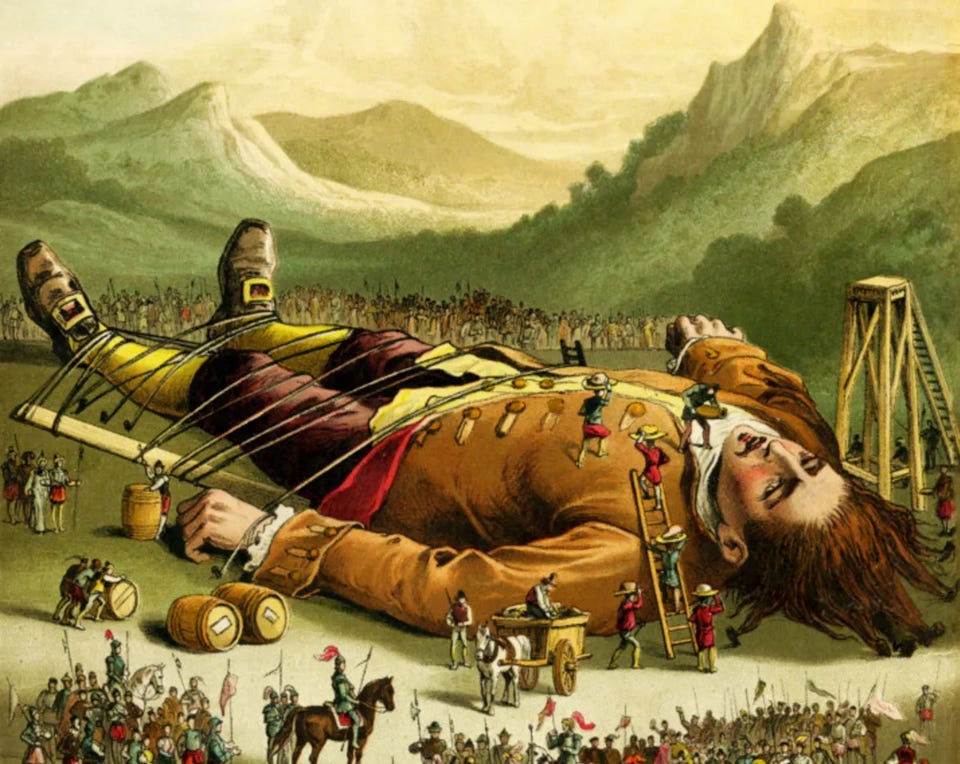
Go on then, what do Gulliver’s Travels and microfinance have in common?
Dutch social impact investor Oikocredit walks us through it on their website. [1]
In the 1720s, Jonathan Swift, the Irish author of Gulliver’s Travels, started offering small low or zero interest loans to “industrious artisans with low income.”
The loans, Oikocredit says, had “two distinctive features that made them structurally almost identical to modern microfinance.” Borrowers had to make partial repayments weekly and applicants needed two people to vouch for their good reputation.
The project and its imitators grew in scale and Oikocredit says it was providing loans to a fifth of the Irish population at its peak, so “laying the foundation” for modern microcredit.
There is, we understand, a tradition of small-scale entrepreneurs, operating alongside a parallel tradition of innovative, small-scale lenders.
In terms of Ireland, the account skips the important bit. The structure of British land ownership in Ireland was not affected by the local availability of small loans. These loans did nothing to help Ireland during the 1846 Potato Famine, during which food continued to be exported to mainland Britain.
The famine left a million people dead and led to the emigration of a million more.
The provision of credit needs to be considered within its specific historical and institutional contexts. Oikocredit’s attempt to establish continuity with modern microfinance pioneers such as Muhammad Yunus in Bangladesh reads like a parody of the concept of “invented tradition.”
The concept was developed by historians Eric Hobsbawm and Terence Ranger in the 1980s. Most “traditions”, they argued, are of recent design and serve a political purpose.
The concept has been widely accepted and adopted by historians who have had no difficulty in identifying instances. “Traditions” are pieces of modern political communication.
The British Royal Family and England’s epically underperforming football team, both given as examples by Hobsbawm, are both a little more German than we English like to dwell on. Readers in different countries will be able to come up with their own examples. [2]
Further Reading: The Cold War Origins of Microfinance
The actual history of credit in Europe and North America is a different topic entirely. That history has been analysed by Thomas Dichter, whose work includes an open-access paper published in 2007. [3]
Dichter found that in modern rich countries, “economic growth occurred first, then came credit for the masses. That credit was and is predominantly for consumption rather than investment.”
Early European forms of microcredit, Dichter found “never played a significant role in business start-up or small business development.” The first attempts at democratizing financial services were almost entirely savings and ‘thrift’ based. “When credit for the poor did come along, it followed the savings movement and developed almost entirely in relation to consumption.”
In both Britain and the United States, formal credit for business use was deployed by large-scale industrial firms. If small entrepreneurs borrowed, they usually did so informally, through family or friends.
The first “Morris Plan” thrift in the US, designed to reduce the use of informal moneylenders by the middle class and the poor, was not established until 1910, by which time the country was already a net exporter of manufactured goods.
The sequence holds if the analysis is extended to developed Asia. Post-war economic recovery in Japan, South Korea and Singapore was engineered by state-directed industrial policy and infrastructure investment. Mass formal credit came later.
Dichter finds “no reason to believe that the nature and sequence of growth and mass credit are fundamentally different for poor countries today than they were in the past.”
“The average poor person in the past (and today) is not an entrepreneur, and when he or she has access to credit it is largely for consumption or cash flow smoothing.”
Today, that points to the need for savings and insurance to play a much bigger role in microfinance than the much more profitable loans which have so far dominated.
[1] Oikocredit and Gulliver’s TravelsMicrocredit and social impact: what do Oikocredit and Gulliver’s Travels have in common? - Oikocredit
[2] Eric Hobsbawm, Terence Ranger (eds), The Invention of Tradition (Cambridge: Cambridge University Press, 1983)
[3] Thomas Dichter, A Second Look at Microfinance: The Sequence of Growth and Credit in Economic History (Cato Institute / Center for Global Liberty & Prosperity, Development Policy Briefing Paper, February 2007). Direct Link: 336522 no pmt.qxp
Comments
Nothing yet. Say the first thing.
Sign in to join the conversation.