
A reasonable question to ask, after thirteen weeks of evidence, is this: if the picture I have been describing is accurate — if the population-level decline in male hormonal function is documented, the mechanism is characterized, the consequences are visible across multiple specialties, and the treatments exist — why does mainstream medicine appear to be entirely unaware of it?
The question deserves a direct answer. It is also a question I have wrestled with for years in my own practice, watching patients cycle through the medical system without anyone connecting their symptoms to the upstream cause that I have been documenting in this series.
The answer is not a single villain. It is not a conspiracy. It is the predictable consequence of how medicine is currently structured — how clinical responsibility is fragmented, how diagnostic frameworks are constructed, how research priorities are set, and how the cultural attention of medical institutions is allocated. Each of these factors, on its own, produces partial blindness to the testosterone crisis. Together, they produce comprehensive blindness.
This article is about those factors. Not because understanding them will change the institutional system overnight — it will not — but because understanding them is the first step toward navigating around them as an individual patient or family member, and toward beginning to address them at the systemic level.
The Specialty Fragmentation Problem
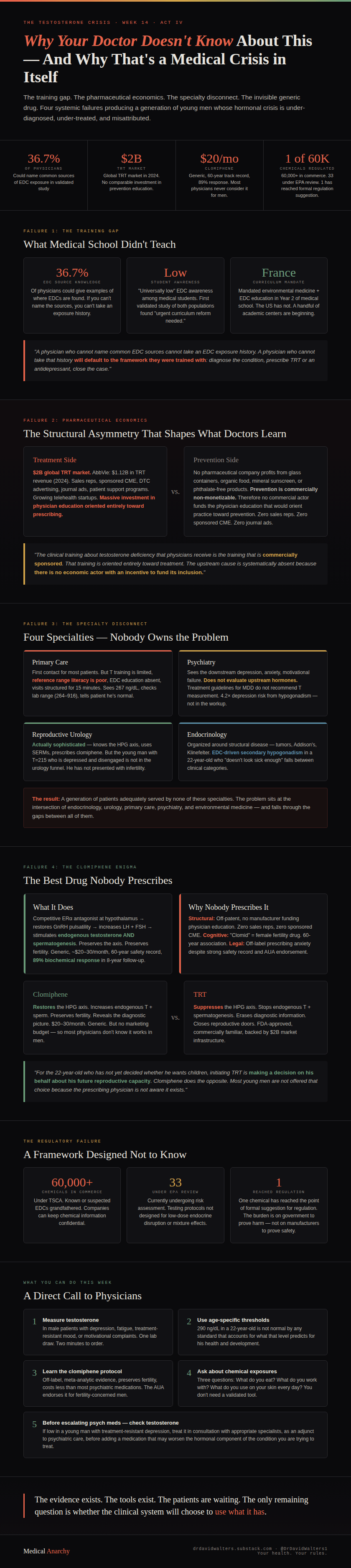
The single most important factor in mainstream medicine’s failure to recognize the testosterone crisis is the way clinical responsibility for the affected patients is distributed across multiple specialties, none of which owns the integrated picture.
The young man with EDC-driven hypogonadism arrives at his primary care physician with depressive symptoms, fatigue, and possibly cognitive complaints. The primary care physician’s training in men’s hormonal health is typically limited — perhaps a few hours of curriculum across three years of residency, focused primarily on identifying overt clinical hypogonadism in older men. The primary care framework defaults to depression treatment, and the patient is referred to psychiatry or simply prescribed an SSRI.
Psychiatry, when consulted, is operating within its own diagnostic framework — DSM categories, neurochemical models of mood disorders, pharmacological approaches focused on serotonin and dopamine modulation. Psychiatric training does not generally include detailed evaluation of reproductive endocrine status, and psychiatric residents are not typically trained to consider hormonal contributions to depression as part of routine workup. The psychiatric diagnosis is made and treated within the psychiatric framework. The hormonal substrate is not investigated.
Endocrinology, when consulted, is dominated by diabetes and thyroid disease. Adult-onset hypogonadism in young men is not a high-volume diagnosis in most endocrinology practices. The Endocrine Society has published guidelines on testosterone deficiency that acknowledge the condition exists but do not adequately address the population-level decline I have been documenting, and the recommended workup typically follows the conventional age-independent threshold of 300 ng/dL — a threshold derived from older men and inappropriately applied to younger ones.
Urology and andrology, the specialties most likely to encounter male hormonal complaints, are themselves divided. Urology is dominated by prostate disease, kidney stones, and surgical conditions. Andrology — the subspecialty focused specifically on male reproductive medicine — is small, with relatively few practitioners in most regions, and is often clustered around major academic centers and fertility clinics. The integration of fertility-focused andrology with the broader picture of male hormonal health is incomplete.
Reproductive endocrinology, when the patient arrives via the fertility pathway, is structured to address the immediate clinical question of pregnancy. The discipline is sophisticated and effective at producing pregnancies. It is not generally structured to investigate why the male partner has impaired spermatogenesis or to address his broader hormonal status.
The patient experiences this fragmentation as a series of disconnected encounters. The integrated picture I have been describing — the EDC-driven HPG axis suppression manifesting across mood, cognition, libido, fertility, and physical function — does not map cleanly onto any single specialty’s framework. No specialty owns it. No clinical pathway captures it. The patient is routed through the system based on whichever symptom is most prominent at the time of presentation, and each specialty addresses its piece without seeing the whole.
This is the central structural problem. Until the integrated picture has a clinical home — until the fragmentation is replaced with a recognized diagnostic and treatment framework that crosses specialty boundaries — patients will continue to fall through the gaps.
The Reference Range Problem
The second major factor is the way diagnostic thresholds for testosterone deficiency are constructed, which I have addressed in earlier articles but which deserves a synthesizing summary in this context.
Laboratory reference ranges for testosterone vary dramatically across facilities. The lower bound of “normal” varies from approximately 130 to 450 ng/dL across different US laboratories, depending on which validation cohort the laboratory used. Most laboratories use age-independent ranges, applying the same cutoff to a 22-year-old and a 72-year-old despite the substantial physiological differences between these populations. The Endocrine Society and the American Urological Association have used a 300 ng/dL threshold derived primarily from testosterone replacement trials in men over 45 — a threshold that is inappropriately applied to younger men whose normative testosterone should be considerably higher.
The 2022 Zhu et al. analysis of NHANES data established age-specific normative cutoffs that would be more appropriate: 409 ng/dL for men aged 20-24, 413 for 25-29, with age-appropriate adjustments. These age-specific thresholds have not been widely adopted in clinical practice. The result is that a 22-year-old with testosterone of 350 ng/dL is told his bloodwork is “within normal limits” when, by age-appropriate standards, he is below normal for his age cohort and clearly suppressed relative to the historical baseline of what young men’s testosterone was supposed to be.
The deeper problem is that the reference ranges themselves are constructed from populations that are themselves experiencing the decline I have documented. Each laboratory’s “normal range” is calibrated against the men who get tested at that laboratory — a population whose average testosterone has been falling for decades. As the population baseline declines, the reference range silently descends with it. A man who would have been clearly hypogonadal by 1985 standards may now be classified as “low normal” by 2024 reference ranges, even though his absolute testosterone level has not changed and his clinical symptoms are unchanged.
The clinical consequence is that the diagnostic threshold has become a moving target that makes the population-level decline invisible at the individual clinical level. The young man with the symptom constellation I have described looks at his lab report, sees “within reference range,” and is told there is no hormonal problem to address. The reference range is wrong — or more precisely, it is calibrated against a deteriorated baseline that does not represent what his testosterone was supposed to be.
This is not the fault of any individual clinician. The reference range comes from the laboratory. The clinician interprets the result against the printed range. The system functions exactly as designed. The problem is that the system was designed to identify clinical abnormality against a stable population baseline — and the population baseline has not been stable.
The Pharmaceutical Incentive Structure
The third factor is one I have alluded to throughout this series but want to address directly here, because it shapes what gets researched, what gets taught, and what clinicians become aware of.
The structural research on the testosterone crisis — the population-level data documenting the decline, the mechanism studies characterizing how EDCs suppress the HPG axis, the clinical observations connecting these findings to the symptom profiles in young men — has been performed almost entirely by academic researchers, environmental health scientists, and a small number of clinical investigators working with limited funding. The pharmaceutical industry has had no role in producing this body of evidence and has no commercial interest in promoting awareness of it.
The reasons are straightforward. The pathophysiology I have described points toward a treatment paradigm in which the upstream cause — environmental chemical exposure — is reduced through behavioral and policy changes, and in which the resulting hormonal suppression is treated, when necessary, with inexpensive generic medications including clomiphene citrate. None of this generates significant pharmaceutical revenue. The molecules responsible for the chemical exposure are produced by chemical companies, not pharmaceutical companies. The treatment medications are off-patent and inexpensive. The framework does not produce a profitable proprietary intervention that would justify the marketing investment that drives most clinician awareness of new clinical concepts.
The contrast with the marketing of testosterone replacement therapy is instructive. Exogenous testosterone is, in most cases, the wrong treatment for the men I have been describing. It addresses a different mechanism, suppresses spermatogenesis (making it inappropriate for fertility-relevant patients), and does not restore the man’s own HPG axis function. It is, however, a profitable intervention that has been heavily marketed to clinicians over the past two decades. The “Low T” awareness campaigns of the 2010s — which I referenced briefly in Week 11 — were funded by pharmaceutical companies marketing branded testosterone preparations. They produced awareness of testosterone deficiency as a clinical concept, but framed it in ways that pointed toward the proprietary treatment rather than toward the upstream cause.
The result is a clinician landscape in which awareness of testosterone deficiency exists primarily in association with the testosterone replacement framework — the framework that pharmaceutical incentives have shaped. Clinicians who have learned about hypogonadism through industry-supported continuing education are likely to think of it in those terms. The alternative framework — secondary hypogonadism driven by environmental factors, treatable with HPG axis restoration via clomiphene — is not represented in the same way in the educational ecosystem.
This is not a conspiracy. It is the predictable consequence of how clinical knowledge dissemination is funded. The information that produces commercial value gets distributed. The information that does not produce commercial value gets less distribution. Clinicians, working under time pressure and without infinite capacity to read independently, end up with a knowledge profile shaped by these incentive structures.
The clinicians who do recognize the picture I have been describing — and there are many — typically do so through their own independent reading, through interactions with patients whose presentations forced the question, or through training in environmental health that exposed them to the EDC literature directly. They are the exception, not the rule, and the system that produced their awareness is not scalable to the full clinician population.
The Cultural Attention Problem
The fourth factor I want to address is more delicate, and I want to handle it with care because this is precisely the place where critique can tip into something other than critique. I will state it as the empirical observation that I believe it is.
The medical institutions that allocate research attention, public health priority, and clinical infrastructure have, historically, responded more rapidly and more robustly to identified threats to women’s reproductive health than to comparable threats to men’s reproductive health.
The data supporting this observation is straightforward. Female reproductive health has dedicated specialty (obstetrics and gynecology) with thousands of practitioners and integrated training across the entire medical curriculum. Male reproductive health is divided across urology and the much smaller subspecialty of andrology. NIH research funding allocated to female reproductive disorders substantially exceeds funding allocated to male reproductive disorders. The number of guidelines, screening recommendations, and clinical pathways for female reproductive health far exceeds those for male reproductive health. The public health response to identified threats to female fertility has been faster and more comprehensive than the response to comparable threats to male fertility — including the specific threat I have been documenting in this series, where the population-level data for male decline is at least as robust as the data that has driven prior female-focused responses.
This is an observation about institutional attention allocation, not an argument that women’s reproductive health has received “too much” attention. It has not. The advances in female reproductive medicine over the past century are extraordinary and have produced genuine improvements in women’s lives. The argument is that the same institutional energy has not been applied to documented threats to men’s reproductive function, even when the evidence is comparable.
The reasons for this asymmetry are complex and partly cultural. Medical institutions reflect broader social attention patterns. Reproductive health was, for much of the 20th century, understood culturally as a women’s issue — both because pregnancy is biologically female and because the political and social movements driving health policy attention to reproduction were focused primarily on women’s experiences. Men’s reproductive health was understood as relatively static, requiring less attention, because the visible markers of male reproductive function (ability to maintain a relationship, ability to father children, ability to perform sexually) were not understood as candidates for medical attention until they failed visibly.
The result is a medical system in which threats to men’s reproductive function arrive at the diagnostic threshold without the cultural and institutional infrastructure that would have surfaced equivalent threats to women’s reproductive function much earlier. The decline I have been documenting has been visible in the data for decades. The institutional response has not yet matched the magnitude of the data.
I want to be precise about what I am not saying. I am not arguing that women’s health attention should be reduced, or that men’s health concerns are being neglected because women’s are receiving attention they should not. The asymmetry is not a zero-sum issue. The question is whether men’s reproductive function deserves comparable institutional attention to women’s, given comparable evidence of population-level threat. By any reasonable standard, the answer should be yes. By the actual pattern of institutional response, the answer has been no.
This is changing slowly. The recognition of male hypogonadism has expanded over the past decade. The fertility evaluation increasingly includes male partner workup. Some advances in male reproductive medicine are emerging. But the gap between the magnitude of the problem and the magnitude of the institutional response is still substantial, and it is one of the structural reasons that the testosterone crisis has been allowed to progress to its current scale without adequate intervention.
The Conversation I Have Had With Colleagues
I want to close this article with something I have largely held back from earlier articles in this series, because the structural argument is more important than any anecdote. But here, in the article specifically about why mainstream medicine has missed this, the experiential dimension matters.
I have, over the past several years, presented the picture I have been describing in this series to colleagues — to physicians I respect, to specialists in adjacent fields, to academic researchers who work in environmental health. The reactions have been instructive.
Some colleagues respond with immediate recognition. They have seen the same patients in their practices. They have noticed the same patterns. They have wondered why no one was talking about it. The synthesis I am offering crystallizes something they had been observing without having articulated. These conversations are gratifying.
Some colleagues respond with skeptical engagement. They want to see the data. They press on the methodology of the population-level studies. They challenge the inferential leap from epidemiological correlation to mechanistic causation. They note correctly that some of the chemical-effect literature is stronger than other parts. These conversations are valuable. They typically end with the colleague acknowledging that the picture is more substantial than they had realized, while reserving appropriate scientific skepticism about specific elements.
Some colleagues respond with dismissal. They see the EDC argument as fringe. They see the chemical-environmental framing as alarmist. They suspect that anyone making this argument must be selling something — a clinic, a treatment, a book, an ideology. These conversations are difficult. They typically do not end with engagement. The colleague has heard enough to fit the argument into a pre-existing category that allows it to be set aside without further consideration.
The dismissive response is not always wrong as a defensive posture. There is a great deal of unreliable health information in the world, and physicians have legitimate reasons to be cautious about claims that seem to challenge mainstream consensus. The cost of being wrong about which alternative frameworks deserve attention is real. Defensive skepticism is a reasonable default for a clinician operating under time pressure who cannot independently evaluate every challenge to standard practice.
What troubles me about the dismissive response is that it forecloses the possibility of seeing the picture. The colleague who has decided that this argument cannot be correct will not look at the patients differently, will not order the appropriate workup, will not consider the alternative treatment framework. The young men who would have benefited from his recognition will remain on antidepressants that do not help them. The pattern will remain invisible to him because the pattern, once dismissed, becomes invisible.
This is the deepest structural barrier. The medicine I have been describing requires a clinician’s willingness to update their framework — to consider that the standard approach is missing something important, that the patients in front of them might benefit from a different evaluation, that the institutional consensus might be partially wrong. Not all clinicians are positioned to do this work. Some are. The patients who find the latter are fortunate.
The work of this series has been, in part, to make the picture visible enough that more clinicians will be in the position to see it — to give the integrated framework enough articulation that colleagues encountering it for the first time have a coherent alternative to engage with, rather than an unspecific complaint about the standard of care.
Whether this work will succeed institutionally remains to be seen. What I know is that the patients are real, the conditions are treatable, and the clinical work continues whether or not the broader system catches up.
Next week, we begin the response. The medication that has been quietly available all along.
Key Sources for This Article
• Bhasin S, et al. (2018). “Testosterone Therapy in Men With Hypogonadism: An Endocrine Society Clinical Practice Guideline.” Journal of Clinical Endocrinology and Metabolism, 103(5), 1715–1744. https://academic.oup.com/jcem/article/103/5/1715/4939465
• AUA. (2018). “Evaluation and Management of Testosterone Deficiency: AUA Guideline.” https://www.auanet.org/guidelines-and-quality/guidelines/testosterone-deficiency-guideline
• Zhu A, et al. (2022). “What Is a Normal Testosterone Level for Young Men? Rethinking the 300 ng/dL Cutoff for Testosterone Deficiency.” Journal of Urology, 208(6). https://pubmed.ncbi.nlm.nih.gov/36282060/
• Köhler TS, et al. (2016). “Current practices of measuring and reference range reporting of free and total testosterone in the United States.” Journal of Urology, 195(5). https://pubmed.ncbi.nlm.nih.gov/26707506/
• Layton JB, et al. (2014). “Testosterone Lab Testing and Initiation in the United Kingdom and the United States, 2000 to 2011.” Journal of Clinical Endocrinology and Metabolism, 99(3), 835–842. https://pubmed.ncbi.nlm.nih.gov/24423353/
• Niederberger CS. (2017). “Re: ‘Low T’ as in ‘Template’: How to Sell Disease.” Journal of Urology. (Critical commentary on the marketing of testosterone replacement therapy.)
• NIH Office of Research on Women’s Health. “Strategic Plan.”
https://orwh.od.nih.gov/
• Schmidt RA, et al. (2020). “Sex disparities in NIH grant funding.” PNAS. https://pubmed.ncbi.nlm.nih.gov/33020280/
• Kovac JR, et al. (2015). “The use of testosterone supplementation in patients with infertility — A survey of the AUA membership.” Translational Andrology and Urology. https://pubmed.ncbi.nlm.nih.gov/26904368/
Dr. David Walters is a physician with clinical and research training in men’s hormonal health. Nothing here constitutes medical advice or establishes a physician-patient relationship.
Next week: the medication that addresses the actual upstream mechanism — clomiphene citrate. Available for decades. Approximately $20 to $30 per month. Almost completely overlooked as a treatment for the testosterone crisis affecting young men.
Week 14 of The Testosterone Crisis. The structural reasons are now on the table. Next week, we begin the response.
Paid subscribers get the physician-grade analysis below — the specific gaps in medical education I’ve identified over 25 years, the pharmaceutical economics that keep clomiphene citrate out of the conversation, and the clinical decision framework I’ve built that any physician can implement.
Comments
Nothing yet. Say the first thing.
Sign in to join the conversation.