
We have been together for twelve weeks now.
If you have read each article in this series, you have read approximately 50,000 words of medical and scientific argument. You have followed the data through three acts. You have encountered, by my rough count, more than a hundred peer-reviewed studies and dozens of regulatory documents and corporate histories.
You have, I hope, also encountered a particular shift in how it is possible to think about a phenomenon that has been hiding in plain sight for fifty years.
Today we step back. Before this series moves into Act IV — the question of what to do, the medication that has been quietly available all along, the framework for treating these patients, and the broader policy question of how a society arrives at this point and how it begins to find its way out — I want to consolidate what twelve weeks of evidence have established. I want to speak directly about what this synthesis means, why it matters, and why I have been asking for your sustained attention.
This is the article I would hand to a thoughtful colleague who told me they were skeptical but willing to look. The argument, in its compressed form. The evidence, as it stands.
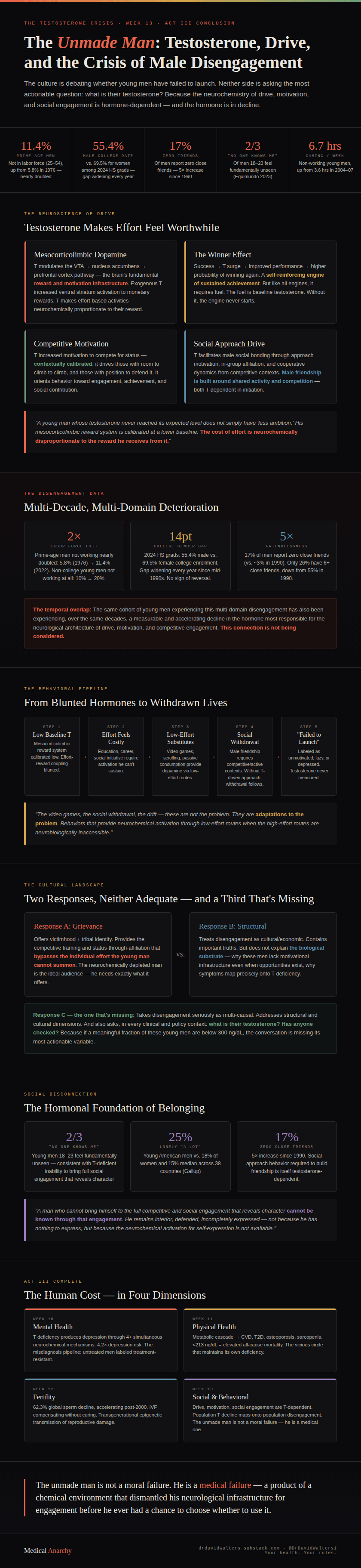
Act I: The Crisis Is Real
The first four articles in this series established the empirical foundation. Population-level data demonstrates that male testosterone has been declining at an age-matched rate of roughly 1 to 2% per year for at least the past four decades — a finding consistent across multiple longitudinal studies in the United States, Europe, and Israel, persisting after adjustment for the standard confounders of obesity, lifestyle, and comorbid disease. Sperm count has fallen by more than 50% in unselected men globally between 1973 and 2018, with the rate of decline accelerating after 2000. Among adolescent and young adult men aged 15 to 39 in the United States, mean testosterone declined approximately 25% in seventeen years according to NHANES data, with similar trends documented in normal-weight men.
These declines describe what testosterone in young men was supposed to look like — and what it now looks like. The historical baseline of 700 to 900 ng/dL in healthy young men in their late teens and early twenties has been replaced by a contemporary average closer to 450 ng/dL, with one in five young men measuring below the conventional clinical threshold for hypogonadism. The reference ranges used in laboratories have been silently shrinking as the population from which they are derived has itself become more deficient — meaning that “normal” today is calibrated against a baseline that is itself substantially compromised.
The clinical consequence is that a young man with testosterone of 250 ng/dL — a value that would have been unambiguously pathological in any prior generation of medicine — is currently being told his bloodwork is within normal limits and his fatigue, depression, and cognitive symptoms are psychological in origin.
This is the crisis. The data is unambiguous. The response, by mainstream medicine, has not been.
Act II: The Cause Is the Chemical Era
The next five articles in this series characterized the mechanism. Endocrine-disrupting chemicals — synthetic compounds that mimic or block the body’s hormonal signaling systems — entered mass production beginning in the 1940s and reached saturation in the consumer environment, food supply, and built environment between approximately 1950 and 1975. These chemicals operate through multiple convergent mechanisms that all suppress male reproductive endocrine function. Some bind estrogen receptors in the hypothalamus, sending false suppression signals to the HPG axis. Some directly inhibit testosterone biosynthesis in Leydig cells. Some upregulate aromatase, shifting steroid metabolism from the male pattern toward the female pattern.
We covered the four major categories: the plasticizers BPA and the phthalates, found in food containers, receipts, IV tubing, and consumer products; the agricultural pesticides including atrazine, chlorpyrifos, and glyphosate, present in conventional produce and animal feed; the persistent industrial pollutants — PCBs, dioxins, and PFAS — that decades of corporate decisions have placed permanently in the bodies of every modern human; and the personal care products — parabens, triclosan, chemical sunscreens, synthetic fragrances — that the average American applies to their skin every day.
The exposure is universal. Over 90% of Americans carry measurable levels of these chemicals at any given moment. The body burden has been integrating across multiple generations. The chemicals are not being removed from the environment — many are still in active production, and those that have been banned persist in soil, water, and human tissue with half-lives measured in years to decades.
The timing is not a coincidence. The decline begins precisely when the chemicals reach saturation in the human environment. The mechanism is biologically plausible and has been characterized in detail. The dose-response relationships exist in human epidemiological studies. The animal model evidence is consistent and unambiguous. The regulatory frameworks designed to protect public health have failed comprehensively, in ways that this series has documented in some detail.
This is the cause. The evidence does not establish certainty in the way a randomized controlled trial of a single intervention would establish certainty. But the totality of the evidence — mechanism, dose-response, timing, epidemiological consistency, and the absence of plausible alternative explanations for the pattern — places the chemical era as the dominant contributor to the testosterone decline this series is documenting.
Act III: The Human Cost
The most recent three articles examined what the testosterone decline is doing to the men affected by it. The depression that does not respond to standard antidepressants because it is hormonally driven, not serotonergically driven. The comprehensive symptom profile that extends from libido through cognitive function through bone density through cardiovascular health, manifesting as a coordinated failure of multiple body systems that mainstream medicine treats as separate diseases. The fertility crisis in young couples that arrives at fertility clinics framed as individual technical problems but which, at population scale, represents a coordinated decline in reproductive capacity that assisted reproductive technology can compensate for but not solve.
These articles described the patients I see in my practice with sufficient regularity that the pattern has become diagnostic. The 25-year-old man on his fourth antidepressant, whose testosterone has never been measured. The 32-year-old going through his third IVF cycle, whose hormonal status was never investigated as a contributor to his impaired spermatogenesis. The 28-year-old with osteopenia at a bone density that should not be possible until his sixties or seventies. The 22-year-old whose testosterone has never reached the level his biology was supposed to deliver during adolescence — and who now lives in an adult body that was constructed without the hormonal scaffolding that was supposed to be present.
This is the cost. Each of these patients is an individual. Together, they constitute a generational pattern that medicine has not yet developed the institutional framework to recognize.
A Single Coherent Phenomenon
I want to make explicit the central argument that has been implicit throughout this series, because in the synthesis it deserves to stand on its own.
The phenomena documented across these twelve articles — the population-level testosterone decline, the parallel decline in sperm count, the rising rates of depression and other mental health diagnoses in young men, the increasing fertility difficulty in young couples, the increasing fragility of multiple aspects of male physical function in successive generations — are not separate problems that happen to coincide. They are manifestations of a single coherent phenomenon: the chemical suppression of the male reproductive endocrine axis at the population level, sustained over multiple generations, with increasingly visible consequences for individual and collective health.
This claim is not radical in its mechanistic dimension. The biology is well-characterized. The peer-reviewed literature documents each link in the chain. Endocrinologists, environmental health researchers, and reproductive scientists have been documenting the components of this picture for decades.
What is radical — or what at least represents a departure from current institutional medicine — is the integration. Mainstream medicine treats each downstream consequence as a separate clinical problem owned by a separate specialty. The depression goes to psychiatry. The fertility goes to reproductive endocrinology. The metabolic syndrome goes to endocrinology focused on diabetes. The cardiovascular risk goes to cardiology. The fragmentation of clinical responsibility means that no specialty owns the integrated picture, and the upstream cause that connects all of them is largely invisible to the practicing clinician encountering any single patient in any single specialty.
The patient experiences the integrated phenomenon. He carries depression, low libido, fatigue, weight gain, fertility difficulty, and possibly metabolic dysfunction simultaneously, as different facets of the same underlying condition. He receives separate treatments for each, none of which addresses the upstream cause. Years pass. The condition deepens. The patient cycles through increasingly aggressive interventions targeting the consequences while the underlying mechanism remains untreated.
The reframe required is to see the single phenomenon. To recognize the EDC-driven HPG axis suppression as the upstream cause that connects the symptom profile. To treat the upstream cause when it is treatable, rather than pursuing the downstream consequences in isolation.
This is what I have been arguing for, across twelve articles, with increasing specificity. The next several articles will turn from documentation to action.
Why This Matters Now
I want to address two questions that thoughtful readers have likely been asking, particularly those who have stayed with this series across all twelve weeks.
The first: if this picture is as clear as I have argued, why is mainstream medicine not addressing it?
The answer involves several reinforcing factors that I have referenced throughout the series and that deserve to be stated together. The fragmentation of clinical responsibility means no specialty owns the integrated phenomenon. The reference range problem means that the diagnostic threshold for “abnormal” has been silently shifting downward as the population baseline declines, masking the deterioration in clinical assessment. The pharmaceutical incentive structure means that no commercial entity profits from articulating an environmentally-driven mechanism that points toward exposure reduction and inexpensive generic medications rather than toward proprietary drugs. The regulatory failure means that the chemicals continue to enter commerce and human bodies despite accumulating evidence of harm. And the cultural blind spot regarding men’s reproductive health means that institutional attention does not flow to a problem affecting men’s hormonal function with the same alacrity it flows to comparable problems affecting women.
These factors are real, and together they explain much of the institutional inertia. They do not justify it. The clinical responsibility for individual patients does not wait for institutional frameworks to update. The young man in front of me, with his testosterone of 198 ng/dL and his three failed antidepressant trials, deserves to be evaluated and treated correctly today, regardless of whether his condition has yet been recognized at the level of consensus medical guidelines.
The second question: if the chemical exposures are universal and accumulating, is there anything individual patients can actually do?
The answer is yes. The exposures can be reduced — meaningfully if not eliminated — through the practical changes documented across the chemical-inventory articles. The HPG axis suppression can often be reversed in patients whose testes remain functionally normal but are not receiving adequate hypothalamic-pituitary stimulation. The medications that address this — particularly clomiphene citrate, which I will examine in detail beginning next week — are inexpensive, well-tolerated in appropriate patients, and can produce substantial restoration of hormonal function within months.
This is what Act IV will address. Not as a marketing of a particular intervention, but as the appropriate clinical response to the picture I have been documenting. The same treatment will not be appropriate for every patient. The same approach will not work in every clinical context. But for the substantial fraction of young men whose hormonal suppression is functional and reversible, the treatment exists and has existed for decades. It has simply not been brought to bear at scale on the patients who would benefit from it.
The Pattern, Once Seen, Is Visible Everywhere
There is a particular cognitive shift that occurs when a pattern that has been hiding in plain sight is finally articulated.
Once you know to look for the integrated symptom profile — fatigue, depression, low libido, cognitive dysfunction, body composition changes, possibly fertility difficulty — in young men, you begin to see it everywhere. In your social circles. In your extended family. In the people you encounter at work. The young man in his late twenties who seems vaguely adrift, who has lost weight and gained it back as different weight, who has been on antidepressants without much benefit, who has stopped doing the things he used to enjoy — this is no longer an unspecified personal struggle. It is a recognizable clinical pattern with a likely mechanism and an available treatment.
The same shift applies to the broader culture. The phenomenon of young men struggling with motivation, drive, relationship formation, and basic forward momentum in their lives — a phenomenon that has been the subject of extensive cultural commentary and political analysis — looks different through this lens. Some fraction of what is being discussed as a cultural or psychological problem may be, in part, a hormonal problem. Some fraction of the apparent decline in young male flourishing is happening in young men whose biological foundation has been compromised by exposures their parents and grandparents could not have anticipated.
I am not making the claim that hormonal suppression explains everything currently affecting young men. Cultural, economic, technological, and educational factors are real and significant. Their interactions with the biological dimension I have documented are complex and not fully characterized. The point is more limited: the biological dimension exists, it is documented, and it has been almost entirely absent from the broader conversation about why young men today seem to be struggling in ways their predecessors did not.
The clinical and cultural conversations need to incorporate the biological substrate. Not as the only factor, but as a factor that has been missing from the analysis. The young men I treat in my practice are individuals with treatable medical conditions. They are also data points in a generational pattern that requires attention at multiple levels — clinical, cultural, regulatory.
The Question We Carry Into Act IV
The remaining articles in this series move from documentation to response. Next week, I will address why mainstream medicine has been so slow to recognize and respond to this picture — the deeper structural reasons that go beyond the factors mentioned above. The week after, I will introduce the medication that has been quietly available for decades and that addresses the actual upstream mechanism in a substantial fraction of patients: clomiphene citrate. The articles after that will address the optimal use of this medication, the broader strategy for restoring HPG axis function, the practical question of how individual patients can find clinicians willing to engage this framework, and the longer-term question of how a society addresses a problem whose causes lie in industrial decisions made decades before the affected children were born.
The question I want to leave you with at the end of Act III is a clinical one with broader implications.
If the picture I have described in this series is correct — and I have tried throughout to present the evidence with appropriate restraint, allowing readers to draw their own conclusions — then a substantial fraction of young men currently being treated for depression, fatigue, low libido, fertility difficulty, and related complaints have an underlying hormonal disorder that is treatable and that is not being treated.
The numbers are not small. The treatments are not expensive. The mechanisms are not contested. The patients are already in the medical system, receiving treatments that do not work because they are addressing the wrong problem.
The question is whether medicine will reorganize itself to recognize and respond to this picture, or whether the patients will continue to be routed through the fragmented system that has produced their current situation, accumulating diagnoses and prescriptions while the upstream cause remains invisible.
This series is, in part, an argument for the former. The remaining weeks will show what that response looks like in practical terms.
I am asking you to keep reading.
Looking Ahead: Act IV
Week 14: Why your doctor doesn’t know about this. The structural reasons mainstream medicine has been slow to recognize and respond to the testosterone crisis. The fragmentation of clinical responsibility. The pharmaceutical incentive structure. The reference range problem. The cultural blind spot regarding men’s health.
Week 15: The $2 pill. Introduction to clomiphene citrate — a medication that has been available for decades, costs approximately $20 to $30 per month, addresses the actual upstream mechanism of EDC-driven HPG axis suppression in many patients, and has been almost completely ignored by the medical establishment as a treatment for male hypogonadism. The history. The pharmacology. The early clinical evidence.
Week 16: How clomiphene actually works. The mechanism in detail. The hypothalamic estrogen receptor blockade. The restoration of GnRH pulsatility. The downstream restoration of LH, FSH, testosterone, and spermatogenesis. The clinical correlates.
Week 17: Optimal clomiphene treatment. The protocol. Dosing. Monitoring. Common side effects and how to manage them. Adjunctive therapies including aromatase inhibitors and hCG. When clomiphene is appropriate, when it is not, and when alternative approaches are needed.
Week 18: Reducing the burden. The broader framework for restoring hormonal health — exposure reduction, lifestyle interventions, nutritional considerations, and the integration of clomiphene treatment with the rest of the patient’s life.
Week 19: A letter to my colleagues. The conversation I want to have with practicing physicians who have stayed with this series. The clinical realities. The institutional barriers. The path forward.
Week 20: The series manifesto. Where we are. Where we need to go. What I have learned from twenty-five years of practice in this area.
Stay with me. The most important articles are still ahead.
Key Sources for This Article
(This article synthesizes evidence from the previous twelve articles. Readers are referred to the individual articles for primary citations. Selected cross-cutting sources:)
• Travison TG, et al. (2007). “A population-level decline in serum testosterone levels in American men.” https://pubmed.ncbi.nlm.nih.gov/17062768/
• Levine H, et al. (2017, 2023). “Temporal trends in sperm count: systematic review and meta-regression analysis.” https://academic.oup.com/humupd/article/29/2/157/6824414
• Skakkebaek NE, et al. (2022). “Environmental factors in declining human fertility.” Nature Reviews Endocrinology. https://pubmed.ncbi.nlm.nih.gov/34912078/
• Gore AC, et al. (2015). “EDC-2: The Endocrine Society’s Second Scientific Statement on Endocrine-Disrupting Chemicals.” Endocrine Reviews, 36(6). https://doi.org/10.1210/er.2015-1010
• Lokeshwar SD, et al. (2021). “Decline in serum testosterone levels among adolescent and young adult men in the USA.” European Urology Focus. https://pubmed.ncbi.nlm.nih.gov/32081788/
• Cignarella A, et al. (2023). “The association of hypogonadism with depression and its treatments.” Frontiers in Endocrinology. https://pmc.ncbi.nlm.nih.gov/articles/PMC10449581/
• Krzastek SC, et al. (2019). “Long-term safety and efficacy of clomiphene citrate for the treatment of hypogonadism.” Journal of Urology. https://pubmed.ncbi.nlm.nih.gov/31144610/
Dr. David Walters is a physician with clinical and research training in men’s hormonal health. Nothing here constitutes medical advice or establishes a physician-patient relationship.
Next week: Act IV begins with a hard question. Why doesn’t mainstream medicine know about this? The answer is more structural — and more uncomfortable — than most patients realize.
Week 13 of The Testosterone Crisis. Acts I-III are complete. The crisis is real. The cause is the chemical era. The cost is generational. Act IV begins next week.
Paid subscribers get the complete data appendix below — every study cited in this article with full context, the statistical analyses I ran on the labor force and social connection data, and the extended discussion of what the behavioral neuroscience actually shows versus what the cultural narratives claim.
Comments
Nothing yet. Say the first thing.
Sign in to join the conversation.