
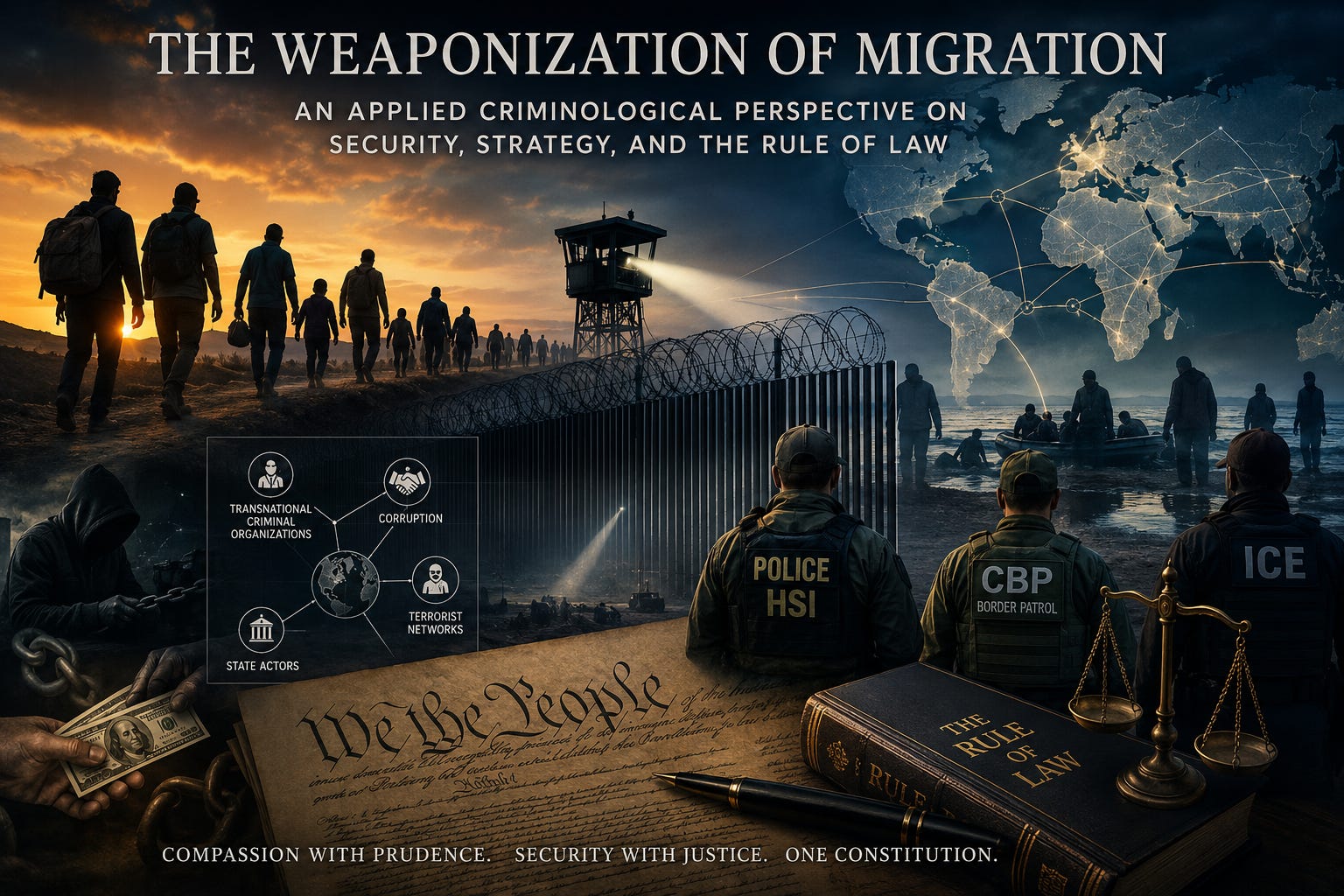
Illegal migration is commonly examined through humanitarian, economic, or partisan political frameworks. While these perspectives explain many individual decisions to migrate, they do not fully account for the complex behavioral environment surrounding modern mass migration. From an applied criminological perspective, illegal migration should also be analyzed through the principles of motive, means, opportunity, organization, and behavioral outcomes. Individual migrants, transnational criminal organizations, state actors, and ideological movements often pursue different objectives while operating within the same migration environment.
Drawing upon professional experience in law enforcement, public safety leadership, academia, and strategic research supporting defense-related planning, this perspective argues that policymakers should distinguish carefully between humanitarian migration, organized criminal activity, geopolitical competition, and ideological exploitation. Historical and contemporary examples demonstrate that migration has, at times, been used as an instrument of coercive diplomacy, criminal enterprise, and strategic statecraft.
The purpose of this paper is neither to diminish the dignity of migrants nor to assign collective motives to any ethnic or religious community. Rather, it encourages a disciplined investigative framework rooted in evidence rather than assumption. Constitutional government depends upon both compassion and prudence. Effective immigration policy requires maintaining secure borders, dismantling criminal organizations, protecting genuine refugees, encouraging lawful immigration, and preserving the constitutional principles that unite a free people.
Keywords: Illegal migration, criminology, organized crime, border security, national security, strategic culture, constitutional government, rule of law
This perspective applies an investigative criminological framework to the analysis of illegal migration, rather than approaching the subject primarily through political, ideological, humanitarian, or economic narratives. The methodology employed reflects principles commonly used in criminal investigations, intelligence analysis, and strategic threat assessment.
Throughout my career in law enforcement, criminal investigations, public administration, and strategic research, I have learned that complex events rarely result from a single motive or a single actor. Investigators are trained to distinguish among participants, identify patterns of behavior, assess motive, evaluate opportunity, and determine who benefits from the observable outcomes. The same disciplined approach is applied in this paper.
Accordingly, this Perspective examines illegal migration through six analytical questions:
Motive – What objectives are being pursued by the various actors involved? These objectives may differ significantly among individual migrants, organized criminal organizations, terrorist facilitators, ideological movements, and state actors.
Means – What logistical, financial, organizational, and technological resources enable or sustain migration activity? This includes transportation networks, document fraud, communications, financial systems, and transnational support structures.
Opportunity – What political, legal, geographic, or institutional conditions create opportunities for illegal migration or its exploitation by criminal or hostile actors?
Behavior – What observable behavioral patterns emerge over time? Rather than relying solely on stated intentions, investigators examine recurring conduct, operational methods, and documented trends.
Beneficiaries – Who derives financial, political, strategic, or ideological advantage from the migration activity? The existence of humanitarian motives among individual migrants does not preclude simultaneous benefits accruing to criminal organizations, governments, or ideological movements.
Convergence of Interests – Do otherwise unrelated actors cooperate because their immediate interests align, even if their long-term goals differ? Criminal organizations, terrorist groups, and state actors have historically demonstrated a willingness to collaborate when doing so advances their respective objectives.
This methodology does not assume that every migration event is coordinated, nor does it assign collective motives to entire populations, ethnic groups, or religious communities. Individuals should be judged according to their own conduct, not by stereotypes or group identity. Likewise, governments, criminal organizations, and ideological movements should be evaluated on the basis of documented behavior, stated objectives, and verifiable evidence.
The purpose of this perspective is therefore not to promote a political position but to encourage a disciplined analytical process. By applying established principles of criminology, behavioral analysis, and strategic assessment, policymakers and citizens alike can better distinguish between humanitarian migration, lawful immigration, organized criminal activity, geopolitical competition, and other factors that may coexist within the same migration environment. Sound public policy begins with accurately identifying the problem it seeks to address.
Over the past several days, the world has watched extraordinary scenes unfold in Spain. Tens of thousands of migrants surged across the border into the Spanish enclave of Ceuta from Morocco, overwhelming local authorities, resulting in dozens of deaths, and reigniting a debate across Europe about border security, sovereignty, and migration policy. The crisis has prompted renewed calls for tighter border controls and intensified discussions among European governments about how to respond to large-scale irregular migration.
For Americans, these images feel familiar.
Between 2020 and 2025, the United States experienced record levels of illegal migration along its southern border. The consequences were felt not only at the border itself but also in communities across the country as law enforcement, local governments, schools, healthcare systems, and immigration courts struggled to respond. Those experiences fundamentally changed the national conversation about border security and immigration policy.
But what if we’ve been asking the wrong questions?
Such as:
Who benefits?
Who finances the activity?
What infrastructure makes it possible?
Who exploits the situation?
Immigration has become one of the defining public policy issues of the twenty-first century. Yet much of the public discussion begins with assumptions rather than investigation.
The Western world generally views migration through a humanitarian framework. Individuals are presumed to be fleeing violence, political persecution, or economic hardship. Those motivations are unquestionably genuine for many people and deserve serious consideration. America has long benefited from lawful immigration, and countless immigrants have strengthened our nation through their work, faith, military service, entrepreneurship, and commitment to constitutional ideals.
Compassion, however, should never replace discernment.
As investigators, we are taught to begin somewhere different.
We begin with behavior.
Who organized the activity?
Who financed it?
Who profits?
Who facilitates it?
Who benefits from the outcome?
These questions have guided homicide investigations, organized crime investigations, public corruption investigations, and counternarcotics operations for decades. They should also guide discussions involving illegal migration.
For two years, I served as a senior program manager for a well-known defense contractor whose leadership team consisted primarily of former Tier One military leaders from both the enlisted and officer ranks. My background differed significantly from theirs. I was the only participant whose professional career had been built in civilian law enforcement and public safety.
In many respects, I served as the “odd man out”—bringing an investigative and criminological perspective to strategic discussions that were often dominated by military planning. My decades of public safety experience, coupled with a Ph.D. in Criminal Justice, made me a valuable addition to the team by combining operational field experience with behavioral research, organizational analysis, and strategic thinking. I was expected not only to understand how criminal and terrorist threats manifested in practice but also to evaluate them through an academic and policy framework capable of informing future planning.
"A nation preserves its humanity not by abandoning the rule of law, but by applying it with both justice and compassion."
— Dr. Currie Myers
Among the projects assigned to our team were research initiatives involving terrorism, illegal migration, transnational criminal organizations, and clandestine underground networks. We regularly conducted tabletop exercises that explored how hostile actors—whether nation-states, terrorist organizations, or criminal enterprises—might exploit vulnerabilities within democratic societies.
One lesson emerged repeatedly.
Modern threats rarely remain confined to traditional institutional boundaries.
Military threats intersect with organized crime.
Organized crime intersects with terrorism.
Terrorism intersects with intelligence operations.
Illegal migration intersects with all three.
The old military saying that “the enemy of my enemy is my friend” frequently proved true. Organizations with vastly different ideologies often cooperate when their immediate interests converge. Criminal cartels, human smugglers, terrorist facilitators, corrupt officials, and hostile foreign actors may not share the same long-term objectives, yet they often exploit the same transportation corridors, logistical networks, financial systems, and weaknesses in border security.
That experience profoundly shaped my understanding of migration. A single migration route may simultaneously carry an economic migrant seeking opportunity, a family fleeing persecution, a human smuggler pursuing profit, a narcotics trafficker moving contraband, or a terrorist facilitator exploiting the same infrastructure. Treating every person moving through that corridor as though they share identical motives is neither good criminology nor sound public policy.
Investigators are trained to resist convenient explanations.
A statement offered during the opening moments of an investigation is rarely accepted at face value. Instead, investigators compare claims against observable behavior, physical evidence, patterns, and corroborating information.
Illegal migration deserves the same discipline.
The central question is not simply why an individual crossed a border.
The larger question is what system made that crossing possible.
Every sustained migration corridor requires infrastructure.
Transportation.
Communication.
Money.
Safe houses.
Recruiters.
False documents.
Financial transfers.
Corrupt facilitators.
Criminal protection.
These characteristics are remarkably similar to those found in sophisticated organized criminal enterprises.
The presence of humanitarian motives among migrants does not eliminate the existence of criminal infrastructure surrounding migration.
Both realities may exist simultaneously.
History demonstrates that population movement has often been used for political purposes.
Empires relocated populations.
Authoritarian governments manipulated demographic patterns.
Modern states have, at times, encouraged migration flows to pressure neighboring nations or influence diplomatic negotiations.
The European experience with Belarus and Poland illustrated how migration itself can become a geopolitical instrument. Likewise, the recurring migration pressures involving Morocco and Spain demonstrate that migration may function as more than a humanitarian phenomenon.
Recognizing this reality does not diminish the humanity of migrants.
Rather, it recognizes that governments and criminal organizations sometimes treat migrants as instruments for achieving broader objectives.
The true exploitation occurs not when analysts acknowledge this possibility, but when vulnerable people are deliberately placed into dangerous circumstances for political or financial gain.
Criminologists understand that crime requires more than motive.
It also requires opportunity.
Weak border enforcement increases opportunity.
Uncertain consequences increase opportunity.
Predictable release policies increase opportunity.
Transnational criminal organizations adapt quickly to these opportunities.
Human smuggling has become a multibillion-dollar criminal enterprise precisely because enormous financial incentives exist wherever governments lose effective control over their borders.
Drug cartels, document forgers, traffickers, money launderers, and organized criminal networks all benefit when migration becomes increasingly dependent upon illicit infrastructure.
This is not speculation.
It is consistent with decades of organized crime research.
America has never been defined by ethnicity.
It has been defined by constitutional principles.
Throughout our history, immigrants strengthened the Republic because they entered an existing constitutional culture.
They learned English.
They respected American law.
They embraced citizenship.
They preserved elements of their cultural heritage while adopting a shared civic identity.
Assimilation was never about abandoning one’s heritage.
It was about acquiring another identity as an American.
That distinction remains essential.
A constitutional republic cannot sustain multiple competing systems of public authority.
There must ultimately remain one Constitution.
One legal system.
One citizenship.
One rule of law.
Without those shared commitments, equal justice becomes increasingly difficult to preserve.
Perhaps the greatest mistake in modern immigration debates is the false choice between compassion and security.
A civilized nation requires both.
A country may welcome lawful immigrants while dismantling criminal smuggling organizations.
It may protect refugees while enforcing immigration law.
It may defend religious liberty while refusing to recognize parallel legal systems that undermine constitutional equality.
These principles complement one another rather than compete.
Compassion without prudence becomes sentimentality.
Prudence without compassion becomes injustice.
Good government requires both virtues operating together.
During more than three decades in public safety, I learned that investigators succeed by resisting simplistic explanations.
Behavior leaves evidence.
Patterns leave evidence.
Organizations leave evidence.
Migration should be examined no differently.
This perspective does not argue that every migrant presents a threat.
Nor does it suggest that every migration event represents a coordinated strategic campaign.
It argues for something both simpler and more important.
Effective public policy begins by distinguishing among the many actors operating within the same environment.
Humanitarian migrants deserve dignity.
Lawful immigrants deserve respect.
Refugees deserve protection.
Criminal organizations deserve prosecution.
Terrorist organizations deserve disruption.
Hostile governments deserve strategic resistance.
Confusing one category with another serves no one well.
America has always been a compassionate nation.
It should remain so.
But compassion and prudence are not opposing virtues.
They are partners in preserving both human dignity and constitutional government.
The responsibility of leadership is not merely to feel compassion.
It is to exercise wisdom.
History repeatedly demonstrates that free societies endure not because they ignore threats, but because they possess the courage to recognize them honestly, confront them lawfully, and preserve the institutions that protect liberty for generations yet to come.
American Enterprise Institute. (2024). Immigration and border security research.
Beccaria, C. (1986). On crimes and punishments (D. Young, Trans.). Hackett Publishing. (Original work published 1764).
Benedict XVI. (2009). Caritas in Veritate. Libreria Editrice Vaticana.
Byman, D. (2015). Al Qaeda, the Islamic State, and the global jihadist movement: What everyone needs to know. Oxford University Press.
Catechism of the Catholic Church (2nd ed.). (1997). Libreria Editrice Vaticana.
Clarke, R. V. (Ed.). (1997). Situational crime prevention: Successful case studies (2nd ed.). Harrow and Heston.
Cohen, E. A. (2002). Supreme command: Soldiers, statesmen, and leadership in wartime. Free Press.
Cohen, L. E., & Felson, M. (1979). Social change and crime rate trends: A routine activity approach. American Sociological Review, 44(4), 588–608.
Compendium of the Social Doctrine of the Church. (2004). Pontifical Council for Justice and Peace.
Council of the European Union. (2021). EU response to the instrumentalisation of migrants by Belarus.
Drug Enforcement Administration. (2024). National Drug Threat Assessment. U.S. Department of Justice.
Europol. (2021). European Union serious and organised crime threat assessment (SOCTA) 2021.
Europol. (2024). Criminal networks in migrant smuggling.
Federal Bureau of Investigation. (2024). Transnational organized crime.
Felson, M. (2006). Crime and nature. Sage.
Freedman, L. (2013). Strategy: A history. Oxford University Press.
Frontex. (2024). Annual risk analysis.
Goldstein, H. (1990). Problem-oriented policing. McGraw-Hill.
Gray, C. S. (1999). Modern strategy. Oxford University Press.
Hamilton, A., Madison, J., & Jay, J. (2003). The Federalist Papers. Signet Classics. (Original work published 1788).
Hegghammer, T. (2010). Jihad in Saudi Arabia. Cambridge University Press.
Heritage Foundation. (2024). Border security and the rule of law.
Heritage Foundation. (2024). The challenges Islamist ideology poses to America’s founding principles.
Hoffman, B. (2006). Inside terrorism (Rev. ed.). Columbia University Press.
Hoffman, F. G. (2007). Conflict in the 21st century: The rise of hybrid wars. Potomac Institute for Policy Studies.
Homeland Security Investigations. (2024). Human smuggling investigations. U.S. Department of Homeland Security.
Huntington, S. P. (2004). Who are we? The challenges to America’s national identity. Simon & Schuster.
Immigration and Customs Enforcement. (2024). Annual report. U.S. Department of Homeland Security.
John Paul II. (1991). Centesimus Annus. Libreria Editrice Vaticana.
Kelling, G. L., & Coles, C. M. (1996). Fixing broken windows. Free Press.
Kilcullen, D. (2013). Out of the mountains: The coming age of the urban guerrilla. Oxford University Press.
Leo XIII. (1891). Rerum Novarum. Libreria Editrice Vaticana.
Madison, J. (1788/2003). Federalist No. 10. In A. Hamilton, J. Madison, & J. Jay, The Federalist Papers. Signet Classics.
Madison, J. (1788/2003). Federalist No. 51. In A. Hamilton, J. Madison, & J. Jay, The Federalist Papers. Signet Classics.
National Counterterrorism Center. (2024). Counterterrorism guide. U.S. Government.
North Atlantic Treaty Organization. (2024). Countering hybrid threats.
Pontifical Council for Justice and Peace. (2004). Compendium of the Social Doctrine of the Church.
Putnam, R. D. (2000). Bowling alone: The collapse and revival of American community. Simon & Schuster.
Sageman, M. (2008). Leaderless jihad: Terror networks in the twenty-first century. University of Pennsylvania Press.
Sampson, R. J. (2012). Great American city: Chicago and the enduring neighborhood effect. University of Chicago Press.
Skogan, W. G. (1990). Disorder and decline: Crime and the spiral of decay in American neighborhoods. University of California Press.
Stern, J. (2003). Terror in the name of God: Why religious militants kill. HarperCollins.
Story, J. (1833). Commentaries on the Constitution of the United States.
Tocqueville, A. de. (2000). Democracy in America (H. Mansfield & D. Winthrop, Trans.). University of Chicago Press. (Original work published 1835).
United Nations Office on Drugs and Crime. (2018). Global study on the smuggling of migrants.
United Nations Office on Drugs and Crime. (2023). Global report on trafficking in persons.
United Nations Office on Drugs and Crime. (2023). Global study on homicide.
U.S. Border Patrol. (2024). National strategy. U.S. Customs and Border Protection.
U.S. Congressional Research Service. (2024). Immigration: Recent developments in border security and asylum policy.
U.S. Congressional Research Service. (2024). Human smuggling and trafficking: Federal law and enforcement.
U.S. Customs and Border Protection. (2024). Southwest land border encounters.
U.S. Department of Homeland Security. (2019). Department of Homeland Security strategic framework for countering terrorism and targeted violence.
U.S. Department of Homeland Security. (2024). Homeland Threat Assessment.
U.S. Department of Justice. (2024). National Drug Threat Assessment.
U.S. Government Accountability Office. (2023). Southwest border: Actions needed to strengthen management and oversight.
U.S. Government Accountability Office. (2024). Immigration courts: Caseload management and adjudication.
Weisburd, D. (2015). The law of crime concentration and the criminology of place. Criminology, 53(2), 133–157.
Wilson, J. Q. (1975). Thinking about crime. Basic Books.
Wilson, J. Q., & Kelling, G. L. (1982). Broken windows. The Atlantic Monthly, 249(3), 29–38.
Dr. Currie Myers is a retired major county sheriff, state trooper, and special agent with 24 years of law enforcement experience at the local, state, and federal levels. An applied criminologist, educator, and public policy scholar, he has served in higher education for more than a decade and is a nationally recognized commentator on crime, criminal justice, ethics, constitutional policing, and public policy. Through his writing, teaching, and media appearances, Dr. Myers works to bridge practical law enforcement experience with academic research to strengthen public safety, ethical leadership, and informed public policy. Myers served for 14 years on the criminology faculty at Benedictine College as the professional in residence.

Comments
Nothing yet. Say the first thing.
Sign in to join the conversation.