
"A city rarely becomes unsafe because criminals become bolder. It becomes unsafe because leaders become weaker."
— Dr. Currie Myers
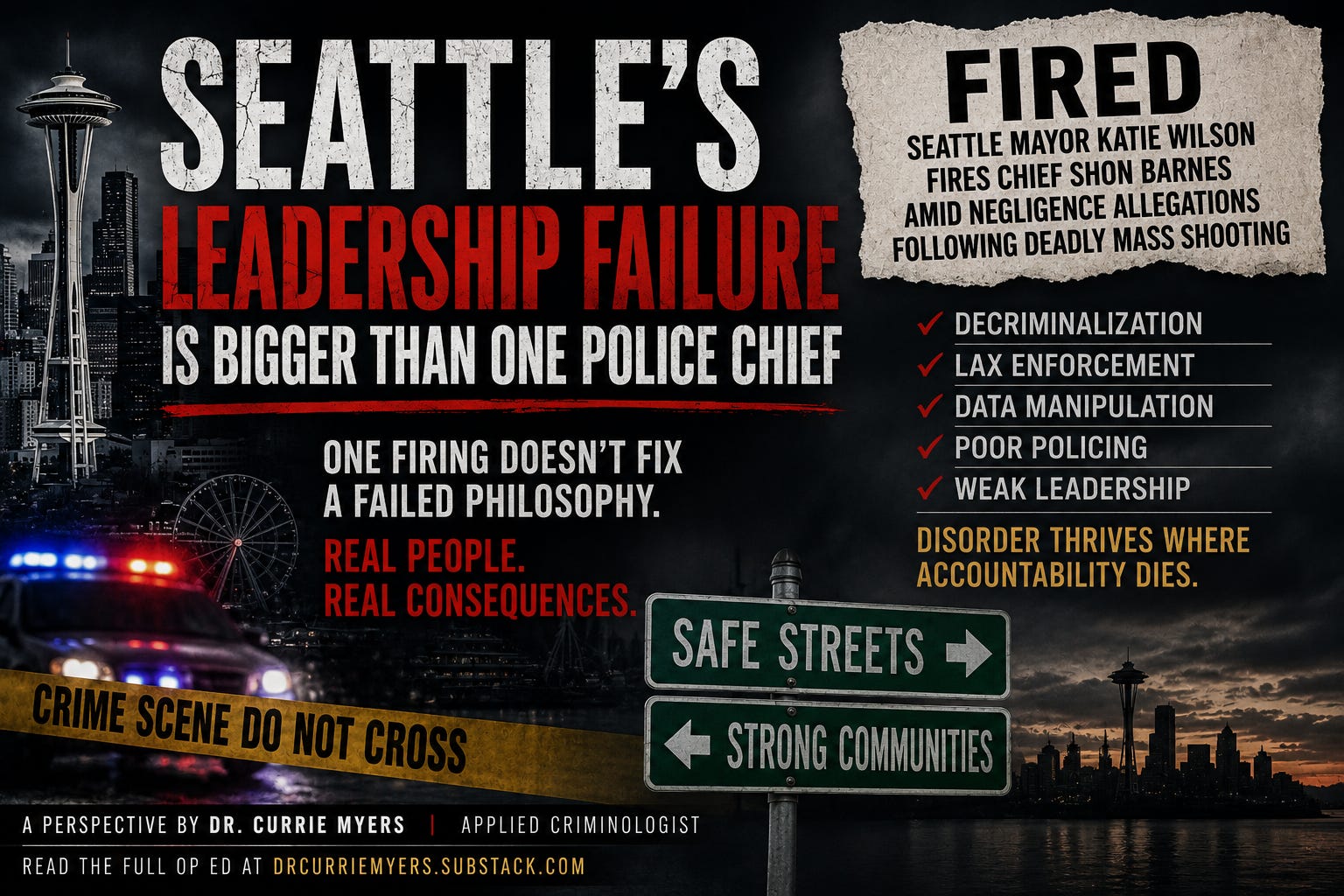
Seattle Mayor Katie Wilson’s decision to remove Police Chief Shon Barnes following the deadly mass shooting at the Bite of Seattle has generated predictable political debate. Barnes was criticized for being away from the city during one of Seattle’s most significant public safety crises, and the mayor concluded that his absence, combined with broader leadership concerns, warranted his removal.
Whether Chief Barnes deserved to lose his job is almost beside the point.
The larger story is that Seattle has spent years embracing public safety policies that have weakened accountability, reduced proactive policing, and sent increasingly mixed messages about criminal behavior. Leadership matters, but leadership begins at city hall—not merely inside police headquarters.
For years I have described what I call the Red State–Blue State Crime Phenomenon. It is not simply about crime rates. National crime trends have generally declined from their pandemic-era highs, making simplistic comparisons between states misleading. The real distinction lies in governing philosophy.
Many jurisdictions that emphasize focused deterrence, enforcement of quality-of-life offenses, support for proactive policing, and accountability throughout the criminal justice system have generally experienced stronger public confidence in public safety.
Conversely, many jurisdictions that have embraced broad decriminalization, reduced enforcement of lower-level offenses, weakened consequences for repeat offenders, and inconsistent support for law enforcement have struggled with disorder, recruitment, officer morale, and public confidence. Those policy choices deserve scrutiny, regardless of political affiliation.
Crime statistics alone never tell the whole story. Changes in reporting practices, charging decisions, prosecution policies, offense classifications, and citizen willingness to report crime can all influence what official numbers appear to show. Serious criminologists understand that statistics are only one measure of public safety—not the measure itself.
Seattle has become an example of this broader debate.
Chief Barnes certainly bears responsibility for his own leadership decisions. A police chief should be visible during a major crisis. Presence matters. Leadership is not simply operational; it is symbolic. Citizens expect their chief to be present during their city’s darkest moments, and that expectation is entirely reasonable.
But firing one chief does not solve systemic problems created over many years.
If the governing philosophy remains unchanged, replacing the chief merely changes the name on the office door.
As for Chief Barnes himself, I offer one observation.
If your tenure as chief was going to end, it would have been far more honorable to lose your position because you insisted on enforcing the law, supported your officers, and refused political pressure to weaken policing. Instead, your leadership became identified with the very policies that have contributed to the erosion of public confidence.
That is not the legacy any police chief should want.
My advice is simple.
Retire.
Go fishing.
Because the next city looking for a police chief should be asking a different question: not whether a candidate can satisfy political expectations, but whether he or she possesses the courage to restore lawful order, support constitutional policing, and put public safety ahead of ideology.
America does not suffer from a shortage of police chiefs.
It suffers from a shortage of courageous leadership.
Dr. Currie Myers is a retired major county sheriff, state trooper, and special agent with 24 years of law enforcement experience at the local, state, and federal levels. An applied criminologist, educator, and public policy scholar, he has served in higher education for more than a decade and is a nationally recognized commentator on crime, criminal justice, ethics, constitutional policing, and public policy. Through his writing, teaching, and media appearances, Dr. Myers works to bridge practical law enforcement experience with academic research to strengthen public safety, ethical leadership, and informed public policy. Myers served for 14 years on the criminology faculty at Benedictine College as the professional in residence.

Comments
Nothing yet. Say the first thing.
Sign in to join the conversation.