
I’m writing this from a coffee shop near London Bridge, just outside Borough Market, watching the crowds loop through the streets in search of cheese. After three weeks circumnavigating the globe - which I haven’t done before - and being more or less permanently in the wrong time zone, sitting still in my own city feels like a minor luxury.

Last week was San Francisco. I’d been invited to give a TED-style talk to a room of LPs, VCs, and the typical operator types who make San Francisco, San Francisco. I was there to be deliberately confrontational - about why scientists just aren’t that useful…
Here’s an outline of that talk, and coincidentally - my life story.
The most expensive lie in deep tech
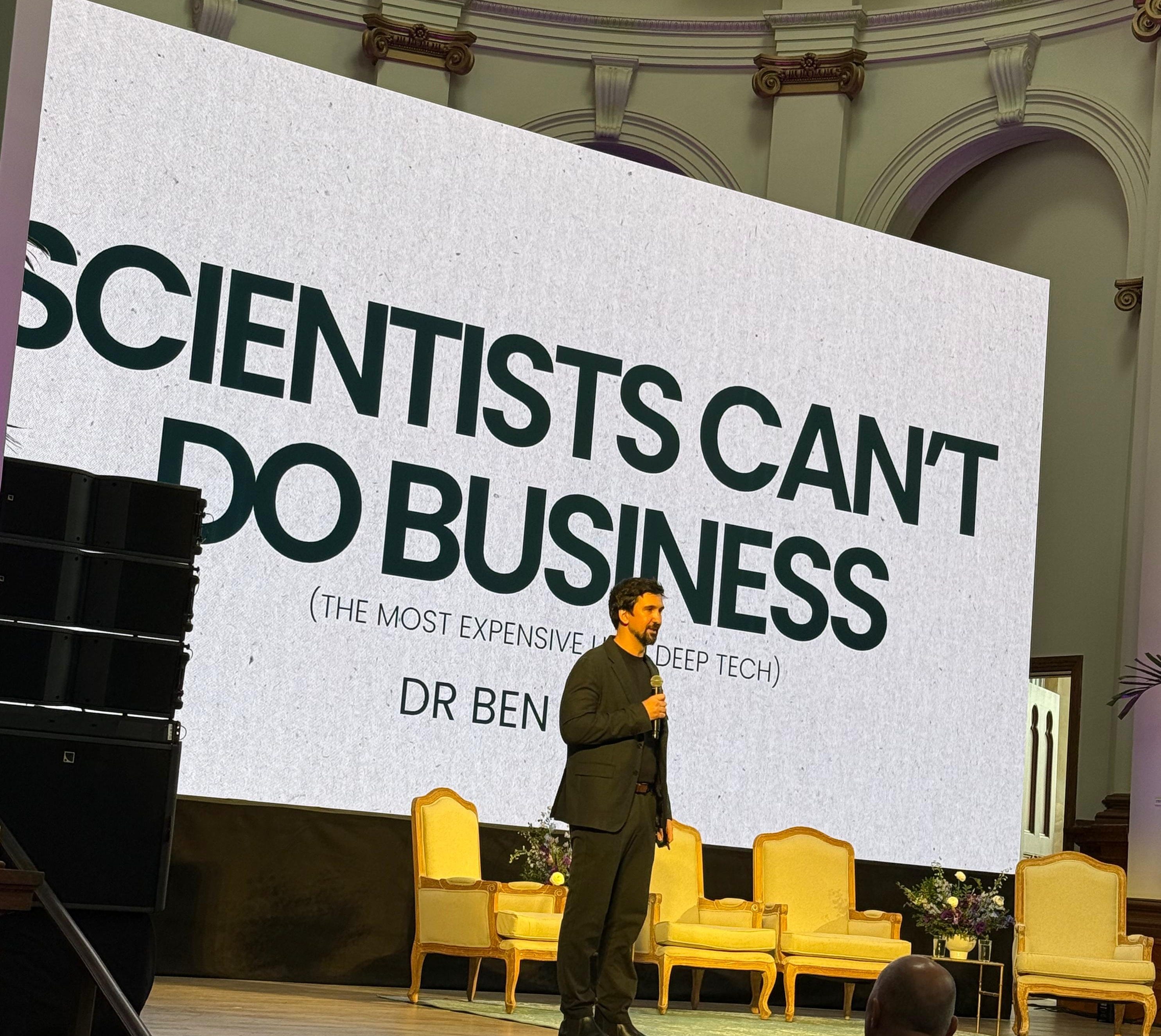
The title on the slide behind me read:
I went with that because, eight years ago, I was the scientist being told it.
Not in those exact words. The version most PhDs get is more diffuse: industry is a bad word, commercialising science is dirty, the pursuit money is deeply embarrassing, and if you make a breakthrough in your lab or discover something useful your job is to hand it to someone “commercially sophisticated” (preferably with grey hair) who will, presumably, get on with delivering it to the world in a way you, humble scientist, are simply not capable of performing.
The variations were creative. I was told ”Don’t patent that, it’ll slow down your academic publishing” and a year later “That business sounds risky and you have no experience.” When a colleague tried to start a company - “You can’t launch that yet - find a ‘commercial’ team with business experience to help in case it goes wrong.”
When I joined the spinout I was part of - Ziylo (link is a spoiler) - our PhD CEO was asked in an investor meeting, when he’d be hiring MBAs to help him run the business. Because, he was just a scientist and they are very good in the lab - but useless in all other “real world” scenarios.
You can read that as ordinary risk-aversion.
Or maybe, more troublingly, the single greatest (often self-imposed) act of ostracising science and scientists from the positions of leadership, influence, and economic value that they are best placed to deliver.
You might say, we got scammed.
And the trouble is, the supposed "throwing ideas over the fence" to commercial or industry teams, in light of the scientist's own incompetence, doesn't actually happen.
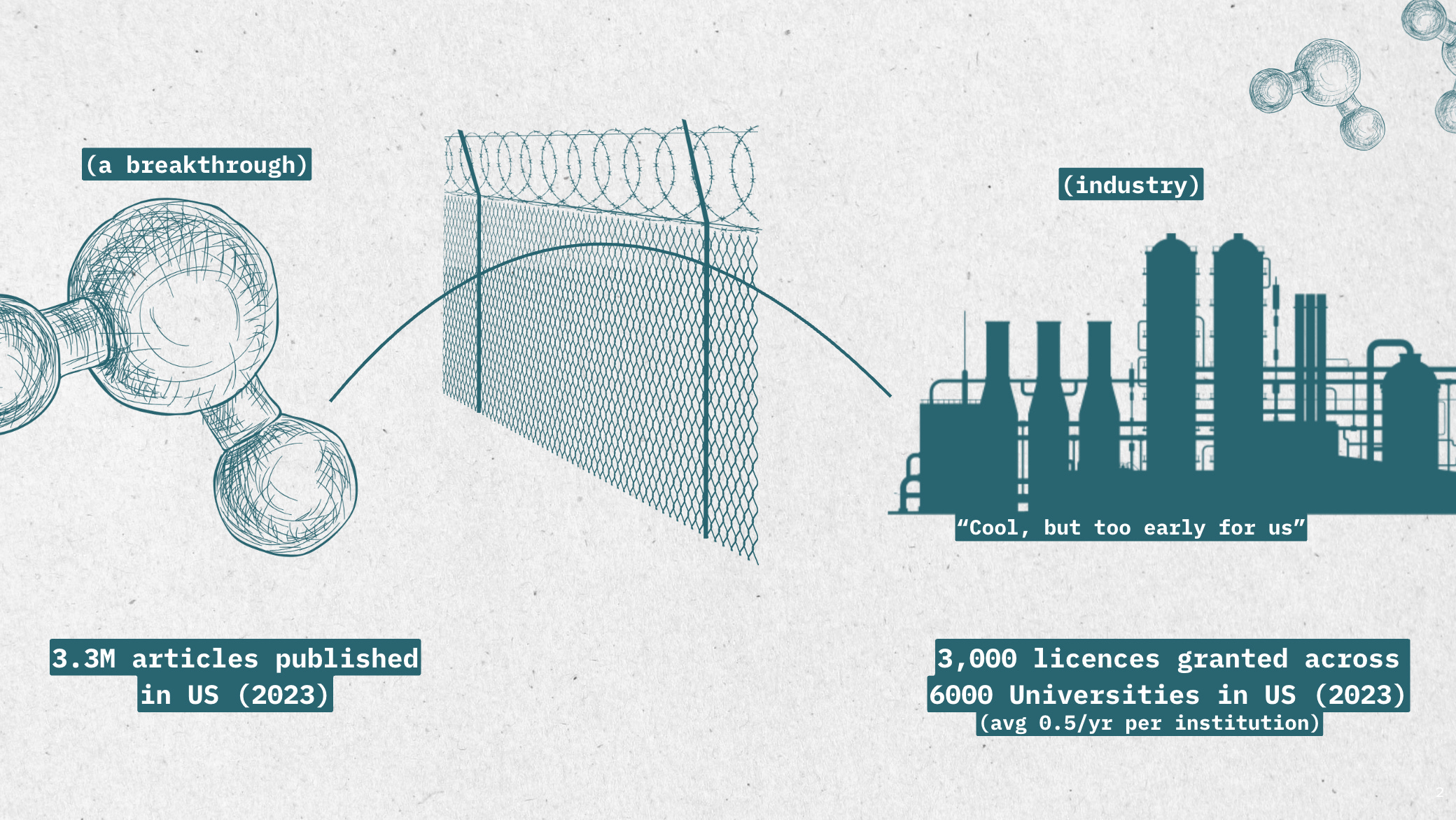
The technologies academia produces are too numerous, too early, and too technical for industry to critically evaluate and evolve at any kind of scale. Industry’s revealed preference, faced with that, is just to not.
The numbers, when you go looking, are stark.
In 2023, US universities published roughly 3.3 million research articles. Those same 6,000-odd institutions granted, in the same year, around 3,000 licences to industry. Half a licence per university per year. Three million ideas in. Three thousand out. The conversion rate of the world’s best ideas into the world’s actual products is, charitably, a rounding error.
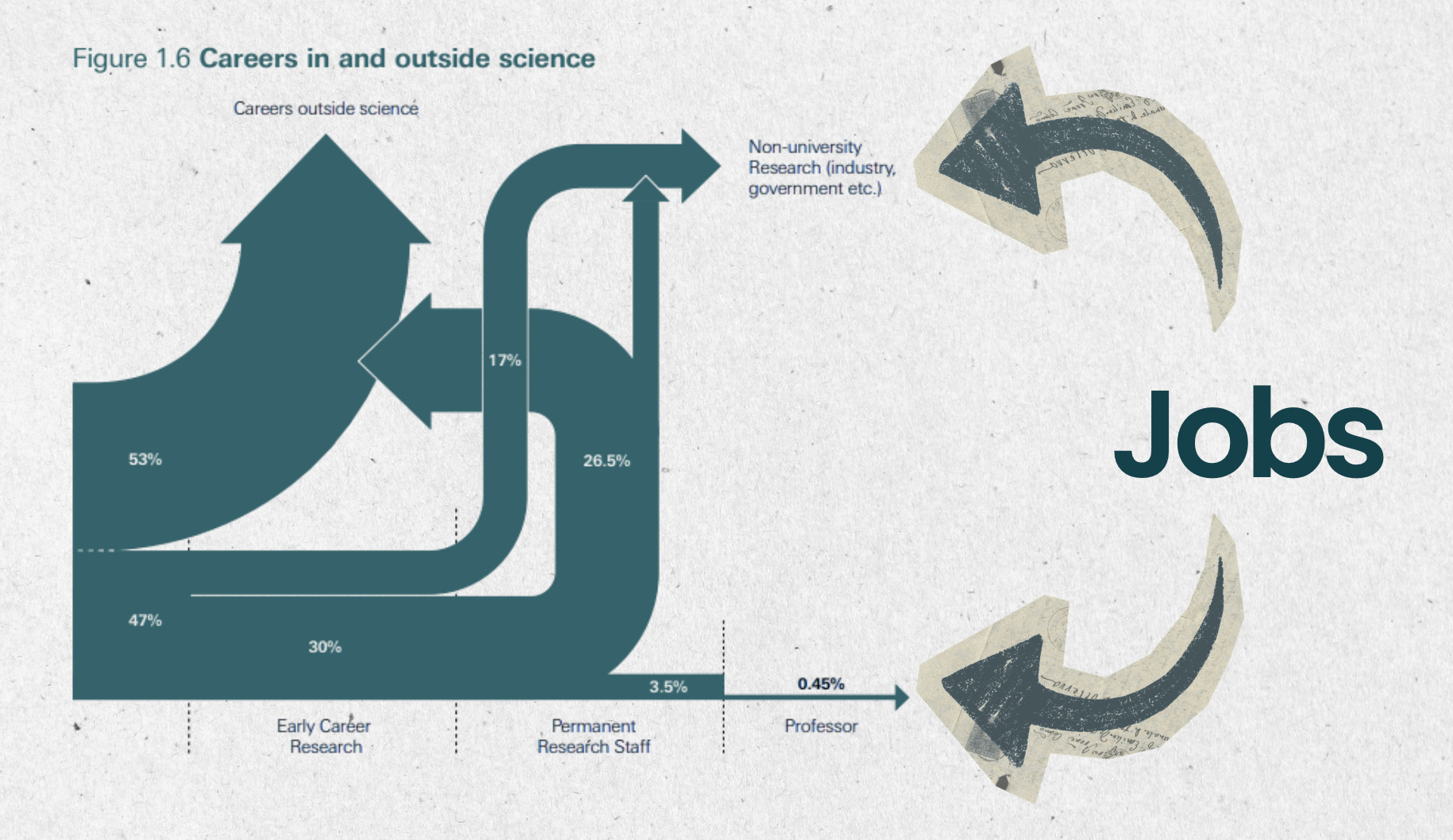
And it stops being an attitude problem the moment you follow the line downstream. Low innovation rates kill the job-creation engine. Most scientists can’t find jobs in academia. Most can’t find jobs in a deep-tech industry that scarcely exists for them. So they go and become accountants. Which, by any reasonable measure of what we asked them to spend a decade training for, is a tragedy.
I think it might be the single greatest waste of human intelligence on the planet.
Then something happened.
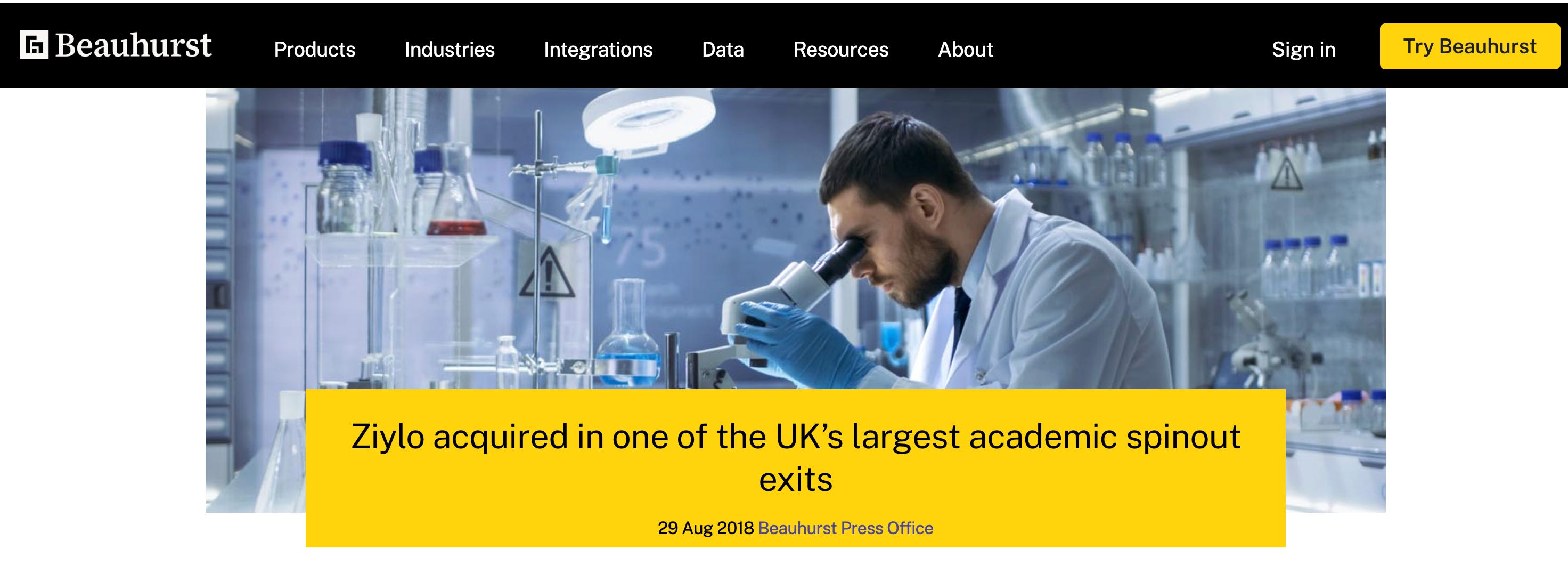
Ziylo was acquired by Novo Nordisk - at the time the largest acquisition of a UK university spinout in history (we’re still top three). Founded by a PhD. Run by PhDs. Sold for a number that made the “find someone with grey hair” advice look, in hindsight, slightly silly.
So I had a case study of N=1.
Scientists can start companies and it doesn’t have to end in catastrophe.
The question I started carrying around after that was simple - “can we do it again?”
The bigger question became:
How do I reliably turn scientists into the kind of leaders who can take a discovery off the digital shelf of an academic journal and actually deliver it?
I knew that mission would take a while and probably more than one company.
My first in 2016 - Spin Up Science - was a training programme. Three of us, embarrassingly small, which would grow to working with 5,000 scientists across 25 universities across the UK, US, and EU laying the groundwork for an entrepreneurial class of scientists. The goal was ‘awakening.’ Build both visibility and capability that beyond the ivory tower you could do something beyond just patenting, publishing, or perishing.
Eighteen months later, something interesting happened.
The same scientists started coming back. “Thanks for the training - I’ve discovered something in my research - I want to start a business. Can you help?”
I didn’t have a business that did that. So I built one.
Spin Up Science Ventures - a venture studio acting as the commercially-experienced guardian angel for first-time scientist-founders through the months that decide whether a company exists at all.
We supported the formation of over 200 companies. Everything from advanced materials for active camouflage to quantum computers. It was fun.
But those companies came back with a different problem.
“You know how scientists can’t do business? Turns out investors can’t do science. They love the market and the team, but they can’t diligence our technology, and can’t tell if we are working on breakthrough science or snakeoil. They’ve asked for a lead science investor. Who is that, in the UK?”
Nobody, was the honest answer. So I thought I’d build that, too.
First as the Science Angel Syndicate for high-net-worths who wanted to back deep science directly, but didn’t have the scientific background in house.
Then as a VC fund - Empirical Ventures. First-ticket capital for the best scientists we could find. We just past our 40th portfolio company in a little over three years, a book that runs from fission and fusion through to cancer detection and treatment and most of the interesting things in between.
98% of our founders hold PhDs, but they speak as commercially sophisticated as MBAs. The difference is they talk commercially about technical topics it would take a decade to upskill most people on - because they have been sitting at the bleeding edge of breakthrough for the last 10 years.
What I’ve found both in principle, and in practice, is it’s much easier to take someone who is the world leading expert in a quantum algorithm and teach them enough about business to get them started, than it is the other way around.
If I look back 8 years - I just wanted to show - I hope you’ll agree
- scientists can do business.
Met - Aza Raskin, inventor of the infinite scroll and one of the more thoughtful voices on what we’ve actually built with the last two decades of software. He and his partner gave a live documentary performance on the rising capability of AI - half lecture, half score, sung and narrated and lit like theatre - about where the curve is heading and what the LPs, VCs, and entrepreneurs in that room are now, like it or not, responsible for shepherding. Unbelievably talented people. The kind of evening where you forget to check your phone, which felt apt given who was on stage…
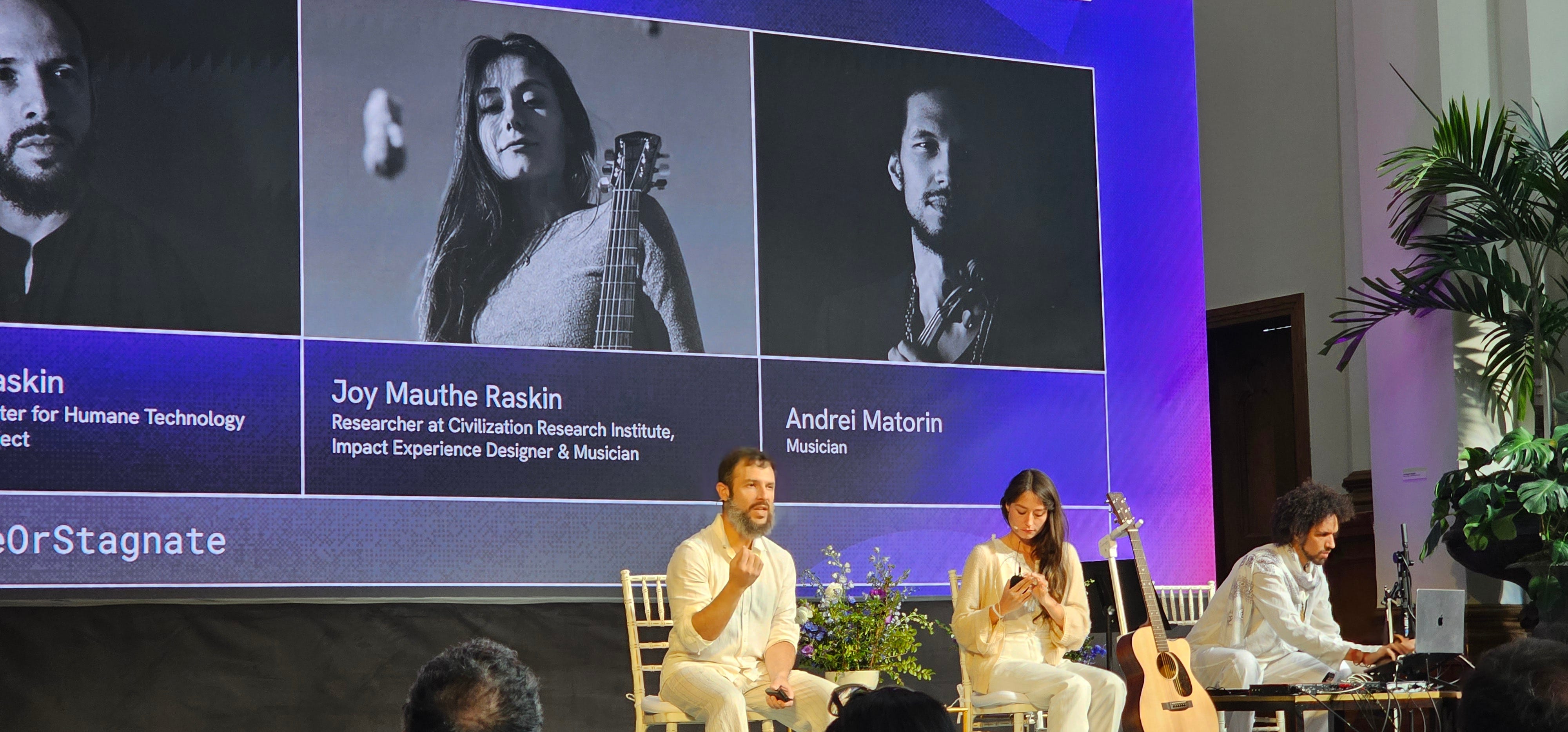
Saw - San Francisco. A city of two cities. The density of world-shapers and problem-solvers per square mile is genuinely unmatched on Earth, and yet the inequality crisis sits a block from the affluence in a way that, every time I land there, I cannot quite reconcile. The same people who can route a billion dollars at a global compute company in an afternoon haven’t found a way to fix the street they walked down to get to the meeting.

Tasted - In-N-Out, near Fisherman’s Wharf, in the last forty-five minutes before the airport. It’s become tradition - the closing ritual of any San Francisco trip is a Double-Double animal style, eaten at a slightly inadvisable speed in the back of a moving car. It is, predictably, exactly the same burger every single time. Which I think is the point. Two posts in a row about a burger place… I need to do better next week.
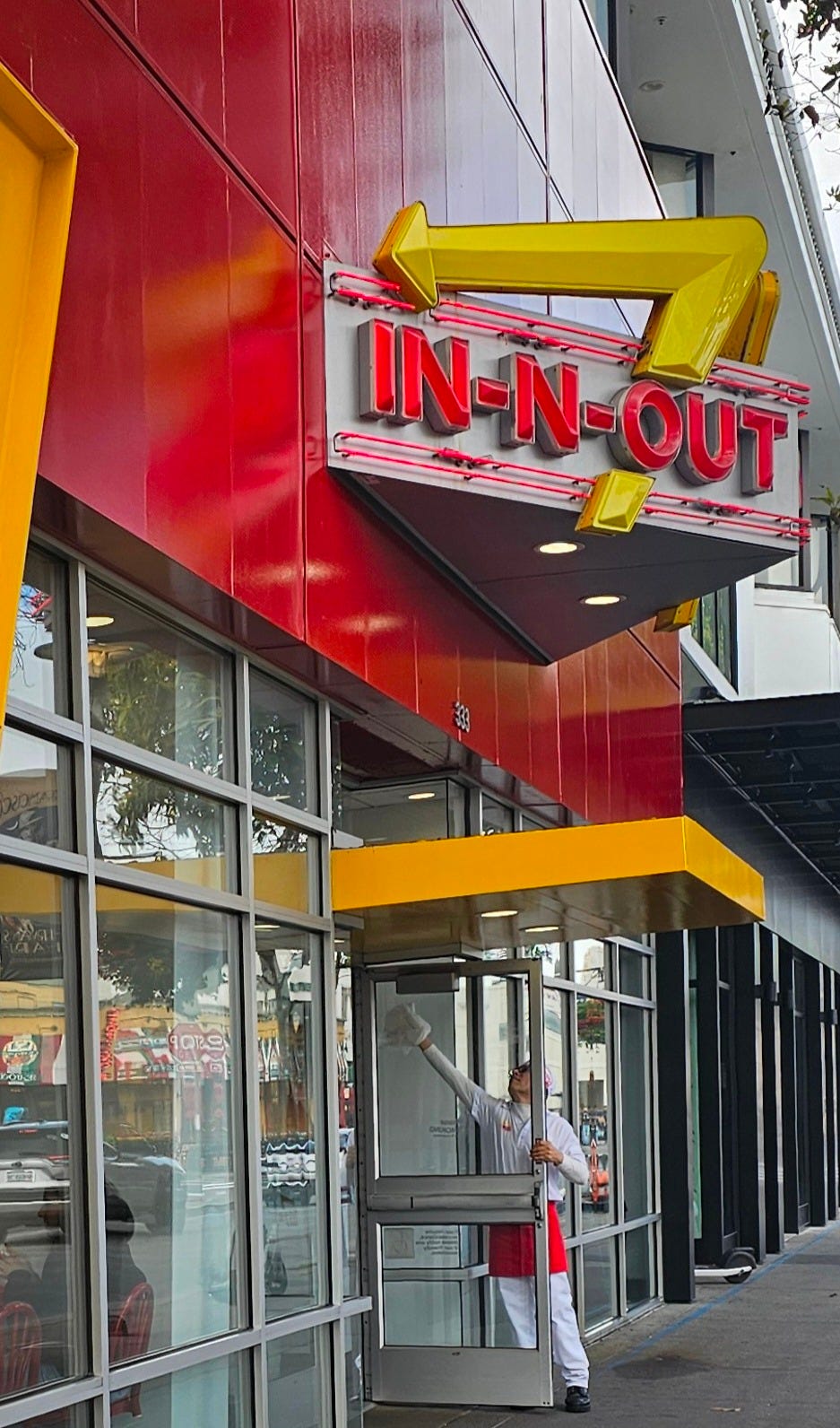
This week is London for the first time in a while, which means a few back-to-back days of fund work, London Tech Week, and - if I’m honest - a heroic amount of laundry.
Feedback always welcome.
Have a wonder-filled week. Until next time
Dr Ben
Quantum of Knowledge goes out roughly weekly while the world stays interesting. Forward it to someone who’d like it.
No posts
Comments
Nothing yet. Say the first thing.
Sign in to join the conversation.