
As part of my PhD — a study of the structures, functions, and intent of human adoption, including the social, legislative, and judicial forces that underpin legislation remaining substantively unchanged to this day, I spent many hours at the New Zealand Archives. There, I waded through hundreds of public submissions on the proposed Adult Adoption Information Act ahead of its passage in 1985. This research became one of the foundations for everything that followed.
You can read here about how that legislation perfectly represents the misinformation all adopted people must live with, and how little it actually delivered. And I examine it in greater detail in On Human Adoption.
If you’re a New Zealander, you’ll recognise one of the submitters: former Prime Minister Robert Muldoon. Turns out he had a lot to say about adoption.
I won’t lie, it was not fun reading those submissions. While there were a handful in support, the overwhelming response to the proposed legislation was a tsunami of strident entitlement.
A question - do you think the relatively consistent attitudes on display here are simply artefacts of their time?
Or do they represent an ongoing belief system? Certainly, the pushback I so often encounter on my public Facebook page suggests that little has changed.
You be the judge.
Here is an excerpt from ON HUMAN ADOPTION. (All quotes are verbatim and on file.)
• We did not want to know her name or anything about her. The law promised us, it was as if the child came from my own body.
• Will interfere with established families – may even break them.
• Will interfere with inheritance.
• Leaves parties open to blackmail.
• Open old wounds, strife and prejudice.
• Unwelcome contact [from mothers] will create problems of dual identity.
• May hurt the adopted person if they were conceived in incest.
• Will affect the rights of the adoptive parents to security, peace of mind and legal rights.
• Will pull the legal security blanket from under “secret mothers”.
• The child is subject to a contract, not a party to it.
• As for the moral right to know: the rights of one individual (the adoptee) cannot impinge on the rights of another.
• Dangerous and positively alarming that adopted adults have rights that transcend the original contract.
• The birth mother is an uninvited stranger.
Adopter submitters emphasise the contractual nature of adoption, emphasising that the mothers knew what they were doing. One commented: “Any girl old enough to have a baby can usually read”.1
Another says: “We entered into adoption of all three of our children with an expectation of total confidentiality. This arrangement suited us then, and we take the strongest exception to any relaxation of this agreement”.2
A third emphasises: “We adoptive parents jealously guard the rights of our children in the pursuit of their own happiness, untrammelled by the hang-ups and idiosyncrasies of others”.3
A fourth states that adoptive parents had given a large part of their lives, love, concern, prayers and much more to bring up a child: “It is unjust to introduce an uninvited stranger with emotional appeal when the child reaches adulthood”.4
None of the submitters appears to consider that men alone were responsible for every pregnancy. A few express empathy for the unwed mother, but there is little curiosity about her circumstances or the processes used to remove her child. There appears to be almost no understanding of the person in their care’s right to autonomy, decision-making, or control over their circumstances or future.
With four adopted people in his care, National Party MP Philip Burdon argues that any alteration to the existing right to privacy would be intolerable and a “gross breach of trust”. His lengthy denunciation of the proposed change includes canvassing other adoptive parents:
We have sought the opinions of other adoptive parents who, as a group, have had little voice. In any discussion and without exception, they are adamant that our happy, well-adjusted children will not have their security and peace of mind intruded upon by anyone, no matter how well-appointed, well-meaning, curious or self-serving.5
He continues:
“Most children put up for adoption are the progeny of reluctant motherhood”. He says they are: “cognisant of the situation who are not happy in their adopted role and who sadly want to know the ‘facts’, which in all too many instances are likely to be distressing and sordid in the extreme.” … “it is incredible that a government would substitute expediency for trust merely to legislate in favour of neurosis”.
One submitter, representing 12 genealogists, requests free access to the original birth certificates of deceased adoptees to further their private genealogical research.6
Another notes her opposition to the bill and signs off by expressing her gratitude: “To those poor girls who made that difficult decision that enabled my husband and I to have the family we were looking forward to”.7
A lawyer involved in a large number of adoptions urges the committee to be aware that support for the bill comes from a minority of adopted persons and natural mothers and that the “committee should not be persuaded by their petitions”.8
He, like others, renders the adopted person voiceless, casting them as perpetual children, determined that they have no right to autonomy or information about their mother, let alone their heritage, extended families, or hereditary health issues.
The submitters are remarkably consistent in their belief that the adopted person legally belongs to the adopters.
Another submitter expressing ‘empathy’ for those “poor girls” is former Prime Minister Rob Muldoon. Three months after his defeat at the polls in 1984, his submission reveals more about his mindset and attitudes towards all women than about the experience of single women or their lost children.
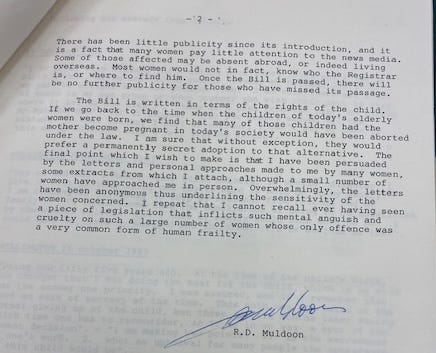
Concerning one element of the bill, that allowed mothers to place a veto on their adoption files, ensuring no contact was not enough for Muldoon.
He claimed to speak for the rights of “elderly women who gave up children for what they believed to be a secret adoption many years ago.”:
“These women became pregnant at a time when abortion was a back street crime attended with grave physical dangers”.
Aside from the minor problem with his maths – the oldest of the “elderly” women would likely be in their fifties – Muldoon explains that most women put the experience of adoption behind them and went on to have a “normal family life”. He says that in many, probably the majority of cases, the husband was not told of the earlier experience. He declares that women are terrified of the passage of the bill: “It is this terror that has been brought to my notice”.
Describing the bill as torture that “[e]quates to physical pain”, Muldoon says he does “not believe that the reasons for passing the bill are adequate to solve the mental anguish inflicted on so many women”.
Muldoon then delivers the zinger, a binary trope adopted people frequently hear when they question adoption. Had the mothers become pregnant at the time of his submission (1984), they could have resorted to abortion: “I am sure that without exception, they [the adopted people] would prefer a permanently secret adoption to that alternative”. He ended by stating:
“I cannot recall ever having seen a piece of legislation that inflicts as much mental anguish and cruelty on such a large number of women whose only offence was a very common form of human frailty”.
Muldoon’s view that all documents, including identities, must remain sealed forever to protect the mothers is patriarchal nonsense. Muldoon, along with those opposed to the bill, presumably well-rooted in their own genealogy and family histories, were asking the government to continue to keep their secrets for them by permanently legalising the disappearance of mothers and erasing the identities of their children.
I want to reach back in time and tell this misogynist, who was constantly batting away allegations and unverified rumours of infidelities, that an unplanned pregnancy is not the same as reluctant motherhood and that adoption is not a substitute for abortion.9
Beneath the superiority and hostility, I sense the fear that comes from any relationship built on secrets and silence. And I realise the obvious. Apart from one adoptive father, a National Party politician, and Muldoon, the submissions all appear to be written by women. While the names of male adopters are often listed at the bottom, they feel like an attachment meant to prove the women’s right to another woman’s child.
And as I found over and over again in my research, not once was there any mention of the role of the men who father children.
It is clear that pregnancy, birth, relinquishment, reassignment, and now the protection of the fictive family are women’s work.
The adopter submissions have affected me more than I care to admit. Rather than elements in a public conversation, they read like an onslaught of ownership and authorship over the lives of the people in their care.
They do not appear to consider the possibility of structural inequalities that privileged them as married couples professing a Christian faith and, therefore, the appropriate family values. They are adamant and strident, often angry at the possibility of unravelling the dream of the adoptological family.
Their entitlement to speak on behalf of the people they acquired is absolute and mind-numbing.
There are many more submissions along these lines. The Salvation Army, for instance, went all out to represent itself as the saviour of mothers and babies. More on them next week.
All references, including the names and details of a handful of submitters, are behind the paywall.
If you find value in this and my other essays on human adoption, please do consider supporting my work - equivalent to buying me one coffee a month.
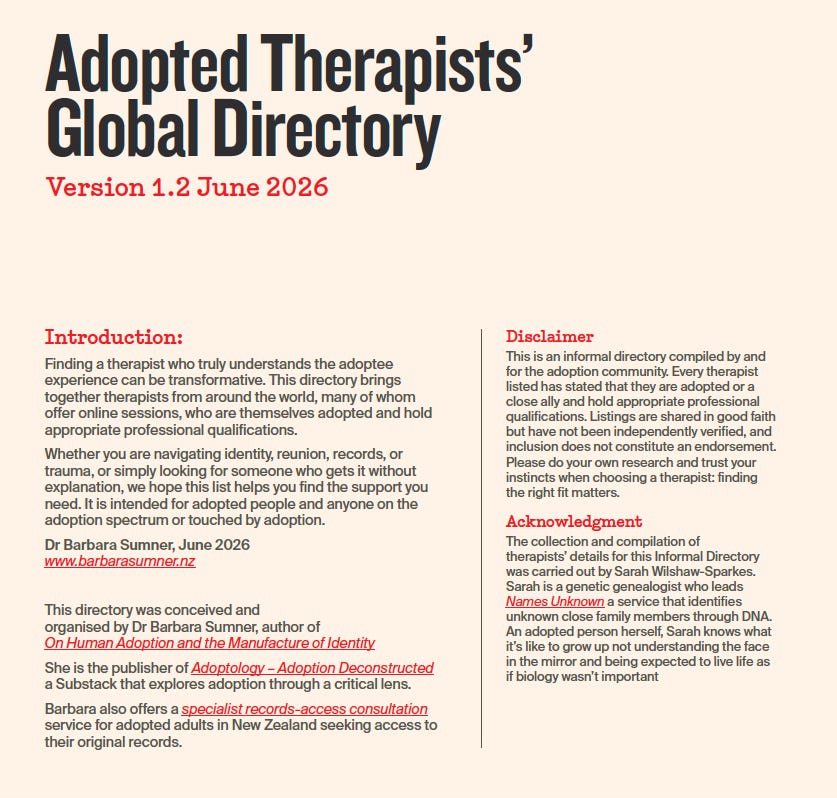
All new paid subscribers receive a copy of the Adopted Therapists’ Global Directory
Comments
Nothing yet. Say the first thing.
Sign in to join the conversation.