
I was triaging at work recently and saw an online consultation from someone who would only see one of my GP colleagues who has been at this practice for almost 20 years now.
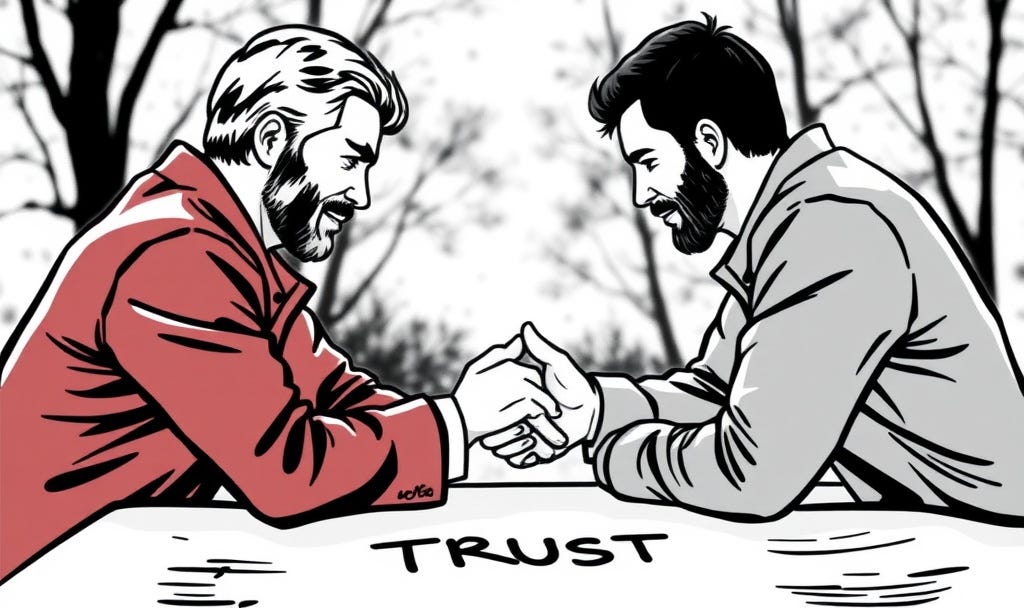
There is something quietly powerful about a long-term relationship with a GP which is being eroded as medicine changes and is being wrecklessly carved up and hollowed out (in the NHS at least).
But this goes beyond medical continuity, that slow accumulation of trust, built over time, through conversations, misunderstandings, small wins, and the occasional disagreement. It’s a relationship where context matters where you are not just a set of symptoms, but a person with a history, a pattern, a story.
Trust like that doesn’t arrive instantly. It is earned. Once established, it becomes one of the most valuable tools in medicine.
A piece of advice from a doctor you know who has seen you at your best and worst, understands you, your tendencies and your blind spots lands differently. It carries weight. Not because the information itself is necessarily unique, but because of the relationship behind it. I know I’m old fashioned but I think most people get where I am coming from. It has its downsides too, as the advice won’t always be right and there is nothing worse than blind faith. But valuable long term relationships breed forgiveness too.
In stark contrast to this, I made the mistake of looking at the comments sections of The Telegraph the other day under an article around politics, and was, as usual, shocked by the passive-aggressive vitriol aimed at the journalist. Articles written for the masses under a real name often attract strong, sometimes deeply negative reactions. Not necessarily because the content is poor, but because the author is visible — and therefore a target.
In contrast, anonymous or AI-generated content floats more freely. It is harder to challenge, because there is no one to challenge. It can be reshaped, reposted, and repurposed without friction. Just look at social media.
So we are left in a strange position.
We seem to like one to one continuity when it comes to health.
We question named-person authors and experts, yet accept virality.
We scrutinise those who are visible, but often absorb the anonymous.
This is not an argument against social media, or against new technologies. There is extraordinary value in the democratisation of information. Patients are more informed than ever. Conversations are more open. Access has improved.
But information without trust is unstable. And trust without sources is fragile. Just look at politics.
The goal, perhaps, is not to reject the new, but to anchor it in something older and more reliable: relationships, transparency, and accountability.
Because in the end, good medicine like good information is not just about accuracy.
It is all about who you are willing to believe, and why.
No posts
Comments
Nothing yet. Say the first thing.
Sign in to join the conversation.