
The Commander (將) is one of Sun Tzu’s Five Factors of Warfare, which we introduced earlier in this series.
Sun Tzu sets a high standard:
將者,智,信,仁,勇,嚴也。
The Commander stands for the virtues of wisdom (智), sincerity (信), benevolence (仁), courage (勇) and strictness (嚴).
Many passages in The Art of War deal with the relationship between the Commander and the Emperor. The Emperor is supreme, but the Commander still has a measure of autonomy, as we will see in Chapter 8, where Sun Tzu concedes that there are “commands of the sovereign which must not be obeyed”. However, the Commander is also responsible for the training and discipline of officers inside the army, and this is supposed to be extremely strict.
For example, Giles translated 信 as sincerity, but it can also mean fidelity, or trust. The virtues of the Commander are not just those needed for leading men in battle. but also those needed to work with higher authority.
Our concepts of military leadership have evolved since Sun Tzu’s time. Officers serving in the armed forces of a modern democratic nation are expected to show greater initiative and responsibility.
In Lord Alanbrooke’s War Diaries, for example, we find the following lament, written when he was appointed Britain’s Chief of the Imperial General Staff in 1942:
“[We have a] lack of good military commanders: Half our Corps and Divisional Commanders are totally unfit for their appointments, and yet if I was to sack them I could find no better! They lack character, imagination, drive and power of leadership. The reason for this state of affairs is to be found in the losses we sustained in the last war of all our best officers, who should now be our senior commanders.”
Brooke was perhaps being diplomatic in his words, or simply repeating a familiar platitude. The sad truth is that many British officers in the Great War were drawn from a class of society that did not prize originality or leadership. Robert Graves, in Goodbye to All That, an autobiography of his early life and wartime service, makes it clear that many of the better men were never serving as officers to begin with.
Even when the talent pool is wide open, recruitment and development of leaders for a large organization is not an easy process. Much has been written about this, and anyone taking part in a Sun Tzu Reading Project will likely have ideas from their own experience. Corporate leaders, for example, face many of the same challenges as Sun Tzu’s Emperors and Commanders, as do people lower down in the corporate hierarchy.
In our earlier post on The Way (道), we saw how divisions in the Bengal government led to its defeat by the British at the Battle of Plassey in 1757. The Nawab (ruler) of Bengal, who also commanded his army in the field, lost the loyalty of his cavalry. which made up a third of his force. Its commander had been bribed by a rival Bengali faction in collaboration with the British.
Fiji’s political crises show a similar pattern, in that when military commanders interpret loyalty, mandate, or national protection differently than the civilian ruler, the foundations of the state begin to shift. Scholars such as Brij V. Lal in his “Broken Waves: A History of the Fiji Islands in the Twentieth Century”, have shown how these fractures accumulated over decades, culminating in repeated interventions when the Commander judged the Emperor’s authority to be compromised.
When the reader looks for parallels between the Warring States and the situation that he or she wants to study, the Commander must always have an intermediate position between the Emperor above and the officers and men below. Combining the roles of Emperor and Commander in a single person can lead to other forms of conflict within the state itself.
Before moving on to some examples for discussion, we should acknowledge one of Winston Churchill’s under-appreciated contributions to our knowledge of military leadership. After the war, his six-volume History of the Second World War was well-received by the public, but many generals and politicians did not share Churchill’s opinion of their efforts and accomplishments. This brought forth a number of books that otherwise might not have been written. Lord Alanbrooke’s War Diaries are among these.
The leading figures from the 1939-1945 conflict have been thoroughly documented, both by themselves and their critics.
In Breakdown and Resolution (1943), published here on Substack, we can find examples drawn from Lord Alanbrooke’s War Diaries 1939-1945, edited by Alex Danchev and Daniel Todman (Orion Press, London). Danchev and Todman provide a useful “cast of characters” at the beginning of the book. Some of the lesser-known names have been listed below, along with links to their Wikipedia entries, where many of the more famous names from the war can be easily found. All of them served in senior but intermediary roles, where the tension between military and civil authority is clearer to the reader’s eye.
Field Marshall Sir John Greer Dill, Senior British Representative on the Combined Chiefs of Staff (Great Britain and the United States).
Admiral William D. Leahy. U.S. Chief-of-Staff to the Commander-in-Chief.
Marshall of the Soviet Union Boris Mikhaylovich Shaposhnikov.
Field Marshall Archibald Percival Wavell, 1st Earl Wavell, Viceroy and Governor General of India.
Modern Fiji provides a contemporary analogue: senior officers operating between elected leadership and the military hierarchy often became the fulcrum on which the entire constitutional order balanced.
Fiji’s political history provides several recent and vivid examples of commanders whose responsibilities diverged from the civilian authority above them. Starting with Sitiveni Rabuka’s 1987 coups, successive military leaders faced what Sun Tzu would view as a breakdown of 信 (trust) between the civilian “Emperor” and the military “Commander”. The justification given by coup leaders was that the elected government had lost legitimacy or threatened national unity, and required the Commander to intervene for the alleged good of the state.
Now, whether or not it was justified reflects Sun Tzu’s observation that when the Commander believes the sovereign’s commands to be harmful, conflict is inevitable. Fiji’s patterns show the dangers of systems where the institutional imbalance between authority and autonomy is unclear.
A Commander with too much independence can quickly become an Emperor in all but name. And similarly, an Emperor who cannot inspire trust or obedience invites military interference.
Fiji’s overall history, from Cakobau’s unification attempts, to colonial intermediaries, to the modern political interventions, show that Sun Tzu’s Commander is not just a proposed figure relevant to a long and away context. Rather, it is a recurring archetype in any group or society that where authority and execution diverge.
Whether in states, armies, or deep-tech organizations, the Commander’s power derives from balance. Fiji serves as a reminder that when this balance falters, the consequences can ripple for decades.
Field Marshall Wavell is one of the very few senior officers to have published an anthology of poetry while still on active service.
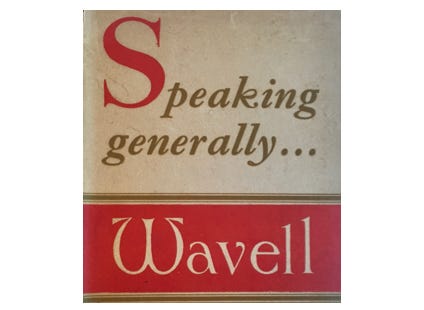
I already had a copy of Speaking Generally, a collection of Wavell’s wartime broadcasts, orders and addresses, still available online at archive.org (uploaded by the Allama Iqbal Library at the University of Kashmir). Speaking Generally is Wavell in his most serious and responsible voice.
In contrast, Other Men’s Flowers is a collection of common English verse that Wavell could recite from memory, and from which he drew inspiration. Also serious and responsible, but in a completely different way.
I first encountered Other Men’s Flowers at Poets House in New York. The collection at Poets House contains over 80,000 poetry books and related materials. It does not take long to grasp the rarity of Wavell’s work.
The title comes from a passage in the collected essays of Michel de Montaigne (1533-1592), and conveys the modest role of the anthologist who assembles a bouquet of flowers contributed by others. In my opinion it reads much better in the original French, given here in modern-day spelling.
Text within this block will maintain its original spacing when published
J’ai seulement fait ici un amas de fleurs étrangères, n’y ayant fourni du mien que le filet à les lier.
Essais, Volume 3, Chapitre XII. De la Physionomie
Other Men’s Flowers is still available: in print at Penguin, and online from multiple sources.

Wavell had mixed success in the war. In July of 1939. he was placed in charge of Britain’s Middle East Command, where he won a number of important victories. In June of 1941, however, he was moved to India by Churchill, who wanted a more vigorous leader for Britain’s Middle East forces. He was appointed Viceroy and Governor General of India in 1943, where he served until 21 February 1947, being replaced by Louis Mountbatten (1st Earl Mountbatten) for the few months prior to Indian and Pakistani independence.
Yet through all of this, Wavell earned the respect of both his comrades and his opponents. The National Army Museum of Great Britain gives him a generally positive biography. His story illustrates the challenges faced by senior officers who are not in complete alignment with the civil authority.
Additional material on Wavell can be found at the Liddell Hart Centre for Military Archives at King’s College London, and at the U.K. National Archives.
Mountbatten, who succeeded Wavell as Viceroy of India, also had a mixed success in the war. Readers wanting another look at him will find some references in Paranormal Romance, which is mostly about Smart Books in Victoria, but also where I picked up a copy of Unauthorized Action by Brian Loring Villa, which describes the secretive and largely dishonest process that led to the 1942 Allied raid on Dieppe. Mountbatten also appears quite frequently in Lord Alanbrooke’s War Diaries, usually as an object of frustration.
Benevolence (仁) is a sophisticated term in the Chinese original - "strict but fair". Related to Confucian philosophy. Note: we can acknowledge the complexity of these concepts, and instead of arguing about the meaning of words that were written 2000 years ago, we try to focus on examples (ancient and modern).
Commanders must believe in themselves, but also in something larger outside themselves. Sometimes this can be a shared belief held by the Emperor and the people, but disagreements can also be addressed by finding external objective criteria that are less than cosmic in scope, as in Getting to Yes, the 1981 book on negotiation by Roger Fisher and William Ury.
Trust (信) is an important pillar. You have to trust your leader for the army as a whole to be successful.
Fiji’s coups offer a stark reminder that once trust (信) breaks between civilian authority and military command, the Commander may begin interpreting “service to the state” in ways that override the sovereign’s intent.
Sun Tzu is like a benchmark. Not all generals are this way. What about being right? Is the general allowed to make mistakes? Note: the annotated Art of War translation from Giles contains observations made by Chinese authors about the state of discipline in Warring States armies. “Wrong” in practice means giving orders that subordinates cannot obey, and dealing with the consequences.
In a non-hierarchical organization, who is the Emperor and who is the Commander? Can we find their equivalents in two groups that have the same relationship as an Emperor and Commander of Sun Tzu’s time?
Our primary source is the Chinese Text Project (中國哲學書電子化計劃), edited by Dr. Donald Sturgeon (Chinese: 德龍).
https://ctext.org (for the project main page)
https://ctext.org/art-of-war (for The Art of War specifically)
Dr. Sturgeon has used the Giles translation, which is in the public domain, and available on Project Gutenberg at http://www.gutenberg.org/ebooks/132
English translations of individual kanji are from Jisho.org.
For more information on language resources, see [Week 1] We begin reading The Art of War.
Our goal at Drawing Legs on a Snake is to create a resource that our subscribers and contributors can use to create new Sun Tzu Reading Projects of their own.
We hope to show how we made connections between Sun Tzu’s world and the conflicts that interested us, and how we coped with managing the process as participants and facilitators.
For more information on Drawing Legs on a Snake and the new Sun Tzu Reading Project, see our guide to starting your own reading project.
Comments are welcome (and will be moderated). The authors can also be reached privately by message here on Substack, and by e-mail.
Comments
Nothing yet. Say the first thing.
Sign in to join the conversation.