
We begin with the first sentence of The Art of War.
孫子曰:兵者,國之大事,死生之地,存亡之道,不可不察也。
Sun Tzu said: The art of war is of vital importance to the State. It is a matter of life and death, a road either to safety or to ruin. Hence it is a subject of inquiry which can on no account be neglected.
Sun Tzu wrote these words during the Warring States Period of Chinese history (c. 403 - 221 BCE). The population of China was approximately forty million, living in small kingdoms that were frequently at war with each other. It was not until 221 BCE that the state of Qin defeated its many rivals and established the Imperial system of government, which endured for 2000 years.
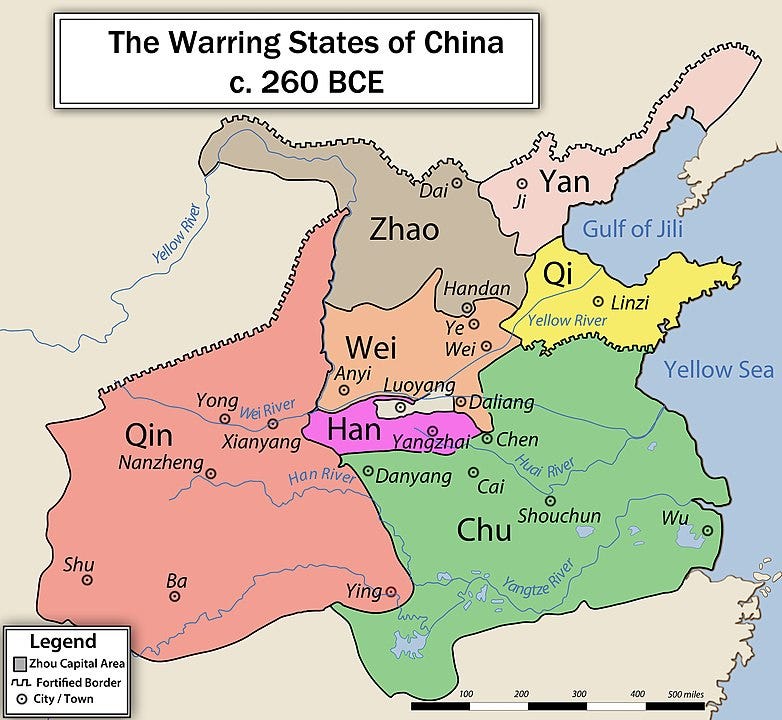
Chinese philosophy in Sun Tzu’s time was closely bound to the concepts of struggle and survival. War was a fact of life.
To get the most from our study of The Art of War, we have to connect Sun Tzu’s world with our own. The concepts introduced in Chapter 1 are foundational. Who is our Emperor? Who is our General? What do we mean by terrain and alliances? We can figure these out as we go along, and as we do so, new analogies and connections will emerge. Sun Tzu devotes an entire chapter to fire attacks, and another one to spies. What meaning can we assign to these?
Many aspects of our lives can be seen in terms of organized groups of people struggling against each other. However, we are not obliged to see every conflict leading to absolute victory or defeat. In The Art of War Chapter 3, “Attack by Stratagem, we will find that
“the best thing of all is to take the enemy’s country whole and intact; to shatter and destroy it is not so good.”
And even more to the point:
“supreme excellence consists in breaking the enemy’s resistance without fighting.”
Sun Tzu deals extensively with the motivation and management of the soldiers under the General’s command. In Chapter 5, “Energy” (also translated as “Strategic Advantage”), we will find that:
“The control of a large force is the same principle as the control of a few men: it is merely a question of dividing up their numbers. Fighting with a large army under your command is no different from fighting with a small one: it is merely a question of instituting signs and signals.”
By the same logic, understanding a book is the same principle as understanding a sentence or a paragraph. This will be our approach to reading The Art of War. We will look for connections between Sun Tzu’s world and our own, one paragraph at a time. We will then try to link these connections together, until the full book is at our command.
The goal of Drawing Legs on a Snake is to build on the work done in Sun Tzu Reading Projects that the authors have conducted in the past. We hope that our readers here will feel inspired to start reading projects of their own, and we have created a guide to help you do this: Starting your own Sun Tzu Reading Project. We are also available to lead workshops or assist you generally (there’s a fee for this, but it’s nominal).
There have been many wise sayings about the value of discussion and disputation, but one of my favorites is an aphorism from Thomas Henry Huxley:
“There is assuredly no more effectual method of clearing up one's own mind on any subject than by talking it over, so to speak, with men of real power and grasp, who have considered it from a totally different point of view.” [Aphorism XXV]
Anyone who has succeeded in any walk of life will already know much of what Sun Tzu has to teach. The reward often lies in finding new analogies and a new language for expressing ideas about strategy and its implementation.
Our first step in connecting The Art of War to our own world is to reconsider its first passage.
孫子曰:兵者,國之大事,死生之地,存亡之道,不可不察也。
Sun Tzu said: The art of war is of vital importance to the State. It is a matter of life and death, a road either to safety or to ruin. Hence it is a subject of inquiry which can on no account be neglected.
What is our State? What States are we at war with?
What separates the path to safety from the path to ruin? (存 ”existence” versus 亡 “death”)
Sun Tzu writes from the perspective of the General, but in reading The Art of War, you can imagine yourself in more than one role. As an Emperor, what would you want your General to do? As a General, how can you best serve the interests of the Emperor and the state, which are not always the same thing.
As a chariot driver or a foot soldier, what rewards do you expect the General and his officers to give you? How do you really know if your Emperor is in harmony with his subjects? Does he (or she) have the Way (道)?
The leaders in large organizations are not always open to sound advice. Perhaps they never have the Way, and human progress depends on their replacement.
As we begin our journey through The Art of War, remember that it deals with the achievement of goals through organized action. However, it can also be read with a view to frustrating the goals of others, especially when these are warlike or destructive.
In Chapter 3 of The Art of War “Attack by Stratagem”, we will find that the General’s first priority should be balk the enemy’s plans, sometimes expressed as: “first, attack strategies”, but also like this:
“Since wars begin in the minds of men, it is in the minds of men that the defences of peace must be constructed”
These words are not from Sun Tzu, but from the Atharva Veda, which dates from the Vedic Period in Northern India, almost a thousand years prior to the Warring States Period in China. They appear in the Constitution of the United Nations Educational, Scientific and Cultural Organization (UNESCO), You don’t have to be a General or an Emperor to apply them.
The next post in this series will deal with the Five Factors of Warfare. This is where a discussion group typically begins to talk about how they want to connect The Art of War to something that interests them. We will end this post with a list of resources.
Our primary source is the Chinese Text Project (中國哲學書電子化計劃), edited by Dr. Donald Sturgeon (Chinese: 德龍).
https://ctext.org (for the project main page)
https://ctext.org/art-of-war (for The Art of War specifically)
Dr. Sturgeon has used the Giles translation, which is in the public domain, and available on Project Gutenberg at http://www.gutenberg.org/ebooks/132
English translations of individual kanji are from Jisho.org (https://jisho.org/)
When the original Sun Tzu Reading Project first got underway, Jisho was the easiest kanji dictionary for English speakers to use. It was written for English-Japanese translation, but it has a good mechanism for looking up kanji by radical, so you don't need to know the Japanese pronunciation (or any Japanese at all).
To explore the meaning of a kanji character and its common combinations with other characters, copy and paste the character from this post to the Jisho search box. This can only be a start, however. The Chinese language has evolved in the last 2000 years.
There are many translations of Sun Tzu available. Apart from Giles, which has a somewhat Victorian (and genuinely imperial) tone, two English translations that I happen to like are:
The Ames translation, in The Book of War: Sun-tzu The Art of Warfare & Karl von Clausewitz On War, Modern Library Paperback Edition, 2000. ISBN 978-0-375-75477-7. This book includes new Sun Tzu texts discovered by archaeologists in 1972, and a discussion of how the Chinese text attained its modern form.
The Sonshi Group translation, available at https://www.sonshi.com/sun-tzu-art-of-war-translation-not-giles.html This is very simple and direct, with no literary flourishes. If a member of your Sun Tzu Reading Project can read the Chinese text directly, their own translation will typically be just as good. However, readers wanting to do their own translations should remember that the meanings of words can change over two thousand years. The scholarly translations are often the best starting point.
Eleven Commentaries on the Art of War. https://www.wdl.org/en/item/11410/.
The Russian translation of Sun Tzu by Nikolai Konard (1891-1970) is available at http://booksonline.com.ua/review.php?book=169716
For basic information on the Warring States Era, the Wikipedia is a good starting point: https://en.wikipedia.org/wiki/Warring_States_period
The Warring States map is by Philg88 - Own work, CC BY-SA 3.0, available on the Wikimedia commons at https://commons.wikimedia.org/w/index.php?curid=11900403
The Constitution of the United Nations Educational, Scientific and Cultural Organization can be found in the UNESCO Digital Library, along with other UNESCO documents. https://unesdoc.unesco.org/home
Aphorisms and Reflections from the Works of T. H. Huxley, Selected By Henrietta A. Huxley. Originally published in 1908, available on Project Gutenberg https://www.gutenberg.org/cache/epub/38097/pg38097-images.html
Want to read more before deciding? Try Starting your own Sun Tzu Reading Project. If you’re prompted to subscribe, you can (usually) chose “continue as a guest”. Access to older articles for non-subscribers is determined by Substack and its rules, not by us.
Comments
Nothing yet. Say the first thing.
Sign in to join the conversation.