
Heaven (天) and Earth (地) are two of Sun Tzu’s Five Factors of Warfare, which we introduced earlier in this series.
In this post, we begin to connect Sun Tzu’s concepts of Heaven and Earth with their counterparts in the world we want to study. Our goal, as always, is to help the organizers and participants in new Sun Tzu Reading Projects, with notes from our earlier iterations.
Heaven consists of everything we cannot control. Night and day, for example, or the passage of the seasons. It also includes events such as floods and hurricanes, which may strike one state but not another. We can prepare for some of these events, and manage their consequences, but we cannot prevent them from occurring.
Earth (ground, terrain) is where we fight. In Chapter 11 of The Art of War, The Nine Grounds ( 九地 ), Sun Tzu defines nine types of terrain, and gives advice on how the General should handle them. Chapter 11 is still some distance ahead of us, but we can start by listing the types with their corresponding kanji characters:
Dispersive ground (有散地); 散 scattering.
Facile ground (有輕地): 輕 light, easy, simple, gentle.
Contentious ground (有爭地); 爭 to dispute, fight, contend, strive.
Open ground (有交地); 交 mingle, mixing, association, coming & going.
Ground of intersecting highways (有衢地); 衢 crossroads.
Serious ground (有重地), 重 heavy, important, esteem, respect.
Difficult ground (有圮地); 圮 destroyed, ruined, to subvert, to injure.
Hemmed-in ground (有圍地), 圍 enclose, surround, encircle, preserve, store, keep.
Desperate ground (有死地); 死 death.
The Art of War is about the command of armies, not the details of manoeuvre and logistics. These must be mastered, but in Sun Tzu’s Five Factors of Warfare, Leadership and The Way (道) rank higher than Method and Discipline (法).
The connections we make between Sun Tzu’s terrain and our terrain do not have to be geographical, or even physical. We can use our imaginations freely.
That said, let’s get started with some physical examples from Chapter 11, followed by some basic advice, which (as Sun Tzu says elsewhere) can be taken or rejected as circumstances require:
When a chieftain is fighting in his own territory, it is dispersive ground. Don’t fight.
When he has penetrated into hostile territory, but to no great distance, it is facile ground. Don’t halt.
Ground the possession of which imports great advantage to either side, is contentious ground. Don’t attack.
Ground on which each side has liberty of movement is open ground. Do not try to block the enemy’s way.
Ground which forms the key to three contiguous states, so that he who occupies it first has most of the Empire at his command, is ground of intersecting highways. Join hands with your allies.
When an army has penetrated into the heart of a hostile country, leaving a number of fortified cities in its rear, it is serious ground. Gather in plunder.
Mountain forests, rugged steeps, marshes and fens—all country that is hard to traverse: this is difficult ground. Keep steadily on the march.
Ground which is reached through narrow gorges, and from which we can only retire by tortuous paths, so that a small number of the enemy would suffice to crush a large body of our men: this is hemmed-in ground. Resort to stratagem.
Ground on which we can only be saved from destruction by fighting without delay, is desperate ground. Fight.
From the standpoint of the General, what matters most is the impact of the terrain on the soldiers’ minds. This comes partly from the known and imagined challenges of fighting. but also from the possibilities of deception and surprise. A General with a record of success will inspire more confidence than a General with a record of failure. We’ll come back to this later in a post on Leadership.
Difficult ground and hemmed-in ground are good tests for a General. A salt marsh on a large, flat island lets us combine the two in a single example, where we can illustrate the importance of Heaven and Earth in the General’s calculations.
Sun Tzu’s advice on salt marshes is succinct: 斥澤 (literally “reject the swamp”).
The Giles translation is brief and to the point:
In crossing salt-marshes, your sole concern should be to get over them quickly, without any delay.
The photograph (below) shows a salt marsh on the western shore of Lulu Island south of Vancouver. There is a dyke with a road (just our of sight) on the right hand side of the picture. The footpath is close to sea level. The view is to the north, showing the mountains that lie to the north and west of Vancouver.
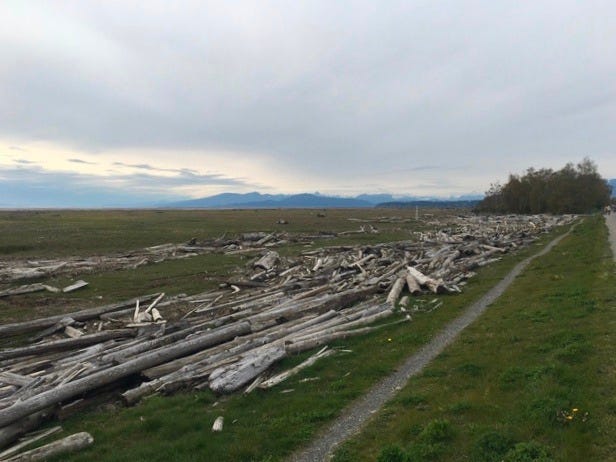
Heaven consists of everything we cannot control. For example:
Wind and rain. The prevailing wind in this region is from the west. The break in the clouds is a sign that clearer weather lies ahead. The prediction of weather in war is important. However, a well-trained and well-equipped army can react more effectively to sudden changes.
Tides. The picture shows the marsh at low tide. The height of the tides is determined by the relative positions of the Sun and the Moon with respect to the Earth. Tides can be predicted years in advance. However, there are also “sudden tides” in the form of tidal waves (tsunami) or river floods.
Night and day. It takes time to cross a salt marsh. A night crossing at low tide can only be made at certain times.
Seasons and temperatures.
All of these “forces of Heaven” are regional in scale. They affect the salt marsh. but also the dryer land that lies at its inland border. Lulu Island (used in our example) has salt marshes and flat, open land. The island as a whole would be hemmed-in ground. It lies between two wide branches of the Fraser River, and can only be accessed at certain locations.
On hemmed-in ground, Sun Tzu recommends using strategems. One of these is to pass through ground that the enemy thinks is impassible, as Hannibal did in crossing the Alps with his elephants in the Second Punic War (218 to 201 BCE).
From this perspective, what matters most is how well the Generals on each side understand the terrain they might fight on, coupled with their ability to get their soldiers to the right place at the right time.
Which brings us back to the concept of Earth (ground, terrain). The goal of the General should be to fight on terrain that favors his army. Here are some additional observations of the Lulu Island salt marsh:
The presence of logs on the ground below the dykes tells us that high tides and storms can inundate the marshes completely. However, the logs are grouped in two distinct rows, which tells us that very high tides and very strong winds may not be all that common.
The presence of tall trees indicates an island with firm ground.
An attack through the salt marsh would be unexpected, but might be possible if the attacker controlled a string of small islands. Possession of the islands would therefore create a threat, forcing the opposing General to deploy forces against it.
The challenges of fighting in marshland can be seen first-hand in the current war between Russia and Ukraine. The Wikipedia has an account of the Dnieper Campaign (2022-present) that makes a good starting point. The Dnieper River itself makes it difficult for either country’s forces to advance against the other’s, but the marshland on the eastern bank has not been easy for either side.
For a historical perspective on salt marshes. the Wikipedia article on the Mesopotamian Marshes is a good starting point. For example, in the wars of Alexander the Great (336 to 323 BCE), the battles between Alexander and Darius III of Persia took place on higher ground well north of the marshes.
For the organizer of a new Sun Tzu Reading Project, salt marshes can also be used to start a discussion on how people in coastal areas face a common enemy.
As global warming brings us higher tides and more intense storms, salt marshes are increasingly seen as valuable in the defense of low-lying coastal areas. For Lulu Island, the Sturgeon Banks Restoration Project addresses some of these issues.
For the organizer: A discussion of Heaven and Earth typically brings out all kinds of ideas. It’s important to draw these out in a way that helps the participants distinguish between where we are fighting (ground) and what we are fighting about, typically some form of wealth and power for our state.
Ground as the market (a typical “business application” of Sun Tzu). A rigorous approach to finding parallels can be helpful when data must be classified and quantified for analysis.
Companies in competition are states at war.
Fight is over revenue, but the typical metric is company valuation, which depends on many factors, including projected revenue and confidence in the management, among other things.
Intellectual property can be a type of ground, as well as a source of wealth and power.
Sales reps are soldiers fighting with sales reps from other companies.
A trade show can be type of ground.
Allegiances can be of two types:
Horizontal (with others in the same business).
Vertical (with suppliers and/or distributors).
Ground in the mind:
Fate: including the astrological ideas that were present at the time of the original writing. But also the world that you were born into as an individual, e.g. rich family, poor family, urban, rural. Area of conflict or relative peace.
Destiny. It governs the General and all other human actors. Whether we believe this or not in the present day, it would have strongly influenced Sun Tzu and the people that edited, revised and published later versions of the work.
Evolution of ground over time. Many battles have been fought over the same terrain, such as the English Channel between Britain and France. The Romans (55 BCE) and the Normans (1066 AD) were successful. The Spanish Empire (1588) and the French Empire (late 1700’s) were not. The participants in a Sun Tzu Reading Project will likely be aware of parallels in other parts of the world that the group can look at. Such as Afghanistan — the graveyard of many empires.
Our primary source is the Chinese Text Project (中國哲學書電子化計劃), edited by Dr. Donald Sturgeon (Chinese: 德龍).
https://ctext.org (for the project main page)
https://ctext.org/art-of-war (for The Art of War specifically)
Dr. Sturgeon has used the Giles translation, which is in the public domain, and available on Project Gutenberg at http://www.gutenberg.org/ebooks/132
English translations of individual kanji are from Jisho.org.
For more information on language resources, see Sun Tzu Chapter One - Laying Plans.
For more information on Drawing Legs on a Snake and the new Sun Tzu Reading Project, see our guide to starting your own reading project.
Comments
Nothing yet. Say the first thing.
Sign in to join the conversation.