
A new paper in Cell by Singh and Kapahi argues that the ovary was never just a reproductive organ, and that the fastest route to understanding how anybody ages runs straight through female biology.
The last line of the abstract is the part I can’t stop thinking about.
After twenty-plus pages arguing that female biology has been sidelined in aging research, the authors conclude that studying females should be prioritized because it has unique implications for slowing aging and preventing age-related disease, “ultimately benefiting both women and men.”
The case for studying women is that it will help men.
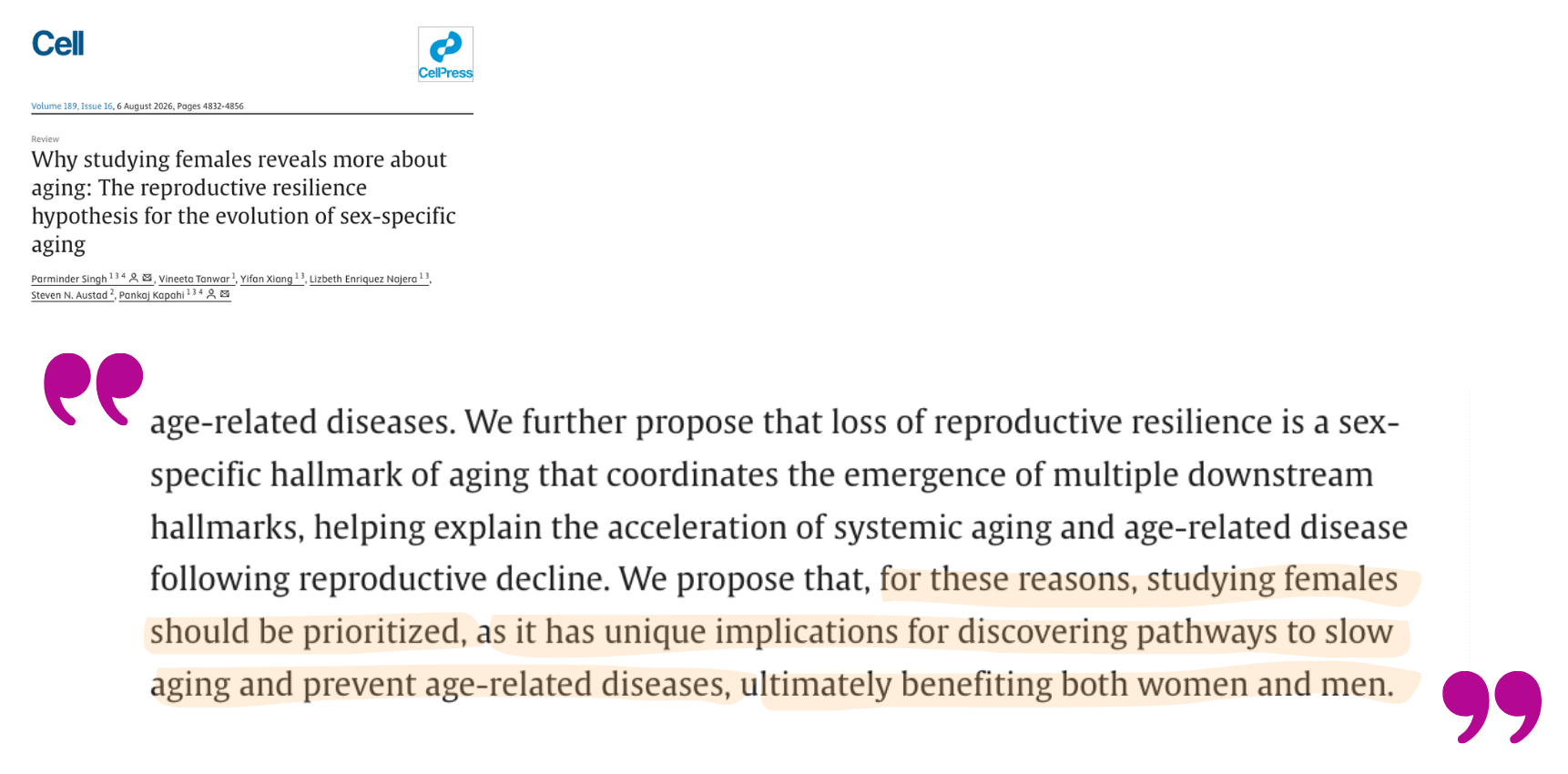
I want to be annoyed. I’m not, particularly. I’ve been doing this long enough to know that the argument which works is the argument you use. But there’s something perfect about it. Women’s health has spent a century as a subspecialty, a footnote in a chapter about the real body. And the thing that might finally move it to the center of the aging field is the discovery that we’ve got something men want.
Fine. Come get it.
Here’s what they’re coming for.
You know the list. Sleep goes. Then the joints, the memory for nouns, the belly fat that arrives despite zero change in diet, the anxiety with a standing 3 a.m. appointment, the itchy ears (yes, that’s a real one), the muscle that used to come back after two weeks off and now doesn’t.
The standard explanation is that estrogen receptors are found in nearly every tissue, so the loss of estrogen at menopause disrupts function almost everywhere. That’s correct. I use it in my clinics every day, and the mechanisms are well described.
But it answers the wrong question. It tells you how the damage propagates. It doesn’t tell you why a reproductive hormone had a vote in bone remodeling, glucose handling, thermoregulation, vascular tone, immune signaling, and barrier function in the first place.
The “why” is the juicy bit.
For decades, evolutionary biology gave one answer: reproduction is expensive, and you pay for it with your lifespan. Fixed energy budget. Spend it on eggs and offspring, and there’s less left for DNA repair, protein maintenance, and the housekeeping that keeps a body running. Reproduction and longevity in a zero-sum fight, and reproduction wins, because evolution has no opinion about your seventies.
Elegant. Also, according to Singh, Kapahi, and colleagues at the Buck Institute, wrong in a way that should have bothered us sooner.
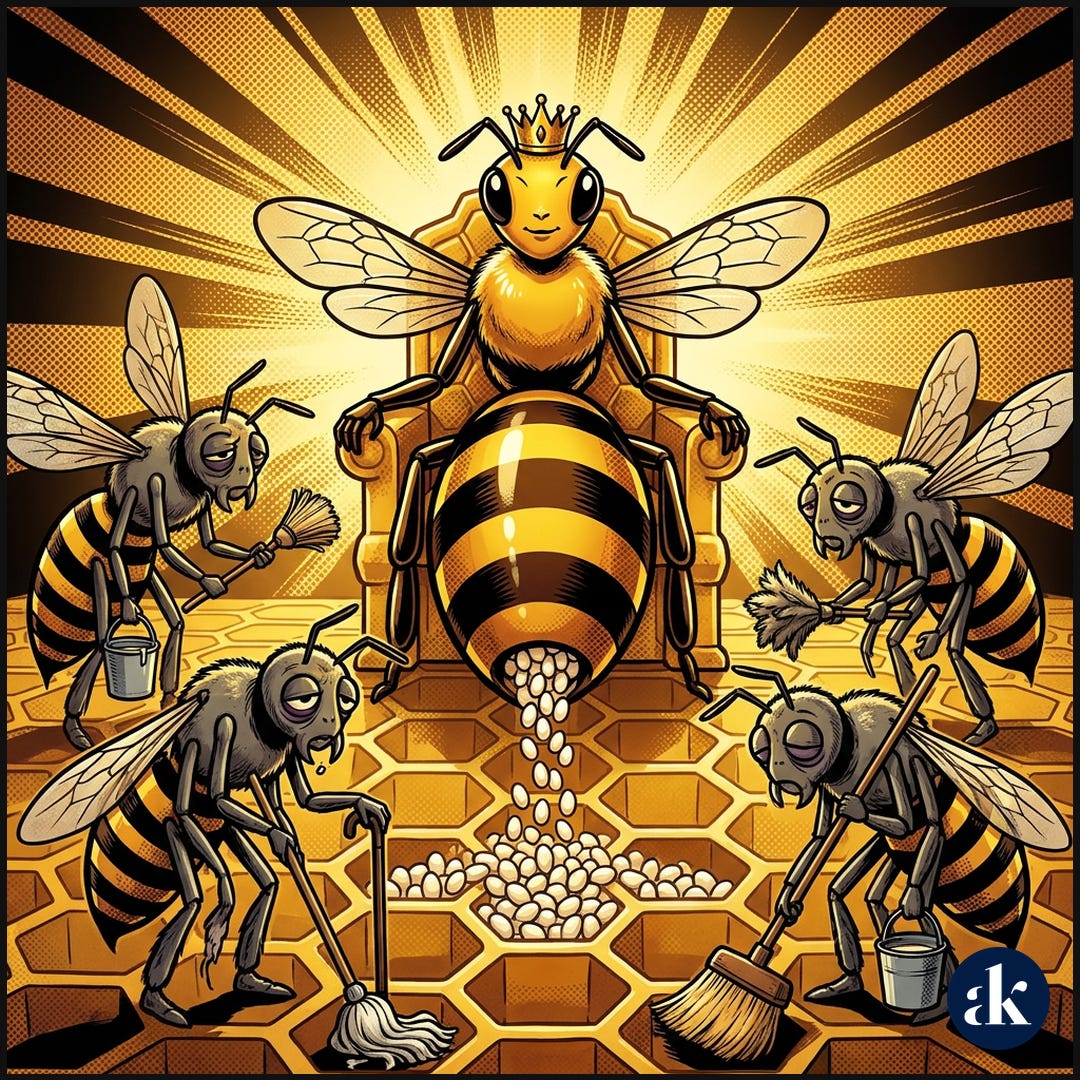
It doesn’t explain why females consistently outlive males across 60-70% of mammal species despite investing far more in reproduction. It doesn’t explain queen bees or naked mole-rat queens, animals whose entire job is reproduction, outliving their non-reproducing sisters by absurd margins. The queen bee lays two thousand eggs a day and lives forty times longer than the workers, who mostly just tidy up.
The heavy lifting, it turns out, might be the bee’s knees.
The Reproductive Resilience Hypothesis (RRH) puts a name to it. When reproductive success depends on staying alive afterward, on surviving a pregnancy, then lactating, then keeping a helpless mammal alive for a decade, selection has a reason to build a body that tolerates stress, repairs damage, and keeps going. Longevity stops being the price of reproduction and becomes part of the benefit.
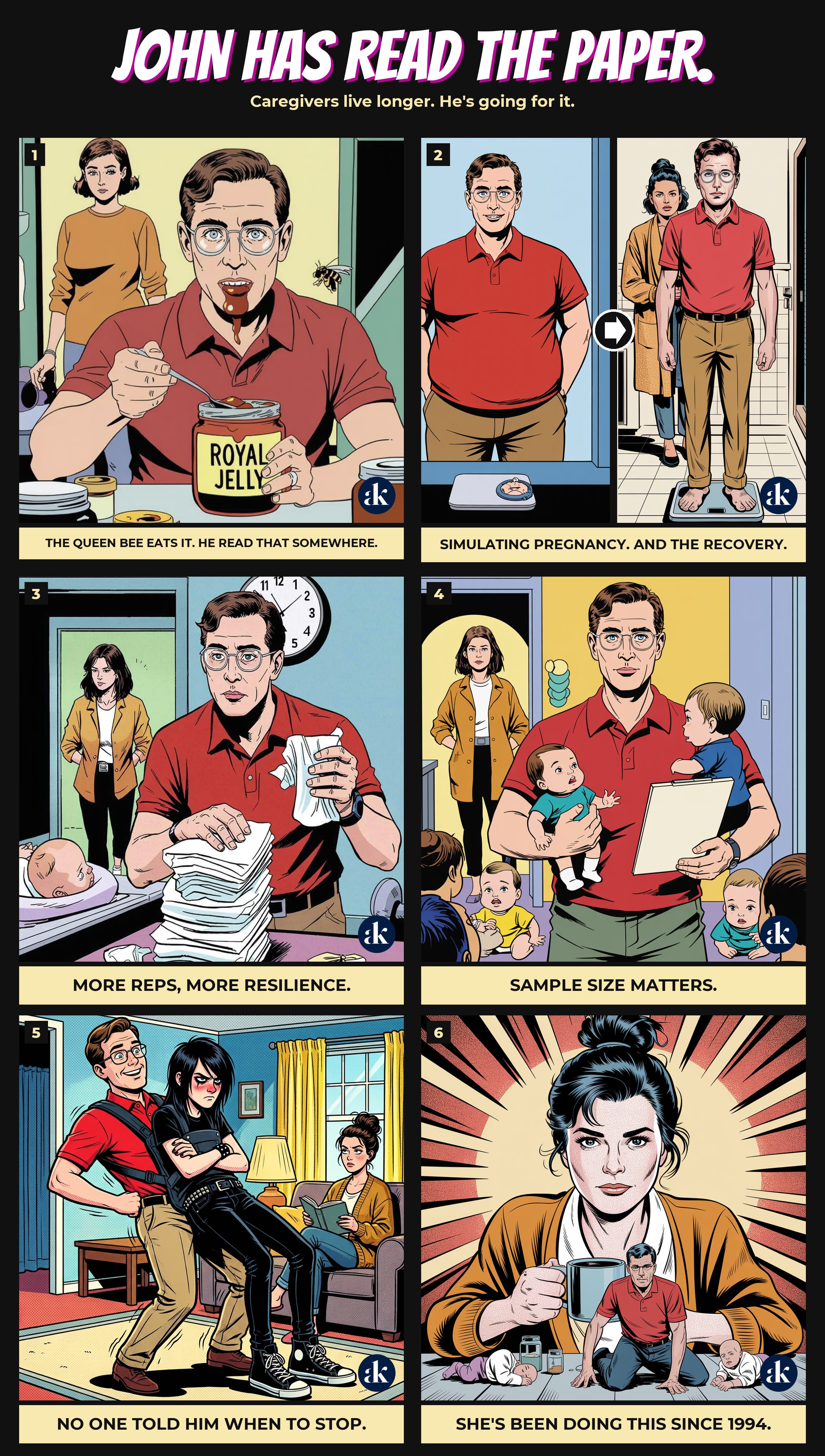
The detail that convinced me this isn’t just a flattering story about women is that it flips. The hypothesis doesn’t predict female longevity. It predicts that whoever has to stay alive for the offspring gets built to last. Usually that’s us. But in the primates where fathers do the actual carrying, it’s them. Kapahi is careful to note this doesn’t mean a human man earns extra years by changing diapers. Pity.
And none of it requires you to have had children. Selection didn’t install this machinery in the women who gave birth. It installed it in the lineage, in response to what female reproduction demanded on average. Your follicles (eggs) formed before you were born. The wiring is standard equipment in a female body, running since your first period, whether or not you ever used any of it for its nominal purpose.
So back to the question. Why do ovarian hormones reach into every system you have?
Because reproduction required something unusual of the body. Not one adaptation, but the ability to shift multiple systems into a coordinated state and then shift them back, repeatedly, on schedule.
Consider what the cycle alone demands. Roughly 400 times in a lifetime, the endometrium rebuilds, basal temperature steps up, insulin sensitivity moves, fluid balance and vascular tone change, and the immune environment of the uterus reconfigures. Not sequentially. Together, because the sequence has a deadline.
There’s a word for this in longevity medicine and nobody applies it here. Hormesis. Repeated, survivable stress that leaves a system stronger than it found it. We accept it for exercise, for heat and cold, for fasting. Then we look at a process that stresses and restores half a dozen organ systems on a monthly schedule for four decades and call it a nuisance.
Pregnancy is the same stimulus at a much higher dose. Blood volume climbs 40-50%. Insulin resistance rises deliberately to shunt glucose to the fetus, then reverses. The immune system tolerates a genetically foreign passenger for nine months without going quiet enough to get you killed by something else. Lactation pulls calcium from maternal bone and then returns it. Every one of those is reversible, expensive, and coordinated, and getting them out of sync is how women died.
You cannot run a whole-body state change with each organ deciding independently. You need a clock. So over evolutionary time the ovary became embedded in an inter-organ network linking the hypothalamus, pituitary, metabolism, immune system, bone, and brain.
The broad receptor distribution isn’t an incidental fact about estrogen. It’s the wiring of a broadcast system.
Which makes the ovary less a gland than a pacemaker. A pacemaker doesn’t do the heart’s work. The muscle contracts fine on its own. What it supplies is timing and coordination, and when it stops, tissue still functions. It just runs off beat and a little wonky.
Menopause, in this framework, isn’t the end of fertility with side effects. It’s the moment a coordination layer comes offline and exposes vulnerabilities that were previously buffered.
If the ovary is a pacemaker, the clinical question writes itself. How do you keep it broadcasting longer, and what do you do once it stops?
Two answers exist right now. One tries to keep the organ itself in the game and is available to a narrow slice of women. One replaces the handful of signals we know how to make and is available to nearly everyone reading this.
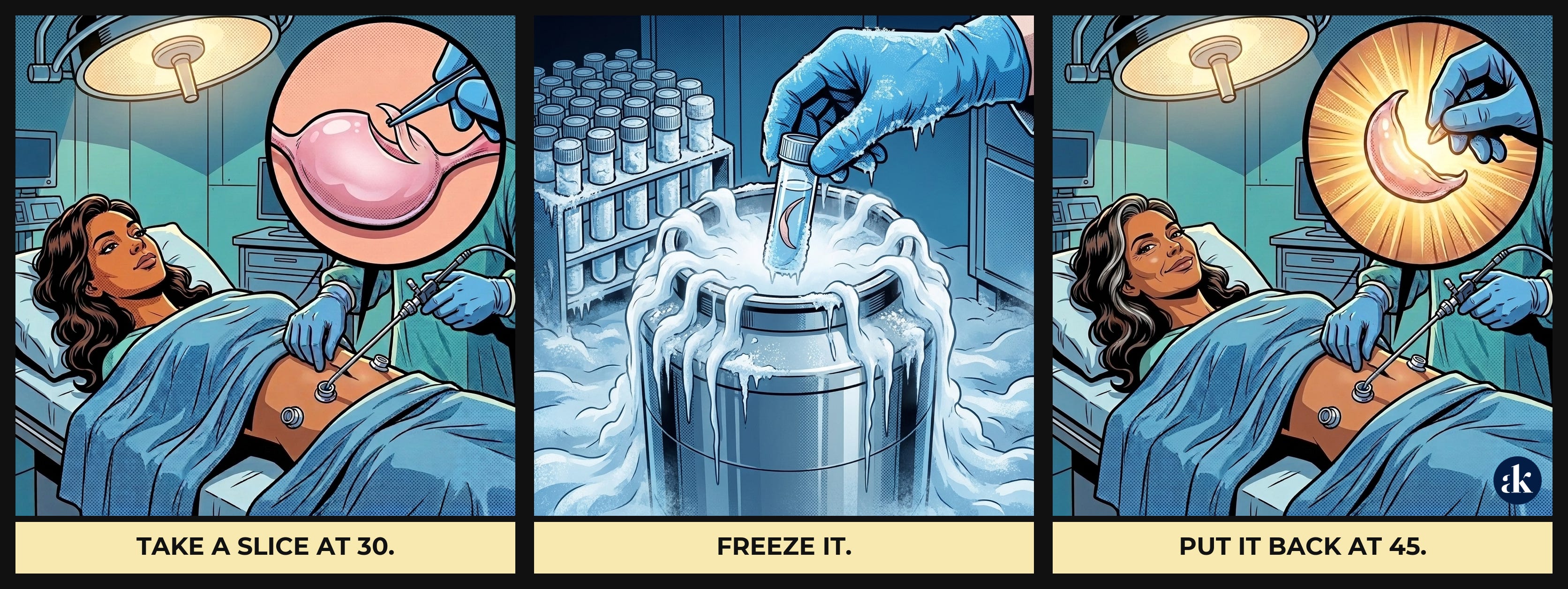
Bank the tissue. Remember that the authors’ stated goal isn’t to extend fertility; it’s to determine whether beneficial ovarian communication can be preserved or restored. There’s exactly one procedure that already attempts that, and it does it the obvious way: by keeping the ovary. Ovarian tissue cryopreservation and transplantation (OTCT) means surgically removing a strip of ovarian cortex, freezing it, and putting it back years later, and it is not theoretical. Dr. Kutluk Oktay performed the first successful cryopreserved transplant in 1999, and it’s now an established fertility option before chemotherapy, with more than 200 babies born from it. The new proposal is to do it electively in healthy women to postpone menopause. Oktay’s 2024 modeling study projected menopause delays of 1.4 to 11.8 years, depending on age at harvest. Dr. Sherman Silber goes further, arguing you could transplant pieces back every decade and skip menopause entirely (check out ovealth.com to learn more).
The caveats: this is a mathematical model rather than a trial, the human hormone-restoration data comes mostly from cancer patients, and it requires multiple surgeries. Also, it’s a young woman’s intervention. If you’re 51, the harvest window has closed, but your daughter’s hasn’t, and almost nobody is telling her the option exists.
If I were 30, I’d seriously consider it. But I’m not 30, so this is easy for me to say.
Which brings us to the part I do for a living.
The authors are careful to say this isn’t an estrogen-only theory of female aging. Then they list the aging machinery that supposedly runs on its own: DNA damage, protein aggregation, mitochondrial dysfunction, stem cell exhaustion.
I’d push back on that list. Estrogen doesn’t get nearly enough credit for what it touches. It shapes mitochondrial function and how cells handle oxidative stress. It’s woven through immune signaling and the inflammatory tone that rises after menopause. It participates in stem cell activation and tissue repair. Calling those processes independent of estrogen because they also occur in men is like calling a fire independent of oxygen because it happens outdoors.
That said, they’re right about one thing. Some aging happens whether estrogen is in the room or not. Men accumulate every process on that list without ever having owned an ovary, and no amount of estradiol stops the clock on all of it.
And here’s where I agree with them harder than they may expect. Replacing estrogen doesn’t restore what was lost. Neither does replacing all three. The ovary was making things we haven’t characterized, and it was doing so in conversation with everything upstream and downstream of it.
FSH is the cleanest example of what falls outside the hormone bottle. SWAN data shows the fastest bone loss and the onset of visceral fat happen during late perimenopause, when FSH is climbing and estrogen is still relatively normal. In mice, blocking FSH while leaving estrogen untouched reduces adiposity, drives white fat toward thermogenic beige fat, and protects bone. The pituitary half of the conversation is doing real work, seemingly independent of estrogen, and nothing in your medicine cabinet addresses it.
Which is the honest frame for what I prescribe. Estradiol, progesterone, and testosterone are the best-characterized outputs of that organ by an enormous margin; they have receptors in every tissue on the paper’s list, and they’re the only ovarian signals we know how to give back. The rest we can’t measure, can’t replace, and in most cases can’t name.
Hormone therapy helps enormously, and it does not make a 52-year-old body identical to a 42-year-old one. I’ve spent years watching that gap and blaming the dose, the route, the absorption, the patient’s sleep, and occasionally the lab. Sometimes I was right. Sometimes it’s the part of the conversation we can’t replace yet.
That’s not an argument against hormone therapy. It’s an argument for it, plus humility about the ceiling.
If you’ve been taking care of yourself and taking hormones, this paper doesn’t change your dose or whether you’re on a patch or a pill. What it might change is how you think about the prescription bottles on your nightstand, currently occupying real estate that could go to a nice candle. Or a vibrator.
They’re not a symptom fix. They’re your remaining line to a communication system that had a hand in how every tissue in your body maintains itself, one we spent a century misfiling as reproductive plumbing. That’s a different relationship to a prescription. It’s the difference between managing hot flashes and staying in touch with what used to keep your bones, brain, metabolism, heart, and immune system on the same schedule.
And it should change what you tell your doctor. If you had a hysterectomy with oophorectomy at 41, that shouldn’t be buried in your history. It may be the most informative number in your chart. Age at menarche, age at menopause, cycle history, and any surgery that touched an ovary belong in there whether or not you were ever pregnant. Not as reproductive background. As aging data.
That’s the part you can do. The rest depends on whether the people who fund this work decide we’re worth the trouble, and the authors of the Cell study have handed them a reason.
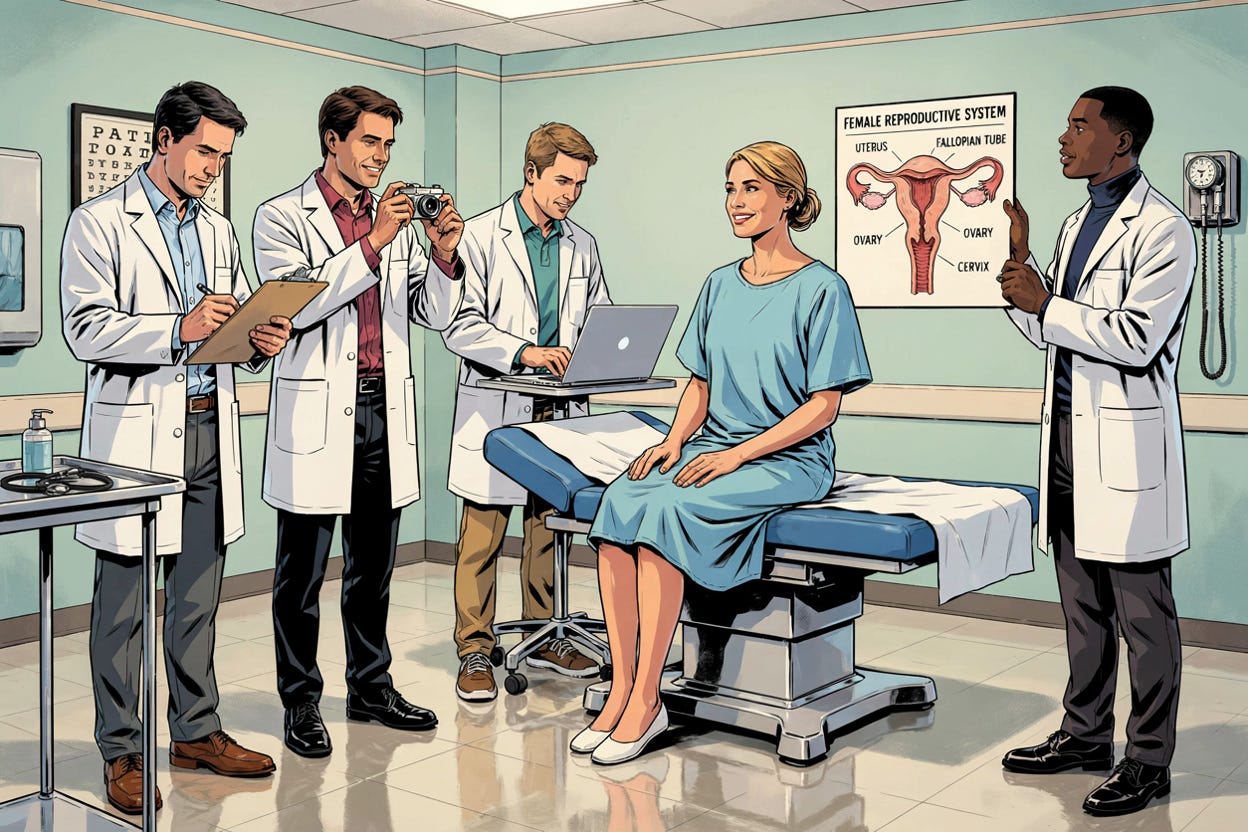
Women have been getting decent medicine by accident for two hundred years, almost always as a side effect of somebody studying a man. Turning that arrangement around, even for entirely self-interested reasons, would be the first time the accident ran in our favor.
But look at what they’d be conceding. The frameworks that run aging research were built on male animals and on young females that had never been pregnant, because a cycling female is a confounder, and confounders get controlled away. Too many variables. Too much fluctuation. Too inconvenient to model. Except those complications are the resilience mechanism. The cycling, the reallocating, the taking apart and putting back together on a deadline, over and over, for as long as there have been mammals. That was the training.
They excluded us for the exact trait they now want to extract.
So they don’t get it on the old terms. Not women as smaller, pinker, more fragile men with an inconvenient hormonal overlay. Women as what we are.
Longevity athletes.
We’re happy to share. Study us for your own sake. Bring funding.
Just don’t act surprised when the signal you’ve been looking for turns out to be the one you kept calling noise.
Main Study
Singh, Parminder, Vineeta Tanwar, Yifan Xiang, Lizabeth Enriquez Najera, Steven N. Austad, and Pankaj Kapahi. “Why studying females reveals more about aging: The reproductive resilience hypothesis for the evolution of sex-specific aging.” Cell 189, no. 16 (2026): 4832–4856. doi:10.1016/j.cell.2026.07.013
Other Sources
Allman, John, Aaron Rosin, Roshan Kumar, and Andrea Hasenstaub. “Parenting and survival in anthropoid primates: Caretakers live longer.” Proceedings of the National Academy of Sciences 95, no. 12 (1998): 6866–6869. doi:10.1073/pnas.95.12.6866
Borfitz, Deborah. “’Reproductive Resilience Hypothesis’ Highlights the Ovary as a Discovery Source in Longevity Research.” Bio-IT World, August 6, 2026.
Buck Institute for Research on Aging. “Why women need to be prioritized in longevity research.” News release, August 6, 2026.
Colchero, Fernando, et al. “Sexual selection drives sex difference in adult life expectancy across mammals and birds.” Science Advances 11, no. 40 (2025). doi:10.1126/sciadv.ady8433
Johnson, Joshua, Sean D. Lawley, John W. Emerson, and Kutluk H. Oktay. “Modeling delay of age at natural menopause with planned tissue cryopreservation and autologous transplantation.” American Journal of Obstetrics and Gynecology 230, no. 4 (2024): 426.e1–426.e8. doi:10.1016/j.ajog.2023.12.037
Lemaître, Jean-François, et al. “Sex differences in adult lifespan and aging rates of mortality across wild mammals.” PNAS 117, no. 15 (2020): 8546–8553. doi:10.1073/pnas.1911999117
Liu, Peng, et al. “Blocking FSH induces thermogenic adipose tissue and reduces body fat.” Nature 546 (2017): 107–112. doi:10.1038/nature22342
Scientific American. “Experimental Ovarian Cryopreservation Could Delay Menopause, but Experts Are Weighing the Risks.” June 2024.
Sowers, MaryFran R., Mary Jannausch, Daniel McConnell, Roderick Little, Gail A. Greendale, Joel S. Finkelstein, Robert M. Neer, Janet Johnston, and Bruce Ettinger. “Hormone Predictors of Bone Mineral Density Changes during the Menopausal Transition.” Journal of Clinical Endocrinology & Metabolism 91, no. 4 (2006): 1261–1267. doi:10.1210/jc.2005-1836
“There’s No Reason To Accept Menopause: Dr. Sherman Silber Breaks Fertility Myths.” Technology Networks, November 2025.
Zaidi, Mone, Tony Yuen, Li Sun, and Clifford J. Rosen. “Regulation of Skeletal Homeostasis,” Endocrine Reviews 39, no. 5 (2018): 701–718. doi:10.1210/er.2018-00050
No posts
Comments
Nothing yet. Say the first thing.
Sign in to join the conversation.