
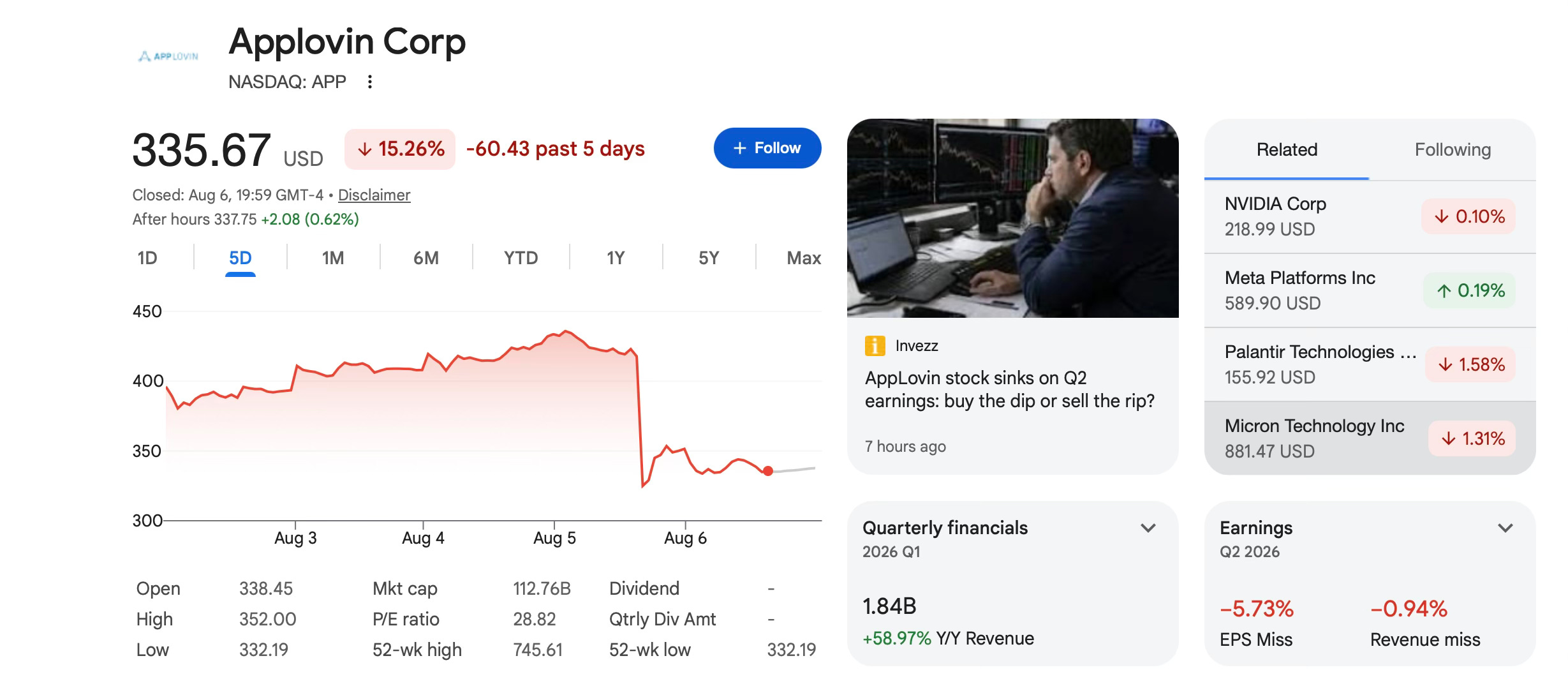
The demand question is settled. Every company that reported this week grew. The new question is cash — and that’s the whole reason AppLovin lost $26.5 billion on a 0.8% miss.
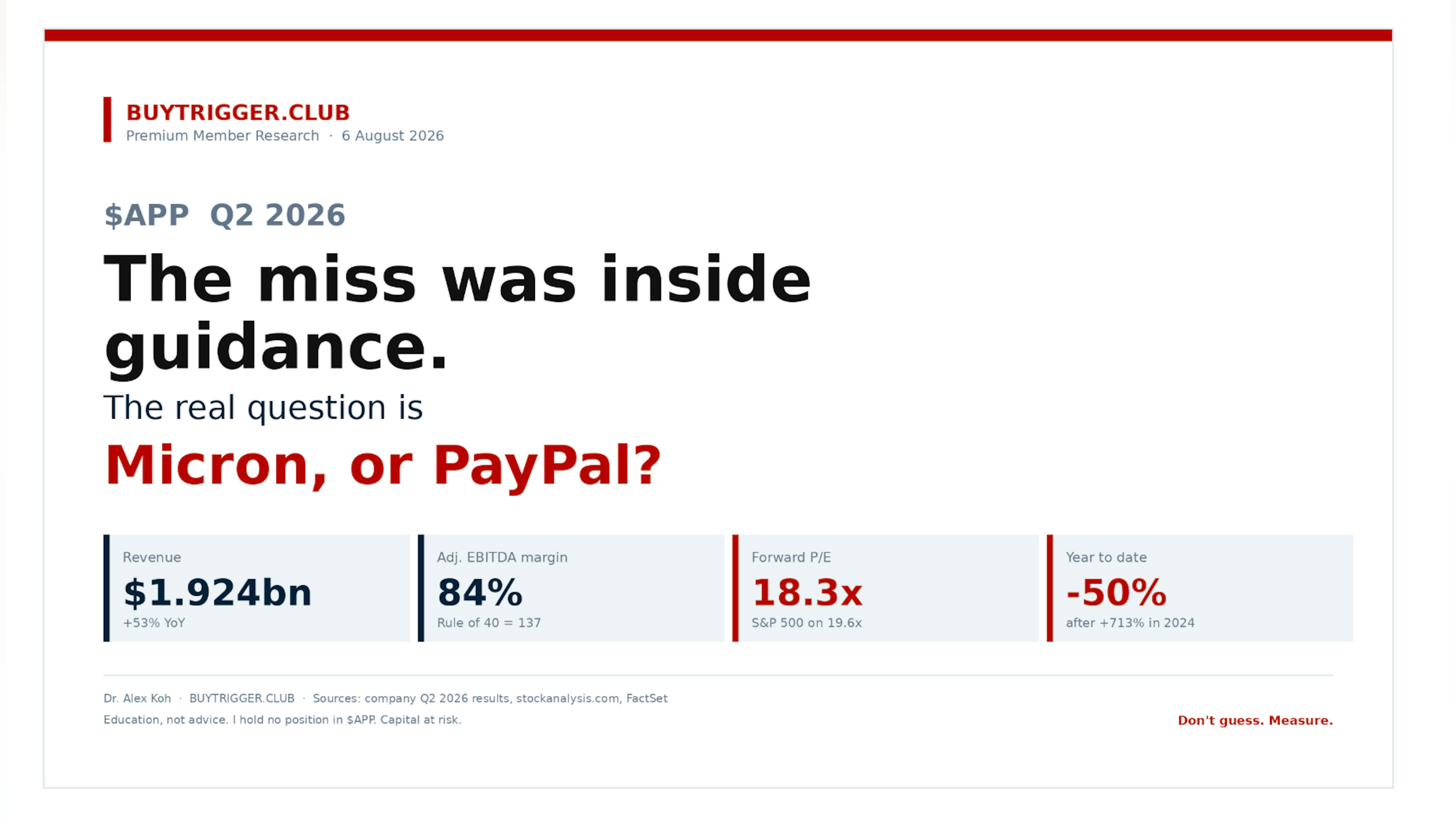
Premium Member Research | Dr. Alex Koh | 6 August 2026
BUYTRIGGER.CLUB — Don’t guess. Measure.
Before we start: this is my read and my process, not financial advice. $APP is a high-growth name that has already halved this year and it can fall a lot further — the bear cases now run to $200. My BuyTrigger and ValueTrigger levels are inputs to my thinking, not price targets or a signal to act. Full transparency: I don’t own $APP. I’m sitting on a lot of cash right now and I haven’t written my top-stocks-to-buy piece this week because there’s nothing I want to pick — I’d rather say that than lie about it. No broker, sponsor or company relationship with AppLovin.
The demand question is settled. Every single company that reported this week grew — Palantir, SpaceX, AppLovin, AMD, Amazon — and most of them grew enormously. The argument about demand in any sector is over.
The new question is cash.
Everybody beat. Everybody grew. Nobody’s happy. Beat on EPS, beat on revenue — stock still drops. So growth alone is clearly not what this market is paying for right now. Hold that thought, because it explains everything below.
And the reason is the Fed. The market is pricing a hike, not a cut — around 55-60% odds for 16 September, with cut odds at 1-2%. Rising rates compress valuations, and compression makes promised future cash worth less today. So the market has stopped paying for the promise and started paying for the cash in the till.
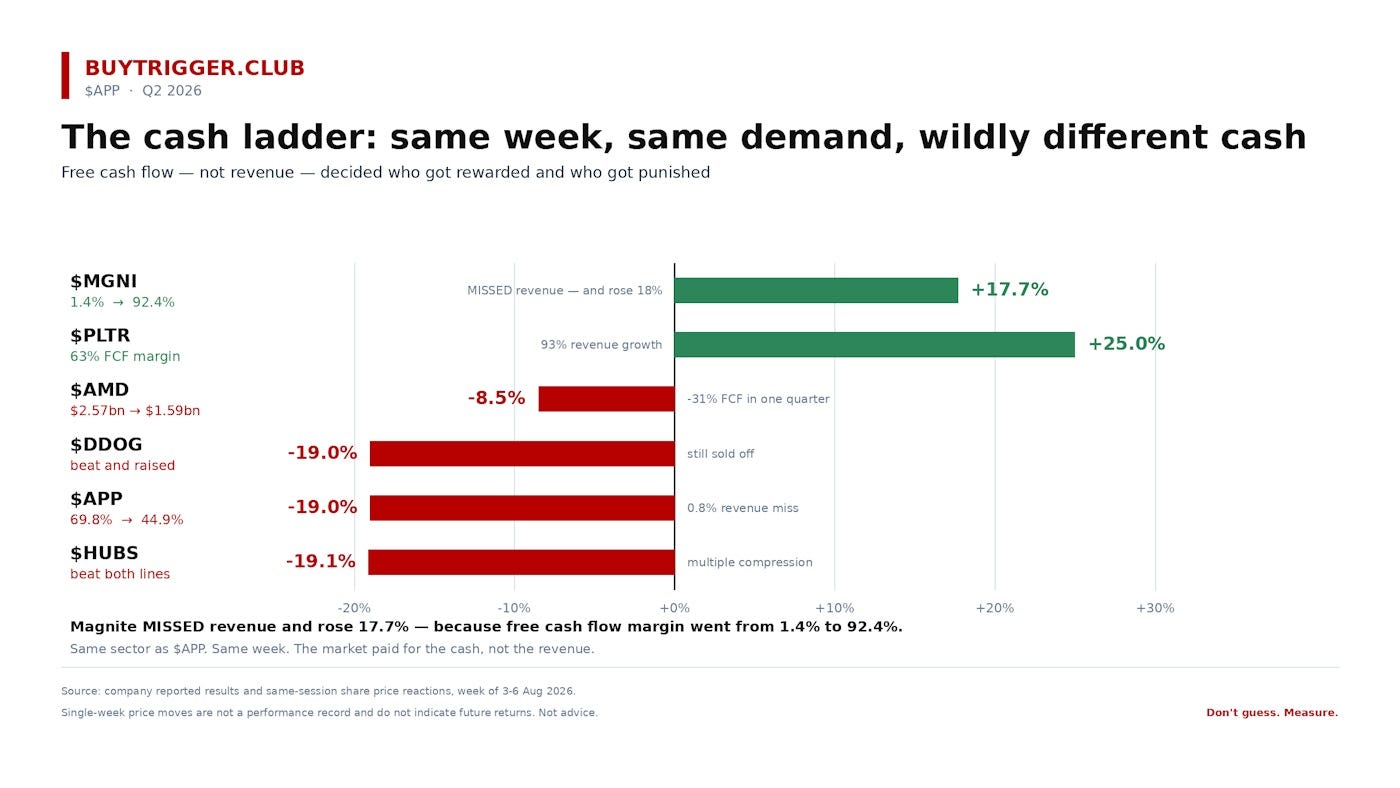
Look at what actually happened this week, because this is the chart I keep coming back to. I call it the cash ladder.
Free cash flow direction versus the share price reaction — same week, same demand, wildly different cash.
$PLTR posted a 63% free cash flow margin on 93% revenue growth and jumped 25%. It’s become normal for a company to double every year. I don’t see the place I work doubling every year — do you? But that’s the bar now.
$APP came in at 44.9% free cash flow margin, down from 69.8%, and dropped 19%.
$AMD did very, very well on the operating line and still fell 8-9% — because free cash flow went from $2.566 billion to $1.588 billion in a single quarter. Minus 31%.
$DDOG beat and raised, and dropped 19%. $HUBS beat both lines, and dropped 19.1%.
And now the one that proves it beyond argument. $MGNI — Magnite — missed on revenue and closed up 17.7%. Missed. And went up nearly 18%.
Why? Their free cash flow margin went from about 1.4% to 92.4%. From one percent to ninety-two. That’s not an improvement, that’s a different company. Suddenly there’s real cash coming in, it shows operating and spending efficiency, and a company generating that kind of cash can do absolutely anything. The market didn’t care that they missed revenue.
Same week. Same sector — Magnite is in advertising too, same as AppLovin. Wildly different cash. One missed and went up 18%. One missed by less and went down 19%.
That’s the tell. Anybody reporting cash-rich right now — rock and roll. Anybody showing declining cash, and I don’t mean declining revenue, I mean declining cash, even just quarter on quarter — they’re getting punished. Very unfairly, in my view. But that’s where the market is looking, and guess what: hardly anybody is talking about it.
Let me be plain, because a lot of you asked and the honest answer isn’t the one in the headlines.
Reason one: the cash flow. Free cash flow margin went from 69.8% to 44.9% quarter on quarter. That’s it. That’s the big one.
Reason two: eight analyst cuts in a single morning. These guys jumped on the bandwagon faster than me. Wells Fargo went 575 to 357. Piper Sandler 665 to 385. BofA 705 to 430. Roughly $200-300 knocked off a target, each, in one go — and two of them downgraded the rating outright.
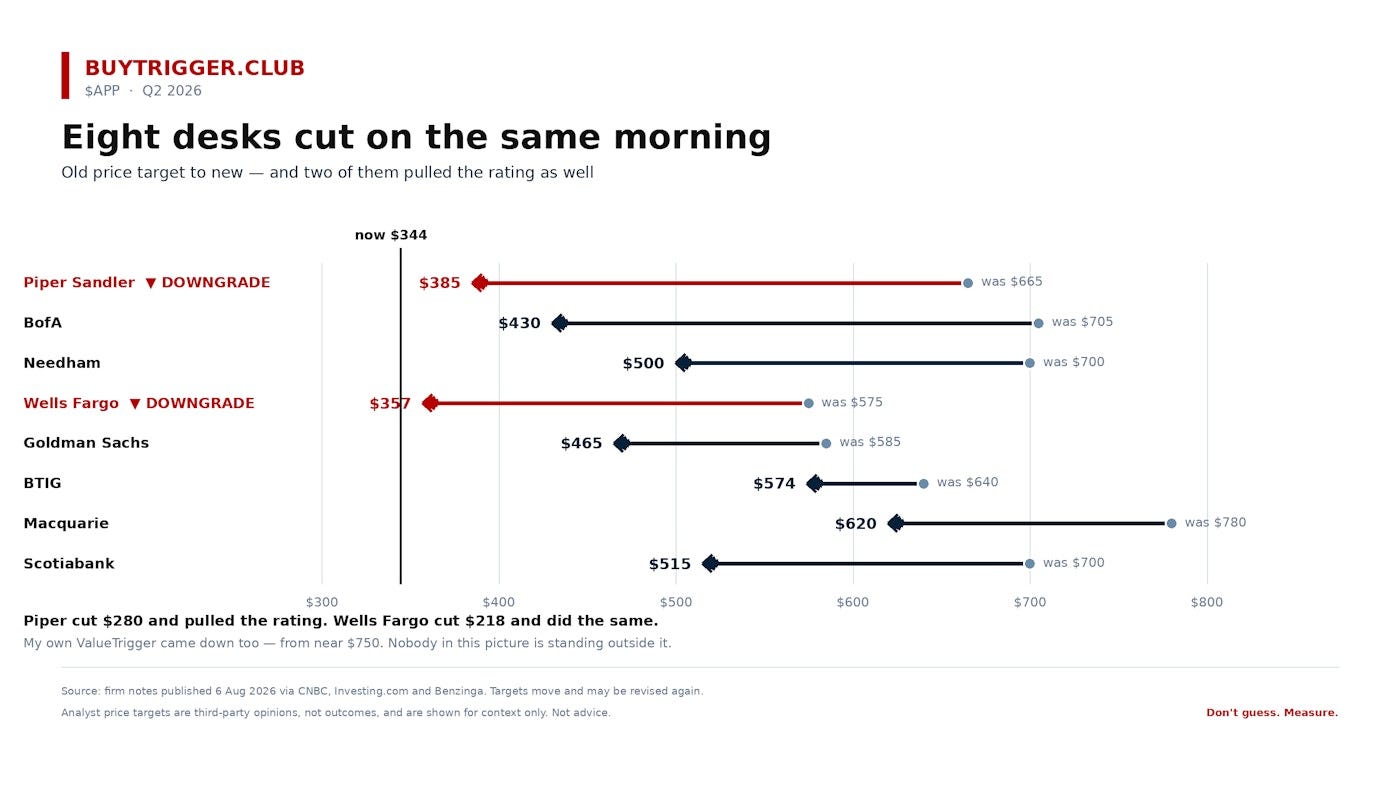
Analyst price target cuts on $APP, 6 August 2026 — old target versus new.
For context on how far that goes: my own ValueTrigger was up near $750 and I’ve cut it too. So I’m not standing outside this pointing fingers — I’m in the same boat. But when eight desks cut on the same morning and two of them pull the rating, that’s not analysis, that’s a stampede, and the stampede moves the price.
Reason three: five straight quarters of deceleration. Not decline. Deceleration. 77% → 68% → 66% → 59% → 53%, guided to about 47%. The number is still high — it’s still a wonderful growth rate — but the direction is one way, and the US market punishes direction.
What did not cause it: the miss. They missed revenue consensus by 0.8% — about $16 million on a $1.924 billion quarter. That is really, really tiny. Knowing about a 0.8% miss doesn’t help you understand a 19% drop at all. Ignore it.
And for the record: I think a 19% repricing on that set of facts is way, way too much. But this is the US market. If you beat and you deliver, it rewards you like Christmas every day. If you miss by a hair and show any sign of deceleration, it will punish you very hard and leave you sitting there undervalued until you perform again. It is not a forgiving market.
Three things being said today that don’t survive contact with the filings.
“AppLovin missed revenue.” They missed consensus. The company’s own guidance range was $1.915 to $1.945 billion, and $1.924 billion lands inside it. What they actually missed was the midpoint — by around 30 basis points. That’s the real story, and it’s why Piper’s note mattered: it’s the first time since the IPO they’ve come in under their own guided midpoint. That’s a streak breaking. It is not a company failing to hit its numbers, and those are two different sentences.
“EPS beat.” Careful. EPS came in at $3.76. Against one consensus set ($3.67) that’s a beat; against another ($3.75) it’s in line to the penny. In line to slightly ahead. Leave the confetti in the box.
“Free cash flow collapsed.” Yes, the margin fell — but free cash flow itself was $863 million, up 12% year on year. The gap comes from two places, and only one of them is temporary: cash taxes jumped to $639.8 million in the first half from $100.6 million a year earlier, six times over, and receivables ate another $352 million.
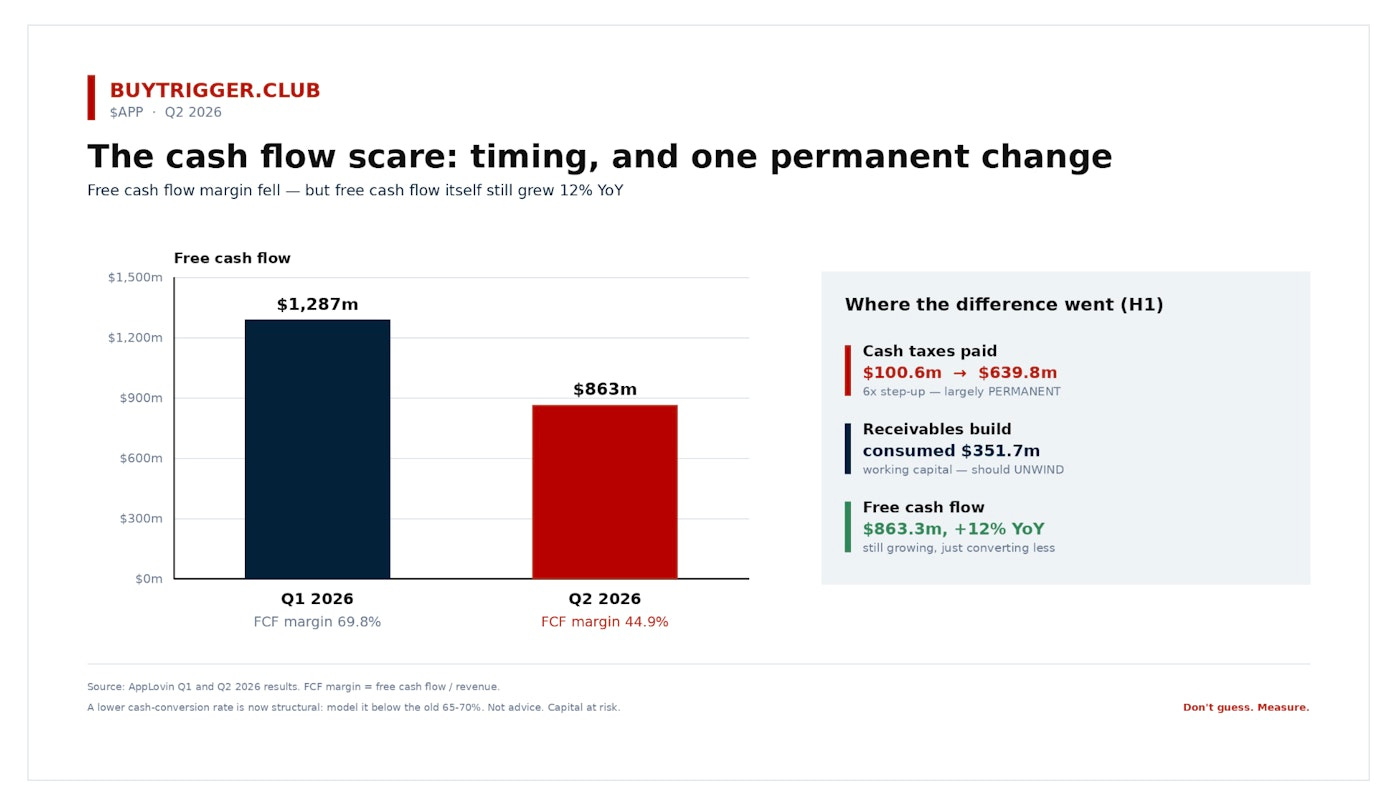
Q1 versus Q2 free cash flow, with the cash-tax and receivables drag identified.
The receivables build is working capital and it should unwind — that’s the normal signature of a customer base broadening rather than deepening. The cash-tax step-up is largely permanent. AppLovin has graduated into being a proper cash taxpayer. So if you’re running a DCF on this name, cut your cash conversion assumption today. Not because the business broke. Because it grew up.
This is why I don’t take my diagnosis from a headline writer. It’s like getting a COVID diagnosis from a news reporter instead of the actual doctor. Data is king — but only when you read it properly.
Adam Foroughi’s explanation was unusually direct. He said the quarter came down to timing, that model improvements were lighter than normal, and the next step up landed just after quarter end.
I’ll be honest — that’s not the right answer.
He’s put his operational product out front as the reason the quarter declined, and people don’t like that. Analysts are not stupid. You don’t go live on a call and not prepare for direct questioning. What people wanted to hear is why the growth is decelerating — where are your clients, are advertisers moving out, what’s changed in the demand. Not “the algorithm update was two weeks late.”
It reminds me of the British high street. Marks & Spencer, Next — every time they miss a summer, they blame the weather. One year it rained too much so nobody bought clothes. Two years later it was way too hot, and they said the same thing: we were expecting rain. Same story, different weather. Come on.
Maybe Foroughi is just less practised at this than a Satya Nadella or a Tim Cook. But when your stock is priced for perfection, the explanation matters as much as the number.
This is the question I can’t fully answer yet, and I want to be upfront about that.
Look across the sector. Meta and Google ads are growing but not sprinting. The only one really accelerating in ads is Netflix — and that’s because they started from virtually zero and they’re buying time. AppLovin has been in this game a long time. Reddit is now entering the same 20% drop zone. Even the ads on Uber are starting to soften, because people are ordering less delivery.
Anyone touching the advertising market has dropped drastically this earnings season.
And underneath it is something simpler: people are buying less stuff. People are watching fewer ads because people are spending less. I see it in London — people eating out less, trying to save. Two incomes isn’t enough to support one or two kids any more. That’s what a long inflation does, and it feeds straight back into an ad budget.
So: is the ads market going through a downturn, or is AppLovin going through a decline? That is not clear yet. Anyone who tells you it is has decided in advance.
That’s the crossroads, and it’s the only question that matters for anyone holding.
Down one road you get the $UA and $GPRO ending. The heat goes, revenue stops growing or starts shrinking, and the turnaround is “just around the corner” for a decade. The stock looks cheap the entire way down. Averaging in feels smart every single time. It bleeds you for years, because cheap plus no-growth equals dead money.
Down the other you get $MU and $AMD. Micron has taken 73%, 55%, 51% and 43% drawdowns in past cycles and was left for dead in the 2022-23 memory collapse — then the AI cycle turned and it ran about +190% in 2026. AMD is the one I’ve watched most closely: two years ago its growth had slipped from 25% down to 20%, it was stuck in a rut, people were half-writing the obituary. After this week’s print they’re running at 49-50%. They didn’t drift back up. They marched.
They went through a rut for a year or two, then once they got their footing in the sector they’re strong in, they bounced.
So which is AppLovin? On today’s numbers it looks a lot more like the Micron road than the Under Armour one. Under Armour broke while shrinking. AppLovin is decelerating at 53% growth on an 84% EBITDA margin, Rule of 40 still up at 137, still throwing off $863 million of free cash a quarter. That’s not a broken business. That’s a strong business in a rut.
But it’s a read, not a fact. And they have to prove it — they need to show it in at least the next two quarters, or they’re going to $200 a share.
Above is why it dropped and what the cash actually says. Below: my levels, the pyramid test, and what I’d genuinely do depending on what your portfolio looks like.
Comments
Nothing yet. Say the first thing.
Sign in to join the conversation.