
Premium Member Research | Dr. Alex Koh | 6 August 2026 BUYTRIGGER.CLUB — Don’t guess. Measure.
Before we start: this is my read and my process, not financial advice. $AMD is a high-risk, cyclical chip business — it can fall hard and you can lose money. My BuyTrigger and ValueTrigger levels are inputs to my thinking, not price targets or a signal to act. And full transparency, because it shapes my lens: I don’t own $AMD anymore. I’m more of an $NVDA guy — that’s where I take my compute exposure. No broker, sponsor or company relationship with AMD. Just the data and how I see it.
I’ve followed AMD for more than half a decade. Every earnings, every forecast, every cash flow line.
And here’s the one thing I’ve learned about Lisa Su. She doesn’t overestimate. She doesn’t sell you rainbows and butterflies. She sells you reality.
So when AMD delivers, they deliver.
There’s only a handful of companies on the planet that hit their numbers bang on, quarter after quarter after quarter. TSMC. Nvidia. AMD. Throw Walmart in there if you like. That’s the club. And this quarter, AMD walked straight back into it.
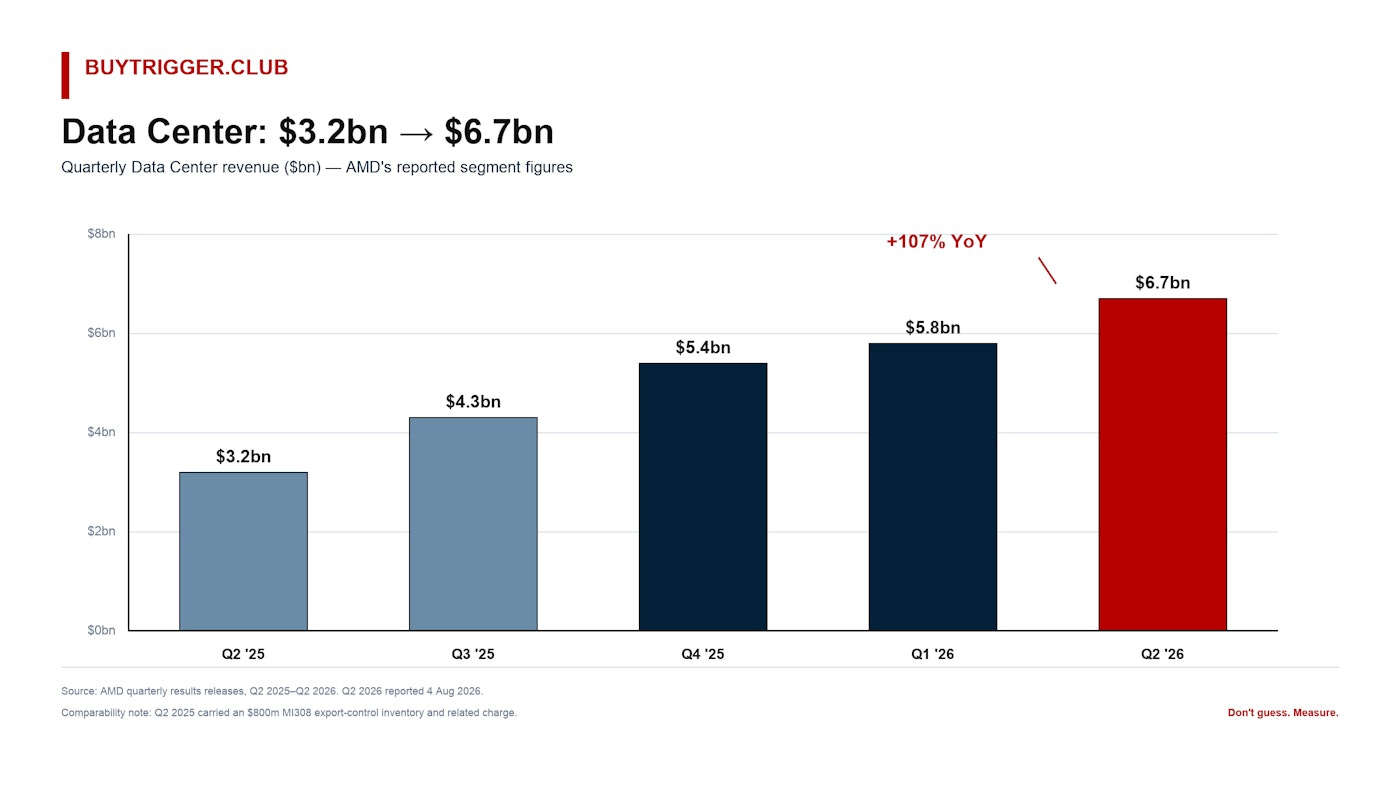
The numbers are fantastic. They’re on target. Revenue $11.536 billion, up 50% year on year. Data Center $6.718 billion, up 107%.
Cast your mind back two years. AMD’s growth had slipped — 25% down to 20%. People were half-writing the obituary. Now? Post this print they’re running at 49-50%. They didn’t drift back up there. They marched.
Everyone stares at the GPU number and stops. Don’t stop there.
Look at the CPU line. EPYC demand is growing — Client revenue was $3.1 billion, up 23%. That’s the quiet engine nobody puts on the thumbnail.
And here’s a piece the market hasn’t priced in properly. AMD barely talks about backlog. They don’t shout about it the way others do. Right now Nvidia captures all the cloud headlines — and most of the cloud spend. But AMD can supply the people Nvidia can’t get to. The second wave. The new clouds. That demand isn’t in these numbers yet. AMD might not sign Elon Musk tomorrow — doesn’t need to. There’s a whole tier of buyers underneath the top table, and AMD is the one at the table with them.
That’s real growth that isn’t captured yet. Keep it in your back pocket.
Data Center revenue: $3.2bn in Q2 2025 to $6.7bn in Q2 2026. Source: AMD quarterly results. The Q2 2025 profit comparison needs the MI308 charge adjustment — coming up.
You’ll see headlines screaming EPS up 246%. Bin that number.
Q2 2025 carried an $800 million charge from the MI308 export-control mess. That charge wrecks the raw year-on-year comparison. Strip it out — like AMD’s own comparable presentation does — and non-GAAP gross margin went 54% to 56%, and comparable non-GAAP EPS rose 82%.
82% is already a monster. It doesn’t need the fake 246% dressing. Measure it clean and it’s still dramatic.
This is exactly why I don’t take my diagnosis from a headline writer. It’s like getting a COVID diagnosis from a news reporter instead of the actual doctor. Data is king — but only when you read it properly.
Here’s the clean scoreboard:
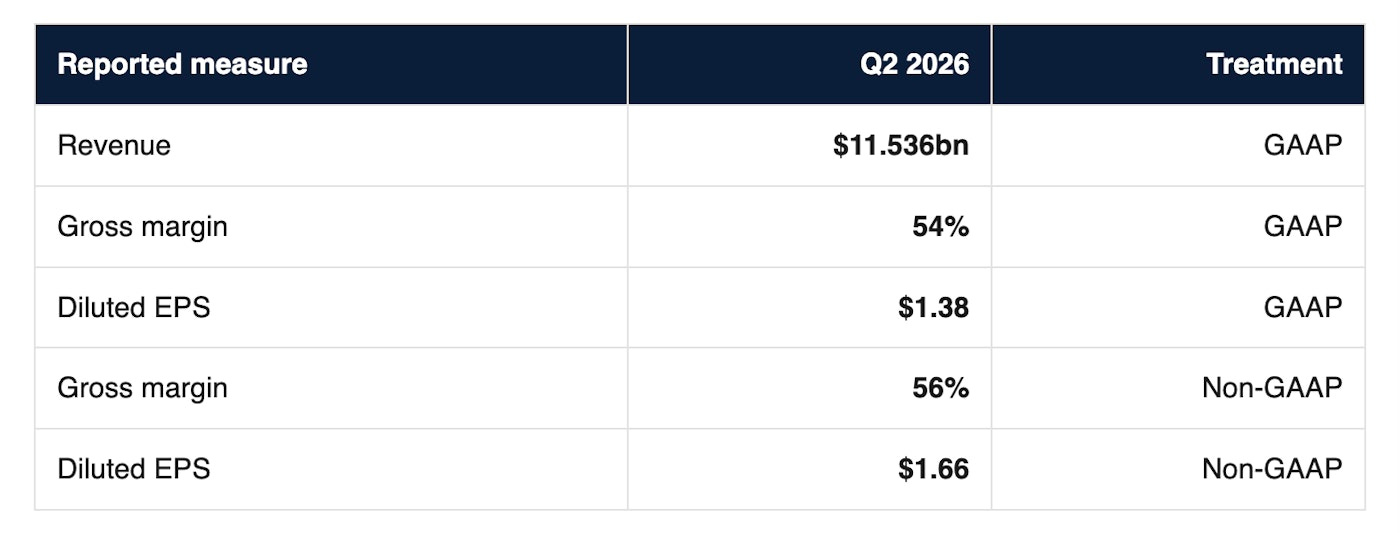
Data Center segment operating income alone was $2.103 billion. High growth throwing off real profit. Client up 23%, Embedded up 19%. Gaming was the one going backwards — down 31% to $779 million on lower semi-custom. One company, four speeds, and the big engine is doing the work.
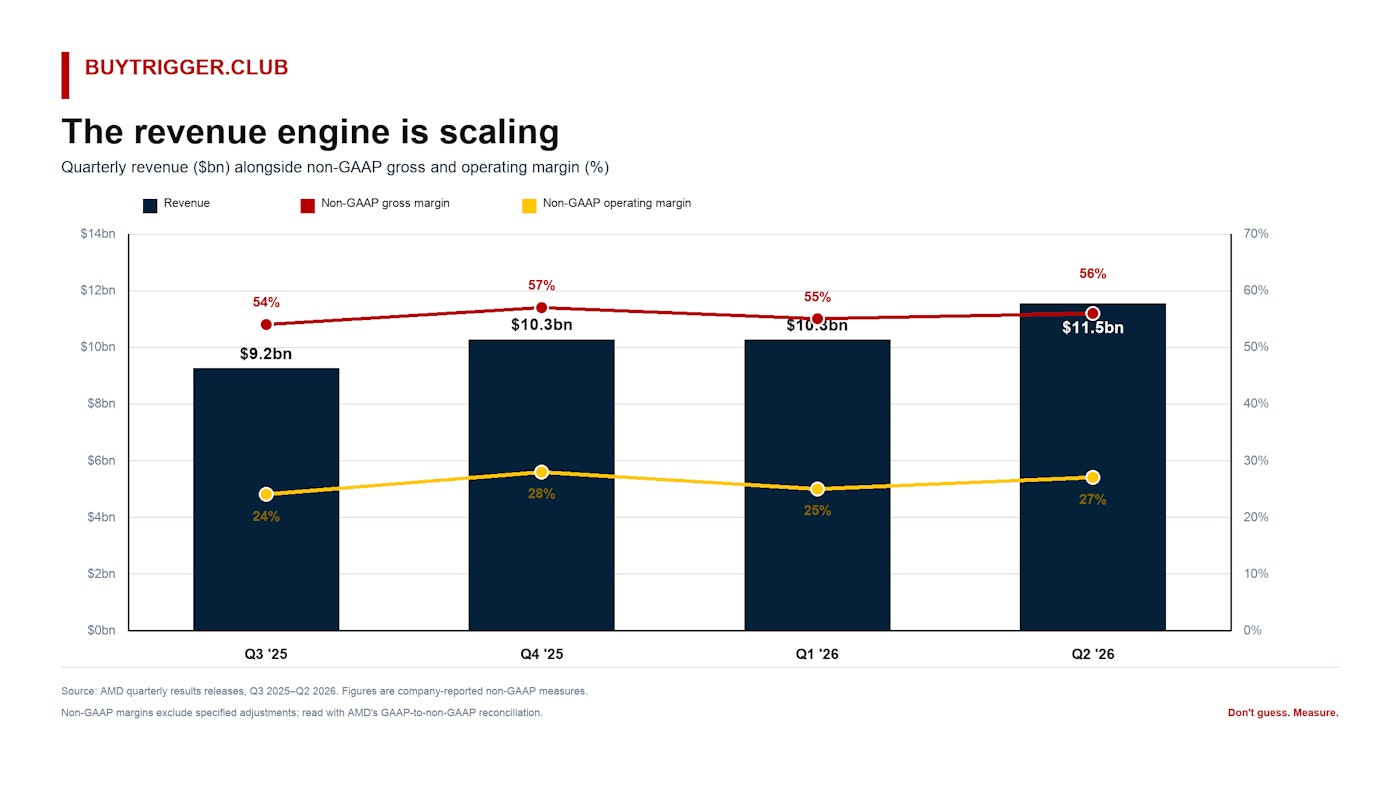
Revenue and company-reported non-GAAP margins, Q3 2025 to Q2 2026. Read non-GAAP with AMD’s reconciliation.
Management guided Q3 to roughly $13.0 billion, give or take $0.3 billion, at around 56% non-GAAP gross margin. At the midpoint that’s about 41% growth year on year. Another big step.
But guidance is a promise, not a receipt. Semiconductors punish the investor who quietly turns a forecast into a done deal before the factories and the customers have delivered. So my checkpoint is simple. Hit the $13 billion. Hold the 56% margin line while doing it. Both happen — another brick in the wall. One slips — the read changes, and I’ll tell you the day it does.
And keep one boundary honest: AMD gave no full-year 2026 guide in these materials. The second-half talk is context, not a number. Don’t let anyone dress it up as one.
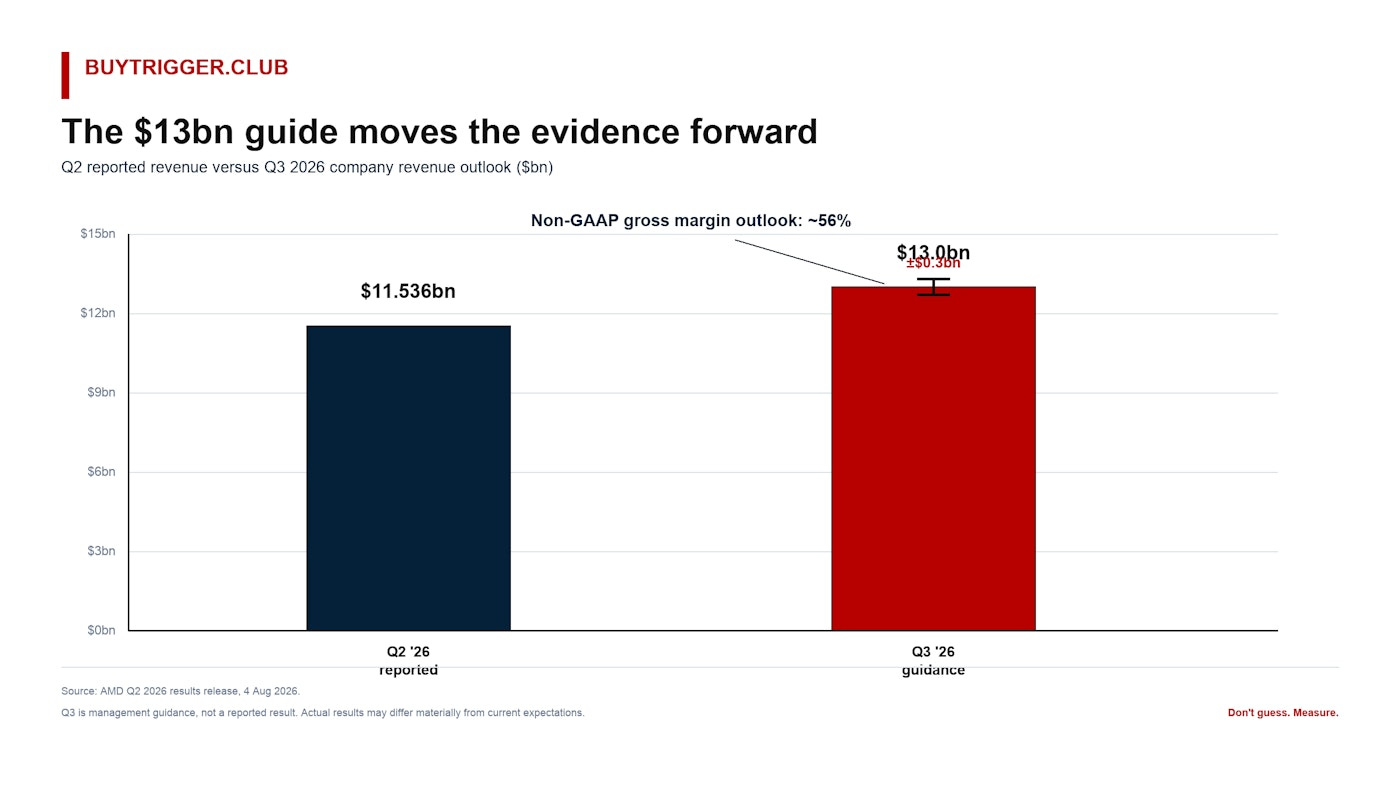
Q2 actual against AMD’s Q3 guidance midpoint. Q3 stays guidance until it’s reported.
This is the bit I sat with the longest, and it’s the one soft spot in an otherwise clean quarter.
Operating cash flow $2.366 billion. Capex $808 million. AMD’s non-GAAP free cash flow $1.558 billion. In Q1? $2.955 billion, $389 million, $2.566 billion. Capex more than doubled while operating and free cash flow stepped down.
Two quarters don’t make a trend, and I won’t pretend they do. But cash is where the truth eventually shows up, so it stays on my watch list. Revenue keeps climbing and cash recovers alongside — that’s quality growth. The gap keeps widening — the character of the growth changes. I’m watching, not ringing an alarm.
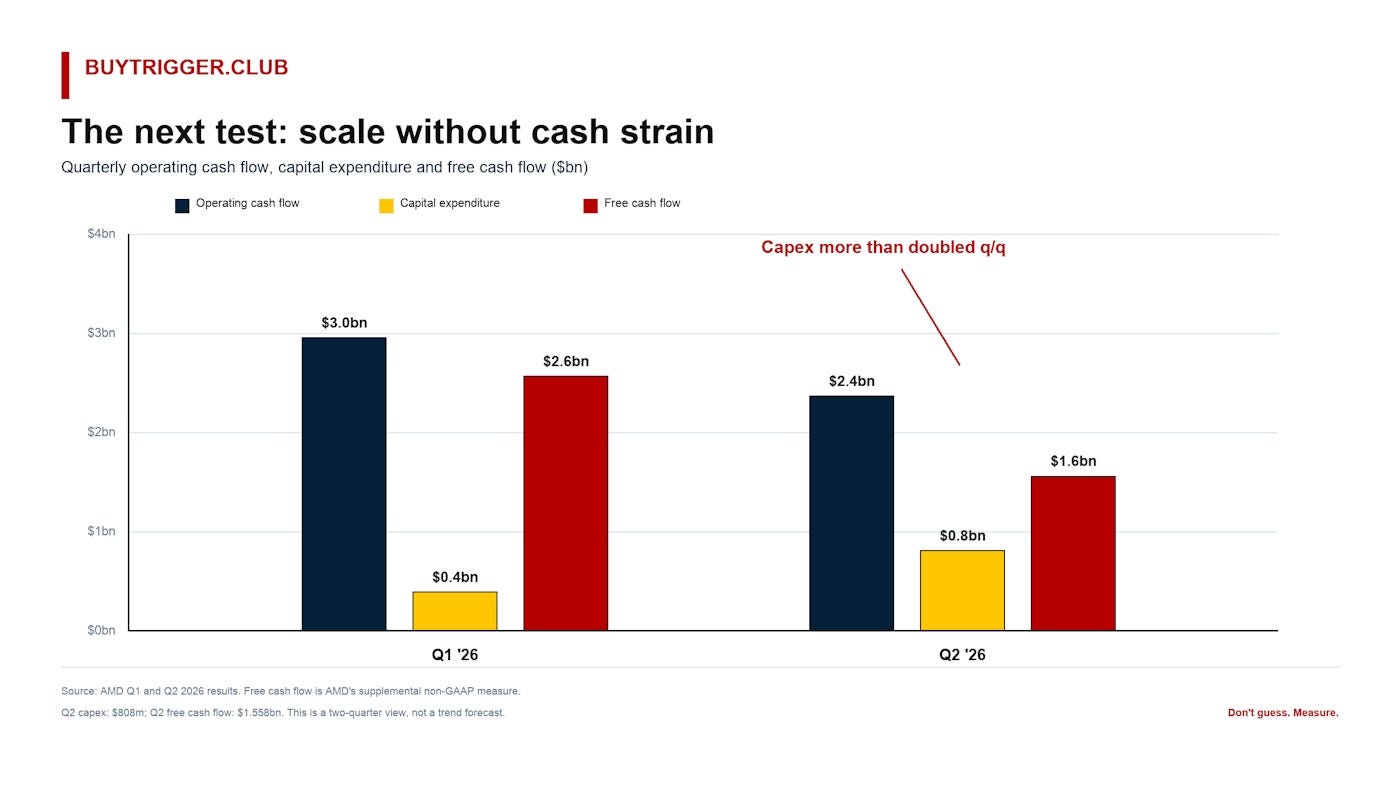
Q1 vs Q2 operating cash flow, capex and AMD’s non-GAAP free cash flow. Two quarters of context, not a settled trend.
Simple. Price. Not the quarter — the price.
The quarter was bang on. The stock came off anyway. And there’s no mystery to it: the valuation was already sitting substantially high going in. People are paying up for future forecasts and for cash flow that’s already baked into the model. When you’ve priced perfection, even a perfect quarter gives you nothing new to buy.
Here’s my honesty on my own numbers. The forecast behind my levels is already the bullish one — because sentiment on AMD is bullish, and I’ve set my inputs that way. Even on that bullish forecast, the current price is sitting above my ValueTrigger. That’s the whole story of the drop. A full price meeting a good quarter.
Now put a real number on it, because I don’t want you taking my word for “expensive.” As of today, AMD trades around 43 times forward earnings. That’s a premium — no hiding it. But look across the AI-infrastructure names and it isn’t the outlier. Marvell is actually richer at about 46x. Dell and Qualcomm are cheaper — roughly 25x and 17x — but that’s the lower-margin hardware and handset end of the pack, not really AMD’s league. (Forward P/E, per stockanalysis.com, 6 Aug 2026.)
So AMD isn’t the cheapest AI-infra name and it isn’t the most expensive either. For a company growing 50% and delivering bang on, quarter after quarter, a low-40s forward multiple is a premium I can stomach. Rich, not ridiculous. It’s not a Parallel Universe stock trading on pure hope. It’s a delivery machine trading a touch above fair value — mine.
Above is the operating read and why it dropped. Below: my dated levels, and the straight answer to the question in my inbox — is it time to buy?
Comments
Nothing yet. Say the first thing.
Sign in to join the conversation.