
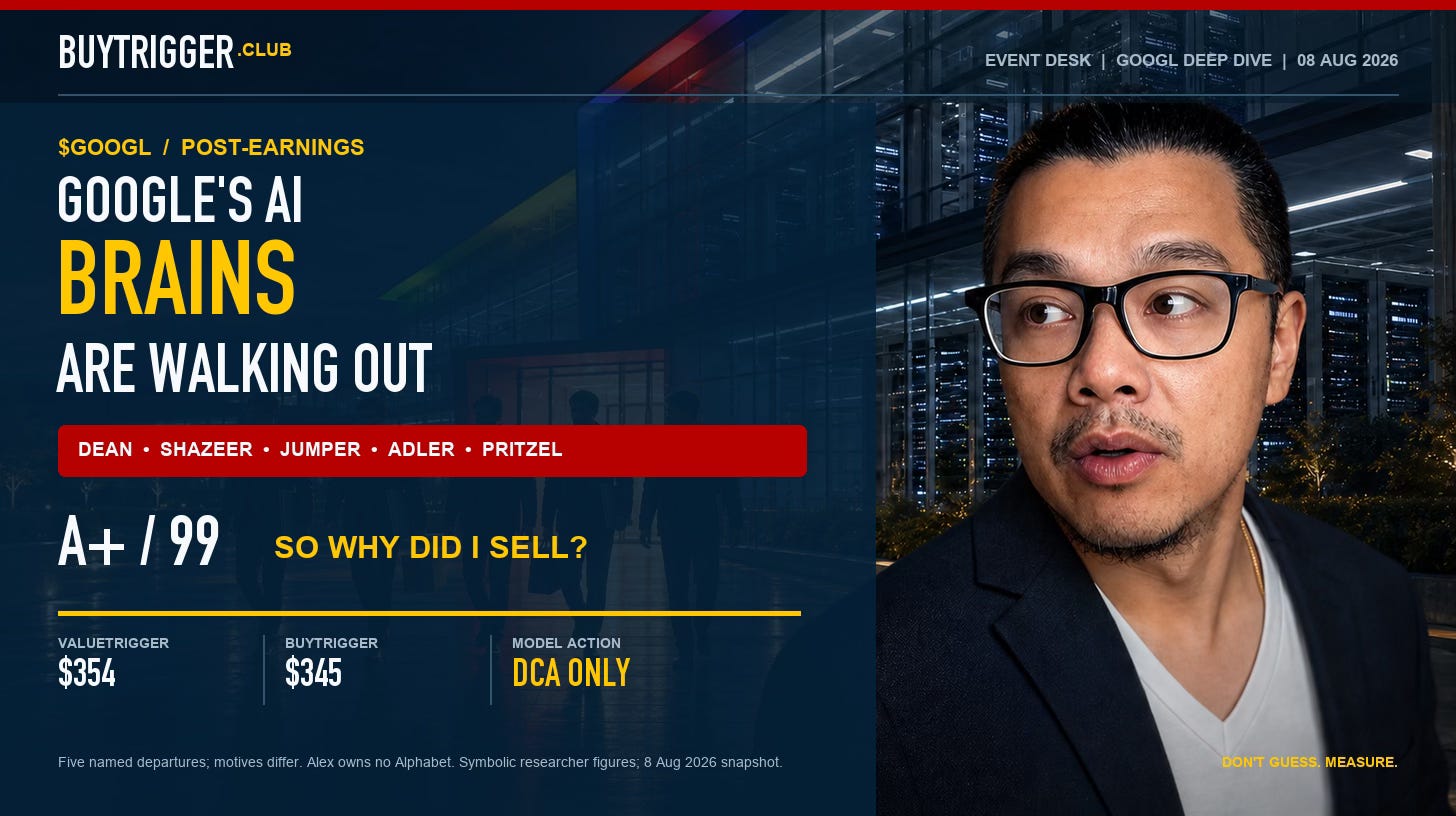
Free Member Research | Dr. Alex Koh | 9th August 2026 BUYTRIGGER.CLUB — Don’t guess. Measure.
Before we start: this is my free article of the week. No paywall. Google is too widely owned, and this argument is too important to lock away. This is my research process, not personal financial advice. Full transparency because it shapes my lens: I sold every Alphabet position across every account between $350 and $360 and I do not currently own the shares. My BuyTrigger levels are dated model outputs, not price targets or instructions to act.
The numbers say Alphabet is getting stronger. My judgement says the strategic risk is getting worse. Both can be true.
I’m sorry this Google article is late.
I should have written it sooner. Google has already moved on from earnings, the share price has moved, and the story has become much bigger than one quarterly report. We now have leadership changes, important researchers leaving, questions over Gemini, and a serious debate about whether Google is selling too much of its scarce TPU capacity to companies that may disrupt it.
But let me begin with my own money.
I sold all my Google across every account between $350 and $360. I moved that capital into Microsoft before Alphabet reported. Club members heard my decision the day before earnings. I did not wait for the result and then rewrite the story afterwards.
Microsoft then rewarded the move very quickly. Its shares jumped 16% in one session after its own earnings. That public share-price move is not my personal return and it does not prove my Google judgement was right. It only tells you that I acted on the relative opportunity I saw. (Axios)
Now comes the uncomfortable part.
My BuyTrigger database still sees Google as a very, very strong company.
It gives Alphabet an A+ Power Rating and a 99 recommendation score. Since my live session on 23 July, its ValueTrigger has risen from roughly $307 to $354.
The BuyTrigger remains $345. At the publication snapshot, with Google around $354, the system’s action is:
DCA ONLY.
That is the dashboard’s model classification, not a personal instruction to readers. It means Google is above the system’s best-reward BuyTrigger but has reached the ValueTrigger boundary. The model permits systematic accumulation; it is not calling this the strongest entry.
So this fight is more interesting than “Alex bearish, computer bullish.”
The model likes the company and now permits a DCA-style entry. It still says the best risk-transfer level is lower.
I like the earnings. I am less comfortable with the future being built behind them.
This is where my BuyTrigger and I are fighting.
Let us not manipulate the story simply because I sold.
Google’s earnings on paper looked clean. Tick, tick, tick. Growth, Search, Cloud, TPU demand, operating margin. Great.
Alphabet reported:
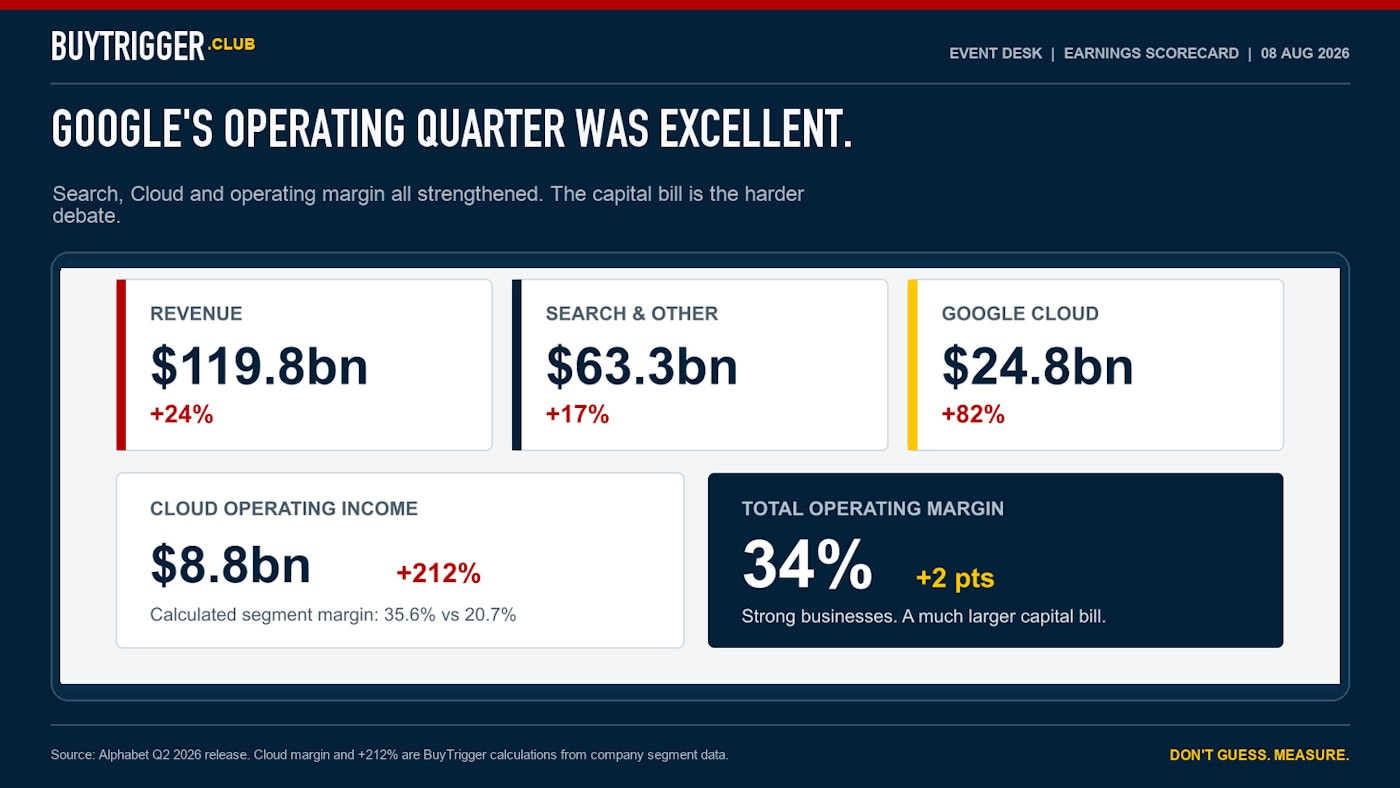
Revenue of $119.8bn, up 24%.
Search revenue of $63.3bn, up 17%.
YouTube advertising revenue of $11.1bn, up 13%.
Google Cloud revenue of $24.8bn, up 82%.
Total operating income of $40.8bn, up 30%.
Operating margin of 34%, up two percentage points.
Cloud operating income rose from $2.8bn to $8.8bn. On the company segment figures, that takes Cloud operating margin from roughly 20.7% to 35.6%. That is not a small improvement. That is a business changing shape in front of us. (Alphabet Q2 earnings release)
There is an accounting caveat. Alphabet says its Alphabet-level activities primarily include shared AI research and development. So 35.6% is the reported Cloud segment margin, not a fully loaded TPU or Gemini margin with every central AI cost allocated into it.
Search growing 17% is particularly important. The simple bear argument was that generative AI would immediately cannibalise Google Search. It has not happened in the aggregate revenue numbers.
AI Mode has passed one billion monthly active users. The Gemini app has reached 950 million. Google’s model APIs are processing about 22 billion tokens per minute. Cloud backlog reached $514bn.
The demand is real.
The debate is what Google must spend to serve it, what margin survives after all the costs, and whether selling that compute makes Google’s own AI position stronger or weaker.
Google reported $9.11 of diluted earnings per share.
That sounds extraordinary because it was extraordinary. But most of it did not come from Search advertisements, YouTube or Cloud.
Alphabet disclosed that gains on equity securities added $6.26 per share after tax. These investments became more valuable on paper during the quarter. Alphabet did not need to sell them and receive the cash for the accounting gain to appear in net income.
The simplest bridge is:
$9.11 reported EPS − $6.26 disclosed investment gain = approximately $2.85.
What does $2.85 mean?
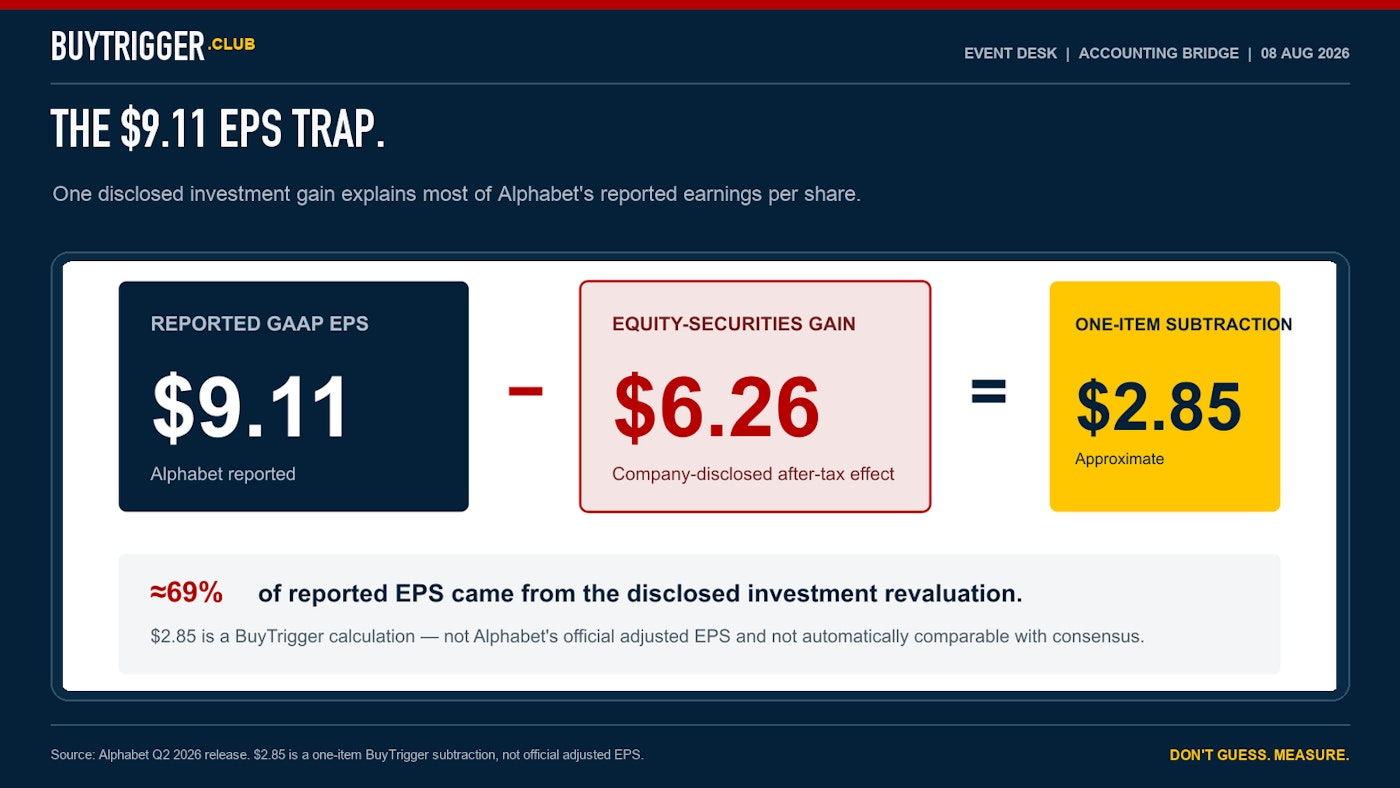
It is a useful way to see the quarter after removing that one enormous investment revaluation. Roughly 69% of reported EPS came from the disclosed equity-securities gain.
But please do not call $2.85 Google’s official adjusted EPS. It is not. It removes one disclosed item and leaves everything else alone. It also should not be compared mechanically with a Wall Street adjusted-EPS forecast unless the definitions match.
My plain-English version is:
Google reported $9.11 per share, but $6.26 came from investments becoming more valuable. Take away that disclosed paper gain and roughly $2.85 remains. That is closer to the recurring-business story, but it is our calculation, not Google’s official adjusted number.
The operating quarter was strong. The EPS headline simply made it look much stronger than the underlying businesses alone.
This is another phrase that can frighten people without explaining anything.
Google generated $39.1bn of cash from operations during the quarter. Search and Cloud did not suddenly stop producing cash.
Google then spent $44.9bn on property and equipment, mainly the data centres, servers and infrastructure required for this AI build.
So:
$39.1bn operating cash flow − $44.9bn capex = negative $5.9bn free cash flow.
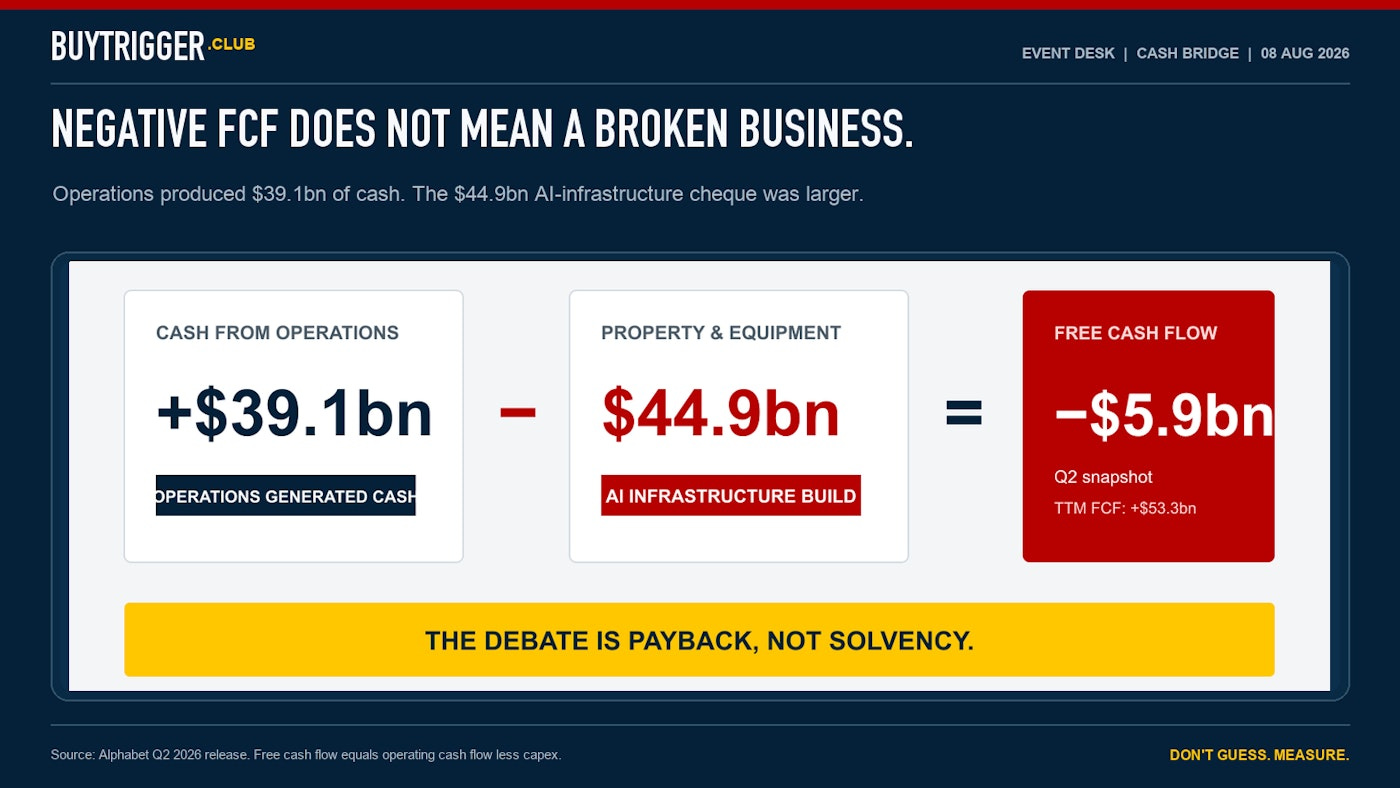
This is not a solvency problem. Trailing-12-month free cash flow was still positive at $53.3bn.
It is a return-on-capital problem.
The cash leaves today. Much of the infrastructure cost reaches the income statement slowly through depreciation over future years. That is how Alphabet can report gigantic accounting profit and negative quarterly free cash flow at the same time.
Management lifted 2026 capex guidance from $180bn–$190bn to $195bn–$205bn and expects another significant increase in 2027. Alphabet also raised nearly $50bn of net equity capital and $20.3bn from senior notes during Q2, while conducting no common-share repurchases. (Alphabet Q2 earnings release)
That is why I said during the live session:
Google created a return-on-capital debate.
The question is not whether Google can write the cheque. It can.
The question is how much future profit each new dollar of AI infrastructure creates after depreciation, electricity, networking, people and financing.
Cash is oxygen. Even for Google.
Alphabet closed at $317.69 on 23 July, down 7.13% that day. (Historical price data)
The market was not saying Search had collapsed. Search grew 17%.
It was not saying Cloud demand was weak. Cloud grew 82%.
The market was repricing the cheque and the uncertainty around its payback. Capex exceeded quarterly operating cash flow. Guidance went higher. More depreciation will arrive later. And an enormous investment gain made the headline EPS less useful for valuing the recurring business. (Axios)
There was also broader market pressure around the session, so I would not attribute every percentage point to one company-specific issue.
Google has since recovered. The BuyTrigger snapshot through 7 August showed $354.25, about 11.5% above the post-earnings close.
The stock moved on.
The argument did not.
Tae Kim’s piece matters because it is not the lazy “AI kills Search” post.
His argument, stripped to the bone, is this:
Google is making today’s Cloud numbers look spectacular by selling and renting scarce TPU compute to AI companies that could weaken Google Search tomorrow, while Google’s own DeepMind researchers may not receive enough of that capacity.
That is the point.
Tae is not saying TPUs are rubbish. He is almost saying the opposite. They are so good, and so valuable, that Google faces a painful allocation choice.
Does the next TPU go to an external customer who pays Google now?
Or does it go to DeepMind, where the financial return is less visible today but could protect Gemini and Search tomorrow?
Tae describes this as Google effectively mortgaging the future to improve the present financials. He contrasts it with Microsoft reserving more of its compute for its own products and strategic model relationships. He also points to Google’s weakness in coding and agentic models, model delays, bureaucracy and the departure of important researchers. (Tae Kim, Google Is a Secular Short)
He later put a subjective 50% probability on Gemini 4 disappointing and argued that valuation support could weaken until Google proves frontier model leadership again. That is his judgement, not a measurable company forecast. (Tae Kim’s post-earnings note)
One disclosure matters: Tae stated that he held no financial position in Alphabet when he published the thesis.
That does not make his analysis weaker. It means his conviction is analytical, not a disclosed Alphabet short with a live profit and loss attached. We should test his evidence, not borrow his certainty.
My exposure is different. I acted. I sold Google and transferred the relevant capital into Microsoft.
But action does not make me automatically correct either.
This was missing from my first research pass, and it should not have been.
SemiAnalysis’s work suggests Google may have built something much bigger than an internal chip programme.
Its external estimates link the Anthropic relationship to roughly 400,000 TPUv7 systems sold directly, valued at about $10bn, plus roughly 600,000 TPUv7 systems rented through Google Cloud, associated with an estimated $42bn of remaining performance obligations. It also estimates Ironwood’s internal total cost at around 44% below Nvidia’s GB200. (SemiAnalysis TPUv7 research)
These figures are SemiAnalysis estimates, not Alphabet disclosures. Google does not give us a TPU-only revenue line, margin or profit-and-loss account. We cannot audit those economics from the company filing.
This is also why I will not tell you Google “earns 35.6% on TPU.” Cloud’s segment result is real, but some shared AI research expense sits at the Alphabet level. TPU-only economics remain undisclosed.
But the strategic implication is still important.
Google may now have a new total addressable market.
It is no longer only defending Search with Gemini or selling ordinary cloud services. It may be competing directly in the profit pool for AI accelerators, complete TPU systems and rented frontier-model compute.
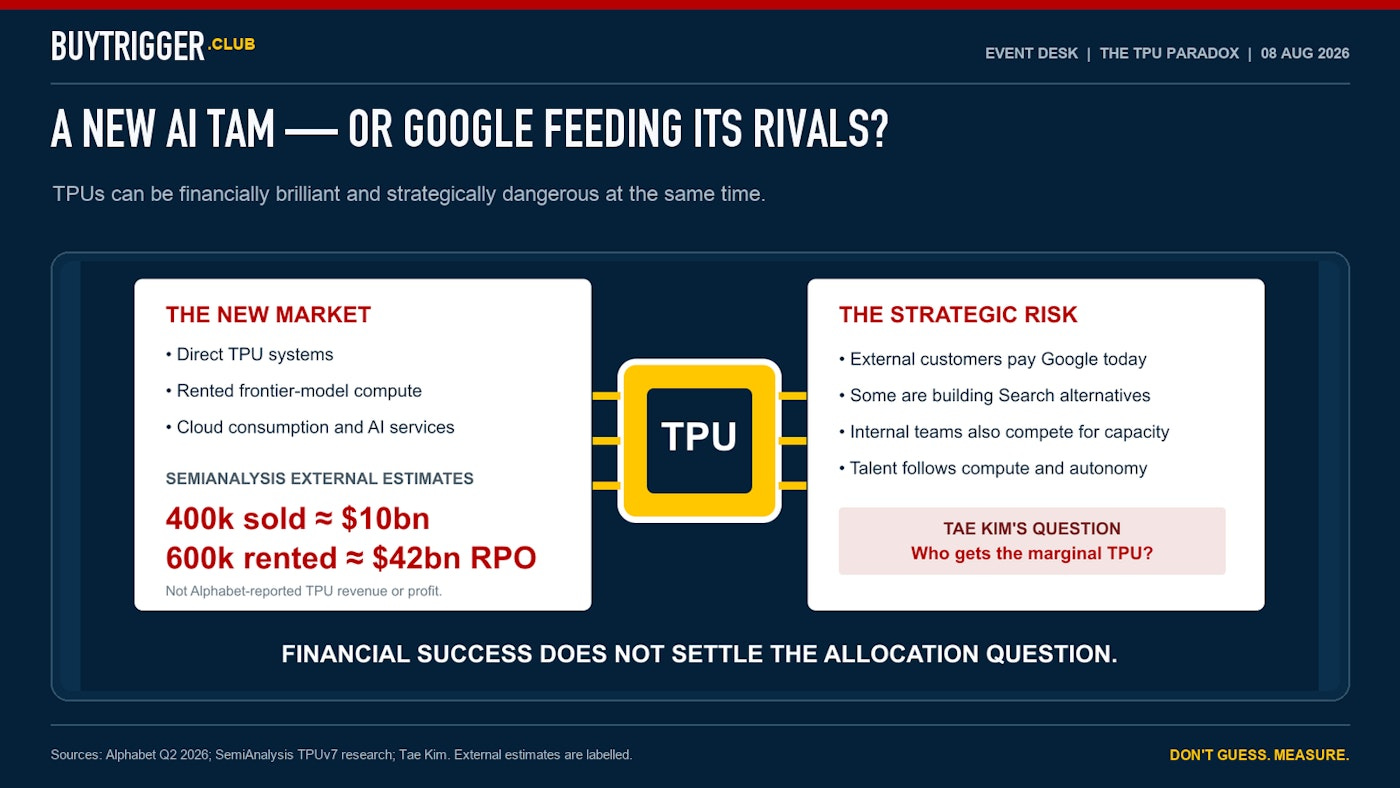
This is the paradox:
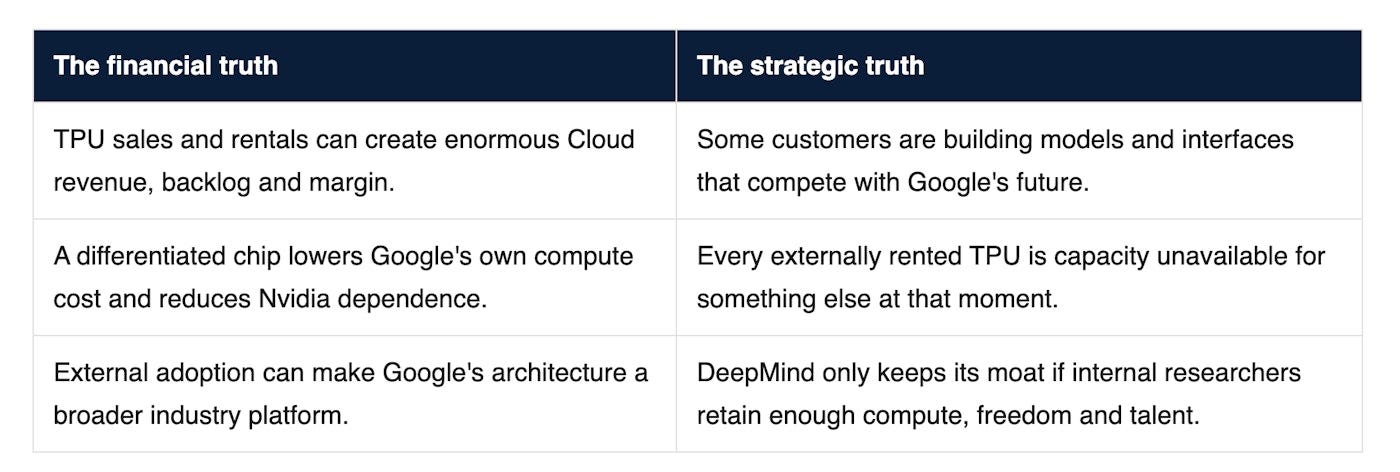
This is not a choice between “TPU good” and “TPU bad.”
It is a capital-allocation question: where does the marginal TPU create the greatest long-term value?
Alphabet does not disclose the answer.
This is where the controversy has moved since earnings.
Bloomberg reported current and former Google researchers describing internal competition for TPUs, narrower research priorities and frustration with approval processes. Google said it balances customer, product and long-term research needs and prioritises DeepMind. (Bloomberg via Los Angeles Times)
TechCrunch documented named departures to rivals, including Jonas Adler and Alexander Pritzel to Anthropic, Noam Shazeer to OpenAI and Nobel laureate John Jumper to Anthropic. (TechCrunch)
Then Google reshuffled the top of its AI organisation. Demis Hassabis moved from the DeepMind CEO role to chairman and Alphabet chief scientist. Koray Kavukcuoglu took the senior operating role. Jeff Dean left to build Discovery Loop with other important Google researchers. Google said the changes were not caused by model delays. Google also remained involved as an investor and compute partner to the new company. (Axios)
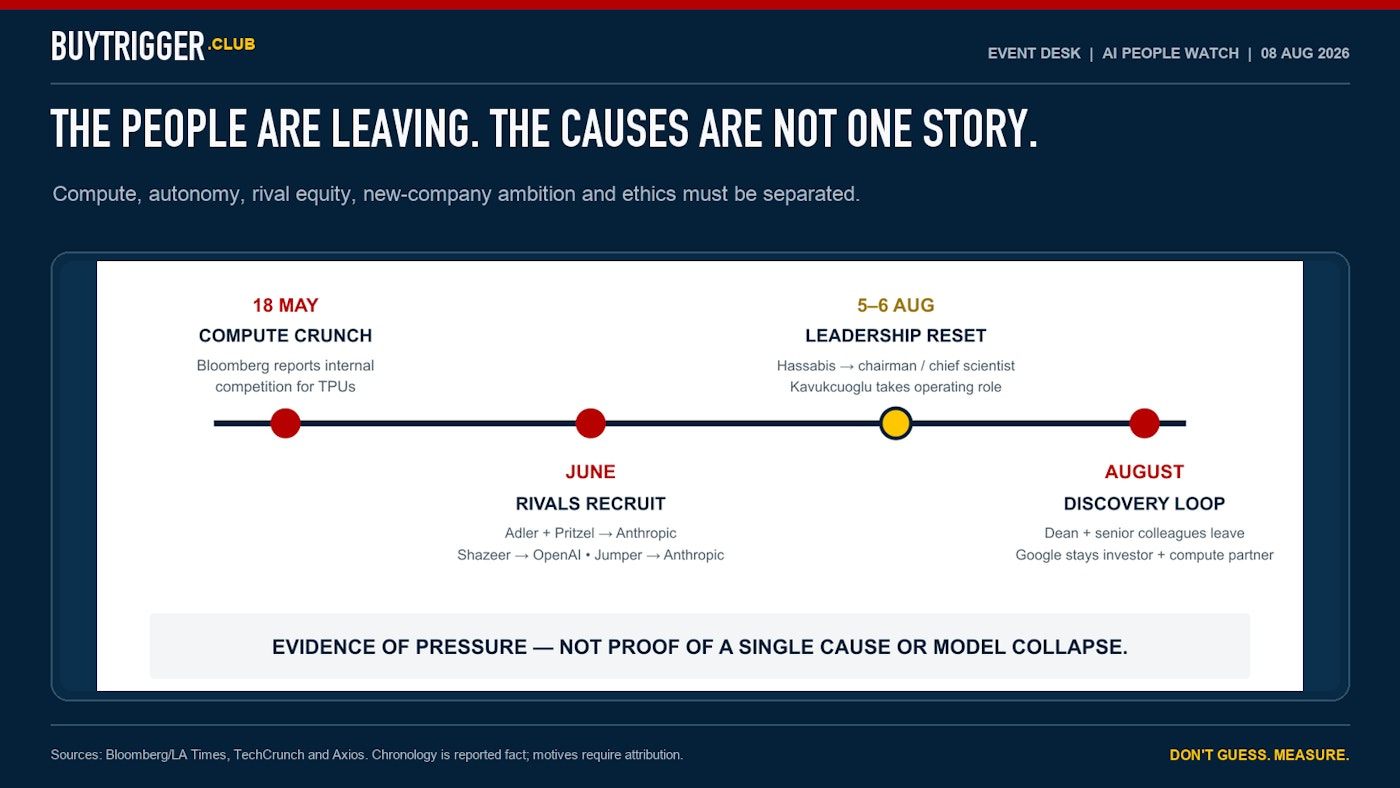
We need to be careful here.
People leave for different reasons: more compute, more autonomy, promotion, rival equity packages, the chance to build a new company, or separate ethical disagreements. I am not going to compress every departure into “Google is doomed because people are quitting.”
Google has always produced brilliant people, and brilliant people leaving to create companies can also expand the Google Cloud ecosystem. Jeff Dean’s new venture keeping Google as an investor and compute partner is not the same as a clean defection to an enemy.
But a pattern of senior exits matters when it touches the exact risk Tae identified: compute allocation, bureaucracy and frontier-model execution.
Culture rarely appears as a neat line in an earnings table. By the time it does, the financial impact can already be late.
That is why my human judgement is more cautious than the scorecard.
If I want to defend my Google sale, I could stop here. That would be easy and intellectually useless.
The strongest counter-case is:
Search is still growing. A 17% increase is not evidence of immediate AI cannibalisation.
Cloud is monetising AI now. Revenue grew 82% and segment operating income more than tripled.
TPUs may be a genuine new platform. Selling systems and renting compute can turn internal infrastructure into a large external business.
Distribution is still extraordinary. Search, Android, Workspace, YouTube and Cloud give Gemini routes to users that most frontier labs must buy.
Departures do not equal collapse. Google retains deep technical talent, and some spinouts remain inside its capital and compute orbit.
The balance sheet can fund the build. One negative free-cash-flow quarter during a capacity surge is not financial distress.
And here is the evidence that makes me most uncomfortable about being too negative: my own database increased Google’s ValueTrigger.
The machine is seeing more economic value even while I am seeing more strategic risk.
Good. This is what the system is supposed to do.
Here is the frozen BuyTrigger read through 7 August:
Power Rating: A+
Recommendation score: 99
ValueTrigger: $354
BuyTrigger: $345
Publication price: approximately $354
Action: DCA ONLY
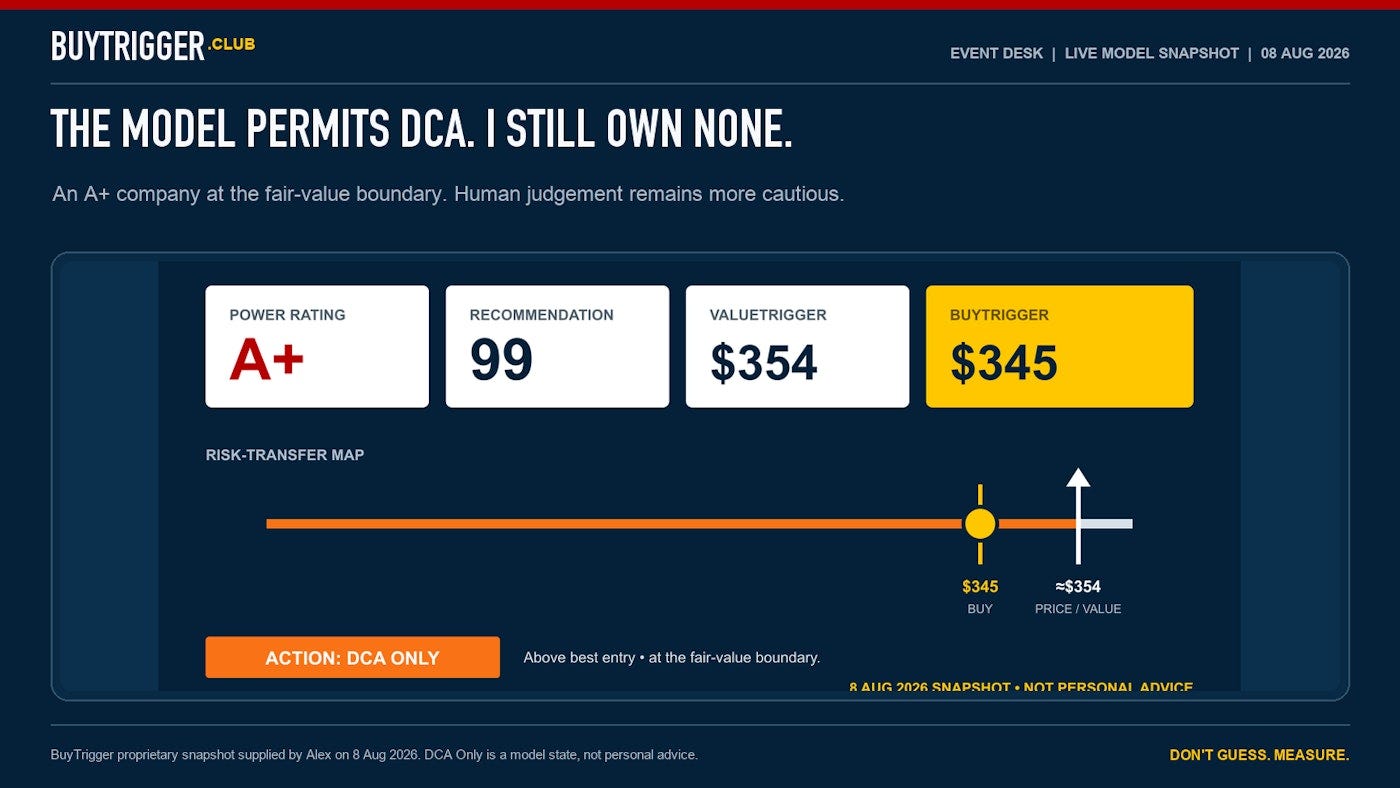
This is why labels matter.
An A+ company is not automatically an A+ purchase at every price.
A 99 recommendation score does not mean chase it above the risk-transfer levels.
The ValueTrigger rising from roughly $307 to $354 tells me the model’s fundamental value increased substantially. The BuyTrigger remaining at $345 tells me the most attractive entry did not move with my emotion. DCA Only says the system now permits gradual accumulation around fair value, but it still distinguishes that from its best risk-transfer entry.
So the system is more constructive than I am. I own no Google. The model has moved into DCA Only.
It is telling me not to confuse my strategic concern with a weak company.
That distinction protects us as investors.
My human side can identify risks the database cannot fully quantify: research culture, bureaucracy, compute politics and the danger of feeding a future rival.
The database can stop my human side from turning a sophisticated concern into a cartoon. It reminds me that Search is growing, Cloud is accelerating, margins are strong and fair value has increased.
This is the fun fight between us two.
I can sell independently. The BuyTrigger level can still stand independently.
No ego. No forced agreement.
System over emotion, always. But the human still owns the capital.
I do not think Google is broken.
I think Google is entering a period where the financial evidence can remain excellent while the strategic evidence becomes noisier.
Over the next few quarters, I expect five debates to dominate:
1. Search monetisation, not just Search usage
AI Mode can generate more queries, but we need to know whether those queries earn comparable revenue and profit after higher inference costs.
2. Cloud mix
Cloud can keep growing very quickly, but investors need to separate recurring consumption, software and services from direct TPU system sales. Hardware-like revenue may carry different economics.
3. Capex payback
The annual spending bill is now close to $200bn. The proof will be operating cash flow, depreciation, margins and eventual free-cash-flow recovery, not management saying demand exceeds supply.
4. Gemini 4
If Gemini 4 restores clear leadership in coding and agents, Tae’s thesis weakens. If it slips or disappoints while rivals trained on Google infrastructure advance, his thesis becomes much harder to dismiss.
5. People and compute
One famous departure is a headline. Repeated departures tied explicitly to compute constraints or bureaucracy would be a pattern. Google must show that external TPU monetisation is not starving the internal research engine.
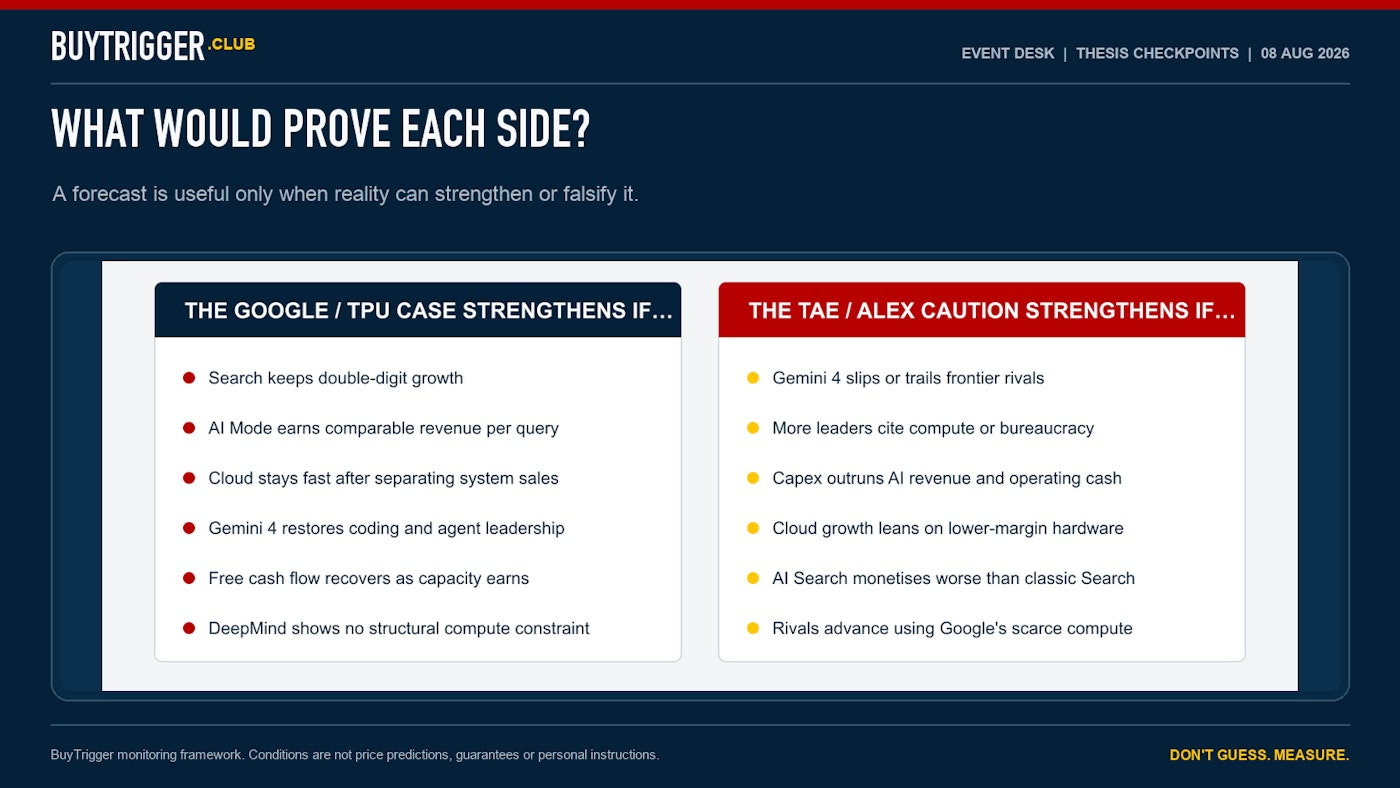
Google delivered an excellent operating quarter.
The $9.11 EPS headline was flattered by an enormous investment revaluation. The negative free cash flow came from a historic infrastructure build, not a cash-losing Search business. TPUs may have opened a valuable new market in AI systems and rented compute.
But the same TPU success creates the hardest question.
Is Google building the industry’s AI infrastructure platform?
Or is it renting its best weapon to the people attacking its castle?
Maybe both.
I sold all my Google at $350–$360 and chose Microsoft. I am comfortable with that decision. I do not currently own Alphabet.
My database still says Alphabet is an A+ company with a 99 recommendation score. It has lifted fair value to $354 and moved the action to DCA Only.
I refuse to torture either conclusion until it agrees with the other.
That is the point of BuyTrigger. It is not there to congratulate me. It is there to fight me when the data demands it.
Don’t guess. Measure.
Are TPUs creating a new Google profit pool, or giving rivals the compute to weaken Search?
Do the senior departures change your view, or is this normal frontier-AI competition?
Which evidence matters more to you: A+ fundamentals and 82% Cloud growth, or the strategic risk around Gemini, talent and compute allocation?
If you own Google, what specific fact would make you change your mind?
Tell me in the comments. I want the strongest case from both sides.
This article is based on Alphabet’s Q2 2026 earnings release and SEC exhibit, Tae Kim’s disclosed Google thesis and post-earnings note, SemiAnalysis’s externally modelled TPUv7 work, reported market-price data, and reporting from Bloomberg/Los Angeles Times, TechCrunch and Axios on Google AI leadership and researcher departures. BuyTrigger levels are proprietary model outputs corrected by Alex for the 8 August publication freeze. Company facts, external estimates, analyst opinion and BuyTrigger interpretation are labelled separately throughout.
Position disclosure: I sold all Alphabet holdings across all accounts between $350 and $360 and do not currently own Alphabet. I transferred the relevant capital into Microsoft before Alphabet’s Q2 2026 earnings, based on my own portfolio decision. Tae Kim disclosed no financial position in Alphabet in the cited article.
BuyTrigger disclosure: The proprietary levels in this article use Alex’s publication freeze supplied on 8 August 2026: ValueTrigger $354, BuyTrigger $345, A+ Power Rating, recommendation score 99 and DCA Only. They can change as price, forecasts and company data change. DCA Only is a model classification, not a personal instruction.
Important: This is research and education, not personal investment advice. Named-stock analysis involves uncertainty. External TPU values are SemiAnalysis estimates, not Alphabet-reported revenue or profit.
No posts
Comments
Nothing yet. Say the first thing.
Sign in to join the conversation.